Wrist Bones: An Evidence-Based Guide for Patients

The wrist contains eight carpal bones arranged in two rows between the forearm and hand. Wrist bones work together with ligaments, tendons, cartilage, and joints to allow strength and flexible movement.
Key Takeaways
- The wrist contains eight carpal bones arranged in two rows between the forearm and hand.
- Wrist bones work together with ligaments, tendons, cartilage, and joints to allow strength and flexible movement.
- Pain, swelling, bruising, weakness, or reduced motion after a fall may suggest a wrist bone injury and should not be ignored.
- Some wrist bone injuries, especially scaphoid fractures, may not be obvious on early X-rays.
- Treatment depends on the cause and may include rest, splinting, therapy, medication, or surgery.
- Early assessment can reduce the risk of long-term stiffness, instability, and arthritis.
Wrist bones are the eight small carpal bones that help the hand move smoothly while connecting it to the forearm. Understanding how these bones are arranged, what symptoms may suggest injury, and when evaluation is needed can help patients protect wrist function and seek timely care.
Overview: what the wrist bones are and why they matter
Wrist bones are the eight small bones known as the carpal bones. They sit between the two forearm bones and the long bones of the hand, creating a compact but highly mobile structure. Although they are small, they play a major role in everyday activities such as gripping, lifting, typing, writing, dressing, and pushing up from a chair.
The wrist is more than a simple hinge. It is a coordinated system of bones, ligaments, tendons, cartilage, nerves, and blood vessels. The carpal bones move together in a controlled way so the hand can bend, extend, rotate slightly, and absorb force. This is why wrist pain can feel complex: a problem in one small bone or ligament may affect the whole joint.
Patients often search for “wrist bones” when they have pain after a fall, notice swelling, or want to understand an imaging report. A clear understanding of wrist anatomy can make symptoms easier to describe and may help people recognize when common problems such as sprains, fractures, or arthritis need medical attention.
The 8 carpal bones and how they are arranged
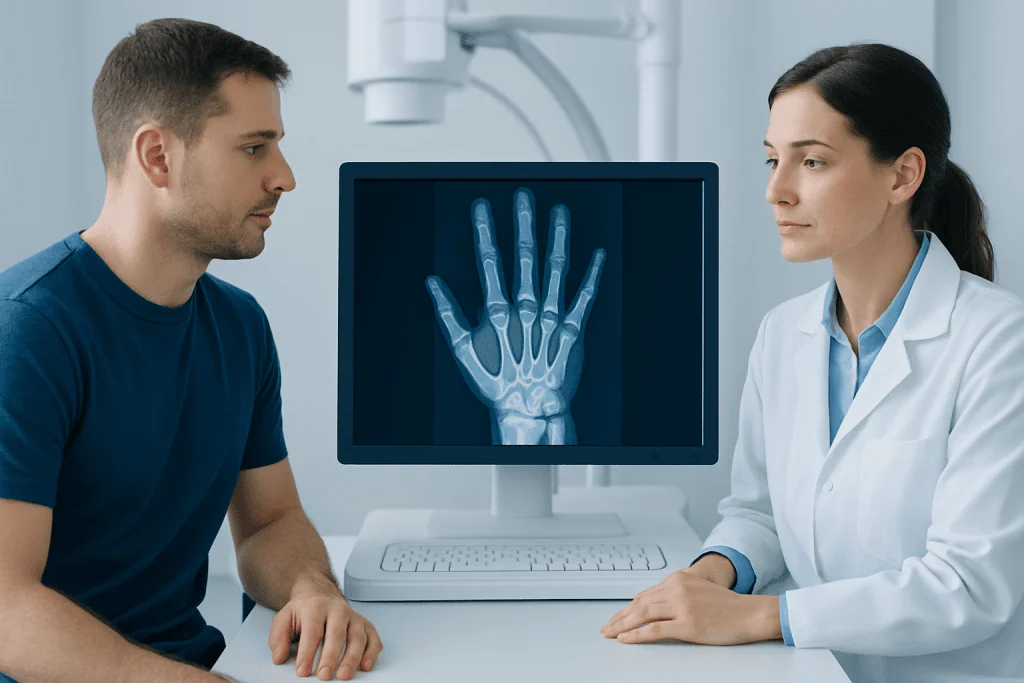
The eight wrist bones are arranged in two rows. In the row closer to the forearm are the scaphoid, lunate, triquetrum, and pisiform. In the row closer to the hand are the trapezium, trapezoid, capitate, and hamate. These bones fit together tightly, almost like a small puzzle, with smooth joint surfaces that allow movement while maintaining stability.
The scaphoid is one of the most clinically important wrist bones because it is often injured in falls onto an outstretched hand. The lunate also matters because it helps transmit force through the center of the wrist. The trapezium is important at the base of the thumb, where it helps provide thumb mobility and pinch strength. The capitate, the largest carpal bone, sits near the center of the wrist and acts as a key structural link.
Doctors may refer to these bones when discussing imaging findings, fractures, dislocations, or degenerative changes. Even if patients do not memorize every name, it helps to know that wrist pain can come from different parts of the carpus and that the exact location often guides diagnosis and treatment.
- Proximal row: scaphoid, lunate, triquetrum, pisiform
- Distal row: trapezium, trapezoid, capitate, hamate
- Main role: balance flexibility with stability during hand use
How the wrist bones work with nearby structures

The wrist bones do not work alone. Strong ligaments connect one carpal bone to another and help keep the wrist aligned during motion. Tendons from the forearm cross the wrist and attach to the hand and fingers, making movements such as gripping, lifting, and finger extension possible. Cartilage covers joint surfaces to reduce friction and support smooth movement.
The median and ulnar nerves pass through or near the wrist, which is why swelling or changes in wrist shape may sometimes lead to numbness or tingling in the hand. Blood supply also matters, especially for the scaphoid, which has a vulnerable circulation pattern. In some fractures, this blood supply can be disrupted, making healing slower than in many other bones.
Because so many structures share a small space, symptoms can overlap. A patient may think the problem is a bone, when the cause is a ligament sprain, tendon irritation, nerve compression, or nearby joint inflammation. Conditions such as carpal tunnel syndrome can cause wrist discomfort and hand symptoms without being a bone problem, which is one reason careful assessment is important.
Common problems affecting wrist bones
Wrist bone injuries are common after falls, sports accidents, road traffic injuries, and repetitive loading. Fractures can involve the distal radius near the wrist or one of the carpal bones themselves. Among the carpal bones, the scaphoid is especially prone to fracture. These injuries may cause pain near the thumb side of the wrist, swelling, tenderness, and reduced grip strength. Some fractures are easy to see on an X-ray, while others may be subtle at first.
Ligament injuries can also affect how the wrist bones move together. A torn or stretched ligament may create pain, clicking, weakness, or a sense that the wrist is unstable. Over time, untreated instability can increase wear on the joint and contribute to arthritis. In some patients, persistent pain after a “simple sprain” turns out to reflect a hidden fracture or ligament injury.
Degenerative and inflammatory conditions can affect the carpal bones and surrounding joints as well. Osteoarthritis may develop gradually with age, prior injury, or heavy repetitive use, while inflammatory arthritis can lead to stiffness, swelling, warmth, and reduced motion. Patients with ongoing joint pain may need evaluation for rheumatoid arthritis or other systemic conditions when symptoms affect more than one joint or are accompanied by prolonged morning stiffness.
Other causes of wrist pain include tendon disorders, ganglion cysts, and compression of nearby nerves. Not every painful wrist means a broken bone, but bone injuries are important to rule out because delayed treatment can lead to long-term problems.
Symptoms that may suggest a wrist bone injury
Symptoms depend on the exact problem, but several signs commonly point to injury involving the wrist bones or nearby structures. Pain after a fall on the hand is a typical warning sign. Swelling, bruising, reduced movement, tenderness when pressing on one area of the wrist, and difficulty gripping objects may also occur.
Some patients notice pain mainly on the thumb side of the wrist, which can raise concern for a scaphoid injury. Others feel deep central pain, a clicking sensation, or weakness when bearing weight through the hand. Severe injuries can cause visible deformity, but many important fractures do not cause obvious shape changes.
Numbness, tingling, pale fingers, marked coldness, or inability to move the fingers normally are more urgent symptoms. These may suggest nerve or blood flow problems or a more serious injury pattern. Persistent pain lasting more than a few days after trauma should not be dismissed, even if the wrist can still move.
- Pain after a fall or twisting injury
- Swelling or bruising around the wrist
- Tenderness in a small, specific area
- Weak grip or pain when lifting
- Stiffness or reduced range of motion
- Clicking, instability, or a sense the wrist “gives way”
How doctors diagnose wrist bone problems
Diagnosis begins with a medical history and physical examination. A doctor asks how the injury happened, where the pain is located, whether there was immediate swelling, and what movements worsen symptoms. During the examination, they assess tenderness, swelling, bruising, alignment, range of motion, grip, and hand sensation.
Imaging is often needed. Standard X-rays are usually the first test, especially after trauma. However, not all carpal bone fractures are visible right away. If symptoms strongly suggest a fracture despite normal X-rays, doctors may recommend repeat imaging, computed tomography, or MRI. These tests can help identify occult fractures, bone bruising, ligament injuries, or joint damage.
Ultrasound can be helpful in selected soft tissue conditions, but bone injury evaluation more often relies on X-ray, CT, or MRI. In more complex cases, treatment planning may involve specialists in orthopedics, hand surgery, or rehabilitation. If surgery is being considered, options such as orthopedic surgery or hand surgery may be discussed depending on the exact diagnosis.
Treatment options and recovery
Treatment depends on the cause, severity, and which wrist bone or supporting structure is involved. Mild sprains and some stable fractures may be managed with rest, activity modification, splinting or casting, elevation, and pain-relieving medication recommended by a clinician. The goal is to protect healing tissue while preventing unnecessary stiffness.
More significant fractures, displaced injuries, nonhealing fractures, or unstable ligament injuries may require a procedure to realign and stabilize the bones. This may involve pins, screws, plates, or other fixation methods chosen by the surgical team. After immobilization or surgery, many patients benefit from physical therapy and rehabilitation to restore strength, motion, and hand function safely.
Recovery time varies widely. A simple minor injury may improve within weeks, while some fractures and ligament injuries take longer and may need months of supervised recovery. Following instructions on splint use, follow-up imaging, hand exercises, and gradual return to activity is important because feeling better too soon does not always mean the bone has fully healed.
Near the end of the care pathway, some patients may seek specialist review for persistent pain, stiffness, or reduced function. Acibadem International’s multidisciplinary specialists in JCI-accredited hospitals diagnose and treat wrist and hand conditions for international patients when advanced assessment and coordinated care are needed.
Self-care, prevention, and when to seek medical care
Good wrist care starts with reducing unnecessary strain and protecting the hand during higher-risk activities. Supportive equipment for sports, fall-prevention strategies, ergonomic adjustments at work, and strength and flexibility exercises may all help lower injury risk. For bone health more broadly, adequate nutrition, regular weight-bearing exercise, and addressing osteoporosis risk are also relevant, especially in older adults.
For mild wrist discomfort without major trauma, short-term self-care may include resting the wrist, avoiding painful activities, applying a cold pack for short periods, and using a brace if advised by a clinician. Patients should avoid repeated heavy lifting or returning to sports too early, since this may worsen a hidden injury.
Medical care should be sought promptly after a fall if there is significant pain, swelling, bruising, deformity, weakness, numbness, or pain in a very specific spot on the wrist. Care is also advisable if symptoms do not improve within a few days, if pain wakes the person at night, or if the wrist cannot bear normal daily use. Early evaluation is especially important when a scaphoid fracture is possible because delayed diagnosis may lead to poor healing.
Frequently asked questions
How many wrist bones are there?
There are eight wrist bones, also called carpal bones. They are arranged in two rows between the forearm and the hand and work together to provide both stability and movement.
Which wrist bone is most commonly injured?
The scaphoid is one of the most commonly injured wrist bones, especially after a fall onto an outstretched hand. It is clinically important because some scaphoid fractures can be hard to see on early X-rays and may heal slowly.
Can a wrist bone be broken even if an X-ray looks normal?
Yes. Some fractures, particularly scaphoid fractures and certain small carpal injuries, may not appear clearly on initial X-rays. If symptoms strongly suggest a fracture, a doctor may recommend repeat imaging, CT, or MRI.
What is the difference between wrist pain from a bone injury and a sprain?
A bone injury often causes localized tenderness, swelling, and pain after trauma, but these features can also occur with a sprain. Because symptoms can overlap, a medical exam and sometimes imaging are needed to tell the difference accurately.
How long does a wrist bone injury take to heal?
Healing time depends on the exact bone involved, the severity of the injury, blood supply to the area, and whether surgery is needed. Minor injuries may improve within weeks, while some fractures or ligament problems take several months to recover fully.
When should someone see a doctor for wrist pain?
A doctor should evaluate wrist pain after a fall, especially if there is swelling, bruising, weakness, tenderness in one spot, numbness, or reduced movement. Medical review is also important when pain persists, keeps coming back, or interferes with normal daily activities.
This article is for general information only and is not a substitute for professional medical advice. Please consult a qualified doctor about your individual situation.
Explore treatments in Turkey — costs, top hospitals & a free quote
JCI-accredited · board-certified surgeons · reply within 24h
Add us as a Preferred Source to see more of our trusted health content across Google Search, AI Overviews and Discover.

More from the Health Library

Perforation: Symptoms, Causes, and Treatment — Complete Patient Guide

Calloused Hands: What Patients Need to Know

Erythrodermic Psoriasis: A Complete Medical Overview

Chlorhexidine Mouthwash: A Complete Medical Overview

Seafood Rich in Iodine: What Patients Need to Know

Percutaneous Coronary Intervention: What Patients Need to Know
Physical Medicine & Rehabilitation Specialists at Acibadem

Fzt. Alperen Mustafa Oğuz
Physical Medicine & Rehabilitation
Assoc. Prof. Dr. Altuğ Yücekul
Orthopedic Surgery & Traumatology
Prof. Dr. Arel Gereli
Orthopedic Surgery & Traumatology
Fzt. Asım Sakallı
Physical Medicine & Rehabilitation