

Biopsy in Turkey: What to Expect Before, During, and After the Procedure
A biopsy removes a small sample of cells or tissue so a pathologist can examine it and clarify a diagnosis. For international patients in Turkey, the process usually includes a remote record review, an in-person consultation, the procedure itself, often under local anaesthesia as a day case, a short observation period, and a pathology report whose timing depends on the sample and any special testing needed.
You have a scan result or a lump that needs answering, and someone has said the word biopsy. It is a normal next step, and it helps to know what the days around it actually look like.
This guide explains what a biopsy is, why doctors recommend one, how the different methods work, and what the days before, during and after a biopsy in Turkey look like in practice. It also covers travel planning, recovery, the risks worth knowing about, and how results are handled once you have flown home.
At a glance
- Procedure type: Diagnostic: a small sample of tissue or cells is removed for laboratory examination
- Purpose: To clarify what an abnormal area is, confirm or rule out disease, and guide treatment decisions
- Anaesthesia: Usually local; sedation or general anaesthesia for deeper, endoscopic or surgical biopsies
- Hospital stay: Most are day procedures; some organ biopsies need hours of observation or an overnight stay
- Physical recovery: Often a few days for minor biopsies; longer for deeper or surgical sampling
- Result timeline: Set by the pathology laboratory, not by how the wound feels, complex samples take longer
- Departments involved: Pathology and radiology, plus the specialty matching the biopsy site, breast health, gastroenterology, pulmonology, urology, gynaecology, ENT, dermatology or general surgery
- International patient support: Pre-travel record review, interpreters, transfers, accommodation guidance and remote follow-up
What a biopsy is, and what it is not
A biopsy removes a small sample of cells or tissue so it can be examined under a microscope. It is a diagnostic step, not a treatment in itself. What it offers that scans cannot is direct tissue evidence: a pathologist can distinguish inflammation, infection, benign growths, precancerous change and cancer in ways imaging alone often cannot.
Samples can come from almost anywhere, breast, thyroid, skin, lymph nodes, liver, lung, prostate, stomach, bowel, cervix, kidney or bone marrow. The method depends on where the tissue is, how deep it sits, and how much material the pathologist needs. Some biopsies use a thin needle through the skin. Others go through an endoscope, or through a small surgical incision.
For international patients, planning a biopsy in Turkey involves more than the procedure itself. The relevant team usually reviews your records, imaging and laboratory results before you travel, so the right department sees you first and the sampling route is already thought through. At Acibadem, this typically means radiology, pathology and the organ-specific specialty working from the same file.
One honest limitation to hold onto from the start: a biopsy answers the question the sample allows it to answer. Occasionally a sample is too small or not representative, and a repeat or a different technique is needed. That is a known part of diagnostic medicine, not a sign that something has gone wrong.
When a biopsy is recommended
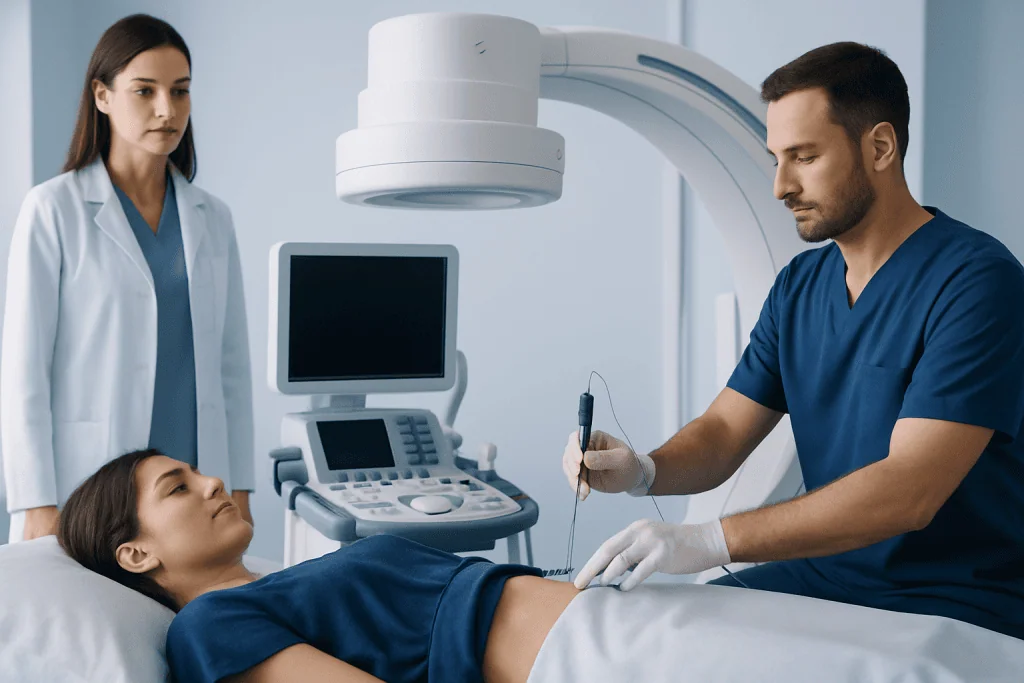
Doctors recommend a biopsy when an examination, scan or screening test shows something that needs tissue-level confirmation. Typical triggers include a new lump, a suspicious finding on ultrasound, mammography or MRI, enlarged lymph nodes, abnormal bleeding, a lesion seen during endoscopy, or blood results that point to a specific organ.
Imaging can show that something is there; it often cannot say exactly what it is. Tissue analysis is usually the most reliable way to close that gap. A biopsy may also follow an inconclusive earlier test, or come before a major treatment decision where the team needs certainty about what they are treating.
Sometimes the question is broader than benign versus malignant. Pathologists can characterise the biological features of a disease, its type, grade and markers, and this detail shapes treatment planning, particularly in cases handled by several specialties together.
A biopsy is only recommended when the value of a clear diagnosis outweighs the risks of taking the sample. That balance depends on your symptoms, your imaging, your general health and how urgently an answer is needed, which is why the decision always rests on a physician’s assessment of your individual case.
Who is a suitable candidate
Suitability comes down to two things: the abnormal area needs a tissue diagnosis, and the sample can be taken safely. Most people meet both conditions. Doctors weigh age, medical history, bleeding risk, current medicines, allergies and chronic conditions affecting the heart, lungs, liver or kidneys.
Some situations call for extra planning rather than a refusal. Blood-thinning medicines, clotting disorders, pregnancy, active infection, or difficulty lying still for an image-guided procedure can all change the timing or the technique. Any adjustment to medicines around a biopsy is decided by the treating doctor, never on your own initiative.
Where a biopsy is not the safest first step, the team may suggest repeat imaging after an interval, a different test, or a combined diagnostic plan. The final call is always made after in-person evaluation, not from records alone.
Types of biopsy
There is no single “biopsy procedure”. The method is matched to the organ, the depth of the target, and how much tissue the pathologist needs to make a confident diagnosis.
| Method | How it works | Typically used for |
|---|---|---|
| Fine needle aspiration | A very thin needle draws out cells | Thyroid nodules, some lymph nodes and superficial lumps |
| Core needle biopsy | A wider needle removes a cylinder of tissue, preserving its architecture | Breast, prostate, liver and soft-tissue lesions where structure matters |
| Image-guided biopsy | Ultrasound, CT, mammography or MRI guides the needle in real time | Deep or small targets, lung, liver, kidney, deep lymph nodes |
| Endoscopic biopsy | Tissue is taken through a scope from inside a body passage | Stomach, bowel, airways, bladder |
| Punch or shave biopsy | A small circular or surface sample of skin | Skin lesions and rashes |
| Incisional or excisional surgical biopsy | Part or all of the lesion is removed through an incision | Lesions where needles cannot give enough tissue, or where full removal is feasible |
Core biopsy is often preferred over fine needle aspiration when the pathologist needs to see how cells are arranged, not just what they look like. An excisional biopsy can sometimes remove the entire abnormality in one step, though whether that is appropriate depends on the working diagnosis. Specialised sampling, cervical biopsy, bone marrow biopsy, sentinel node procedures, follows its own pathway within the relevant department. Your doctor should be able to explain why one method has been chosen over another; it is a fair question to ask.
Remote review before you travel
Most international cases start with a remote review. The coordinating team typically asks for your medical history, current symptoms, previous pathology reports, imaging files or discs, recent blood results and a medication list. For visible findings, such as a skin lesion, photographs may also be useful.
This early review does several practical things. It helps the team judge whether a needle, endoscopic or surgical approach is most likely, whether extra imaging should be arranged on arrival, whether medicines need adjusting under medical supervision, and roughly how many days you should plan to stay. Our guide on travelling to Turkey for biopsy review walks through this stage in more detail.
Be clear about what remote review can and cannot do. It shapes a plan; it does not finalise one. The biopsy method, anaesthesia and timing are only confirmed after in-person examination, and plans sometimes change once the specialist has seen you. Flexible travel arrangements are sensible for exactly this reason.
Before the procedure
Preparation depends on the site and method. You will have a consultation and, often, blood tests to check clotting, blood count or organ function. If your previous scans are outdated or incomplete, imaging may be repeated so the safest sampling route can be planned.
Tell the team about everything you take, prescription medicines, blood thinners, antiplatelet drugs, diabetes medicines, painkillers, supplements and herbal products. Some may need pausing or adjusting beforehand, but only your treating doctor decides that, and only they decide when anything restarts. Mention allergies to local anaesthetics, contrast agents, latex or dressings.
Fasting rules vary. A superficial biopsy under local anaesthetic may need none; sedation or general anaesthesia usually means no food or drink for a set number of hours. The specifics are covered in when to stop eating, drinking or smoking before a procedure, and our dedicated guide on how to prepare for a biopsy in Turkey covers the full checklist. If sedation is planned, arrange for someone to accompany you.
Before the procedure, your doctor explains the reason for the biopsy, its expected benefit, the risks, and the alternatives. This is the right moment to ask about pain control, pathology timing and when you will be cleared to fly.
What happens on the day
The team confirms your identity, the target area and the anaesthesia plan. The skin or access site is cleaned, and local anaesthetic is usually injected to numb the area. Deeper, more complex or endoscopic biopsies may use sedation or general anaesthesia instead.
During a needle biopsy, the doctor places the needle into the target, often watching it on ultrasound or CT as it advances. Expect pressure, pushing and sometimes a clicking sound from a core biopsy device; sharp pain is uncommon once the anaesthetic has taken effect, though brief discomfort can occur. Several samples are often taken deliberately, more material improves the chance of a definitive answer.
Endoscopic biopsies follow the pattern described in our endoscopy guide: a scope reaches the area from inside, and small instruments take the tissue. Surgical biopsies involve a small incision to remove part or all of the lesion.
Afterwards, the site is compressed or dressed to limit bleeding, and the sample goes to the pathology laboratory. You are then monitored, briefly for simple biopsies, longer where sedation was used or where the organ involved carries a higher bleeding risk.
Hospital stay and discharge
Many biopsies are outpatient procedures: after a short observation period, you return to your accommodation the same day. This is common for skin, breast, thyroid, lymph node, prostate, cervical and many image-guided soft-tissue biopsies.
Longer monitoring applies when sedation was used, when the sample came from the lung, liver, kidney or another organ where early observation matters, or when underlying conditions raise the risk. In a minority of cases an overnight stay is advised. This is precaution, not a complication.
Discharge instructions are specific to your biopsy, and they matter more than any general guide. They cover wound care, showering, activity limits, when paused medicines restart under the doctor’s direction, what sensations are normal in the first days, and exactly which signs your team wants reported. Keep the written summary; it is tailored to your procedure in a way no article can be.
For international patients, discharge planning also covers flying, local transport and the timing of your first review. Teams often prefer you to stay in Turkey until that first control visit, when they can check the site directly.
Recovery timeline
Physical recovery and diagnostic progress run on separate clocks. The wound often settles quickly; the laboratory works to its own schedule, especially if special stains or additional tests are needed.
| Timeframe | What to expect |
|---|---|
| First 24 hours | Mild pain, tenderness, small bruising or slight spotting at the site. Rest is usually advised; no driving if sedation was used. |
| First week | Most minor biopsy sites settle. Routine activity often resumes quickly, though heavy exercise, swimming or strain may still be restricted depending on the site. |
| Weeks 2–4 | Surface wounds generally heal in this window. Stitches, if used, are reviewed or removed per your doctor’s instructions. |
| Months 1–3 | Deeper or surgical biopsy sites continue healing internally. Attention usually shifts from the wound to the pathology findings and next steps. |
| Final result | The site typically heals before the diagnostic process finishes. Final interpretation and planning can take additional time for complex samples. |
These are patterns, not promises. A lung, liver, endoscopic or bone marrow biopsy carries different restrictions from a simple skin or breast needle biopsy, and your own instructions take precedence over every row of this table.
What to avoid afterwards
The common thread is protecting the site from bleeding and disturbance. For most patients that means no strenuous exercise, heavy lifting or high-impact activity for a period set by the biopsy type. Keep dressings in place for as long as instructed, and avoid soaking the area, baths, pools, hot tubs, the sea, until the wound has sealed.
If you received sedation, do not drive, operate machinery, sign important documents or drink alcohol until the effects have fully worn off, usually the rest of that day at minimum.
Medicines that were paused before the biopsy, blood thinners, supplements, anti-inflammatories, restart only on your doctor’s instruction and timetable. Smoking can interfere with healing, so this is a reasonable window to cut down or pause if you can.
Chest, abdominal and internal-organ biopsies come with more careful rest guidance. Ask specifically when you can fly, exercise, return to work and travel normally; the answers differ by procedure.
Risks and possible complications
Biopsies are performed routinely and most pass without incident, but no procedure is free of risk. The common effects are temporary: pain, bruising, mild bleeding and local swelling, all of which usually improve within days.
Less common complications depend on the site and method. They include infection, heavier bleeding, injury to nearby structures, delayed wound healing, fainting, and allergic reactions to medicines or antiseptics. Some organs carry specific risks, air leakage around the lung after a chest biopsy, or internal bleeding after certain abdominal organ biopsies, which is exactly why those procedures involve longer observation and stricter activity limits.
There is also a diagnostic risk: the sample may be non-diagnostic or unrepresentative, and a repeat biopsy or different technique may be needed. This is frustrating but not rare, and it does not by itself suggest a serious finding.
Teams reduce these risks by reviewing imaging carefully, choosing the safest route, checking clotting and medicines beforehand, and monitoring you afterwards. Your discharge summary lists the specific warning signs relevant to your biopsy type, and the clinical notice at the top of this page applies as it does across the site.
Results and what the pathology report means
The central output of a biopsy is the pathology report. It may confirm a benign condition, inflammation, infection, precancerous change or malignancy, and it often includes tissue characteristics that shape what happens next.
Timing varies honestly and unavoidably. Straightforward samples move faster; others need additional processing, immunohistochemistry, expert second review or molecular testing. Your doctor should tell you when the initial result is expected and how it will be shared, in person, or remotely after you return home.
A biopsy result is interpreted alongside your symptoms, examination, imaging and history, not in isolation. When findings do not fit together, further testing or occasionally a repeat biopsy is the correct response. It helps to think of the biopsy as a decision-making step: its value is in moving you from uncertainty toward a diagnosis specific enough to plan around.
Travel planning for international patients
Plan your trip around four fixed points: the consultation, any pre-procedure tests, the biopsy itself, and at least one early follow-up review. How long that takes depends on whether the procedure is a simple outpatient biopsy or involves deeper organs, sedation or overnight monitoring: the remote review before travel usually gives a realistic estimate.
Travel with your passport, medical reports, imaging, medication list and the contact details of your usual doctor at home. If you take blood thinners or manage complex conditions, raise travel timing early so any medication changes can be coordinated safely by the medical team. Book flexibly where possible, since the plan can shift after in-person evaluation.
Flying home deserves a specific answer, not a general one. Some patients can fly soon after a superficial biopsy; lung and deep-organ biopsies often require a wait until the doctor confirms it is safe. Our guide on when you can fly after a procedure in Turkey explains why the answer varies. Before your return flight, confirm your travel clearance, what to monitor en route, and how your results will reach you.
How the cost of a biopsy in Turkey is worked out
There is no single price for a biopsy because there is no single biopsy. A quotation reflects the organ involved, the technique, whether imaging guidance is needed, the anaesthesia type, whether observation or an overnight stay is required, and the complexity of the pathology work, routine processing costs less to deliver than extensive immunohistochemical or molecular testing.
Pre-procedure consultations, blood tests, repeat imaging and specialist reviews can also appear in a quotation. Endoscopic and surgical biopsies involve more departments and resources than a simple outpatient needle biopsy, and quotations reflect that.
Read any package description carefully. Packages often combine coordination, consultation, the procedure, routine nursing care, standard pathology processing and a first follow-up. Items commonly outside a package include extended pathology studies, emergency care if unexpectedly needed, treatment for whatever the biopsy diagnoses, medicines taken outside hospital, accommodation and flights. The same logic applies to any treatment that follows the biopsy: its cost depends entirely on the diagnosis and the plan, so an accurate figure only exists after medical review of your individual case.
How Acibadem organises biopsy care
A biopsy runs across several departments at once: the specialty that requested it, the radiologists who guide it, and the pathologists who interpret it. Acibadem’s hospitals house these teams within one network, which matters most when the best sampling route is genuinely debatable and needs a joint decision, or when the result leads directly into treatment planning within the same group. Our guide to what happens before, during and after treatment in Turkey describes how that broader pathway works.
For international patients, coordinators handle the practical layer, directing your file to the right specialist, arranging interpreters, transfers and accommodation guidance, and keeping remote follow-up open after you fly home. None of this replaces the clinical judgement at the centre of the process: the right biopsy plan for you emerges from a physician’s evaluation, and your comfort with that plan should drive your decisions.
Medical review and disclaimer
This guide has been medically reviewed by the Acibadem International medical team. It provides general, patient-friendly information about biopsy procedures and what international patients can expect when planning care in Turkey.
It does not replace a personal consultation, physical examination, imaging review, pathology review or advice from your doctor. The suitable biopsy method, timing, anaesthesia, hospital stay and follow-up plan can only be determined after physician evaluation of your individual case.
Every patient is different. Recommendations vary with the tissue involved, your symptoms, previous results and overall health, and recovery times, risks and result timelines differ from one person to another. A formal assessment with the relevant specialist is what confirms whether a biopsy is needed, which type is appropriate, and how to prepare for it properly.
Step by step
- Initial contact. You contact Acibadem International and describe the finding or the biopsy you have been advised to consider.
- Medical record submission. You share your medical history, imaging, reports, any previous pathology, medication list, and photos where relevant.
- Preliminary medical review. The appropriate department reviews your file to assess whether a biopsy is likely needed and which type may suit.
- Treatment plan and quotation. You receive a preliminary plan covering consultations, likely tests, the expected biopsy approach, and an individualised quotation.
- Travel planning. Your coordinator helps with timing, estimated stay, transfers, interpreter needs and accommodation guidance.
- Arrival. You are guided through registration and your appointment schedule.
- In-person consultation. The specialist examines you, reviews your records, and confirms or adjusts the biopsy plan.
- Pre-procedure tests. Blood tests, updated imaging or an anaesthesia review are completed if needed.
- The biopsy. The procedure is performed using the chosen technique, needle, image-guided, endoscopic or surgical.
- Observation. You are monitored for a short same-day period, or longer where your biopsy type requires it.
- First control. The doctor checks the site, reviews your early recovery, and explains the pathology timeline.
- Discharge and travel clearance. You receive wound care advice, activity guidance, your specific warning signs, and clearance timing for flying.
- Remote follow-up. After you return home, results are shared and next steps coordinated remotely where appropriate.
Your checklist
- Passport and travel documents
- Full medical history and a summary of current symptoms
- List of current medicines, including blood thinners, supplements and herbal products
- Known allergies, medicines, latex, contrast agents, anaesthetics, dressings
- Details of previous surgeries or earlier biopsies
- Recent blood test results, if available
- Imaging reports and the image files or discs themselves
- Previous pathology reports, if any
- Contact details for your usual doctor or referring physician
- Insurance or payment information, if relevant
- A companion plan if sedation is expected
- Your questions about diagnosis, recovery and travel timing
Key takeaways
- A biopsy provides tissue-level evidence that imaging alone often cannot, and it guides what happens next.
- The method is matched to the organ, the depth of the target, and how much tissue the pathologist needs.
- Many biopsies are day procedures under local anaesthetic; deeper organ biopsies need longer observation.
- Physical recovery and pathology timing run on separate clocks, feeling well does not mean the report is ready.
- Your discharge summary sets out what is normal after your specific biopsy and which signs your team wants reported.
- Plan your stay around the consultation, the procedure and at least one early follow-up, and confirm flying clearance before booking your return.
Frequently asked questions
Is a biopsy always necessary?
Not always. Some abnormalities are followed with repeat imaging or other tests. A biopsy is recommended when tissue analysis is the most reliable way to confirm a diagnosis, and the specialist decides based on your symptoms, scans and overall clinical picture.
Is a biopsy painful?
Most are done under local anaesthetic, which numbs the area well. Pressure and brief discomfort are common during the procedure, and some soreness afterwards is normal. More complex biopsies use sedation or general anaesthesia for comfort.
How long do I need to stay in Turkey for a biopsy?
It depends on the biopsy type and whether you need pre-procedure testing, sedation or observation afterwards. Minor biopsies often need only a short stay; deeper or more complex procedures add days for monitoring and an early follow-up. A realistic estimate comes from the remote review of your records before travel.
Can I fly soon after the procedure?
Sometimes, particularly after a simple superficial biopsy. Biopsies involving the lung, deeper organs or sedation may require a wait until your doctor confirms it is safe. Get explicit travel clearance before booking your return flight.
What is the average cost of a biopsy in Turkey?
There is no meaningful average, because the procedure varies so much. The quotation depends on the organ, technique, imaging guidance, anaesthesia type, any hospital stay, and the complexity of pathology testing. An accurate figure only exists after medical review of an individual case, so treat any flat advertised price with caution.
When will I get the pathology result?
Timing depends on the tissue type, sample complexity and whether special laboratory tests are needed. Some results are straightforward; others require additional processing or expert review. Your doctor will tell you when to expect an update and how it will be communicated, including remotely after you return home.
What if the biopsy result is inconclusive?
An inconclusive result can happen when the sample is too small, not representative, or hard to interpret. The response may be a repeat biopsy, a different technique, more imaging or another test. It means more information is needed, not necessarily that something serious is present.
Will the biopsy remove the entire abnormal area?
Sometimes, but not always. An excisional biopsy can remove the whole lesion where feasible; needle and incisional biopsies take only a sample for diagnosis. Your doctor will explain whether your procedure is purely diagnostic or may also serve as complete removal.
Add us as a Preferred Source to see more of our trusted health content across Google Search, AI Overviews and Discover.

Update history
- PublishedJuly 8, 2026
- Medical review approvedSeptember 1, 2026
- Last content updateSeptember 1, 2026
References3
- Biopsy: MedlinePlus, U.S. National Library of Medicine medlineplus.gov
- Biopsy: NHS nhs.uk
- Diagnosis: National Cancer Institute cancer.gov
More Patient Guides

HoLEP in Turkey: How It Compares With TURP and What Recovery Involves
HoLEP in Turkey treats enlarged prostate tissue with laser enucleation; learn how it compares with TURP, recovery, travel and follow-up.
Porcelain Veneers in Turkey: Who Is Suitable and How Many Visits Are Needed?
Porcelain veneers in Turkey can enhance tooth shape and colour in two visits for suitable patients after a personalised dental assessment.
How to Prepare for a Sedation Procedure in Turkey
Prepare safely for a sedation procedure in Turkey with guidance on fasting, medicines, travel, recovery and follow-up.
Treatment Delays in Turkey: What Happens If Tests or Recovery Change Your Schedule
Treatment delays in Turkey can happen if tests or recovery change your plan. Learn how to manage appointments, travel, accommodation and follow-up.