

Dialysis During a Medical Trip to Turkey: Safe Planning Guide

Yes, dialysis during a medical trip to Turkey can usually be arranged, but only if you plan it before you book flights. You need written clearance from your home nephrologist, a complete records packet for the receiving unit, confirmed session dates before departure, and an itinerary built around your dialysis rhythm rather than squeezed in beside it.
You can usually keep your dialysis sessions on track while you travel to Turkey for medical care. What you cannot do is sort it out after you land. Dialysis during a medical trip to Turkey works when the arrangements are made weeks before your flight, in writing, with your home nephrologist and the receiving unit both involved.
This guide explains what a dialysis unit will ask of you as a visiting patient, how to build your treatment itinerary around your sessions rather than the other way round, how healthcare access and payment work for visitors to Turkey, and what changes if you use peritoneal dialysis. It is a planning guide, not medical advice: your own nephrologist decides whether travel is appropriate for you.
At a glance
- When to start planning: Before you confirm flights, ideally several weeks ahead, so the receiving unit has time to review your records
- Key documents: Dialysis prescription, recent laboratory results, viral serology, medication list, vascular access details, recent clinical summaries
- Main safety priorities: Continuity of schedule, infection screening, vascular access protection, fluid balance
- Who is involved: Your home nephrologist and dialysis centre, the receiving unit in Turkey, and the team coordinating your main treatment
- Do not travel if: Your nephrologist advises against it or your condition is unstable
Why dialysis planning shapes the whole trip
Dialysis during a medical trip to Turkey is not a travel detail like a hotel booking. Your session schedule is part of your treatment, and a delayed or missed session can affect fluid balance, blood pressure and potassium levels, which in turn can affect your fitness for the consultations, tests or procedures you came for. The dialysis plan therefore has to come first, and everything else in the itinerary fits around it.
Two conversations need to happen before anything is booked. The first is with your home nephrologist, who confirms whether travel is medically reasonable for you right now and puts any conditions in writing: flight duration limits, fluid guidance, what a delay would mean for you. The second is with the team organising your care in Turkey, so that the hospital knows from the start that you receive dialysis. Early disclosure is what allows appointments, session times, interpreter support and transport to be arranged as one coherent plan instead of competing commitments crowded into the same day.
If your nephrologist has doubts about your stability, a recent access infection, unstable blood pressure, a recent hospitalisation, take that seriously. Our guide on when to delay a medical trip to Turkey for safety reasons covers how to think about postponement without losing your treatment plan altogether.
Is it safe to travel internationally while on dialysis?
Many people on dialysis travel internationally, and for a stable patient with a well-organised plan it is a routine event for the receiving unit. Whether it is safe for you depends on your individual condition, and only your nephrologist can answer that. In general, the factors that matter are stability of your recent sessions, the state of your vascular access, your cardiovascular condition, any recent infections or hospitalisations, and the length and complexity of the journey itself.
What makes international dialysis travel safer is not the destination: it is the quality of the handover. A receiving unit that has your full prescription, recent bloods and serology before you arrive can slot you into its schedule with the same information your home unit works from. A unit asked to dialyse a stranger with photographed documents on a phone cannot. The single most useful thing you can do for your own safety is to make sure nothing about your dialysis needs to be explained verbally at the last minute.
What to prepare before you travel
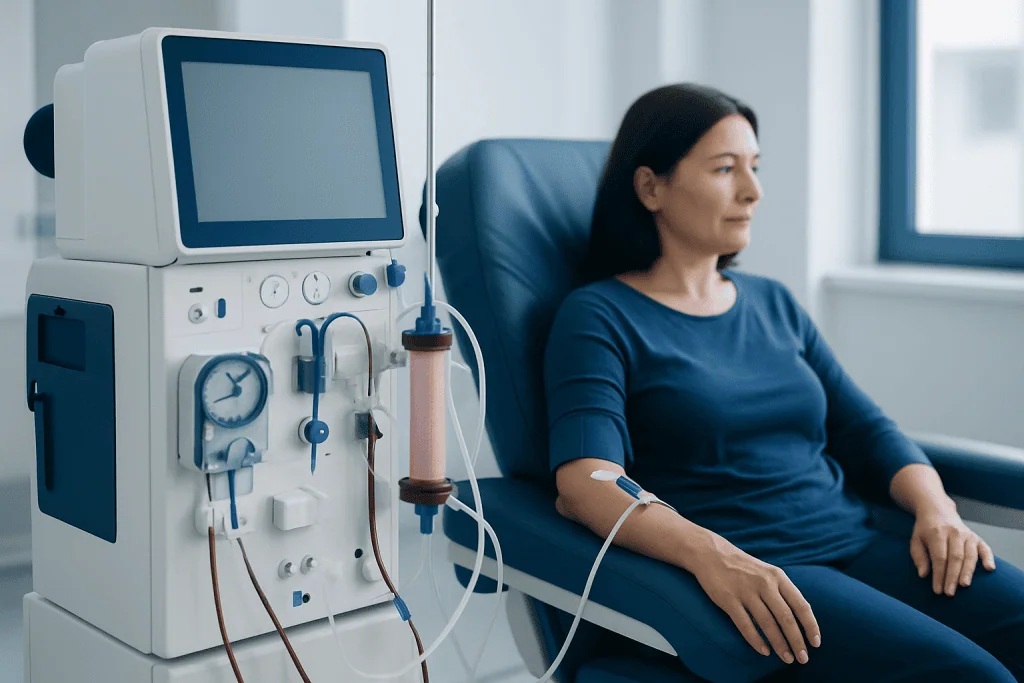
Dialysis units have formal requirements before they accept a visiting patient, and they vary between centres. Ask your home dialysis centre to prepare a travel packet, in English if possible. If your records are in another language, ask early whether translation is needed: this takes time and is not something to discover the week before departure. A typical packet includes:
- Current dialysis prescription: frequency, session duration, dialyser type if specified, blood flow and dialysate details if your unit provides them
- Recent laboratory results: potassium, haemoglobin, creatinine, urea, albumin, calcium, phosphate, and coagulation results where relevant
- Viral serology and infection screening: most units require recent hepatitis B, hepatitis C and HIV results before accepting a visiting patient; some request additional tests, and results usually need to be recent, ask the receiving unit how recent
- Medication list: doses and timing, allergies, anticoagulants, insulin, blood pressure medicines, and erythropoiesis-stimulating agents if used
- Vascular access details: fistula, graft or catheter, its location, and any recent complications or interventions
- Clinical summaries: recent discharge summaries, cardiology notes, and details of any recent infections or admissions
Carry these as proper documents, not screenshots. Unit protocols require formal records for safety checks, and a coordinator cannot substitute for a missing serology result. Keeping everything in one organised folder, paper and digital, pays off repeatedly during a treatment trip; see how to keep your medical records organised during treatment in Turkey for a workable system.
Alongside the records packet, prepare a short emergency summary you carry on your person, not in luggage: diagnosis, dialysis schedule, access type, allergies, key medications, your home nephrologist’s contact details and your hospital contact in Turkey. If a companion travels with you, they should know where it is.
Scheduling dialysis around your medical appointments

The safest itinerary starts from your usual rhythm. If you dialyse three times a week at home, the travel plan should preserve that pattern as closely as possible, with the interval between your last home session and your first session in Turkey no longer than your normal gap. In practice that usually means a session shortly before departure and a confirmed slot in Turkey before you board, not a hope that one will be available on arrival.
Build the rest around it. Consultations, imaging and pre-procedure tests go on non-dialysis days where possible, or well clear of session times where not. Long flights and time-zone changes are tiring on their own; combined with dialysis they argue for buffer days, not back-to-back commitments. If your main treatment is time-sensitive, the teams need to know your session timing so appointments are placed safely around it rather than colliding with it.
At Acibadem International, the international patient services team coordinates between hospital departments, including nephrology where needed, so that dialysis is visible in the overall itinerary rather than handled as a separate errand. Whatever your main specialty, the principle holds anywhere: dialysis on the itinerary in writing, not as a verbal understanding.
One more scheduling honesty: how you feel after a session varies. Some people feel well within an hour; others need an afternoon. Plan dialysis days as light days, and treat anything you manage beyond rest as a bonus. If gaps open up between appointments, that is normal on treatment tripsmanaging appointment gaps during a medical trip to Turkey covers how to use them without overcommitting.
Choosing where to dialyse: what “best” actually means
People often ask which country is best for dialysis. The honest answer is that “best country” is the wrong frame. Haemodialysis is a standardised treatment delivered to a prescription; what matters is whether a specific unit can deliver your prescription, meets recognised hygiene and screening standards, communicates with your home team, and sits within a system that can manage complications if they arise. A well-run unit in any country beats a famous one that never saw your records.
For a medical trip, the practical answer is narrower still: the sensible place to dialyse is wherever keeps your dialysis and your main treatment coordinated, ideally within the same hospital system or in a unit that communicates directly with it. Fragmented care, where the team treating you does not know what the dialysis unit is doing, is the risk to avoid. Turkey has a large hospital sector accustomed to international patients, and major centres routinely dialyse visitors; the quality question is answered unit by unit, through the records review process itself. A unit that asks you detailed questions before accepting you is showing you exactly the caution you want.
Healthcare access and payment for visitors to Turkey
Tourists do not get free healthcare in Turkey. The public system covers people enrolled in Turkish social security; visitors are treated as private patients and pay for care directly or through insurance. Emergency departments will treat anyone who arrives, but ongoing treatment, including routine dialysis sessions, is billed to the patient.
This has two planning consequences. First, get a written quote from the unit before you travel, so you know what each session covers and how payment works. What you pay depends on the unit, the type of dialysis, any additional tests the unit requires on arrival, and how many sessions your stay needs, which is why quotes are given individually rather than as a standard figure. Second, check your travel insurance carefully. Many standard policies treat routine dialysis as maintenance of a pre-existing condition and exclude it, even when they cover emergencies. Specialist policies exist; read the exclusions before you rely on any of them, and get confirmation in writing.
Safety considerations during your stay
Travel disturbs routine, and routine is what keeps dialysis stable. Restaurant food in Turkey, as anywhere, can carry more salt than you expect, warm weather increases thirst, and busy days increase fatigue. Ask your nephrologist for travel-specific written guidance on fluid limits and diet before you go, and for their advice on which changes in how you feel they would want to know about. Practical help on holding a renal diet away from your own kitchen is in how to manage special diets during medical travel in Turkey. If you are travelling in high summer, plan fluid guidance and rest around the heat with extra care.
Vascular access protection is a daily discipline, not a one-off precaution. Blood pressure cuffs, blood draws and IV lines do not go on your fistula or graft arm unless your dialysis team has specifically approved it, and in an unfamiliar hospital, you are the one who says so, every time. If you use a catheter, keep the dressing clean and dry and follow the care instructions your home unit gave you. Your medicines stay on their home schedule too, unchanged unless your treating doctors change them; keeping regular medicines on schedule during medical travel covers time zones, carriage and documentation.
Accommodation, transport and daily logistics
Choose accommodation that keeps the triangle small: hotel, hospital, dialysis unit. Istanbul traffic is genuinely heavy at peak times, and a short distance on the map can take three times as long as expected. Build a buffer into every dialysis day, both directions.
Plan dialysis days as quiet days. If you feel well afterwards, a gentle outing is a bonus, not a plan, and any sightseeing should follow the same conservative logic as the rest of the trip: short, flexible, close to base. Planning safe sightseeing around medical treatment in Turkey sets out how to do that without turning recovery time into a schedule.
International patient coordination, airport transfers, hotel guidance, interpreter arrangements, appointment timing, takes real friction out of a dialysis trip, and Acibadem International provides this support to international patients. It complements your nephrologist’s travel advice; it does not replace it. You remain responsible for following the medical plan your home team set.
If you use peritoneal dialysis
Peritoneal dialysis changes the logistics substantially. Instead of booking sessions, you are moving a supply chain: solutions, tubing, a cycler if you use one, and enough margin for things going wrong. Do not assume supplies are available locally unless your PD provider has confirmed it in writing, solution formulations and connection systems are not universally interchangeable.
- Supplies: ask your provider whether they can arrange delivery to your accommodation in Turkey, what lead time they need, and what storage conditions the solutions require
- Equipment: confirm your cycler’s power requirements and whether you need a plug adapter or voltage confirmation for Turkey
- Airline rules: contact the airline before booking about medical equipment and liquids, and carry written documentation for everything; keep at least an emergency quantity of supplies and all medications in hand luggage, never only in checked baggage
- Backup plan: know in advance which unit could provide temporary haemodialysis if your PD supplies are delayed or lost, arranged before travel, not improvised after
If your medical trip involves surgery or an invasive procedure, your nephrology team and the treating specialists may need to discuss timing, anticoagulation, infection risk, fluid management and whether temporary changes to your dialysis plan are appropriate. This is exactly why early disclosure matters: it gives the teams time to plan together instead of reacting under pressure.
Step by step
- Speak with your home nephrologist first. Ask whether you are fit to travel and whether your dialysis has been stable enough for an international trip. Get the advice in writing, including any limits on flight duration, fluid intake or activity, and what a delayed session would mean for you.
- Disclose dialysis before anything is booked. The team organising your treatment in Turkey needs to know from the first conversation, before flights, hotels or appointment dates are set. This determines which records the receiving unit requires and how the itinerary is built.
- Assemble a complete travel packet. Prescription, recent labs, infection screening, access details, medication list, allergies and recent clinical summaries, current, legible, and in English or translated if the unit requests it.
- Confirm session dates before you depart. Date, approximate time, location, required documents and what to bring to the first session, all in writing. Never travel assuming a slot will materialise on arrival.
- Build flights around treatment timing. Dialyse shortly before departure where possible, avoid tight connections, and leave real time between landing and your first medical commitment.
- Pack hand luggage as if checked bags will be lost. Medications, prescriptions, dialysis summary, insurance documents, emergency contacts and access information stay with you. PD users carry an emergency quantity of supplies and equipment documentation.
- Keep the itinerary flexible. Dialysis days may demand rest, and appointments can move after doctors review your condition. A plan with slack in it absorbs surprises; a tight one turns them into problems.
Your checklist
- Written travel guidance from your home nephrologist
- Dialysis prescription and recent treatment records
- Recent blood tests and infection screening results, dated within the receiving unit’s required window
- Medication list with doses, allergies and anticoagulant details
- Vascular access details and access protection instructions
- Confirmed session dates, unit location and contact details in Turkey, in writing
- Written quote from the unit and insurance terms checked for dialysis exclusions
- Emergency summary carried on your person, with a copy held by your companion
- Hotel and transport plan with buffers for traffic and post-session rest
- For PD: supply delivery confirmed, airline rules checked, backup haemodialysis plan agreed
Key takeaways
- Dialysis during a medical trip to Turkey works when it is arranged weeks ahead, with your home nephrologist and the receiving unit coordinating in writing.
- Your prescription, recent labs, infection screening, medication list and access details travel ahead of you, as formal documents, not screenshots.
- Flights, consultations, procedures and rest are planned around the dialysis schedule, never the other way round.
- Visitors pay for dialysis in Turkey; get a written quote from the unit and check insurance exclusions before travelling.
- Protect your vascular access daily, keep medicines on their home schedule, and carry an emergency summary on your person.
- PD users move a supply chain, not a booking: confirm delivery, airline rules and a backup plan before departure.
Frequently asked questions
Is it safe to travel internationally while on dialysis?
Many dialysis patients travel internationally when their condition is stable and their nephrologist agrees. Safety depends on your individual health, recent session stability, access condition, cardiovascular status, and on the quality of the handover to the receiving unit. A complete records packet sent ahead, confirmed session dates, and written travel advice from your own nephrologist are what make the difference. Do not travel without medical clearance.
Is it safe to go to Turkey for medical procedures while on dialysis?
Turkey has a large hospital sector experienced with international patients, and major centres routinely dialyse visitors. Safety depends less on the country than on the specific arrangements: whether your dialysis and your main treatment are coordinated, whether the unit reviewed your records before accepting you, and whether your nephrology and treating teams have discussed timing, fluid management and any procedure-related risks in advance.
Which country is best for dialysis?
There is no meaningful “best country”, haemodialysis is a standardised treatment delivered to your individual prescription. What matters is the specific unit: whether it can deliver your prescription, meets recognised hygiene and screening standards, and communicates with your home team. For a medical trip, the best place to dialyse is wherever keeps your dialysis and your main treatment coordinated, ideally within the same hospital system.
Do tourists get free healthcare in Turkey?
No. Turkey’s public system covers people enrolled in Turkish social security; visitors are private patients who pay directly or through insurance. Emergency departments treat anyone who arrives, but ongoing care, including routine dialysis sessions, is billed. Request a written quote from the unit before travelling, and check your travel insurance carefully, because many standard policies exclude routine dialysis as maintenance of a pre-existing condition.
How early should I arrange dialysis in Turkey?
Start before confirming flights or hotel dates, ideally several weeks ahead. Units need time to review your prescription, laboratory results and infection screening, and some serology results must be recent, which may mean fresh tests at home before departure. Last-minute requests compress the safety checks that protect you.
What documents does a dialysis unit usually ask for?
Typically your dialysis prescription, recent treatment records, blood tests, viral serology (usually hepatitis B, hepatitis C and HIV), medication list, allergy information and vascular access details. Requirements vary between centres, and some request additional tests, so ask the receiving unit for its exact list, and how recent each result must be, before you travel.
What if my flight is delayed and I miss a dialysis session?
A missed session is a medical matter, not just a scheduling one, which is why the plan should never depend on everything running on time. Dialyse shortly before departure, avoid tight connections, and keep the receiving unit’s contact details with you so timing can be adjusted as soon as a delay appears. Ask your nephrologist before travelling what a delayed session would mean for you specifically, and carry that written advice in your hand luggage.
Can I sightsee in Istanbul while on dialysis?
Often yes, if your doctor agrees and you feel well, but plan it conservatively. Keep outings short and close to base, avoid heat, dehydration and salty food beyond your limits, and never schedule sightseeing against a dialysis day. Treat anything beyond rest on a session day as a bonus, not a commitment.
Add us as a Preferred Source to see more of our trusted health content across Google Search, AI Overviews and Discover.

Update history
- PublishedJune 22, 2026
- Medical review approvedSeptember 13, 2026
- Last content updateSeptember 12, 2026
References3
- Dialysis: NHS nhs.uk
- Dialysis: MedlinePlus medlineplus.gov
- Travelers with Chronic Illnesses: CDC Travelers' Health wwwnc.cdc.gov
More Patient Guides

HoLEP in Turkey: How It Compares With TURP and What Recovery Involves
HoLEP in Turkey treats enlarged prostate tissue with laser enucleation; learn how it compares with TURP, recovery, travel and follow-up.

Porcelain Veneers in Turkey: Who Is Suitable and How Many Visits Are Needed?
Porcelain veneers in Turkey can enhance tooth shape and colour in two visits for suitable patients after a personalised dental assessment.

How to Prepare for a Sedation Procedure in Turkey
Prepare safely for a sedation procedure in Turkey with guidance on fasting, medicines, travel, recovery and follow-up.

Treatment Delays in Turkey: What Happens If Tests or Recovery Change Your Schedule
Treatment delays in Turkey can happen if tests or recovery change your plan. Learn how to manage appointments, travel, accommodation and follow-up.