

Flying After Gallbladder Surgery: Timing and Precautions

Most people can consider flying after gallbladder surgery once they are mobile, eating and drinking normally, and their surgeon has confirmed recovery is on track. After uncomplicated keyhole (laparoscopic) surgery, that point often falls around one to two weeks. Open surgery usually means waiting four to six weeks or longer. The type of operation, your general health and the flight length all shift the timing.
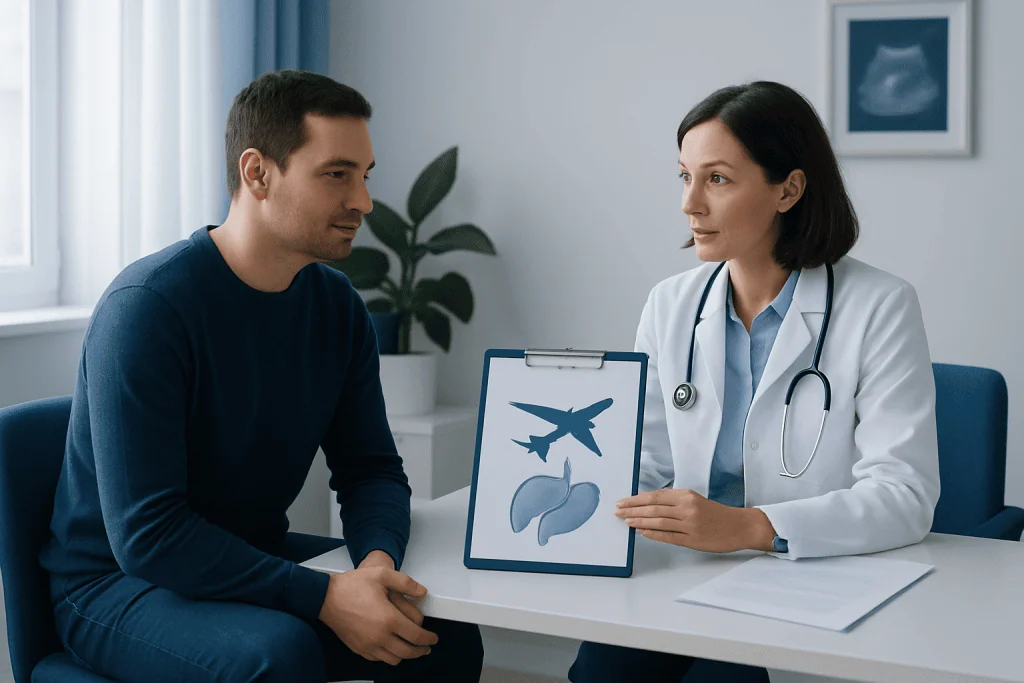
You have a flight home to think about, and one question matters: when is it safe to sit on a plane? Flying after gallbladder surgery is usually considered once you are medically stable, mobile, eating and drinking adequately, and your surgeon agrees that travel is appropriate. After an uncomplicated laparoscopic cholecystectomy, that point often falls around one to two weeks. Open surgery, complications, long-haul routes or individual health factors can mean waiting longer. This guide explains where those timeframes come from, so you can plan with your surgeon rather than around a guess.
At a glance
- Keyhole (laparoscopic) surgery: flying is often possible around 1–2 weeks, with surgeon clearance
- Open surgery: usually 4–6 weeks or longer, depending on healing
- What fitness to fly means: mobile, stable, hydrated, comfortable and able to manage the journey
- The main flight-specific risk: blood clots, because recent surgery and long periods of sitting each raise the risk
- The decision that counts: your operating surgeon’s, based on your operation and your recovery, not a generic timeline
Flying after a cholecystectomy: what actually decides the timing
A cholecystectomy, the operation to remove the gallbladder, is one of the most commonly performed abdominal operations worldwide, and most are done laparoscopically, through several small incisions rather than one large one. That matters for travel, because the size of the incisions and the amount of internal disturbance largely determine how quickly you become mobile and comfortable again. It is why the flying timeframe after keyhole surgery is measured in days to a couple of weeks, while the timeframe after open surgery is measured in weeks.
No single number applies to everyone. The realistic timeline after a cholecystectomy depends on the type of operation, how straightforward it was, your pain control, wound healing, bowel function, other medical conditions, and the length and complexity of the journey itself. A ninety-minute flight two weeks after uncomplicated keyhole surgery is a very different proposition from a twelve-hour long-haul flight in the same week.
Fitness to fly also means more than being able to sit in a seat. You need to walk through an airport, stand in queues, manage your own medication and documents, drink enough fluids, and cope with a delay if one happens. Surgeons weigh all of this, not just the state of your wounds, when they give an opinion on travel. Our general guide to flying after surgery, procedure by procedure explains why timeframes differ so much between operations.
One caution about crowd-sourced advice: forum threads and social media discussions about flying after gallbladder surgery can offer practical ideas, but they cannot account for the details of your operation, your risk factors or how your recovery is actually progressing. The discharge instructions from your own surgical team are the reference point that matters.
How long after gallbladder surgery can you fly in an airplane?

For uncomplicated laparoscopic gallbladder removal, surgeons often consider a short flight reasonable after roughly one to two weeks, provided recovery is progressing well. A long-haul flight usually warrants a more cautious plan, because sitting still for many hours raises the risk of deep vein thrombosis (DVT), and that risk is already higher in the weeks after any operation. Depending on your individual risk, a surgeon may advise waiting longer, wearing compression stockings, or adding other preventive measures.
After open gallbladder surgery, travel is typically delayed for around four to six weeks, sometimes longer. An open operation involves a larger incision through the abdominal wall, and the return to comfortable movement is slower. If the surgery was performed urgently, involved significant infection or inflammation, or was followed by a complication, the safe window moves again, in each case, individually.
Airline policy is a separate layer. Some carriers ask for a medical certificate after recent surgery, and most reserve the right to require one if there is any doubt about your fitness to fly. Check what your airline needs before you book, and remember the order of authority: airline permission does not replace medical clearance, and a changeable ticket does not make an early flight safer.
- Short flight, keyhole surgery: may be considered from around 1–2 weeks with surgeon approval and good mobility.
- Long-haul flight: usually needs clot-prevention planning and often a longer wait.
- Open or complicated surgery: typically 4–6 weeks or more before flying is discussed.
A practical timeline for travel after gallbladder removal
The table below is a general orientation, not a substitute for your surgeon’s instructions. The day of the operation counts as day 0, and every row assumes recovery is going to plan, if it is not, no generic schedule applies, and the timeline is set individually by your surgical team.
| Recovery period | What usually matters | Flying considerations |
|---|---|---|
| Days 0–2 | Early recovery: pain and nausea control, gentle walking, monitoring for early complications. | Flying is generally avoided unless the surgical team specifically judges it necessary and safe. |
| Days 3–7 | Gradually increasing movement, tolerating food and fluids, settling wounds and bowel function. | Most people are not yet ready for routine air travel; individual advice is essential. |
| Week 1–2 | Many people feel substantially better after uncomplicated keyhole surgery. | A short flight becomes realistic for selected patients with explicit surgeon clearance. |
| Weeks 2–4 | Stamina and comfort keep improving; a gradual return to daily activities. | Many laparoscopic patients can travel if cleared; long-haul flights may still need extra precautions. |
| Weeks 4–6+ | The typical recovery window after open surgery, with wide individual variation. | Travel is considered once healing, mobility and a medical review support it. |
If you are travelling internationally for treatment, build flexibility into the itinerary from the start. A changeable ticket, a companion where possible, insurance that covers date changes, and a few spare days in the treatment city all reduce the pressure to fly before you are ready. It also helps to know the warning signs worth reporting before flying home, so your pre-departure review can deal with anything unresolved. At Acibadem, international patient services coordinate follow-up timing, interpreter support and discharge paperwork around the care plan, so the travel date follows the recovery rather than the other way round.
What a cholecystectomy involves, and why the operation type changes the wait
Cholecystectomy is considered a routine operation in experienced hands, but it is still real abdominal surgery performed under general anaesthetic, and the recovery deserves respect. The most common reason for the operation is symptomatic gallstonesstones that cause pain, inflammation of the gallbladder, or blockage of the bile ducts. Less often, the gallbladder is removed for polyps, chronic inflammation or other conditions identified by your treating team.
In the laparoscopic version, the surgeon works through several small incisions using a camera and fine instruments, and the abdomen is inflated with carbon dioxide gas to create working space. Most of that gas is released at the end of the operation, but small amounts can linger for a few days and cause the well-known shoulder-tip ache. The small incisions are the reason people are usually walking on the day of surgery and often home within a day or two. You can read more about how the procedure to remove the gallbladder is planned and performed, and about the wider work of our general surgery teams.
Open cholecystectomy, through a single larger incision under the ribs, is used when keyhole surgery is not suitable or has to be converted during the operation, for example because of severe inflammation, scarring from previous surgery or anatomical difficulty. The abdominal wall needs more time to heal, coughing and twisting stay uncomfortable for longer, and lifting restrictions last longer. That is the anatomical reason the flying timeframe stretches from weeks one to two out to weeks four to six and beyond.
What happens to your body after gallbladder removal, and how it affects the flight
You can live without a gallbladder. The organ stores and concentrates bile between meals; after gallbladder removal surgery, bile flows continuously from the liver into the intestine instead. Digestion carries on, but some people notice temporary changes, looser stools, urgency after rich meals, or bloating, while the digestive system adjusts. For many, these settle over weeks to months; a smaller number notice longer-lasting sensitivity to fatty food. This is the honest downside of the operation, and it is usually weighed against the symptoms the gallstones were causing.
For the flight itself, this has two practical consequences. First, choose food you already know you tolerate: airline and airport meals lean heavily on fat, and a long queue for the lavatory is not the place to discover a new trigger. Light, familiar meals in the day before travel and simple snacks in your hand luggage are a sensible plan. Second, keep drinking water regularly through the journey, unless your team has given you a fluid restriction, cabin air is dry, and dehydration makes both fatigue and clot risk worse.
Blood clots, cabin gas and pressure: the flight-specific questions
The most important flight-specific risk after any recent operation is venous thromboembolism: a clot forming in a deep leg vein, which can travel to the lungs. Surgery itself temporarily increases clotting tendency, and immobility during a long flight adds to it. The standard countermeasures are movement, hydration and, for some patients, graduated compression stockings; our guide to compression socks for flying after surgery explains how they work and how they should fit. Whether stockings or a prescribed blood thinner are appropriate for you is an individual decision made by your surgeon, based on your age, mobility, flight duration, weight, smoking status, hormone treatment, any history of clots, and other health conditions.
A question specific to keyhole surgery is the gas used during the operation. The residual carbon dioxide from a laparoscopic cholecystectomy is absorbed by the body within days and does not behave like the trapped air that concerns surgeons after some eye or ear procedures. By the time most people are otherwise fit to fly, cabin pressure changes are not the limiting factor, mobility, comfort, wound healing and clot risk are.
Cabin conditions do matter in smaller ways. The mild drop in oxygen at cruising altitude is well tolerated by healthy people but adds a small load if you are still weak or anaemic after surgery. Dry air accelerates dehydration. Cramped seating discourages movement. None of these is dangerous by itself; together they explain why surgeons treat a long-haul flight differently from a short hop.
Ground travel, driving and rest before you fly
You may be able to travel locally before you are ready to fly, but the same recovery principles apply. A long car, coach, train or ferry journey is difficult if pain, nausea, fatigue or a frequent need for the toilet would make it hard to manage. In the first days, a nearby place to rest and easy access to your surgical team count for more than reaching a destination quickly. On longer road journeys as a passenger, plan regular stops to walk gently, stretch your calves and drink water.
Driving is its own threshold. The usual standard is that you can wear a seatbelt comfortably, control the vehicle fully, and perform an emergency stop without pain or hesitation, and that you are no longer taking sedating pain medicines. This point tends to arrive sooner after laparoscopic than open surgery, but your surgeon’s advice and your motor insurer’s conditions both apply.
Prolonged bed rest, meanwhile, is not part of modern recovery after gallbladder surgery. Rest matters, especially in the first days, but gentle movement is actively encouraged because it supports circulation, breathing and bowel function. Short, frequent walks do more for your fitness to fly than days spent lying still. Heavy lifting and strenuous activity stay off the list until your surgeon releases them: the restriction period differs between keyhole and open surgery and between patients.
Preparing for a safer flight after gallbladder surgery
Once your surgeon has cleared travel, plan the journey around comfort, mobility and clot prevention. An aisle seat makes it easier to stand and walk. Airport assistance, booked in advance, removes long walks and queues. Arriving early removes rushing. Do not lift heavy cabin bags into overhead lockers, ask a companion or crew for help, and pack so that everything you actually need in flight sits in a small bag under the seat in front of you.
During the flight, move your ankles and calves while seated and get up for short walks when the seatbelt sign allows. Wear loose clothing that does not press or rub on your incisions. Keep your prescribed medicines, discharge summary and surgeon’s contact details in hand luggage rather than the hold, with enough medication to cover delays and the first days after arrival. Alcohol interacts with some pain medicines and works against hydration, which is why many surgeons advise leaving it out of the journey. How pain is managed in the days before you travel also shapes how the flight feels: our guide to how we control pain after surgery explains what to expect.
Step by step
- Get individual fitness-to-fly clearance. Discuss travel with your operating surgeon before confirming dates, especially for flights within the first few weeks. Tell the team the flight duration, connections, whether you will travel alone, and any history of blood clots or other conditions.
- Schedule a review before departure. A postoperative check timed a few days before the flight leaves room to change plans if healing is behind schedule.
- Confirm airline requirements. Ask whether a medical certificate or clearance form is needed after recent surgery, and pre-book mobility assistance if walking distances or handling luggage will be difficult.
- Follow the clot-prevention plan you are given. This may include frequent movement, hydration, compression stockings or a prescribed medicine: the combination is set by your surgeon for your risk profile and journey length.
- Pack for recovery, not just the flight. Discharge summary, operative note, medication list, prescriptions, insurance details and surgeon contacts all travel in hand luggage, with spare medication for delays.
- Make movement easy. Choose an aisle seat where possible, walk gently before boarding and during the flight when safe, and use ankle circles and calf raises whenever you must stay seated.
- Keep the plan flexible. A travel date is a target, not a commitment. If recovery falls behind schedule, the plan changes with it, and a changeable ticket makes that decision far easier.
Your checklist
- Clear fitness-to-fly advice from your operating surgeon, ideally in writing
- Postoperative review completed before departure
- Airline policy checked, including any medical-certificate requirement
- Travel insurance and emergency assistance details to hand
- Discharge summary, medication list and surgeon contacts in hand luggage
- Enough prescribed medication for delays and the first days at home
- Aisle seat or mobility assistance arranged if helpful
- A plan for regular walking, calf exercises and water through the journey
- A companion or support plan for after arrival, if you may need help
Key takeaways
- After an uncomplicated laparoscopic cholecystectomy, flying is often possible around one to two weeks, with individual surgeon clearance, not by the calendar alone.
- Open surgery, complications and long-haul routes stretch the timeline, typically to four to six weeks or more.
- The main flight-specific risk is blood clots; movement, hydration and any measures your surgeon prescribes are the countermeasures.
- Fitness to fly means more than healed wounds: mobile, stable, hydrated, and able to manage the airport, the medication and a delay.
- Flexible tickets, a pre-departure review and documents in hand luggage turn a stressful journey into a manageable one.
Frequently asked questions
Can you fly after gallbladder surgery?
Yes, once your recovery supports it and your surgeon agrees. Flying itself does not harm a healed cholecystectomy; the questions are whether you are mobile and comfortable enough for the journey, whether your clot risk is managed, and whether recovery is progressing normally. Those are individual judgements, which is why a generic date cannot replace your surgeon’s clearance.
How soon after gallbladder surgery can I fly?
After uncomplicated keyhole surgery, many surgeons consider a short flight reasonable from around one to two weeks. After open surgery, the usual window is four to six weeks or longer. Long-haul flights, complications and personal risk factors, such as a history of blood clots, can extend either timeframe. Your own surgeon’s advice, based on how you are actually healing, is the number that counts.
Is it safe to take a long-haul flight after gallbladder removal?
A long-haul flight needs more planning than a short one, mainly because many hours of sitting raise clot risk at a time when surgery has already raised it. Surgeons often advise a longer wait, plus preventive measures matched to your risk: regular walking in the cabin, calf exercises while seated, steady hydration and, for some patients, compression stockings or a prescribed medicine.
Is cholecystectomy considered major surgery?
It sits in the middle ground. Laparoscopic cholecystectomy is one of the most frequently performed abdominal operations and is routine in experienced hands, but it is still abdominal surgery under general anaesthetic, with real recovery and real, if uncommon, risks. Open cholecystectomy is closer to what most people picture as major surgery, which is why its recovery, and its flying timeline, is longer.
What happens to your body after the gallbladder is removed?
Bile flows continuously from the liver into the intestine instead of being stored and released with meals. Digestion continues normally for most people, though some notice looser stools, urgency after fatty meals or bloating while the system adjusts, changes that usually settle over weeks to months. A smaller number remain sensitive to rich food longer term, which is worth remembering when choosing meals around a flight.
Can I travel alone after gallbladder surgery?
Some people manage well alone after a smooth laparoscopic recovery; others benefit from a companion, particularly on long journeys or after open surgery. The honest test is practical: can you move through the airport, manage luggage without heavy lifting, take your medication on time, cope with a delay and get help if you feel unwell? Pre-booked airport assistance can close much of the gap.
What should I eat before and during a flight after gallbladder removal?
Keep meals light and stick to food you already know you tolerate. Because some people have temporary digestive changes after the operation, rich or fatty airline food can trigger discomfort or urgency at an inconvenient moment. Simple snacks in your hand luggage cover delays, and drinking water regularly through the flight helps with both the dry cabin air and general recovery, unless your team has advised a fluid restriction.
Add us as a Preferred Source to see more of our trusted health content across Google Search, AI Overviews and Discover.

Update history
- PublishedAugust 15, 2026
- Medical review approvedSeptember 13, 2026
- Last content updateSeptember 12, 2026
References2
More Patient Guides

Septoplasty Recovery: Week by Week
Learn what to expect after deviated septum surgery: a week-by-week septoplasty recovery timeline, when it is usually safe to fly home, and…

Gallbladder Surgery Recovery: Week by Week
Learn what to expect after gallbladder surgery: a week-by-week recovery timeline, pain, diet, wound care, when it is safe to fly home…

Robotic Hysterectomy Recovery: Week by Week
Recovery from robotic hysterectomy week by week: pain, lifting, wounds, driving, flying home safely, warning signs and questions to ask before you…

Breast Reconstruction Recovery: Week by Week
DIEP flap recovery week by week: hospital stay, drains, pain, walking, showering, driving, when it is usually safe to fly home, and…