

How to Choose the Right Surgeon for Spine Surgery in Turkey

To choose the right surgeon for spine surgery in Turkey, start with your diagnosis, not with ranking lists. The right surgeon is the one whose regular case mix matches your specific problem, who works in a hospital with imaging, intensive care and rehabilitation on site, and who explains what surgery can and cannot change before you commit to travel.
Search for spine surgery in Turkey and you will find ranking lists, package offers and “top surgeon” claims. None of them can tell you which surgeon is right for your spine, because that depends on your diagnosis. This guide explains how spine surgery decisions are actually made, what separates a well-run spine centre from a well-marketed one, and the questions worth asking before you book a flight.
At a glance
- Guide type: Decision-making guide for choosing a spine surgeon and hospital in Turkey
- Who it is for: International patients considering surgical treatment for a spinal condition
- Relevant specialists: Neurosurgeons and orthopaedic spine surgeons, supported by radiology, anaesthesia, pain medicine and rehabilitation
- Anaesthesia: Most spine operations use general anaesthesia; the approach depends on the procedure
- Hospital stay: Varies from short observation to several days, depending on the operation and your progress
- Recovery: Highly individual; nerve-related symptoms often improve gradually over weeks to months
- Key decision factors: Surgeon’s case mix, hospital resources, honesty about non-surgical options, follow-up after you return home
- International patient support: Interpreter services, record review before travel, transfers, accommodation guidance, remote follow-up
How to choose the right surgeon for spine surgery in Turkey
Start with the diagnosis, not the surgeon. Spine surgery is not one operation. A microdiscectomy for a herniated disc, a decompression for spinal stenosis, a multi-level fusion for instability and a scoliosis correction are different procedures with different demands on the surgeon and the hospital. To choose the right surgeon for spine surgery in Turkey, you first need a confirmed diagnosis, and then a surgeon whose everyday work matches that diagnosis.
This matters more than reputation. A surgeon who is excellent at degenerative lumbar surgery is not automatically the right person for a revision operation or a deformity correction, and the reverse is also true. The honest version of “who is the best spine surgeon” is always “best for what, exactly?”
The second half of the decision is the hospital around the surgeon. Spine surgery depends on imaging quality, anaesthesia expertise, intensive care availability and early rehabilitation as much as on the operating surgeon. For a broader overview of the procedures themselves, see the spine surgery in Turkey treatment guide; this page focuses on the choosing.
When surgery enters the picture
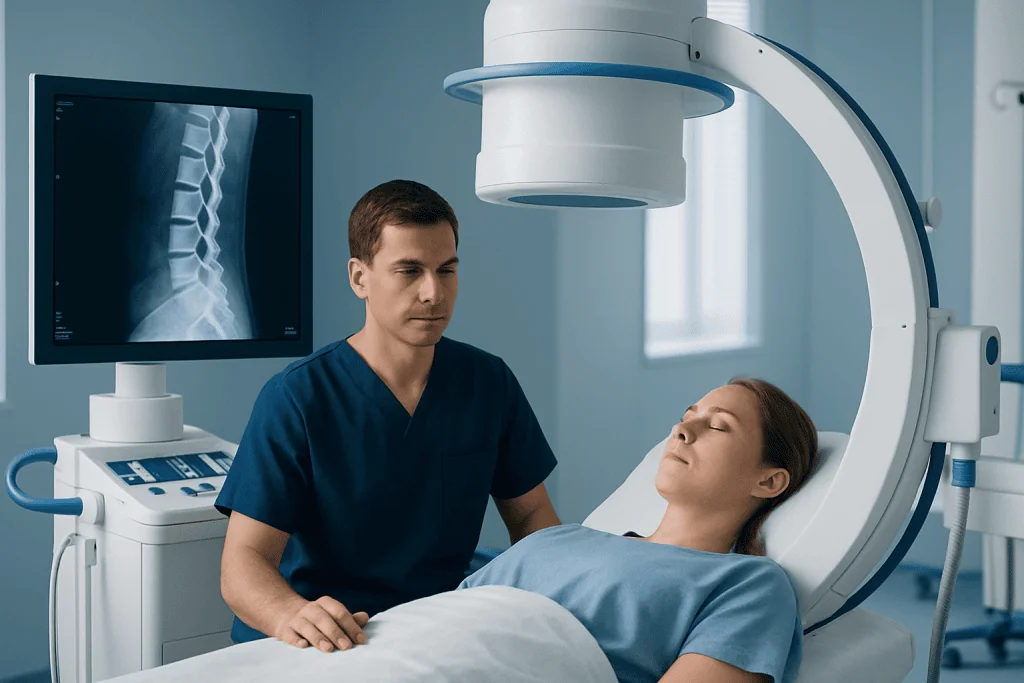
Most people looking for a spine surgeon have lived with persistent back or neck pain, arm or leg pain, numbness, weakness or walking difficulty for some time. Surgery is rarely the first treatment for these problems. It is usually considered after clinical examination, imaging and, where appropriate, a proper trial of non-surgical care such as physiotherapy, medication or injections. Our guide on choosing between surgery and non-surgical treatment covers that earlier decision in detail.
Surgeons move faster when imaging shows a structural problem that clearly explains the symptoms, significant nerve compression, instability, deformity, fracture, infection or a tumour-related condition, and faster still when there is progressive weakness or loss of function. Those clinical judgements belong to the examining doctor, and they shape which kind of surgeon you need.
One useful test of quality applies at this stage: a careful spine surgeon should be willing to tell you that surgery is not the right answer, or not the right answer yet. A centre that recommends an operation to every enquiry is not doing assessment; it is doing sales.
Neurosurgeon or orthopaedic spine surgeon?
Both neurosurgeons and orthopaedic surgeons perform spine surgery, and the overlap between them is now large. In broad terms, neurosurgery training centres on the nervous system: the spinal cord, nerve roots and conditions such as tumours within the spinal canal, while orthopaedic spine training centres on the skeleton, alignment and deformity. In practice, an experienced spine surgeon from either background handles the common degenerative operations well.
What matters more than the title is subspecialisation. Ask what proportion of the surgeon’s practice is spine surgery, and within that, how often they treat your specific condition. A surgeon who operates on the spine daily, with a case mix that includes problems like yours, is a stronger match than a general surgeon of either specialty who operates on the spine occasionally.
For complex cases, intradural tumours, severe deformity, combined problems, the strongest answer is often not one surgeon but a team, where neurosurgical and orthopaedic expertise sit in the same hospital and can plan together.
Matching the surgeon to your case

You are in a good position to make this choice when your symptoms clearly affect your daily life, conservative treatment has not given enough relief, and your examination findings match what the imaging shows. That last point is important: spine scans in adults frequently show age-related changes that cause no symptoms, so the right surgeon treats the patient, not the picture.
Case complexity should drive the match. First-time surgery for a single-level disc herniation is a different undertaking from revision surgery after a previous operation, multi-level disease, poor bone quality or deformity. If your case is complex, prioritise centres with advanced imaging, intraoperative technology and multidisciplinary review over any individual name.
Being able to share clear records before travel also matters. Recent MRI or CT scans, radiology reports, previous treatment history and an honest description of your symptoms allow a meaningful remote review. Without them, any preliminary opinion is guesswork.
What to check about the surgeon
When you speak with a surgeon or receive a treatment proposal, these are the questions that separate marketing from substance:
- Training and focus. Is the surgeon a neurosurgeon or orthopaedic surgeon, and is spine surgery the core of their practice?
- Case mix. How often do they treat your specific condition, and how often with the specific technique being proposed?
- The alternative. Can they explain what happens if you do not have surgery, and which non-surgical options remain?
- Technique reasoning. Why this approach, minimally invasive or open, decompression alone or with fusion, rather than another? What are the trade-offs?
- Limits. What will surgery probably improve, what may it not change, and which of your symptoms are least likely to respond?
- Complication planning. Who manages problems if they arise during your stay, and what is the plan if you have already flown home?
- Continuity. Will the surgeon you speak to be the surgeon who operates, and who handles your follow-up?
A confident, well-organised surgeon answers these questions without irritation. Evasive or absolute answers, especially any suggestion that an outcome is certain, are a reason to keep looking.
What to check about the hospital
The surgeon is one part of a system. For spine surgery, the system should include modern MRI and CT imaging, an anaesthesia team experienced with spinal procedures, intensive care capacity for complex cases, intraoperative imaging or neuromonitoring where clinically appropriate, and physiotherapy that begins during the admission, not after it.
Multidisciplinary structure matters, too. Good spine programmes bring neurosurgery, orthopaedics, radiology, pain medicine, neurology and rehabilitation into the same planning process. For an international patient with limited time in the country, this coordination is not a luxury: it is what allows assessment, decision and treatment to happen efficiently and safely within one stay.
Finally, check the practical layer: interpreter availability, how the hospital communicates with patients abroad, and how written discharge instructions are provided. These details predict how well your care will travel home with you.
Is there a “best” surgeon or a “best” country?
You will see lists claiming to name the best neurosurgeon in Turkey or ranking countries for spinal surgery. Treat them with caution. There is no independent, standardised ranking of individual spine surgeons anywhere in the world, and many published lists are advertising. Surgical quality varies between surgeons and hospitals far more than it varies between countries; excellent spine surgery exists in Turkey, as it does in many other countries, and so does mediocre spine surgery.
Turkey’s genuine strengths for international patients are structural: large hospital groups with high surgical volumes, modern equipment, established international patient departments and short waiting times. Those strengths still have to be verified at the level of the specific hospital and the specific surgeon, using the questions above. “Best” is not a name on a list: it is the closest match between a surgeon’s proven experience and your particular spine.
Online evaluation before travel
A remote review of your records is the sensible first step before committing to travel. Based on your history, symptom description and imaging, a spine team can usually indicate whether surgery looks likely, which specialist should assess you, whether fresh imaging will be needed on arrival, and how long a stay to plan for.
Two honest limits apply, and a trustworthy centre will state both. First, no final surgical decision can be made remotely; it requires in-person examination. Second, a remote opinion is only as good as the records behind it, so incomplete imaging means a provisional answer. Be wary of any provider that confirms an operation, a date and a fixed plan from photographs of old scans.
It is reasonable to ask who exactly will review your records, a surgeon, or an administrator, and whether your case will be seen by more than one department if the diagnosis is not straightforward.
Before the operation
Once you are in Turkey and surgery is being considered, expect a full consultation: neurological and musculoskeletal examination, review of your imaging on screen with you, and a clear discussion of surgical and non-surgical options. Depending on your age, health and the planned procedure, the team may request blood tests, cardiac assessment, updated imaging and an anaesthesia review.
Tell the team about every medicine you take, including blood thinners and supplements. Any change to medication before surgery is the treating doctor’s decision, made with knowledge of your full history, never adjust anything on your own. Smoking, uncontrolled diabetes and osteoporosis can affect surgical planning and healing, so raise these openly; they change the plan, not the welcome.
You will also be asked to sign consent forms. Read them properly and ask about anything unclear: our guide on surgery consent in Turkey explains what the forms cover and which questions to ask before signing.
What happens during spine surgery
The operation itself depends entirely on the procedure. Most spine surgery is performed under general anaesthesia. Incision size, the use of implants, and technologies such as intraoperative imaging, navigation or nerve monitoring vary with the diagnosis, the spinal level and the surgeon’s plan, which should have been explained to you in plain language beforehand.
Afterwards you are monitored in a recovery area, then transferred to your room or, for complex cases, to a higher level of care. Early priorities are pain control, neurological checks and getting you moving as soon as it is safe. For many procedures, walking begins within the first day; for others, mobilisation is more gradual. Your team sets the pace based on the operation and your response.
Hospital stay and discharge
Stays range from short observation after a straightforward decompression to several days after fusion, deformity correction or revision surgery. Before discharge, the team confirms that your vital signs are stable, pain is manageable, the wound is behaving, and you can move safely at the level expected for your procedure.
Your discharge pack should be written, specific and portable: wound care, medication guidance, activity limits, physiotherapy instructions, follow-up timing, and the specific changes your team wants reported during recovery. As an international patient, insist on receiving this in a language you read comfortably: you will rely on it after you fly home.
Discharge planning also covers travel readiness: whether you need airport assistance, whether a companion should stay with you, and when flying is medically reasonable for your particular operation. These answers differ between a microdiscectomy and a multi-level fusion, so ask for yours specifically.
Recovery timeline
Recovery is highly individual. It depends on the diagnosis, the procedure, the number of levels treated, your general health and whether compressed nerves need time to settle. The table below is a general shape only; your surgeon’s plan for your case takes precedence.
| Timeframe | What to expect |
|---|---|
| First 24 hours | Monitoring, pain control, neurological checks and assisted movement. Many patients begin gentle mobilisation if the procedure allows. |
| First week | Wound care, progressive walking and adjustment to everyday movements. Fatigue and soreness are normal; travel timing depends on the procedure and the surgeon’s advice. |
| Weeks 2–4 | Gradual increase in light activity, a follow-up review, and physiotherapy where planned. Sitting tolerance and mobility usually build step by step. |
| Months 1–3 | Ongoing healing and strengthening. Restrictions are eased progressively, but heavy lifting and strenuous activity typically remain limited. |
| Longer term | Pain, stability, posture and nerve function can continue to evolve over months. Nerve-related symptoms often improve slowly, and some may improve only partially. |
Because most international patients travel home before recovery is complete, ask before surgery how remote follow-up will work: who reviews your progress, through which channel, and how your local doctor or physiotherapist can be kept informed.
What to avoid after surgery
Restrictions depend on the operation, but common themes include avoiding heavy lifting, sudden twisting, repetitive bending, high-impact exercise, long periods of sitting without breaks, and an early return to physically demanding work. If a brace has been prescribed, wear it exactly as instructed, no more, no less.
Do not change or stop prescribed medicines on your own, and do not remove dressings outside the guidance you were given. Smoking and nicotine deserve particular attention because they can impair healing, especially after fusion procedures; discuss this honestly with your team before the operation, not after.
Gradual movement generally supports recovery better than prolonged rest. When you are unsure whether a specific activity is safe for your operation, ask your medical team rather than guessing, clear answers to exactly these questions are one of the marks of a well-run spine programme.
Risks and possible complications
Every spine operation carries risk, and the profile depends on the condition, the spinal level, the approach, your health and whether this is first-time or revision surgery. General surgical risks include bleeding, infection, anaesthesia-related problems, blood clots and wound issues. Procedure-specific risks include nerve irritation or injury, spinal fluid leak, incomplete symptom relief, recurrence of disc problems, implant-related issues where implants are used, and nonunion after fusion. Some patients improve only partially even when the operation goes exactly to plan.
Patients often ask specifically about L4–L5 surgery, because this level of the lower back is one of the most commonly operated. The risk at L4–L5 is not fixed: a single-level microdiscectomy there is a different proposition from a fusion, and a first operation is different from a revision. The nerve roots at this level affect leg strength and sensation, which is why surgeons discuss nerve-related risks carefully for lumbar procedures. What you should expect from any surgeon is a specific, personal risk discussion, not a generic reassurance and not a number pulled from the internet.
This is also why surgeon choice is a safety decision. Careful diagnosis, realistic expectation-setting, appropriate hospital resources and a clear plan for managing complications all reduce avoidable risk, reputation alone does none of these things.
Results and expectations
Spine surgery usually aims to relieve pressure on nerves or the spinal cord, reduce pain, restore stability, protect function or correct a structural problem. What it achieves in your case depends on how long symptoms have been present, whether nerves are already damaged, the precise diagnosis, previous operations and your overall health.
Different symptoms respond differently. Leg or arm pain from nerve compression often responds differently from long-standing numbness or weakness, which may recover slowly or incompletely. In some cases the primary goal is preventing deterioration rather than removing every symptom. An ethical surgeon says this out loud before you consent, and never promises a perfect outcome.
Some patients continue to need medication, physiotherapy or lifestyle adjustments after surgery, and a small number need further treatment later. Hearing these possibilities before the operation is a sign you have chosen well.
Travel planning for spine surgery
Plan for three phases: assessment days before surgery, the admission itself, and a recovery period in Turkey before you are cleared to fly. Ask for realistic estimates of each for your specific procedure, and whether a companion is recommended, for complex operations it often is.
Bring your passport, imaging on disc or digital link, radiology and specialist reports, a complete medication list and details of allergies and previous surgeries. For the flight home, discuss seating, walking aids and movement during the flight with your team; many surgeons also recommend compression measures for long flights after surgery, explained in our guide on compression socks for flying after surgery. The decision on when flying is appropriate always belongs to the treating team.
How cost works
You will not find fixed prices for spine surgery here, because honest pricing for spine care cannot exist before a medical review. What a quotation reflects: the diagnosis, the complexity of the operation, the spinal region and number of levels treated, whether implants are needed, the expected length of stay, operating room technology, and whether additional specialties or rehabilitation are involved.
Scope matters as much as the figure. Ask precisely what a quotation includes, surgeon and anaesthesia fees, hospital services, inpatient care, follow-up during your stay, and what it excludes, such as pre-travel testing, additional imaging, pathology, medication after discharge, rehabilitation, accommodation, flights or the management of unexpected findings. Ask how a longer stay or an extra test would be handled. A provider that answers these questions in writing, before you travel, is telling you something important about how it works.
Why choose Acibadem
Acibadem operates a network of hospitals in Turkey with the infrastructure spine surgery depends on: advanced diagnostic imaging, modern operating theatres, anaesthesia and intensive care services, and inpatient rehabilitation support. Spine cases are planned within multidisciplinary teams that can bring neurosurgery, orthopaedics, radiology, pain medicine and physiotherapy into a single pathway, which matters most when a diagnosis is complex, a previous operation has failed, or a limited stay means assessment and treatment need to run efficiently.
For international patients, the practical layer is built in: record review before travel, interpreter services, transfer assistance, accommodation guidance and structured remote follow-up after you return home. The aim is a pathway you can understand and question at every step, not just an operation date.
Medical review and disclaimer
This guide has been medically reviewed by the Acibadem International medical team. It exists to help you weigh the choice of surgeon and hospital for spine surgery in Turkey.
It is general educational information. It does not replace a consultation, physical examination, imaging review or individualised recommendation from a qualified physician. Not every patient with back or neck symptoms needs surgery, and not every patient is suited to travel-based treatment; the right approach for you can only be determined after physician evaluation of your symptoms, history, examination findings and imaging.
Step by step
- Initial contact. You describe your spinal problem, current symptoms and treatment goals to the international patient team.
- Medical record submission. You share reports, MRI or CT scans, previous operation details, your medication list and symptom history.
- Preliminary medical review. Your records are reviewed to identify the appropriate spine specialist and flag any missing information.
- Treatment plan and quotation. You receive a preliminary opinion, the likely pathway, an estimated stay duration and a quotation based on the available records, with its scope stated.
- Travel planning. Flights, accommodation, companion needs and transfers are planned around the assessment and surgery schedule.
- Arrival. Transport and hospital coordination are arranged to match your appointments.
- In-person consultation. The spine specialist examines you, reviews your imaging and confirms whether surgery is appropriate, or recommends an alternative.
- Pre-operative tests. Blood tests, anaesthesia assessment and updated imaging are completed as needed.
- Treatment. Your procedure is performed according to the confirmed surgical plan and hospital safety protocols.
- Hospital stay. You are monitored, begin mobilisation when appropriate, and receive pain control and nursing support.
- First control. The team reviews your wound, mobility and early recovery before discharge planning.
- Discharge and travel clearance. You receive written instructions, medication guidance, follow-up timing and advice on when flying is appropriate.
- Remote follow-up. Your recovery is followed through remote communication and scheduled updates after you return home.
Your checklist
- Passport or other travel identification
- Recent MRI, CT, X-ray or other relevant imaging, with radiology reports
- Specialist consultation notes and previous treatment records
- Detailed medical history, including chronic conditions
- Current medication list, including blood thinners and supplements
- Known drug, food or material allergies
- List of previous surgeries and hospitalisations
- Description of current symptoms and how long they have been present
- Records of prior physiotherapy, injections or pain treatment
- Recent blood test or cardiac evaluation results, if available
- Contact details for your local doctor for ongoing follow-up
- Your written list of questions about surgeon experience, technique, risks and follow-up
Key takeaways
- Choose a spine surgeon by matching their regular case mix to your specific diagnosis, not by ranking lists or reputation alone.
- Both neurosurgeons and orthopaedic spine surgeons perform spine surgery well; subspecialisation and case volume matter more than the title.
- The hospital around the surgeon, imaging, anaesthesia, intensive care, rehabilitation, is part of your safety, not a detail.
- A surgeon willing to advise against surgery, or to explain what an operation will not fix, is showing you quality.
- Confirm before travel who reviews your records, who operates, what the quotation covers and how follow-up works after you fly home.
Frequently asked questions
How do I choose the right surgeon for spine surgery in Turkey?
Match the surgeon to your diagnosis. Ask about their training, how much of their practice is spine surgery, how often they treat your specific condition, and what hospital resources support them. A good surgeon also explains non-surgical alternatives, states the limits of what surgery can achieve, and describes how follow-up works after you return home.
Which surgeon is best for spine surgery: a neurosurgeon or an orthopaedic surgeon?
Both perform spine surgery, and for common degenerative operations an experienced subspecialist from either background is appropriate. Neurosurgical training centres on the spinal cord and nerves, orthopaedic training on the skeleton and alignment. For complex cases such as tumours or severe deformity, the strongest option is often a hospital where both specialties plan together.
Who is the best neurosurgeon in Turkey?
There is no independent ranking of individual surgeons, and lists claiming to name the best are usually advertising. A more useful question is which surgeon regularly and successfully treats your specific condition, in a hospital with the imaging, intensive care and rehabilitation support your case needs. That answer differs from patient to patient.
Which country has the best spinal surgeons?
No country holds that title. Surgical quality varies far more between individual surgeons and hospitals than between countries. Turkey offers high-volume spine centres, modern equipment and established international patient services, but you should still verify the specific surgeon and hospital using the same questions you would ask anywhere.
How risky is L4–L5 surgery?
It depends on the procedure and the patient. L4–L5 is one of the most commonly treated levels of the lower back, and a single-level microdiscectomy carries a different risk profile from a fusion or a revision operation. General risks include infection, bleeding, nerve irritation or injury, spinal fluid leak and recurrence. Your surgeon should discuss the risks of your specific operation with you personally.
How long do I need to stay in Turkey for spine surgery?
It varies with the operation and your recovery. Plan for assessment days before surgery, the hospital admission itself, and a recovery period before you are cleared to fly. Simpler procedures may allow a relatively short stay, while fusion, deformity or revision surgery usually requires longer. The care team can estimate this after reviewing your records.
Will I definitely feel completely better after spine surgery?
No ethical surgeon will promise that. Many patients improve meaningfully, but results depend on the diagnosis, how long nerves have been compressed, and your overall health. Nerve-related symptoms such as numbness or weakness may improve slowly or only partially, and some patients continue to need physiotherapy or medication afterwards.
What affects the cost of spine surgery in Turkey?
The diagnosis, the complexity of the operation, the number of spinal levels treated, whether implants are needed, the length of hospital stay, and any additional tests or rehabilitation. The scope of the quotation matters just as much, ask in writing what is included, what is excluded, and how unexpected findings or a longer stay would be handled.
Add us as a Preferred Source to see more of our trusted health content across Google Search, AI Overviews and Discover.

Update history
- PublishedJune 22, 2026
- Medical review approvedAugust 31, 2026
- Last content updateAugust 31, 2026
References2
- Lumbar decompression surgery: NHS nhs.uk
- Herniated disk: MedlinePlus medlineplus.gov
More Patient Guides

HoLEP in Turkey: How It Compares With TURP and What Recovery Involves
HoLEP in Turkey treats enlarged prostate tissue with laser enucleation; learn how it compares with TURP, recovery, travel and follow-up.

Porcelain Veneers in Turkey: Who Is Suitable and How Many Visits Are Needed?
Porcelain veneers in Turkey can enhance tooth shape and colour in two visits for suitable patients after a personalised dental assessment.

How to Prepare for a Sedation Procedure in Turkey
Prepare safely for a sedation procedure in Turkey with guidance on fasting, medicines, travel, recovery and follow-up.

Treatment Delays in Turkey: What Happens If Tests or Recovery Change Your Schedule
Treatment delays in Turkey can happen if tests or recovery change your plan. Learn how to manage appointments, travel, accommodation and follow-up.