

Managing Valuables and Personal Belongings in a Turkish Hospital

Bring only what you need: identification, medical papers, a phone and charger, basic toiletries and a small amount of money. Leave expensive jewellery and extra electronics elsewhere. Ask the ward team about storage as soon as you arrive, choose one trusted person to hold valuables during procedures, and keep a short written list of everything you brought so you can check it at discharge.
Where does your passport go when you are wheeled off for surgery? Who holds your phone and wallet while you are under sedation? These are the small questions that keep international patients awake the night before admission, and they are easy to settle in advance. Managing valuables and personal belongings in a Turkish hospital comes down to a few habits: pack light, copy your documents, name one person to hold your valuables, and ask the ward team about storage before you need it.
This guide walks you through each of those habits in detail. It covers what to bring and what to leave behind, how hospital belongings policies usually work, what happens during procedures and room transfers, and what to do if something goes missing. It sits alongside our broader guide on keeping valuables and medical documents safe during treatment travel, which covers airports, hotels and transfers; here, the focus is the hospital itself.
At a glance
- Best approach: Bring only essential items and keep valuables to a minimum
- Documents: Keep your passport, medical papers and payment documents organised, with copies stored separately
- Storage: Ask the ward team about in-room or hospital storage options on arrival, practices vary by ward and room type
- Procedures: Decide before surgery or sedation exactly who will hold your phone, wallet and jewellery
- Companion role: One trusted person should manage valuables, not several people at once
- Support: International patient teams and interpreters can help you ask practical questions in your language
Why belongings planning matters during your hospital stay
When you travel to Turkey for treatment, your attention naturally goes to appointments, tests, surgical plans and recovery. The practical details, where your passport sits, how much cash you are carrying, what happens to your suitcase, can feel trivial by comparison. Yet these details shape how secure and settled you feel, and they are exactly the things that become hard to manage once you are tired, fasting or recovering from anaesthesia.
A hospital is a busy, shared environment. Nurses, doctors, cleaning teams, porters, interpreters and visitors move through patient areas throughout the day. Rooms change, beds move, and you may pass through several departments in a single morning. Managing valuables and personal belongings in a Turkish hospital is not about distrust; it is about reducing the number of moments when an item can quietly separate from you.
At Acibadem, international patient services and interpreters can guide you on local practices, visitor arrangements and practical storage questions. They can translate ward instructions and help you confirm where an item should go. What they cannot do is take over responsibility for your valuables. Your passport, money, jewellery and devices remain your responsibility, or that of the companion you choose. Planning ahead makes that responsibility light rather than stressful.
How hospital belongings policies usually work
Belongings policies vary between hospitals, wards and room types, so the honest answer to “what is the policy?” is always: ask on arrival. That said, most policies follow the same logic, and knowing it helps you ask better questions.
Hospitals generally encourage patients to send valuables home or keep them with a companion, because a patient room is not designed as a secure vault. Where storage exists, a lockable cupboard, a room safe, or a ward-level arrangement, staff will tell you how it works and what it is suitable for. Some items, such as very large sums of cash or irreplaceable jewellery, may simply be inappropriate to keep in any hospital setting, and staff may say so plainly.
Nursing staff also have a role. If you arrive with valuables and no companion, tell your nurse rather than hiding items around the room. In many hospitals, staff will document what you have with you, advise on the safest available option, and make sure items removed for a procedure are labelled and returned. Documentation protects both you and the team: a written or witnessed record of what was handed over avoids uncertainty later.
One of the recurring security challenges in any hospital, anywhere in the world, is the sheer flow of people through open areas, corridors, waiting rooms, cafeterias. Most losses are not dramatic thefts; they are items left on chairs, forgotten in bathrooms or packed into the wrong bag during a transfer. The habits in this guide are designed around that reality. If you ever have a genuine security concern rather than a misplaced item, our guide on how to report a safety concern in a Turkish hospital explains who to speak to and how.
What to bring and what to leave behind
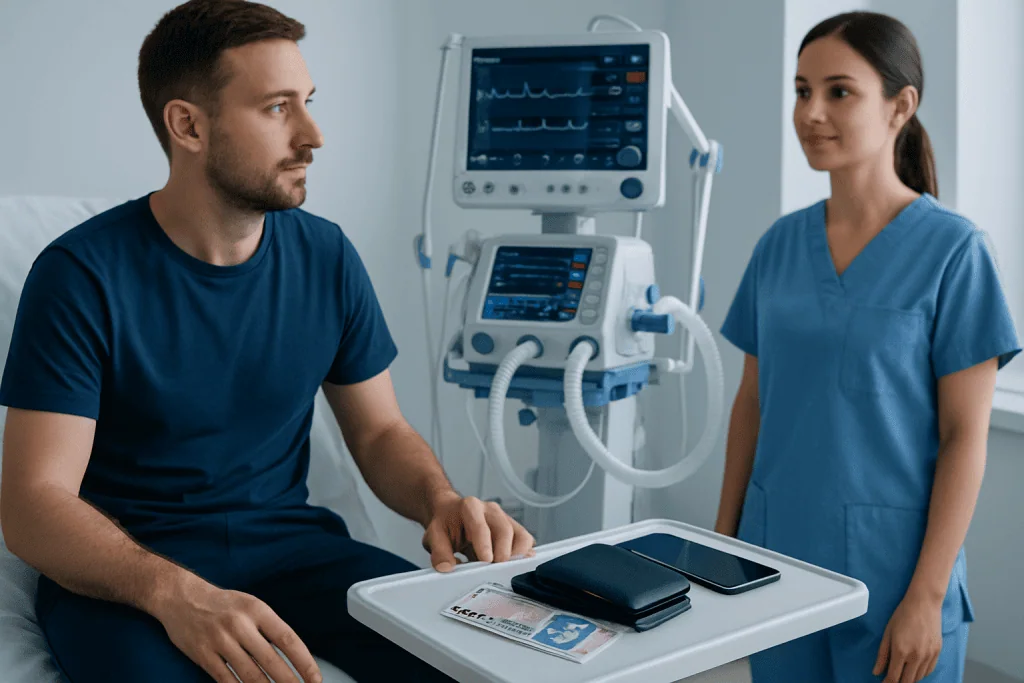
When it comes to managing valuables and personal belongings in a Turkish hospital, the safest rule is simple: bring what you need, not everything you own. For most stays, that means identification, medical documents, a phone and charger, basic toiletries, comfortable clothing, any approved personal medical items, and a small amount of money or one payment card. If you are staying in a hotel before or after treatment, leaving your main suitcase there, where appropriate and secure, can shrink the pile of things you must track on the ward.
Leave behind anything expensive, hard to replace or emotionally significant: fine jewellery, luxury watches, large amounts of cash, spare electronics, sentimental keepsakes. If you wear a wedding ring, religious jewellery or another meaningful item, ask your care team in advance whether it must be removed for imaging, surgery or other procedures. Knowing the answer early lets you plan calmly rather than making a rushed decision at the theatre door.
Useful items to pack in your hospital bag include:
- Your passport, plus a copy kept separately
- Appointment confirmations and hospital contact details
- Insurance, payment or guarantee documents if applicable
- Mobile phone, charger and a plug adapter for Turkey
- Glasses, hearing aids or dental appliances in labelled cases
- A small toiletry bag and non-slip footwear
- A simple change of clothes for discharge
- A short written list of the valuables you are bringing
That last item matters more than it looks. A list on your phone or a slip of paper takes two minutes to write and makes discharge packing, room transfers and any loss report far easier.
Keeping passports, documents and payment items secure

Your passport is your most important belonging while receiving care abroad. You will need it for hospital registration and identity checks, and possibly for accommodation, banking, flight changes or consular support. Turkish hospitals verify identity carefully at admission and before procedures: our guide to patient identification checks in Turkish hospitals explains what to expect, so keep the passport itself in one consistent place rather than moving it between bags.
Before you travel, make both digital and paper copies of your passport, your visa or entry stamp if relevant, insurance papers, prescriptions and emergency contacts. Store digital copies in a secure cloud account or a password-protected folder, and keep paper copies separate from the originals. Copies do not replace a lost passport, but they make consular replacement and hospital administration considerably smoother.
Handle payment items with the same discipline. Carry only the cash you reasonably need for small personal expenses such as snacks or taxis, and one or two payment cards rather than your full wallet. For any hospital-related payment or deposit, use the hospital’s official payment desks and channels only. What a treatment costs depends on your specific plan and is confirmed through official quotes and invoices, never hand cash to an individual, and ask the international patient services team if you are unsure which desk to use.
Managing phones, laptops and other electronics
Your phone is your link to family, travel plans, banking, translation apps and hospital coordination, so treat it as your second most important item after your passport. Keep it charged, protect it with a strong passcode, enable device tracking if your phone offers it, and never leave it unattended in waiting rooms, cafeterias or transport vehicles. Before any procedure, ask your nurse where the phone should go and who can retrieve it for you afterwards.
Laptops, tablets and cameras are reasonable to bring if you are staying several days or working remotely during recovery, many patients use quieter stretches productively, as covered in our guide to managing time between appointments in Turkey. But every extra device is an extra thing to lose during a room change or discharge. Label chargers and cables, keep devices in one bag, and ask honestly whether your phone alone could do the job for a short stay.
Two practical notes. First, Turkey uses Type C and Type F plugs with a standard voltage of 230V, so bring a suitable adapter if your devices use a different plug. Second, if you rely on medical electronics, a CPAP machine, a mobility-aid charger, hearing aid accessories, tell your care team in advance so they can advise on safe use in the hospital environment and make sure these items are treated as essentials rather than optional extras.
During tests, surgery or room transfers
Procedures and transfers are the moments when belongings most often separate from their owners. Depending on the test or treatment, you may be asked to remove clothing, jewellery, glasses, contact lenses, hearing aids, dentures or hair accessories. Always ask two questions before handing anything over: where will this be kept, and when will it come back to me?
If you have a companion, agree in advance that they will take your phone, wallet, passport and jewellery before surgery or sedation begins. If you are travelling alone, raise this with the ward team early, ideally at admission, not on the morning of the procedure, and ask what the safest available arrangement is. Do not assume that items left on a bedside table will follow you to another department; they usually stay where they are.
Build a small ritual around every move. Before leaving your room for imaging, endoscopy or theatre, run a quick mental check: passport and wallet secured, phone accounted for, glasses or hearing aids in their cases, luggage identified. When you return, especially if you are drowsy, check the same short list calmly, or ask your companion to do it for you. Personal aids like dentures and hearing aids deserve special care: they are small, easily wrapped in bedding or tissues, and genuinely disruptive to lose.
How companions can help without creating confusion
A companion is the single most useful safeguard for your belongings, particularly when you are fasting, sedated or moving between departments. The key is to choose one trusted person as your valuables manager rather than letting several relatives or friends handle items in turn. One person, one bag, one clear answer to “where is my passport?”
Agree a simple system before admission. For example: your companion keeps your passport, wallet and jewellery in one designated bag at all times, while you keep your phone and glasses with you when appropriate. Whenever your companion leaves the hospital, for the hotel, a restaurant or the airport, confirm out loud what they are taking and what stays. If your companion will be staying overnight, it helps to know the ward’s arrangements in advance; see our guide to overnight companion rules in Turkish hospital rooms.
If language is a concern, Acibadem interpreters and patient coordinators can help you and your companion clarify instructions about admission, room changes, discharge timing and visitor arrangements. They can also help you ask practical questions, whether a particular item should stay in the room, go with your companion, or be stored elsewhere, so nothing is decided by guesswork.
If something is missing or you need help
If you cannot find an item, pause before you worry. Most “lost” belongings turn up in bedding, drawers, procedure clothing bags, bathrooms, companion bags or transport areas. Check the last place you remember using the item, then tell your nurse or patient coordinator promptly: the sooner staff know, the easier it is to trace an item through recent room or department changes.
Give a clear description: what the item is, its colour, the brand if relevant, where and when you last saw it, and whether you have recently moved rooms or visited another department. If your written valuables list includes the item, show it. Staff can check with housekeeping, the previous department and any lost-property process the hospital runs.
Some losses need faster, parallel action. For a lost payment card, contact your bank straight away to block it. For a lost phone, use device tracking if you enabled it and consider remotely locking the device. For a lost passport, contact your country’s embassy or consulate in Turkey about replacement or emergency travel documents; your paper and digital copies will speed this up. None of these steps require you to wait for the hospital search to finish, run them alongside it.
Step by step
- Pack a hospital essentials bag. Before admission, separate hospital essentials from your main suitcase: documents, phone and charger, toiletries, glasses or hearing aid cases, comfortable clothing and only a small amount of cash.
- Make copies of key documents. Keep digital and paper copies of your passport, insurance papers, prescriptions and hospital contacts, stored separately from the originals.
- Write a valuables list. Note every valuable item you are bringing, phone, cards, jewellery, devices. Two minutes now saves confusion at every transfer and at discharge.
- Choose a valuables manager. If you have a companion, agree that one person holds your wallet, passport and jewellery during procedures. If you are alone, ask the ward team about secure options before your first procedure, not on the day.
- Ask about storage on arrival. During admission or once you reach your room, ask exactly where personal items should be kept. Practices vary by ward, room type and treatment plan, so confirm rather than assume.
- Prepare for procedures in advance. Remove valuables before surgery, imaging or sedation, place personal aids in labelled cases, and confirm who will hold each item until you return.
- Check belongings after every transfer. Whenever you change rooms or departments, run through your short list: passport, wallet, phone, charger, glasses, hearing aids, medication list, discharge clothes.
- Pack slowly before discharge. Discharge days are busy with paperwork and transport. Use your checklist, open every drawer, check the bathroom and charging points, and ask your companion or coordinator to sweep the room with you before leaving.
Your checklist
- Passport, visa or entry documents, plus copies stored separately
- Hospital appointment details and emergency contacts
- Insurance, payment or guarantee documents if applicable
- Mobile phone, charger and Turkey-compatible adapter (Type C/F, 230V)
- Glasses, hearing aids, dentures or retainers in labelled cases
- Small amount of cash and one or two payment cards
- Basic toiletries and comfortable clothing
- Medication list and approved personal medical devices
- A written list of the valuables you brought
- Contact details for your hotel, companion and patient coordinator
Key takeaways
- Bring only essential valuables; leave jewellery, large cash amounts and spare electronics in a safer place.
- Keep your passport, payment documents and medical papers organised, copied and in one consistent location.
- Belongings policies vary by ward and room type, ask the team on arrival rather than assuming, and tell your nurse if you have valuables and no companion.
- Name one trusted companion as your valuables manager for procedures, sedation and transfers.
- Keep a short written list of what you brought, and use it at every room change and before discharge.
- If something goes missing, report it promptly and act in parallel: block lost cards, track lost phones, contact your embassy about a lost passport.
Frequently asked questions
What are the policies for hospital patients regarding their belongings?
Policies vary between hospitals and even between wards, but the common thread is that patients are encouraged to keep valuables to a minimum, use whatever secure storage the ward offers, and hand irreplaceable items to a trusted companion. Ask at admission how storage works in your specific room and what happens to belongings during procedures, confirming directly is always more reliable than assuming.
What should nursing staff do if a patient has valuables with them?
In most hospitals, nursing staff will advise the patient on the safest available option, document any valuables the patient cannot keep on them, label items removed for procedures, and make sure they are returned afterwards. If you arrive with valuables and no companion, tell your nurse openly so this process can happen, hiding items around the room is the least safe option.
Should I bring my passport to the hospital in Turkey?
Yes. As an international patient you will need it for registration and identity checks. Once admission is complete, keep it in one consistent, secure place rather than carrying it around, and keep digital and paper copies stored separately from the original.
What should I do with my phone during surgery?
Ask your nurse before the procedure where your phone should be kept. If you have a companion, they can usually hold it along with your wallet and other valuables. Protect the phone with a passcode, enable tracking if available, and confirm who will bring it back to you after you wake.
Can I wear jewellery during my hospital stay?
Simple jewellery may be acceptable in some situations, but you may be asked to remove it for surgery, imaging or certain treatments. The safest choice is to leave valuable pieces at home or with a trusted companion. If you wear a wedding ring or religious jewellery, ask your care team early whether it must come off, so you can plan calmly.
How much cash should I bring?
Only a small amount for personal expenses such as snacks or taxis, plus one or two payment cards. For hospital-related payments, always use the hospital’s official payment desks and channels, and ask the international patient services team if anything is unclear. Avoid keeping large sums of cash in your room or bag.
What if I lose something in the hospital?
Tell your nurse or patient coordinator as soon as you notice, with a clear description of the item and where you last saw it, including any room or department changes. Most items turn up in bedding, drawers, procedure bags or bathrooms. For lost cards, phones or passports, act in parallel: block the card, track the phone, and contact your embassy or consulate about passport replacement.
What is one of the biggest security issues in hospitals?
The open, high-traffic nature of hospital buildings. Corridors, waiting rooms and cafeterias see a constant flow of staff, patients and visitors, which makes unattended belongings easy to misplace and hard to trace. Most losses are accidental rather than theft, which is why the practical answer is behavioural: fewer items, one designated holder, and a quick check after every transfer.
Add us as a Preferred Source to see more of our trusted health content across Google Search, AI Overviews and Discover.

Update history
- PublishedJune 8, 2026
- Medical review approvedSeptember 13, 2026
- Last content updateSeptember 12, 2026
References1
More Patient Guides

When a Hospital Stay in Turkey Becomes Longer Than Planned: What to Arrange
If your hospital stay in Turkey is longer than planned, arrange medical updates, accommodation, travel changes, insurance and support for your companion.

Waiting for Test Results in Turkey: How to Use Time Between Appointments
Waiting for test results in Turkey is easier with a clear plan for appointments, rest, records, questions and support in Istanbul.

Unexpected ICU Stay in Turkey: What Patients and Families Should Expect
Unexpected ICU stay in Turkey: learn what patients and families can expect, from communication and visiting to care updates and travel support.

How to Manage Special Diets During Medical Travel in Turkey
Special diets during medical travel in Turkey are easier to manage when you share your needs early, confirm meals and carry safe…