

Staying Connected During Treatment in Turkey: SIM Cards, Wi-Fi, and Useful Apps

Land in Turkey with one connection method already working — usually roaming or a pre-installed eSIM. Switch to a local SIM later if your stay is long or you need a Turkish number. Download maps, translation and messaging apps before you fly, keep sensitive logins off public Wi-Fi, and save key contacts on paper as well as your phone.
Will your phone work the moment you land in Istanbul? How will you message home after a long appointment day? These are small questions until you are tired, jet-lagged and standing in an arrivals hall with a dead signal bar. A little planning before you fly removes almost all of that friction.
Staying connected during treatment in Turkey is not difficult, but it rewards preparation. This guide walks through your realistic options — roaming, eSIM, local SIM cards and Wi-Fi — explains how to pick between them for a medical stay, and covers the apps and simple digital safety habits that make treatment days run more smoothly.
At a glance
- Best first step: Check whether your phone is unlocked and supports eSIM before you travel
- Simplest arrival setup: Roaming or a pre-installed eSIM that works the moment you land
- For longer stays: A local SIM from an official provider shop; bring your passport for registration
- Most useful apps: Maps with offline areas, translation, messaging, airline, taxi and note-taking apps
- Wi-Fi tip: Treat public Wi-Fi as a backup and keep banking and sensitive logins on mobile data
- Low-tech backup: Key contacts and addresses written on a paper card as well as saved in your phone
Why staying connected matters during treatment
When you travel for medical care, your phone stops being a convenience and becomes part of your logistics. You will use it to confirm transfers, find your way between accommodation and hospital, check appointment times, translate a menu or a pharmacy label, and reassure family at home. Staying connected during treatment in Turkey is, in practice, one of the easiest parts of the trip to get right — and one of the most stressful to leave to chance.
Turkey’s major cities have dense mobile coverage and widespread Wi-Fi. Airports, hotels, cafés and many hospital areas offer guest networks, and visitors can normally choose between roaming, an eSIM or a physical local SIM. The right choice depends on three things: how long you will stay, whether you need a Turkish phone number, and how much setup you want to handle yourself while you are recovering.
There is one more reason to plan this properly. If your treatment involves any recovery period, you will have days when you are tired and simply do not want to troubleshoot mobile settings, queue at a phone shop or hunt for a working network. Setting everything up before departure means the connection quietly works in the background while you focus on the reason you came. It also makes it easier for a companion to support you practically during treatment, because both of you can reach each other and the hospital at any point in the day.
Your connection options: roaming, eSIM, local SIM, and Wi-Fi
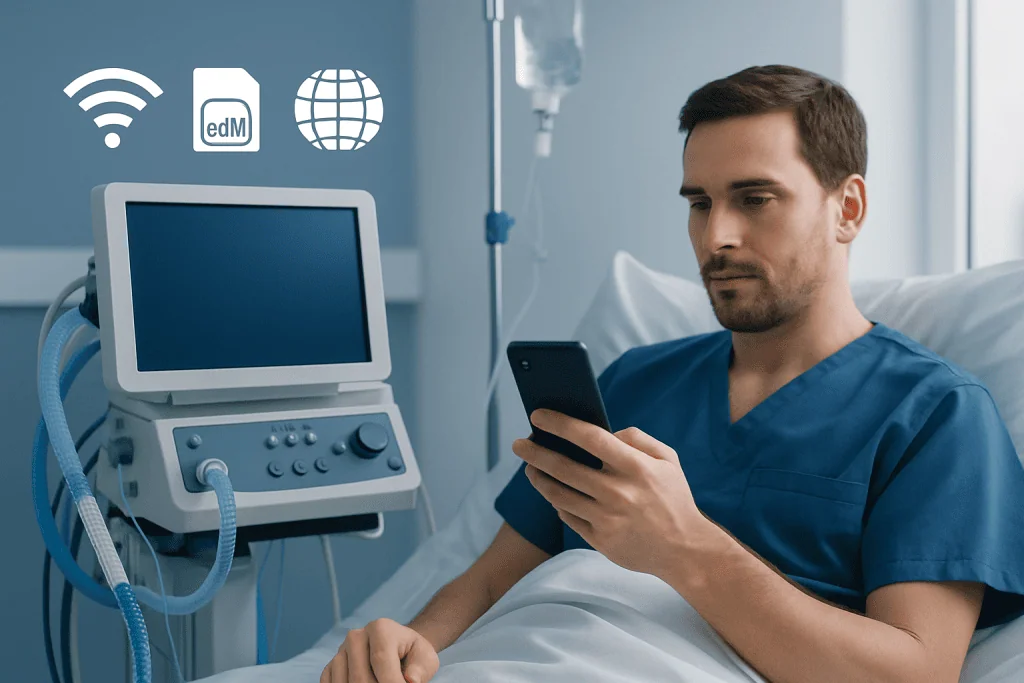
Roaming is the zero-effort option. Your home provider’s service usually works the moment you land, which matters when your first hour in Turkey involves finding a driver, messaging your coordinator and confirming a hotel address. The trade-off is cost: roaming in Turkey can be expensive with some providers, so check your operator’s rates and any travel add-ons before departure. Many patients use roaming purely as an arrival bridge, then switch to something cheaper within a day or two.
eSIM is often the best balance of convenience and value if your handset supports it. You buy a data plan online, install it at home over your own Wi-Fi, and activate it when you arrive. On a dual-SIM phone you can keep your home number live for calls, texts and verification codes while all your data runs through the Turkish or travel eSIM. This suits patients who mostly use data-based apps — WhatsApp, email, video calls — rather than local voice calls.
A physical local SIM makes sense for longer stays, or if you want a Turkish number for local calls, deliveries, drivers and accommodation hosts. Buy from an official shop of one of the main Turkish operators, at the airport or in the city, rather than from an informal reseller. You will be asked for your passport, because SIM registration is a legal requirement in Turkey — keep it accessible when you go. Be aware that phones used with Turkish SIM cards over an extended stay of several months may fall under Turkey’s device registration rules; for a typical treatment visit of days or weeks this is unlikely to affect you, but it is worth knowing if your stay stretches out.
Wi-Fi alone is the weakest plan. It works as a supplement — for large downloads, video calls from your room, a companion’s laptop — but it fails exactly when you need connectivity most: in a taxi, on a street corner, walking between buildings. During a medical stay, a modest mobile data plan buys flexibility and calm that hotel Wi-Fi cannot.
How to choose the best setup for your stay

For a short visit of a few days — arrival, tests, procedure, follow-up, departure — an eSIM or a roaming package is usually the simplest answer. You are online from the moment the plane door opens, and you never have to fit a shop visit into a schedule that already includes transfers, admissions paperwork and hotel check-in.
For a stay of one to several weeks, a local SIM starts to earn its keep. A Turkish number makes it easier to receive calls from local services, book couriers, and coordinate with drivers who prefer to phone rather than message. If you are travelling with a companion, a practical split is for one of you to carry a local number while the other stays on roaming or eSIM data — between you, you cover every situation.
Before deciding, check four things honestly:
- Is your phone unlocked? A locked handset cannot take a foreign SIM or a third-party eSIM.
- Does it support eSIM? Most recent smartphones do; older or budget models may not.
- How much data do you actually use? Maps, translation and messaging are light; video calls are not.
- Do your banking and security apps depend on your home number? If yes, keep that SIM active for verification codes and run Turkish data on a second line.
When in doubt, choose the arrangement that needs the least maintenance. During treatment, simple and reliable beats slightly cheaper and fiddly every time. Where you stay also shapes how much you rely on your phone day to day — a hotel within walking distance of the hospital reduces the number of journeys you have to navigate. Our guide on choosing the right area to stay near the hospital covers that decision in detail.
Connectivity and hospital access: what international patients should know
Patients researching staying connected during treatment in Turkey often ask a broader question at the same time: how does hospital access actually work for foreigners? The short version is that international patients are routinely treated in Turkey’s private hospital sector, and being a foreign national is not a barrier to receiving care. Private hospitals that regularly receive overseas patients typically run international patient departments that handle scheduling, interpreting and practical coordination — which is also why having a working phone number and one clear messaging channel matters from day one.
Visitors are not covered by Turkey’s public health insurance system, so tourists do not receive free healthcare. As an international patient you will normally pay for treatment yourself or through an insurer, based on a quote prepared for your specific case; what that quote depends on and how payment works in practice is covered in our guide to paying medical bills in Turkey. Whether Turkey is a good choice for your particular treatment is a decision to make with your own doctors, based on your condition, the specific hospital and team involved, and how follow-up will be handled once you return home — no destination is right for every patient or every procedure.
Useful apps that make daily life easier in Turkey
A handful of well-chosen apps, installed before you travel, will do more for your stay than any amount of improvising on weak airport Wi-Fi. Download, sign in and test everything while you still have your home network and remembered passwords.
- Maps app with offline areas downloaded — save your hotel, hospital, nearest pharmacy and a supermarket as favourites
- Translation app with the Turkish language pack installed for offline use
- Messaging app your family already uses — WhatsApp is very widely used in Turkey
- Airline and airport apps for gate changes and schedule alerts
- Taxi or transport app used in your destination city
- Notes or medication reminder app plus secure document storage
Translation apps deserve a special word. They are excellent for signs, menus and shop counters, but they have real limits in clinical conversations, where a mistranslated word can matter. Hospitals experienced with international patients provide interpreter support for consultations; treat the app as a tool for daily life, not for consent discussions. We cover the boundaries in using translation apps safely during medical visits in Turkey.
Document storage is the other quiet workhorse. Keep copies of your passport identification page, insurance documents if relevant, hotel booking and transfer details in a secure, password-protected cloud folder. If a paper copy goes missing, the digital one is thirty seconds away. A notes app also pairs well with keeping a daily recovery log — questions occur to you at odd hours, and writing them down beats trying to remember them in a consultation.
Finally, agree one communication channel for practical, non-urgent matters with your hospital coordinator and stick to it. When you have several bookings and daily movement between accommodation and hospital, one clear channel prevents messages scattering across three apps and two phone numbers.
Using Wi-Fi safely in hospitals, hotels, and public places
Free Wi-Fi is genuinely useful in Turkey, and genuinely worth a little caution. On any public or shared network, avoid online banking, payment entry and logins to accounts that hold personal or medical information. If you need to open something sensitive, switch to your own mobile data — that is one of the strongest arguments for carrying a data plan at all.
Hospital and hotel guest networks vary in strength by floor, building layout and how many people are connected. If you or a companion plan video calls home or remote work meetings, test the connection in your actual room on the first day rather than assuming it will hold everywhere. Knowing early lets you buy extra mobile data before you need it.
The basics of digital safety take ten minutes and cover most risks: turn on your screen lock, enable your phone’s find-my-device feature, keep the operating system updated, use strong unique passwords, and let photos and documents back up automatically in case the phone is lost or damaged in transit. If you are struggling to get online, hotel receptions and hospital information desks are usually the quickest route to a working, legitimate network — better than trying a string of open networks of unknown origin.
Practical communication tips for treatment days
Appointment days are long and hard on batteries. Maps, messaging and translation apps running together will drain a phone by mid-afternoon, so carry a power bank and your charging cable. Turkey uses the two-pin Type C and F plugs standard across continental Europe — if your devices come from the UK, Ireland, North America or elsewhere, pack the right adapter, and pack a spare.
Save your key contacts in more than one place. Your hospital contact, patient coordinator, hotel, driver or transfer service, and one family contact should live both in your phone and on a small paper card in your wallet. If the battery dies or the phone is temporarily out of reach during a procedure, the essentials survive.
Manage the flow of messages as deliberately as you manage the data plan. If several relatives want updates, set up one family group chat, or ask one person to relay news on your behalf. Agreeing one or two update times per day keeps everyone informed without you feeling on call while you rest. Getting between appointments is its own small logistics exercise — our guide to travelling around Istanbul during treatment covers taxis, transit cards and timing in detail.
And remember that none of this has to be solved alone. If you are worn out after travel or a long day, a companion, hotel staff or the hospital’s international patient desk can handle the practical end — a SIM top-up, a Wi-Fi password, an interpreter for a scheduling call.
What to prepare before you fly to Turkey
The best time to sort out connectivity is before departure, not in the arrivals hall. At home, you have your usual network, your saved passwords and no time pressure. Check that the handset is unlocked, confirm eSIM support, review roaming rates, install and sign in to every app you will need, and update the operating system so nothing forces a large download over hotel Wi-Fi.
Then prepare for the low-connectivity moments that every trip has. Screenshot your hospital address (in Turkish as well as English), hotel booking, transfer details and appointment schedule. Download offline maps for your destination city and save important PDFs to the device itself, so nothing depends on a signal.
Finally, agree expectations with the people at home. Decide how often you will check in and through which app, so that a quiet afternoon — because you were in consultation, or resting, or simply out of signal in a hospital basement — does not become a cause for worry. Patients consistently find that a fixed once-or-twice-daily update rhythm keeps everyone calmer than constant availability.
Step by step
- Check your phone before travel. Confirm it is unlocked and supports eSIM if you plan to use one. Check battery health, charger compatibility with Turkey’s Type C/F sockets, and that your key apps are updated and signed in.
- Choose your main connection method. Pick roaming, eSIM, a local SIM or a combination based on length of stay and whether you need a Turkish number. If simplicity matters most, choose whatever works the moment you land.
- Download essential apps in advance. Install maps, translation, messaging, transport, airline and document storage apps at home. Add offline map areas and the Turkish language pack so a weak first signal costs you nothing.
- Save and back up important details. Keep hospital address, hotel details, transfer contacts and appointment times in your phone and in a second format — screenshots or a printed sheet. Back up passport and booking documents to protected cloud storage.
- Use Wi-Fi carefully. Prefer mobile data for banking, payments and anything involving personal records. On public networks, keep the device locked, updated and free of sensitive logins.
- Set one communication routine. Choose one main messaging app, one family point of contact, and one channel for practical questions to your hospital coordinator. Fixed update times beat constant availability.
Your checklist
- Phone is unlocked for international use
- eSIM compatibility checked or local SIM plan decided
- Roaming charges reviewed with home provider
- Passport packed for SIM registration if needed
- Offline maps downloaded for hospital and hotel area
- Translation and messaging apps installed with Turkish language pack
- Power bank, charger, and Turkey plug adapter packed
- Key contacts saved on phone and written on paper
- Important documents backed up securely with a strong password
Key takeaways
- An eSIM or roaming package is the easiest way to be online the moment you arrive in Turkey.
- A local SIM suits longer stays or anyone who needs a Turkish phone number; bring your passport for registration.
- Download maps, translation, messaging and transport apps — with offline packs — before you travel.
- Keep sensitive logins on mobile data; treat public Wi-Fi as a convenience, not a plan.
- Save hospital, hotel and family contacts both digitally and on paper, and agree fixed update times with home.
Frequently asked questions
Can foreigners go to hospital in Turkey?
Yes. International patients are routinely treated in Turkey, particularly in the private hospital sector, and being a foreign national is not a barrier to care. Hospitals that regularly receive overseas patients typically have international departments that coordinate appointments, interpreting and practical logistics, which is why having a working phone and one clear communication channel matters from your first day.
Do tourists get free healthcare in Turkey?
No. Visitors are not covered by Turkey’s public health insurance system, so tourists and international patients normally pay for care themselves or through an insurer. Costs are set out in a quote prepared for your specific case, which reflects the procedure, the tests involved and the expected length of stay.
Is Turkey good for medical treatment?
Turkey has a large healthcare sector that receives many international patients each year, and major cities have hospitals experienced in treating visitors from abroad. Whether it is the right choice for you depends on your condition, the specific hospital and team, and how follow-up will be arranged after you return home — a decision best made with your own doctors rather than on reputation alone.
Should you buy a SIM card at the airport or in the city?
If speed is the priority, the airport is the easiest place to get connected straight after landing. If you prefer to compare plans calmly, an official provider store in the city works well — just make sure you have some connectivity, such as roaming or an eSIM, to cover you until then. Either way, carry your passport, as it is required for SIM registration.
Is an eSIM better than a physical SIM for medical travel in Turkey?
For many patients, yes. You can install it before departure, activate it on arrival, and keep your home SIM live for calls and verification codes on a dual-SIM phone. A physical local SIM wins when you need a Turkish number for local calls and services, or when your handset does not support eSIM.
Will Wi-Fi alone be enough during your stay?
Possibly, for a very short stay spent mostly between hotel and hospital. But Wi-Fi fails at the moments you most need connectivity — in a taxi, on the street, between buildings — so most patients feel more secure with at least a small mobile data plan for maps, transport and messaging.
What apps are most useful during treatment in Turkey?
Maps with offline areas, a translation app with the Turkish language pack, the messaging app your family already uses, your airline app, and a local taxi or transport app cover most needs. Many patients also add a medication reminder, a notes app for questions between appointments, and secure storage for travel and hospital documents.
How can you keep in touch with family without feeling overwhelmed?
Choose one main app, nominate one relative to relay news to everyone else, and agree one or two fixed update times a day. This keeps the people at home informed while freeing you from answering repeated messages when you should be resting or in appointments.
Add us as a Preferred Source to see more of our trusted health content across Google Search, AI Overviews and Discover.

Update history
- PublishedAugust 1, 2026
- Medical review approvedSeptember 2, 2026
- Last content updateSeptember 2, 2026
References2
- Turkey — Traveler View, CDC Travelers' Health — wwwnc.cdc.gov
- Foreign travel advice: Turkey — GOV.UK — gov.uk
More Patient Guides

When a Hospital Stay in Turkey Becomes Longer Than Planned: What to Arrange
If your hospital stay in Turkey is longer than planned, arrange medical updates, accommodation, travel changes, insurance and support for your companion.
8 min read
How to Handle Laundry During a Longer Treatment Stay in Turkey
Laundry during a longer treatment stay in Turkey is manageable with hotel services, local laundries and support from your patient coordinator.
8 min read
Waiting for Test Results in Turkey: How to Use Time Between Appointments
Waiting for test results in Turkey is easier with a clear plan for appointments, rest, records, questions and support in Istanbul.
8 min read
Unexpected ICU Stay in Turkey: What Patients and Families Should Expect
Unexpected ICU stay in Turkey: learn what patients and families can expect, from communication and visiting to care updates and travel support.
8 min read