Hair Cloning And Regeneration
Hair cloning and regeneration aims to support hair growth by using regenerative techniques and specialist hair loss assessment. Availability and suitability depend on the patient’s diagnosis, donor area, and treatment goals.
Quick answer
Hair cloning and regeneration covers two different ideas. True hair cloning, growing new follicles from a patient's cells in a laboratory, remains experimental and is not yet a routine, approved treatment anywhere. Regenerative hair treatments, by contrast, are available now: they use biologic material and controlled stimulation to support weakened but still-living follicles, aiming to reduce shedding and improve hair thickness in suitable candidates.
Hair Cloning and Regeneration: What It Means and What Is Realistic
Hair cloning and regeneration is an area of hair restoration medicine focused on supporting hair growth through advanced assessment and regenerative techniques. It covers two very different things: true hair cloning, which means creating new follicles from a patient’s own cells in a laboratory, and regenerative hair treatments, which stimulate follicles that are weakened but still alive. The first remains experimental. The second is available now, for the right candidates, as part of a properly diagnosed treatment plan.
That distinction matters, because the phrase is used loosely online. Some clinics use “hair cloning” to describe established procedures under a more futuristic name. Others present laboratory research as if it were a treatment you could book next month. Neither serves you well. This page explains what hair cloning and regeneration actually means in clinical practice, which parts of it can help you today, which parts are still years away, and how a serious assessment separates one from the other.
Hair loss itself is rarely only a cosmetic concern. For many people, it changes how they recognise themselves in the mirror, how they feel in photographs, and how confident they feel in professional or social settings. It also creates uncertainty. Will the shedding stop? Is the thinning temporary or progressive? Is a hair transplant the right option, or is there a way to strengthen existing hair first? If you are researching treatment abroad, these questions can feel even harder to answer, because you are comparing clinics, technologies and claims from a distance.
At Acibadem, no recommendation is made before a careful evaluation. Hair loss has many possible causes: genetic pattern hair loss, hormonal changes, nutritional deficiencies, autoimmune conditions, stress-related shedding, scalp inflammation, or scarring disorders. A treatment that helps one person may be ineffective or inappropriate for another. The first and most important step is therefore not a procedure. It is a specialist diagnosis and a realistic plan.
The goal of hair regeneration care is straightforward: protect what can be preserved, strengthen hair that is still biologically active, and plan additional treatment when needed. Some patients use regenerative therapies alone. Others combine them with medical treatment, hair transplantation, dermatologic care, or ongoing maintenance. The right approach depends on the pattern of hair loss, the donor area, your age, your medical history, your expectations, and your long-term goals.
What Hair Cloning and Regeneration Means in Clinical Practice
Hair cloning and regeneration refers to treatments intended to support hair follicle activity and improve the conditions needed for hair growth. In everyday patient language, the term bundles together several different concepts. Some are established in clinical practice. Others are still being studied in laboratories. A careful medical consultation separates realistic options from claims that the evidence does not yet support, and that separation is the single most useful thing you can take from this page.
What is true hair cloning?
True hair cloning is the idea of multiplying a patient’s hair-forming cells in a laboratory to create new follicles that can be implanted into thinning or bald areas. Researchers sometimes describe this work as hair follicle tissue engineering: culturing dermal papilla cells or other follicle-forming cells outside the body, expanding their numbers, and coaxing them to form functioning follicles when returned to the scalp. It has been an important field of scientific research for many years, and the appeal is easy to understand. Traditional hair transplantation depends on a limited donor area, usually at the back and sides of the scalp. Every graft moved to the front is a graft no longer available elsewhere. If new follicles could be reliably created from a small tissue sample, that ceiling would disappear, and patients with advanced loss or depleted donor zones would have options they currently lack.
The obstacle is biology, not ambition. A hair follicle is a miniature organ with its own growth cycle, blood supply and signalling environment. Before cloned follicles can become a standard medical procedure, several things must be predictable: the direction and angle in which a new follicle grows, whether it cycles normally rather than producing a single hair and stopping, whether its thickness and colour match the surrounding hair, and whether it survives long term in its new location. Cells cultured outside the body also tend to lose some of their hair-forming instructions, a problem researchers continue to work on. Until these questions are answered consistently and safely, true hair cloning remains investigational.
What is hair multiplication, and how does it differ from cloning?
Hair multiplication is a related but distinct research concept, and the two terms are often confused. Multiplication approaches typically involve dividing or partially extracting existing follicles in the hope that both the removed portion and the remaining portion regenerate into growing hairs, effectively turning one follicle into two. Cloning, by contrast, means growing entirely new follicles from cultured cells. Neither is an established, routine clinical treatment today, and results from multiplication approaches have historically been inconsistent. If you see either term used in marketing for a procedure available right now, it is worth asking precisely what is being offered, because in most cases the underlying treatment is a conventional transplant technique or a regenerative therapy under a more dramatic name.
What are regenerative hair treatments?
Regenerative hair treatments are the part of this field that exists in clinical practice today. They do not create new follicles. Instead, they aim to improve the scalp environment and stimulate follicles that are miniaturised, weakened, or resting but still alive. Many use biologic material derived from your own blood or tissuePRP for hair loss is a widely used example, processed in a controlled clinical setting and delivered into targeted areas of the scalp. Others use medically selected stimulation methods, applied where appropriate and available. The objective is to encourage healthier hair cycling, support hair shaft thickness, and reduce ongoing shedding in suitable candidates. These treatments sit within a broader family of non-surgical hair restoration options that a specialist can weigh against surgical alternatives.
The word “suitable” carries real weight here. In androgenetic alopecia, male or female pattern hair loss, follicles miniaturise gradually over years, producing shorter and thinner hairs until growth becomes barely visible. If follicles are still present and active, regenerative strategies may help improve hair calibre and density. If an area is completely bald and its follicles have been inactive for a long time, regeneration alone is unlikely to produce meaningful coverage, and transplantation or other options become the honest conversation. A regenerative treatment applied to the wrong scalp is not a smaller version of success; it is an ineffective treatment.
Will hair cloning be available in 2026?
No one can honestly promise a date, and as things stand, true hair cloning is not expected to be a routine, approved clinical treatment in 2026. Research programmes continue, some with encouraging laboratory results, but the path from laboratory follicle formation to a safe, regulated, repeatable procedure involves clinical trials, regulatory review and manufacturing standards that take years to satisfy. Any clinic currently advertising “hair cloning” as a bookable procedure is describing something else, usually a transplant or a regenerative therapy. Treat confident timelines with scepticism. What you can access now is the regenerative and surgical side of the field, planned around an accurate diagnosis.
Because terminology in this field is genuinely confusing, Acibadem’s approach begins with clarity. You are told what is medically available, what is investigational, what may help your specific pattern of hair loss, and what results are realistically possible. This matters most for patients travelling from abroad, who are often comparing clinics whose marketing language overlaps even when their actual treatments differ substantially.
Who May Benefit From Hair Regeneration Treatment?
Hair regeneration may be considered if you have active hair thinning, increased shedding, early to moderate pattern hair loss, or reduced hair quality after illness, stress, hormonal change, or certain medical conditions. It may also form part of a broader restoration plan for patients preparing for, or recovering from, hair transplantation.
The signs that usually prompt people to seek assessment are familiar: a widening part line, thinning at the crown, recession at the temples, reduced ponytail volume, visible scalp under bright light, more hair on the pillow or in the shower drain, or a gradual change in hair texture. Men typically notice a receding hairline or crown thinning. Women more often notice diffuse thinning across the top of the scalp while the frontal hairline stays relatively preserved: a pattern that has its own treatment considerations, covered in more detail on our hair transplant for women page. Some patients describe cycles of shedding that improve for a while and then return.
How is the cause of hair loss diagnosed?
Diagnosis begins with a detailed medical history, because the story of your hair loss often points to its cause before any test does. Your physician will ask when the loss began, whether it was sudden or gradual, whether relatives have similar patterns, and whether you have had recent illness, surgery, childbirth, weight loss, emotional stress, new medications, thyroid disease, anaemia, hormonal symptoms, or scalp itching and scaling. Each answer helps distinguish genetic, inflammatory, metabolic, nutritional, hormonal and stress-related causes, categories that call for quite different treatment.
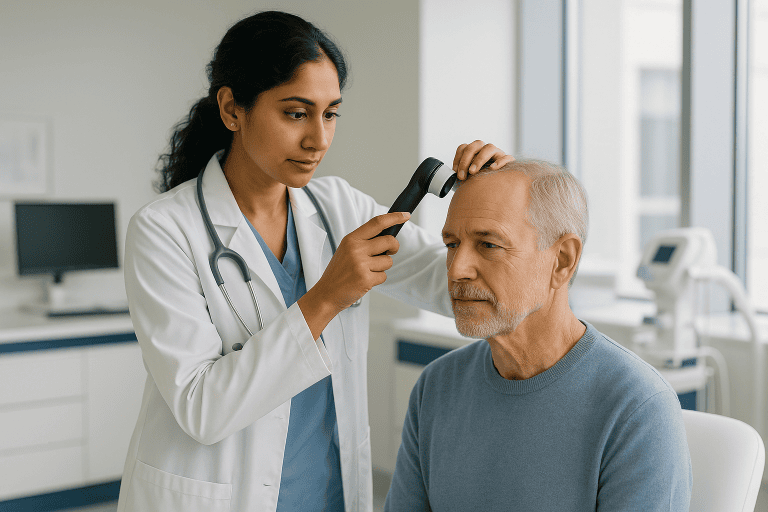
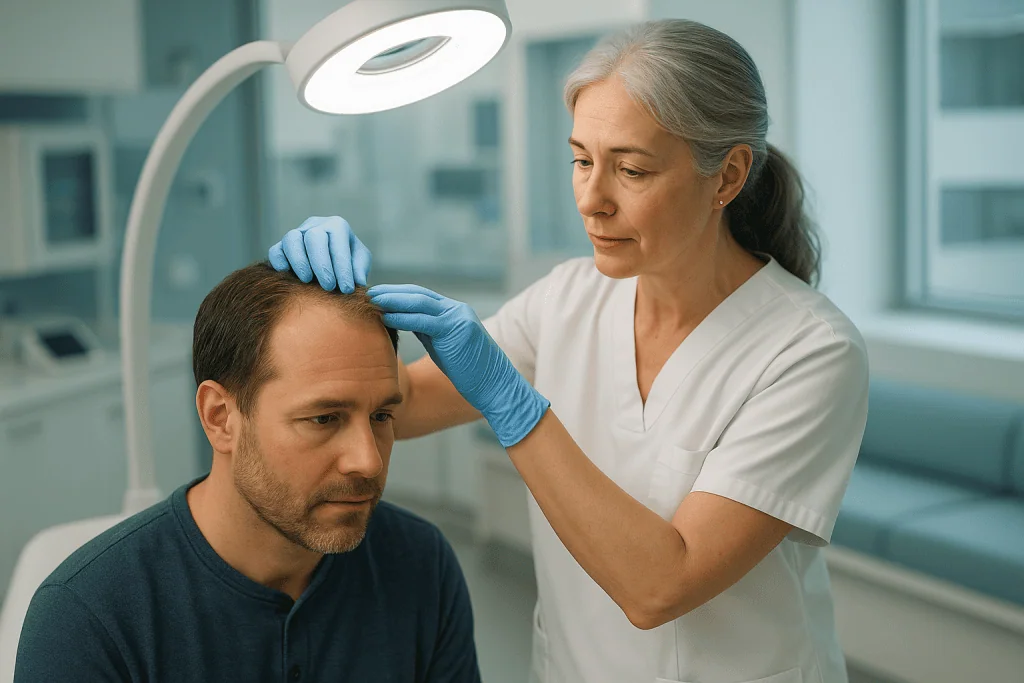
A scalp and hair examination follows. This may include magnified imaging of the scalp and follicles, density assessment, evaluation of hair shaft diameter, examination of the donor area, and comparison between thinning and non-thinning zones. Blood tests are recommended in some cases to check iron stores, thyroid function, vitamin levels, hormone profile, inflammatory markers, or other relevant factors. If scarring alopecia, autoimmune disease or an inflammatory scalp disorder is suspected, a dermatologist may recommend further testing or a scalp biopsy before any regenerative treatment is considered. Skipping this step to move straight to a procedure is a false economy: a treatment aimed at the wrong diagnosis wastes time during which the real condition progresses.
The patients most likely to benefit from regeneration are those whose follicles are weakened but not permanently lost. That usually means people in early or moderate stages of pattern hair loss, patients with stress-related shedding once the trigger has been addressed, and those with scalp or hair quality concerns where biologic stimulation may support recovery. Patients with advanced baldness, extensive scarring, untreated inflammatory scalp disease, or expectations that no treatment could meet will usually need a different plan, and deserve to hear that plainly at the first consultation, not after several sessions.
Suitability also depends on your donor area and long-term goals. If transplantation is being considered, the donor zone must be assessed carefully, because it is a finite resource that has to serve you for decades. Regenerative treatment can improve the quality of existing hair, but it cannot substitute for proper donor planning when surgical restoration is needed. A well-designed plan accounts not only for today’s thinning but for how your hair loss is likely to progress over the coming years.
Conditions and Indications Hair Regeneration May Address
Hair regeneration may be considered for several types of hair loss, but the indication must be individualised. The same visible thinning can be produced by very different medical processes, and treatment should always be matched to the diagnosis rather than to the appearance alone.
Androgenetic alopecia is one of the most common indications. In men it typically affects the temples, frontal hairline and crown; in women it more often causes diffuse thinning over the top of the scalp. Regenerative therapies may help improve hair thickness and density where miniaturised follicles remain active. Because this condition is progressive and genetically driven, treatment is usually framed as ongoing management rather than a one-off intervention.
Telogen effluvium is a shedding condition that can follow stress, illness, surgery, childbirth, rapid weight loss, nutritional deficiency, or medication changes. In most cases, the primary treatment is identifying and correcting the trigger, after which the hair cycle typically recovers on its own timetable. Regenerative care may be considered in selected patients when shedding persists or recovery is slow, but it should never replace the medical investigation that finds the trigger in the first place.
Hair thinning related to nutritional or hormonal imbalance often improves when the underlying issue is treated. Low iron stores, thyroid disorders, vitamin D deficiency and certain androgen-related conditions can all contribute to shedding or poor hair quality. Regenerative therapies may then be used as supportive treatment once the deficiency or hormonal factor has been addressed: the order matters, because stimulation cannot compensate for a scalp that lacks the metabolic resources to grow hair.
Post-transplant support is another common indication. Some patients receive regenerative treatment before or after hair transplantation to support scalp healing, improve the environment around transplanted grafts, and strengthen the native hair surrounding them. It is not a substitute for precise graft placement or careful surgical planning, but it can form part of a comprehensive restoration strategy, including for patients undergoing hair transplant repair after an earlier procedure elsewhere.
Early hairline or crown thinning may suit non-surgical management when the goal is to slow progression and improve hair quality before more extensive loss develops. Here, regenerative treatment may be combined with prescription or non-prescription medical therapies, depending on the diagnosis and what you tolerate, decisions that belong to your treating physician after examination.
Regenerative treatment is usually not the first choice when hair loss is caused by active scarring alopecia, untreated infection, severe inflammatory scalp disease, or complete follicle loss in a bald area. In these situations, controlling the underlying disease is the priority; in scarring conditions, ongoing inflammation can permanently destroy follicles while cosmetic treatments are being pursued. Once the condition is stable, reconstructive or restorative options can be reconsidered on firmer ground.
How Hair Regeneration Treatment Is Performed
The treatment journey begins well before any injection, device-based therapy or procedural step. A careful consultation determines whether regeneration is appropriate at all and how it should fit into a long-term plan. For international patients, this often starts with a remote review of photographs, medical history, previous treatments and laboratory results where available. The final recommendation is usually confirmed after an in-person examination, because scalp findings and donor quality are best assessed directly rather than from images.
Preparation and Assessment
Before treatment, your physician evaluates the pattern and stage of your hair loss. Magnified scalp imaging may be used to examine follicle density, miniaturisation, scalp health and hair shaft variation. Photographs are often taken under standardised conditions so that later comparisons measure real change rather than differences in lighting or hair styling: a detail that matters more than it sounds, because hair appearance is easily distorted by wet hair, different partings or camera angles.
You may be asked to list your medications, supplements, previous hair treatments, allergies, bleeding tendencies, autoimmune conditions and recent illnesses. Patients taking blood thinners or certain anti-inflammatory medications may need specific instructions, and any decision about medication belongs to your treating doctor, never to a checklist. The scalp should usually be clean on the day of treatment, and chemical hair procedures such as colouring may need to be avoided shortly before or after, depending on the plan.
What happens during the procedure?
The exact steps depend on the regenerative method selected, but most biologic scalp treatments follow a recognisable sequence:
- Collection: a small amount of blood or tissue-derived material is taken, in the same visit for most blood-based treatments.
- Processing: the material is prepared in a controlled clinical setting to concentrate the components that support healing and cellular signalling.
- Mapping: the physician marks the treatment zones on your scalp based on the diagnosis, imaging and the distribution of thinning.
- Comfort measures: local anaesthetic or cooling techniques may be used before delivery, depending on the protocol and your sensitivity.
- Delivery: the prepared material is introduced into the targeted areas using fine injections or specialised delivery methods, at a depth and spacing chosen by the physician.
- Aftercare briefing: you receive specific instructions on washing, activity, sun exposure and follow-up before you leave.
When device-assisted delivery is used, the aim is to distribute treatment evenly across thinning areas while minimising trauma to the scalp. Some protocols combine injections with microneedling or other controlled stimulation methods to activate repair pathways in the skin. For patients undergoing transplantation, regenerative treatment may be timed before surgery, during the surgical process, or after implantation, with the intention of supporting graft handling, scalp recovery and the health of existing hair. The transplant itself, whether performed as FUE or DHI, remains a separate procedure requiring careful donor extraction, graft preparation, hairline design and placement.
Technology Used in Hair Regeneration Care
Modern hair regeneration care relies on accurate diagnosis as much as on the treatment material itself. Digital scalp imaging, magnification systems and photographic documentation help physicians assess follicle density, miniaturisation, scalp inflammation and response over time. Laboratory testing identifies deficiencies or medical factors contributing to the loss. In the treatment setting, medical processing systems prepare biologic material under controlled conditions, while fine injection instruments, scalp mapping methods and device-assisted delivery tools distribute treatment precisely and consistently. Where transplantation is part of the plan, advanced graft handling, magnification and implantation techniques protect follicle viability and create a natural-looking distribution.
One caution belongs here: technology is only useful when guided by the right diagnosis. No device or biologic product can overcome poor patient selection, untreated scalp disease or unrealistic planning. That is why Acibadem’s emphasis falls on medical evaluation, documentation and follow-up rather than a one-size-fits-all protocol built around a machine.
How long does treatment take, and how many sessions are needed?
A single regenerative session is usually completed in an outpatient setting, often within a visit that also includes assessment, preparation, scalp mapping and post-treatment instructions, so plan for the appointment to take longer than the procedure itself. Many patients return to light daily activities the same day or the next day, depending on the method and the sensitivity of their scalp.
Hair growth is slow by nature. Visible changes, when they occur, appear gradually over several months rather than immediately, because the hair cycle itself takes months to turn over. Some patients need a series of sessions spaced over time, followed by maintenance treatment if ongoing genetic hair loss is present. Others have regenerative treatment as a supportive step around transplantation or as one component of a broader medical programme. Your physician should be able to explain the expected schedule for your specific plan before you commit to it.
What is recovery like after a regenerative scalp treatment?
Recovery is usually mild for appropriately selected regenerative scalp procedures. You may experience temporary redness, tenderness, swelling, pinpoint bleeding, tightness or a mild headache, and these effects generally settle within a short period. Your care team will explain how to wash your hair, when to resume exercise, whether to avoid sun exposure or particular hair products, and how any medications or supplements fit into the aftercare plan, instructions that come from your treating doctor, tailored to what was actually done.
If you are travelling for treatment, timing is discussed in advance. Most standalone regenerative procedures do not require a long stay, but when treatment is combined with transplantation or additional dermatologic care, the recommended time near the clinic may be longer. Follow-up can often continue remotely through structured photo review after you return home, supported by clear written instructions and ongoing communication with the care team.
Hair Regeneration vs Hair Transplant: How They Differ
Hair regeneration and hair transplantation solve different problems, and understanding the boundary between them prevents disappointment. Regeneration works with follicles you still have: it can support their function, but it cannot put hair where no living follicle remains. Transplantation physically relocates follicles from your donor area into thinning or bald zones: it creates coverage, but it spends a finite resource and requires surgical planning. Many long-term plans use both, regeneration to stabilise and strengthen existing hair, surgery to rebuild areas that regeneration cannot reach. The full range of surgical and supportive options is described across our hair operations pages.
Can regeneration replace a hair transplant?
No, not where follicles have been permanently lost. A completely bald area that has been smooth for years contains few or no follicles capable of responding to stimulation, and no currently available regenerative treatment creates new ones. Where regeneration earns its place is earlier in the process: in thinning zones where miniaturised follicles still survive, in stabilising native hair around a planned transplant, and in supporting scalp health before and after surgery. A candid consultation will tell you which category each area of your scalp falls into.
How much do 3,000 grafts of hair cost?
There is no single honest answer, because graft pricing varies with the surgical technique, the clinic, the surgeon’s planning time, the country and what the quoted package actually includes. More importantly, a graft number quoted before anyone has examined your scalp is not a plan: it is a guess. The number of grafts you genuinely need depends on the size of the area to be covered, your hair characteristics, the density your donor area can safely supply, and how your loss is expected to progress. A responsible clinic determines the graft count from the examination, not the other way round, and explains what the figure covers before you decide anything. If you are comparing quotes, ask each clinic to justify its graft number against your actual donor capacity and long-term pattern of loss.
Why Acting Early Matters
Hair follicles do not usually disappear overnight. In most progressive hair loss conditions they miniaturise over years, and during that window the follicle is weakened but still alive. Early diagnosis identifies whether the process is reversible, controllable or progressive, and that knowledge creates the opportunity to preserve existing hair before more extensive loss develops.
Delaying evaluation narrows your options. In androgenetic alopecia, prolonged miniaturisation eventually leads to areas where follicles no longer produce cosmetically meaningful hair, and regenerative therapies are far less likely to help there. Transplantation may still be possible, but the donor area is limited, and advanced loss demands more complex planning to distribute a finite supply across a larger territory.
Delay also allows treatable medical causes to keep working against you. Iron deficiency, thyroid imbalance, inflammatory scalp disorders, medication-related shedding and hormonal conditions can each worsen hair loss while they remain unaddressed. In scarring alopecia, early treatment is especially important, because active inflammation can permanently destroy follicles, and regenerative treatment applied without controlling that inflammation is ineffective at best and inappropriate at worst.
Acting early does not mean rushing into a procedure. It means obtaining an accurate diagnosis, documenting the pattern of loss, and choosing a plan that protects your long-term options. For many patients, the most valuable intervention is a structured strategy: medical treatment when indicated, regenerative support when suitable, transplant planning when appropriate, and follow-up that catches progression before it forecloses choices.
Benefits of Hair Regeneration Treatment
The potential benefits depend on your diagnosis, the stage of hair loss and the treatment plan, but the most common goals are summarised below. Note the careful wording: these are aims for suitable candidates, not promises.
| Benefit | What It Means for You |
|---|---|
| Supports weakened follicles | Regenerative techniques may help follicles that are still active produce stronger, thicker-looking hair over time. |
| May reduce ongoing shedding | In selected patients, treatment can form part of a plan to stabilise hair loss and improve hair cycling. |
| Non-surgical or minimally invasive option | Many regenerative procedures are performed in an outpatient setting with limited downtime compared with surgery. |
| Can complement hair transplantation | When used appropriately, regenerative care may support scalp recovery, the graft environment, and the quality of existing native hair. |
| Personalised long-term planning | A specialist assessment determines whether regeneration, medication, transplantation, or combined care is most suitable for your pattern of loss. |
Recovery Timeline After Hair Regeneration
Recovery varies by treatment method, but many patients follow a general pattern similar to the timeline below. Your own instructions from the care team always take precedence over any general schedule.
| Time Period | What Patients Can Expect |
|---|---|
| Day 1 | Mild redness, tenderness, swelling or pinpoint marks may be present. Most patients can perform light daily activities while following scalp care instructions. |
| First Week | Temporary sensitivity usually improves. You may be advised to avoid intense exercise, harsh hair products or excessive sun exposure for a short period. |
| First Month | Hair may not look noticeably different yet. Some shedding can occur as hair cycles shift: a finding your physician interprets in context rather than in isolation. |
| Three to Six Months | Early improvements in shedding, texture or thickness may become more visible in suitable candidates. Standardised follow-up photographs help assess change objectively. |
| Longer Term | Maintenance may be recommended for progressive hair loss. Long-term results depend on diagnosis, genetics, medical treatment and adherence to the plan. |
What Influences a Good Result?
The most important factor is the accuracy of the diagnosis. Hair regeneration is most useful when the hair loss process is understood and active follicles remain. If thinning is driven by untreated inflammation, scarring, severe deficiency or hormonal imbalance, that underlying condition must be addressed for any hair treatment to have a meaningful chance of helping.
The stage of hair loss matters almost as much. Early and moderate thinning offers more opportunity for follicle support than long-standing bald areas. Regenerative techniques can improve the performance of existing follicles, but they cannot reliably create dense coverage where follicles have been permanently lost. Patients with advanced loss may need transplantation, scalp medical therapy or a combined plan, and are better served hearing that at the outset than discovering it after months of ineffective sessions.
Individual biology sets the ceiling. Age, genetics, sex, hormonal profile, donor area quality, scalp health, smoking status, stress, nutrition and medication use can all influence outcomes. A patient with strong genetic hair loss may need ongoing maintenance even after an initial improvement. A patient with telogen effluvium may recover well once the trigger is corrected, while another with chronic shedding may need further investigation before any procedural treatment makes sense.
Consistency is the factor patients most often underestimate. Hair grows in cycles, and visible change takes months. Someone who stops recommended medical therapy too early, misses follow-up, or expects immediate density may feel disappointed even while a biological response is developing gradually beneath the surface. Objective monitoring, standardised photographs and scalp analysis, separates perception from measurable change, in both directions.
Technique and clinical environment complete the picture. Regenerative material must be prepared appropriately, delivered to the correct scalp areas, and used for the right indication. If treatment is combined with transplantation, then graft quality, donor preservation, hairline design, the angle and direction of placement, and postoperative care all shape the final appearance. A natural result depends on planning as much as on growth. Patients concerned about visible signs of treatment during recovery may also want to read about hair transplant without shaving, which addresses a common practical worry for people who cannot step away from work or social commitments.
Finally, expectations should be calibrated honestly. The realistic aim may be reduced shedding, improved hair shaft thickness, better scalp coverage, or support for transplant results, and not every patient will achieve the same degree of improvement. Some patients will be advised that regeneration is unlikely to meet their goals at all. That advice is not a failure of the consultation; it is the consultation doing its job, protecting you from unnecessary treatment and pointing you towards the path that fits your situation.
How Hair Regeneration Care Is Organised at Acibadem
International patients researching hair regeneration usually have two priorities: medically credible guidance, and practical support while receiving care away from home. Hair loss treatment is emotionally sensitive, and the international setting adds real questions about travel, language, scheduling, follow-up and continuity of care. Acibadem’s model addresses both the medical and the logistical sides of that experience.
Care begins with specialist evaluation rather than a standard package. Depending on your needs, dermatologists, hair restoration physicians, plastic surgeons, endocrinology specialists or other clinicians may be involved. When findings suggest a more complex condition, multidisciplinary discussion helps ensure the treatment plan is medically appropriate. This matters particularly when hair loss may be linked to autoimmune disease, hormonal imbalance, nutritional deficiency, or previous procedures elsewhere that did not go to plan.
Diagnostic pathways are tailored rather than templated. Scalp examination, digital imaging, laboratory testing and medical history are used together to identify the type and stage of hair loss. If transplantation is being considered, donor area analysis and long-term planning are part of the assessment from the start. If regenerative therapy is suitable, the physician explains the expected course, the number of sessions, recovery instructions, and how your response will be evaluated over time, so you know before the first session what “working” will look like and when it can reasonably be judged.
Technology supports both diagnosis and treatment. Magnified scalp analysis evaluates follicle miniaturisation and density. Controlled preparation systems support consistency in biologic treatments. Device-assisted delivery methods distribute treatment carefully across selected scalp zones. When surgery is part of the plan, modern graft extraction, preparation and implantation techniques help preserve follicles and create natural direction and density. In each case the technology is selected according to your diagnosis; it is never a substitute for medical judgement.
For patients travelling from Europe, the Middle East, the United States and other regions, Acibadem International coordinates the practical side of a visit: appointment planning, medical record transfer, multilingual support, help with accommodation arrangements where requested, and structured follow-up communication after patients return home. Remote photo review often begins before travel and continues afterwards, so the in-person portion of care is used for what genuinely requires it, examination, treatment and direct discussion with the physician.
Transparency runs through the process. Patients are told when a treatment is supportive rather than curative in intent, when multiple sessions may be needed, and when transplantation or medical therapy would serve them better than regeneration. In a field where online claims can be confusing, careful explanation is part of responsible care: the goal is that you understand what can reasonably be achieved and what is needed to maintain it over time.
Personalised planning matters because hair restoration is not a single moment. A young man with early temple recession, a woman with diffuse thinning after hormonal change, a patient with donor depletion from previous transplants, and someone recovering from stress-related shedding all require different strategies. The plan considers your current appearance, the biology of your hair loss, your donor reserve, likely future progression, and your own goals, in that order.
Planning Ahead: What a Structured Assessment Involves
If you are weighing up hair cloning and regeneration as a route back to fuller hair, the most useful preparation is understanding what a serious assessment looks like, so you can recognise one when you see it. It starts with history and examination, not with a price list. It names your diagnosis and the stage of your loss before naming a procedure. It distinguishes what is available now from what remains experimental, and it explains why each recommended step suits your scalp specifically rather than scalps in general.
A structured assessment typically clarifies three things: whether your follicles are still active enough to respond to regenerative treatment, whether an underlying medical condition is contributing to the shedding and needs addressing first, and whether your long-term goals are better served by medical therapy, regenerative support, transplantation, or a combination staged over time. Clear photographs, records of previous treatments, laboratory results and an honest account of your history all make that evaluation more precise, wherever it takes place.
Hair loss can feel urgent and deeply personal, but the best decisions are made with an accurate diagnosis, realistic expectations and careful planning. True hair cloning may one day change what is possible for advanced hair loss; today, it remains research. Regenerative hair treatment, by contrast, is available now and can offer meaningful support for selected patients, especially when it is used at the right stage, for the right diagnosis, and as part of a long-term strategy rather than as a standalone hope.
Preparation
- A specialist evaluates hair loss pattern, scalp condition, medical history, and expectations before treatment. Blood tests or dermatologic assessment may be requested when needed. Patients may be advised to avoid smoking, alcohol, and blood-thinning medicines before the procedure if medically appropriate.
Aftercare
- Mild scalp tenderness, redness, or swelling can occur and usually improves within a few days. Patients should follow washing, sun protection, and activity instructions given by the care team. Follow-up visits help assess response and determine whether additional sessions or alternative hair restoration options are needed.
Frequently Asked Questions
What affects the cost of hair cloning and regeneration?
The main factors are diagnosis, scalp condition, donor area quality, the regenerative method used, whether laboratory processing is required, clinician expertise, clinic setting, and the need for follow-up or combined hair transplantation. A personalised quote is only possible after specialist assessment.
How can I get a personalised quote from Acibadem?
You can request a free consultation and share photos, medical history, previous hair treatments, and your goals. The team can then advise whether an in-person scalp assessment is needed and prepare a treatment plan with the relevant inclusions.
Is hair cloning the same as a hair transplant?
No. Hair transplantation moves existing follicles from a donor area, while hair cloning and regeneration usually refers to regenerative techniques intended to support hair growth or scalp quality. True follicle cloning remains an evolving area, so a specialist should explain what technique is actually being offered.
Will I need more than one visit?
This depends on the diagnosis, chosen technique, and response to treatment. Some patients may have assessment and treatment planned within the same travel pathway, while others may require staged care, maintenance sessions, or monitoring.
What is usually included in an international patient package?
Packages may include specialist consultation, scalp assessment, treatment planning, the selected regenerative procedure, basic medications, interpreter support, transfer coordination, and follow-up guidance. Exact inclusions should be confirmed before travel.
Is this medical or financial advice?
No. This information is general and educational. Treatment suitability and final costs must be confirmed through a specialist consultation and an individual quotation.
Medically reviewed by the Acıbadem International Medical Board August 31, 2026
See our medical review board →
Update history
- PublishedJune 8, 2026
- Medical review approvedAugust 31, 2026
- Last content updateAugust 31, 2026