Basal Cell Carcinoma: Symptoms, Causes, and Treatment Options
Basal cell carcinoma often appears as a sore, bump, or patch that does not heal normally. Long-term ultraviolet exposure from sunlight or tanning beds is the main risk factor.
Key Takeaways
- Basal cell carcinoma often appears as a sore, bump, or patch that does not heal normally.
- Long-term ultraviolet exposure from sunlight or tanning beds is the main risk factor.
- Diagnosis usually involves a skin examination and a biopsy to confirm the type of skin cancer.
- Treatment depends on the tumor’s size, depth, and location, and may include minor surgery or other targeted methods.
- Early medical assessment helps prevent deeper local tissue damage and improves cosmetic outcomes.
Basal cell carcinoma is the most common type of skin cancer. It usually develops on sun-exposed skin, tends to grow slowly, and is often highly treatable when found early.
Overview
Basal cell carcinoma is the most common skin cancer. It begins in basal cells, which are found in the lower part of the epidermis, the outer layer of the skin. In many people, it grows slowly and is unlikely to spread to distant organs, but it can continue to enlarge and damage nearby skin and tissue if it is left untreated.
This cancer is seen most often on areas that receive frequent sun exposure, such as the face, ears, scalp, neck, shoulders, and arms. However, it can also develop in less expected places, especially in people with cumulative ultraviolet exposure over many years. Because its appearance can vary, some lesions are mistaken for a harmless pimple, scar, or patch of dry skin.
Early diagnosis matters. Basal cell carcinoma is often very treatable, and treatment at an earlier stage may allow for simpler procedures and better cosmetic results. A clinician may also evaluate whether a lesion could represent another form of skin cancer, such as skin cancer more broadly, because several skin conditions can look similar at first.
How basal cell carcinoma can look and feel
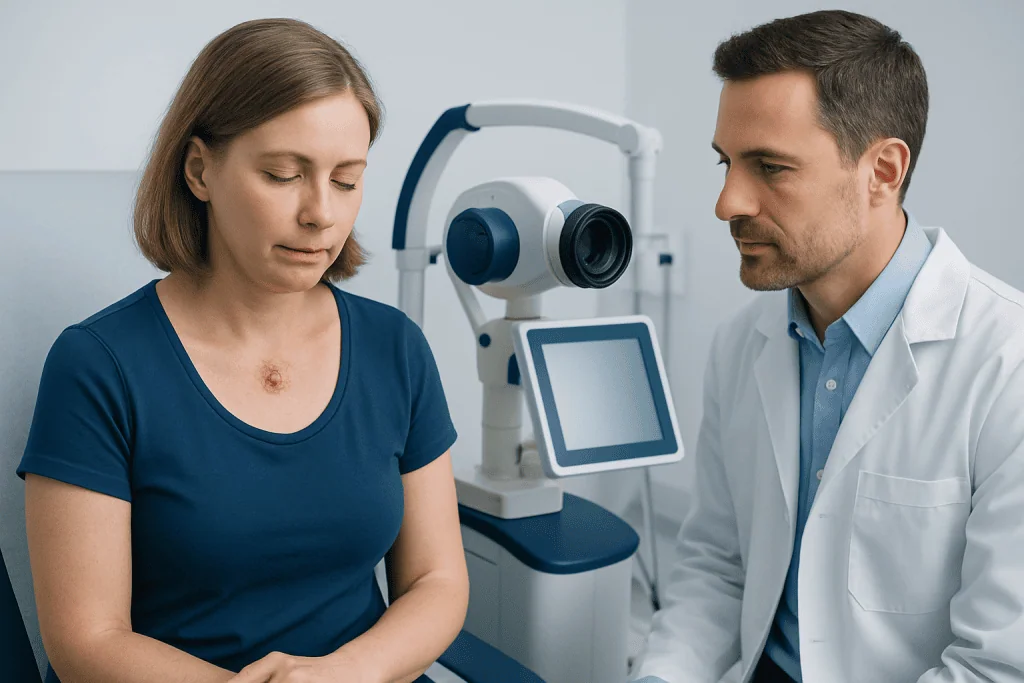
Basal cell carcinoma does not always look the same. One common form appears as a small, shiny or pearly bump, sometimes with visible tiny blood vessels on the surface. Another may look like a flat, scaly, reddish patch or a waxy area that resembles a scar. Some lesions crust, ooze, or bleed easily, then seem to heal before returning again.
A useful clue is that the spot behaves differently from normal skin. It may persist for weeks or months, gradually enlarge, or repeatedly break down and reform. Many people notice that the area is fragile and bleeds after washing, shaving, or minor friction.
Symptoms are often mild. The lesion may be painless, but some people describe itching, tenderness, or a burning sensation. Basal cell carcinoma is less likely than some other cancers to cause general symptoms such as fatigue or weight loss; instead, its effects are usually local to the skin and surrounding tissue.
- A pearly, translucent, or shiny bump
- A sore that does not heal as expected
- A flat pink, red, or brown patch
- A scar-like, firm, pale, or waxy area
- A spot that bleeds, crusts, or recurs in the same place
Causes and risk factors

The main cause of basal cell carcinoma is ultraviolet, or UV, damage to skin cells. This damage most often comes from sunlight and indoor tanning devices. UV exposure builds up over time, so risk can reflect both intense sun exposure and many years of everyday exposure.
People with fair skin, light-colored eyes, or blond or red hair have a higher risk because they burn more easily, but basal cell carcinoma can occur in any skin tone. Age increases risk because UV damage accumulates over time, although younger adults can also develop it, especially after frequent tanning bed use or significant sun exposure.
Other factors may raise the chance of developing basal cell carcinoma. These include a personal history of skin cancer, immune suppression, prior radiation therapy to the skin, certain inherited syndromes, and chronic exposure to arsenic in uncommon settings. A family history of skin cancer may also contribute, partly through shared skin type and sun-exposure patterns.
It is important to know that basal cell carcinoma usually arises from a combination of environmental exposure and individual susceptibility. Its development is not a sign of poor hygiene, and it is not contagious.
How doctors diagnose it
Diagnosis starts with a clinical skin examination. A dermatologist or another qualified doctor will look at the lesion’s shape, color, border, texture, and location, and may examine the rest of the skin for other suspicious spots. In some cases, a dermatoscope, a handheld magnifying device with light, is used to assess the lesion more closely.
The only way to confirm basal cell carcinoma is usually with a biopsy. During a biopsy, the doctor removes all or part of the suspicious area and sends it to a laboratory for microscopic examination. This helps determine whether the lesion is basal cell carcinoma and, if so, which subtype it is.
The pathology result helps guide treatment. Some basal cell carcinomas are considered lower risk, while others have more aggressive growth patterns or appear in cosmetically and functionally sensitive areas such as the eyelids, nose, lips, or ears. Imaging tests are not needed for most people, but they may be considered if a tumor is unusually large, recurrent, or suspected to involve deeper structures.
If there is concern about a broader evaluation, clinicians may also coordinate dermatology care for full-body skin assessment, monitoring, and treatment planning tailored to the patient’s skin type, medical history, and lesion characteristics.
Treatment options
Basal cell carcinoma treatment is chosen based on the lesion’s size, subtype, depth, location, and whether it is a first-time or recurrent tumor. The goal is to completely remove or destroy the cancer while preserving as much healthy tissue and appearance as possible. In many cases, treatment is performed with local anesthesia in an outpatient setting.
Surgical removal is a common and effective approach. Standard excision removes the visible tumor along with a margin of surrounding skin. In selected cases, especially on the face or in recurrent tumors, Mohs micrographic surgery may be recommended because it allows step-by-step removal with immediate microscopic margin control. This tissue-sparing method can be especially useful when preserving function and cosmetic outcome matters.
Some superficial or low-risk tumors may be treated with other methods. These can include curettage and electrodesiccation, cryotherapy, topical prescription medications, or photodynamic therapy, depending on the lesion and the treating clinician’s judgment. Radiation therapy may be considered for people who are not good surgical candidates or for select tumors in difficult locations.
For rare advanced cases that cannot be treated adequately with local methods, systemic therapies may be used under specialist supervision. In complex situations, care may involve oncology as well as skin and surgical specialists. When reconstruction is needed after removal, doctors may also coordinate plastic surgery to help restore function and appearance.
Prevention and self-care after treatment
Sun protection is the most effective way to lower the risk of future basal cell carcinoma. This includes seeking shade when the sun is strongest, wearing protective clothing and a wide-brimmed hat, using broad-spectrum sunscreen, and avoiding tanning beds. These habits matter year-round, not only in summer.
People who have had one basal cell carcinoma have a greater chance of developing another skin cancer later. For that reason, regular follow-up visits and routine self-checks are important. A patient can look for any new spot, a changing patch, or a wound that does not heal, and compare the skin over time in a mirror or with photographs if helpful.
After treatment, following wound-care instructions supports healing and may reduce scarring or infection risk. Patients should keep follow-up appointments so the doctor can confirm complete healing and check for recurrence. If a lesion returns or a new one appears, it should be assessed rather than watched indefinitely.
Near the end of the care journey, some patients benefit from a coordinated review of ongoing skin surveillance and reconstructive needs. Acibadem International’s multidisciplinary specialists in JCI-accredited hospitals diagnose and treat basal cell carcinoma for international patients when specialist evaluation is needed.
When to seek medical care
Medical care should be sought for any skin lesion that persists, grows, bleeds easily, or does not heal within a few weeks. A spot that repeatedly crusts over, reopens, or looks different from nearby skin deserves professional assessment, even if it is not painful.
Prompt evaluation is especially important for lesions on the face, eyelids, ears, scalp, lips, hands, or genital area, where delayed treatment may affect function or cosmetic outcome. People with a history of skin cancer, organ transplantation, immune suppression, or extensive sun damage should have a lower threshold for arranging a skin examination.
Urgent medical advice is also appropriate if a treated area becomes increasingly painful, swollen, or shows signs of infection, or if a previously removed lesion seems to return. A qualified doctor can determine whether the change is benign, needs biopsy, or should be treated as a possible recurrence.
Frequently asked questions
Is basal cell carcinoma dangerous?
Basal cell carcinoma is a form of skin cancer, so it should always be taken seriously and assessed by a doctor. It usually grows slowly and rarely spreads to distant parts of the body, but it can cause significant local damage if treatment is delayed.
Can basal cell carcinoma go away on its own?
Basal cell carcinoma generally does not go away on its own. Some lesions may seem to improve temporarily, especially if they crust and then heal over, but the abnormal cells usually remain and can continue growing.
What is the first sign of basal cell carcinoma?
The first sign is often a small skin change that does not behave like a normal blemish. It may appear as a shiny bump, a sore that keeps returning, or a flat patch that slowly enlarges over time.
How is basal cell carcinoma different from melanoma?
Basal cell carcinoma and melanoma are both skin cancers, but they arise from different cells and behave differently. Basal cell carcinoma is usually slower growing and less likely to spread, while melanoma is more likely to become aggressive if not diagnosed early.
Does basal cell carcinoma always need surgery?
Not always. Surgery is common because it can remove the cancer completely, but some superficial or low-risk cases may be treated with other methods such as topical therapies, cryotherapy, or carefully selected nonsurgical approaches.
Can basal cell carcinoma come back after treatment?
Yes, recurrence is possible, especially if the tumor was in a high-risk location or had aggressive features. People who have had one basal cell carcinoma also have a higher chance of developing another skin cancer, which is why follow-up and sun protection remain important.
References
- American Academy of Dermatology
- National Cancer Institute
- American Cancer Society
- National Health Service
- World Health Organization
This article is for general information only and is not a substitute for professional medical advice. Please consult a qualified doctor about your individual situation.
Basal Cell Carcinoma in Turkey — costs, top hospitals & a free quote
JCI-accredited · board-certified surgeons · reply within 24h
Add us as a Preferred Source to see more of our trusted health content across Google Search, AI Overviews and Discover.

Medical Oncology Department
Medical treatment of cancer with chemotherapy, immunotherapy and targeted therapies under a multidisciplinary tumor board.
60 specialists in this unit