Fitness for Hips: An Evidence-Based Guide for Patients

Hip fitness includes strength, flexibility, balance, and movement control, not only stretching. Low-impact activities such as walking, cycling, swimming, and guided strengthening are often hip-friendly.
Key Takeaways
- Hip fitness includes strength, flexibility, balance, and movement control, not only stretching.
- Low-impact activities such as walking, cycling, swimming, and guided strengthening are often hip-friendly.
- Exercise should be adjusted if there is pain, arthritis, injury, or limited mobility.
- Core and glute strength play a major role in supporting the hips during daily activity.
- Persistent pain, limping, locking, or reduced range of motion should be assessed by a doctor.
Fitness for hips focuses on improving strength, mobility, balance, and daily movement patterns to support the hip joints. A well-planned routine can help reduce stiffness, improve function, and lower strain on the hips, especially when paired with good technique and medical guidance when needed.
Overview: What fitness for hips really means
Fitness for hips means keeping the hip joints and surrounding muscles strong, mobile, and well-coordinated so they can support daily movement comfortably. For most people, this includes a combination of strengthening, flexibility work, balance training, and low-impact aerobic activity rather than one single exercise program.
The hips are large ball-and-socket joints that help with walking, climbing stairs, standing up, turning, and maintaining posture. They work closely with the gluteal muscles, core, thighs, and lower back. When one part of this system becomes weak or stiff, the hips may have to absorb extra load, which can contribute to discomfort or reduced function over time.
A patient-friendly approach to hip fitness is not about pushing through pain or achieving extreme flexibility. It is about improving how the hips move and how the body controls that movement. This is especially important for older adults, people with sedentary jobs, recreational athletes, and anyone recovering from reduced activity.
Hip-focused exercise can also be useful for people managing common conditions such as osteoarthritis or bursitis, although the routine may need to be adapted. If symptoms are significant, an individualized assessment helps identify which movements are beneficial and which should be limited for a period of time.
How healthy hips support daily life
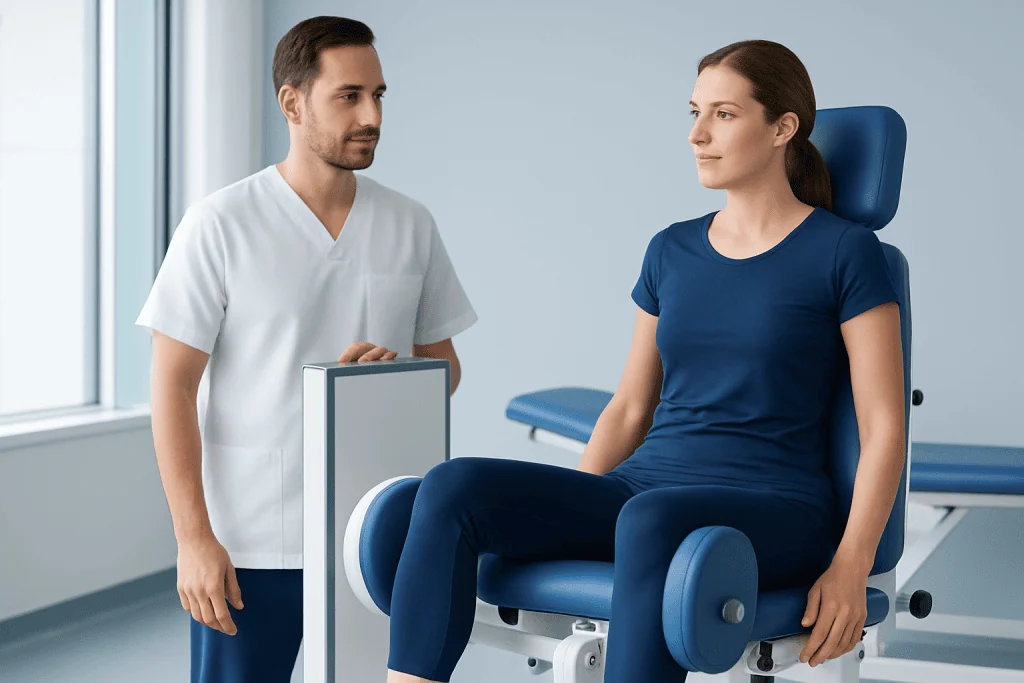
The hip joint must be both stable and mobile. Stability helps the pelvis stay level when standing on one leg, walking, or climbing stairs. Mobility allows the leg to move forward, backward, outward, and inward without excessive strain on nearby muscles and tendons.
When hip fitness is reduced, people may notice stiffness after sitting, trouble getting up from a chair, difficulty putting on shoes, or fatigue during walking. Sometimes the issue does not start in the hip itself. Weak gluteal muscles, tight hip flexors, poor posture, or reduced ankle mobility can all change how the hip works.
In practical terms, good hip fitness can support:
- More comfortable walking and standing
- Better balance and lower fall risk
- Improved stair climbing and squatting mechanics
- Reduced strain on the knees and lower back
- Better tolerance for exercise and daily activity
This wider body connection is one reason hip care should not focus only on the painful area. A balanced routine often includes the glutes, abdominal muscles, thighs, and lower back, along with attention to everyday movement habits.
Key parts of a hip-friendly fitness program
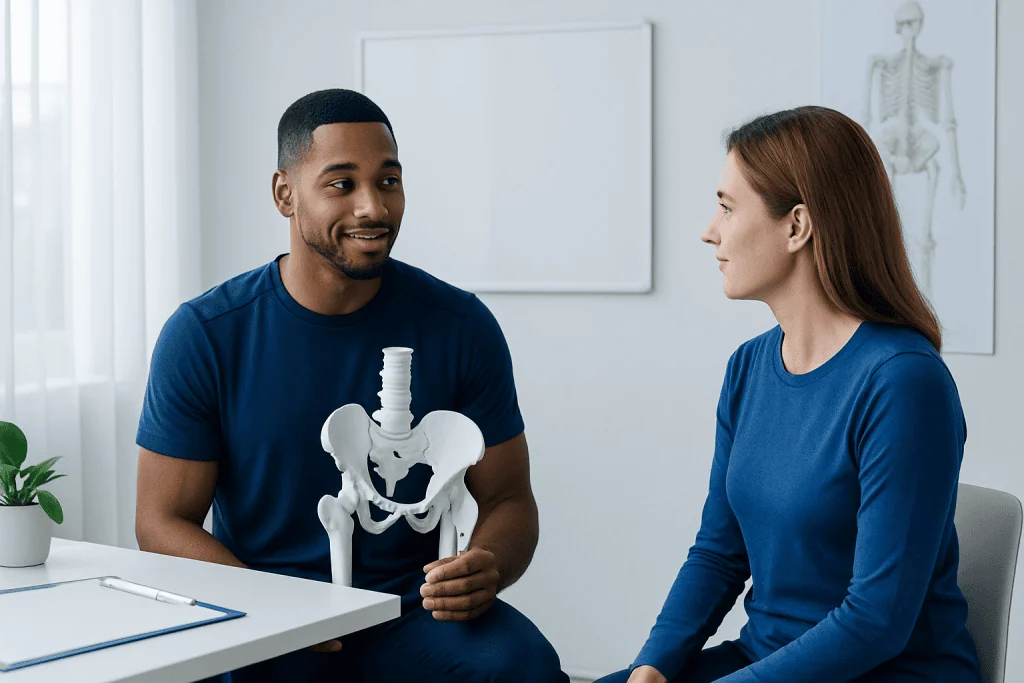
An evidence-based fitness program for hips usually includes four elements: strengthening, mobility, aerobic conditioning, and balance or neuromuscular control. These components work together to improve joint support while helping the person move more efficiently.
Strengthening often targets the gluteus medius, gluteus maximus, deep hip stabilizers, quadriceps, and core muscles. Examples may include bridges, sit-to-stand exercises, side-lying leg raises, step-ups, and resisted band work. These exercises are often started with body weight and light resistance, then progressed gradually based on comfort and form.
Mobility work may include gentle stretching or controlled range-of-motion exercises for the hip flexors, hamstrings, and surrounding tissues. The goal is not to force the joint into painful positions, but to restore comfortable movement. Slow, repeated motion is often more helpful than aggressive stretching, especially in people with joint irritation.
Aerobic exercise supports circulation, endurance, and weight management, all of which can benefit the hips. Walking on level ground, cycling, water exercise, and elliptical training are commonly well tolerated. In some cases, a supervised physical therapy and rehabilitation program can help patients learn safe technique and progression.
Exercises and activities that are often helpful
Many people do best with low-impact activities that allow regular movement without repeated heavy loading. Walking, swimming, aquatic exercise, stationary cycling, and carefully progressed strength training are common options. The best choice depends on symptoms, fitness level, balance, and any underlying joint condition.
Examples of commonly recommended movements include:
- Bridges for glute and core support
- Clamshells or banded side steps for hip stabilizers
- Sit-to-stand practice for everyday strength
- Gentle hip flexor and hamstring stretches
- Single-leg balance exercises near a stable support
- Step-ups with attention to alignment
Technique matters. During exercise, the knee should usually track in line with the foot, the trunk should stay controlled, and movements should be smooth rather than jerky. Mild muscle effort is expected, but sharp joint pain, catching, or worsening limp suggests the activity should be stopped and reassessed.
Some people with structural problems, advanced arthritis, or persistent pain may need specialist care before starting a general program. In selected cases, evaluation by orthopedic teams and imaging can clarify whether symptoms are due to soft tissue strain, arthritis, impingement, or another issue such as hip pain with a specific underlying cause.
What can aggravate the hips
Not every exercise suits every hip. Deep squats, high-impact jumping, sudden twisting, heavy lifting with poor form, or repetitive uphill running may increase symptoms in some people, especially if strength and mobility are limited. Long periods of sitting can also contribute to stiffness and reduced hip extension.
Common risk factors for hip problems include aging-related joint changes, previous injury, weak gluteal muscles, reduced flexibility, obesity, repetitive sports loading, and poor movement mechanics. Inflammatory joint conditions, tendon disorders, and lower back problems can also refer pain to the hip region.
Warning signs during exercise include pain that rises steadily with each repetition, pain lasting well beyond the session, a sense of instability, locking, or marked reduction in range of motion. These symptoms do not always mean serious damage, but they do suggest that the plan needs adjustment.
For people with significant joint degeneration, specialist treatment may be considered alongside exercise. Depending on the diagnosis, this may involve medication, injections, or surgical options such as hip replacement when conservative care no longer provides enough function or comfort.
How doctors assess hip fitness and hip symptoms
When hip symptoms interfere with daily life, medical evaluation helps separate general deconditioning from a specific joint or soft tissue problem. A doctor will usually ask about pain location, stiffness, clicking, instability, walking tolerance, previous injury, exercise habits, and whether symptoms spread to the groin, thigh, buttock, or lower back.
The physical examination may assess gait, posture, hip range of motion, muscle strength, balance, and pain with certain movements. Functional tasks such as standing from a chair or stepping may show patterns of weakness or compensation that are not obvious at rest.
If needed, imaging studies such as X-rays or MRI may be used to look for arthritis, tendon injury, labral problems, bursitis, or other structural causes. Sometimes the main issue is not damage but reduced conditioning and movement control, which can still respond very well to a guided exercise program.
Based on the findings, the care team may recommend lifestyle changes, a home exercise program, supervised rehabilitation, pain management strategies, or referral to an orthopedic specialist. The goal is to restore safe movement while addressing the cause of symptoms rather than treating pain alone.
Prevention, self-care, and building a sustainable routine
Long-term hip fitness is usually built through consistency, not intensity. Starting with manageable sessions two to four times per week can be more effective than occasional demanding workouts. A gradual increase in repetition, resistance, or duration allows the muscles and joints to adapt without unnecessary flare-ups.
Helpful self-care habits include warming up before exercise, changing position regularly during the day, avoiding prolonged sitting, wearing supportive footwear, and maintaining a healthy body weight when possible. Strengthening the core and gluteal muscles often improves hip mechanics more than repeated stretching alone.
People who already have a diagnosed hip condition may benefit from a more personalized rehabilitation approach. In some cases, treatment may involve coordinated care that includes imaging, rehabilitation, and orthopedic review. Near the end of the care pathway, some patients may be evaluated for procedures such as orthopedic rehabilitation to support recovery after injury or surgery.
Acibadem International’s multidisciplinary specialists and JCI-accredited hospitals diagnose and treat hip conditions for international patients, including evaluation, rehabilitation, and orthopedic care when appropriate. Even so, the most suitable plan depends on the individual’s diagnosis, goals, and overall health.
When to seek medical care
It is sensible to seek medical advice if hip pain lasts more than a few weeks, returns repeatedly, or limits walking, sleep, work, or exercise. An earlier assessment is also important after a fall, sports injury, or sudden increase in activity followed by significant pain.
Prompt medical attention is recommended for severe pain, inability to bear weight, visible deformity, fever with joint pain, increasing swelling, numbness, or a hip that locks or gives way. These symptoms may need urgent evaluation.
People with known arthritis, osteoporosis, inflammatory disease, or previous hip surgery should also ask a clinician before changing exercise intensity significantly. A qualified doctor or physiotherapist can help decide which activities are safe, which should be modified, and whether further tests are needed.
In general, exercise is beneficial for the hips when it is tailored to the person and does not worsen symptoms. Early guidance can often prevent a minor movement problem from becoming a more persistent limitation.
Frequently asked questions
What is the best fitness for hips routine?
The best routine usually combines hip and glute strengthening, gentle mobility work, balance training, and low-impact aerobic exercise. It should match the person’s age, symptoms, fitness level, and any diagnosed hip condition.
Can exercise help hip pain?
Yes, exercise can help many common causes of hip discomfort by improving strength, joint support, and movement control. However, the type and intensity of exercise matter, and persistent or sharp pain should be assessed by a clinician.
Are squats good or bad for the hips?
Squats can be helpful when done with proper form and within a comfortable range. They may need to be modified or avoided temporarily if they cause pain, especially in people with arthritis, impingement, or limited mobility.
Which activities are usually easiest on the hips?
Walking on level surfaces, stationary cycling, swimming, and water exercise are often well tolerated because they are lower impact. Individual response varies, so symptoms during and after activity should guide progression.
How often should hip exercises be done?
Many people start with two to four sessions per week, depending on the program and their symptoms. Gentle mobility work may be done more often, while strengthening exercises usually need rest between harder sessions.
When should someone stop a hip exercise?
An exercise should be stopped if it causes sharp pain, catching, locking, marked instability, or a clear worsening of symptoms afterward. Mild muscle fatigue is expected, but joint pain that escalates is a sign to modify the activity and seek advice if needed.
References
- American Academy of Orthopaedic Surgeons
- National Institute of Arthritis and Musculoskeletal and Skin Diseases
- American Physical Therapy Association
- Arthritis Foundation
- National Health Service
This article is for general information only and is not a substitute for professional medical advice. Please consult a qualified doctor about your individual situation.
Joint and spine care in Turkey — expert assessment & treatment
JCI-accredited · board-certified surgeons · reply within 24h
Add us as a Preferred Source to see more of our trusted health content across Google Search, AI Overviews and Discover.