Arm Bones: An Evidence-Based Guide for Patients

The main arm bones are the humerus, radius, and ulna. These bones work with muscles, ligaments, and joints to allow lifting, reaching, turning, and gripping.
Key Takeaways
- The main arm bones are the humerus, radius, and ulna.
- These bones work with muscles, ligaments, and joints to allow lifting, reaching, turning, and gripping.
- Common problems include fractures, dislocations, overuse injuries, and age-related bone weakness.
- Diagnosis may involve a physical exam and imaging such as X-rays, CT, or MRI.
- Treatment depends on the cause and may range from rest and splinting to rehabilitation or surgery.
- Persistent pain, deformity, swelling, numbness, or loss of movement should be medically assessed.
Arm bones are the humerus in the upper arm and the radius and ulna in the forearm. Together, they create the framework for shoulder, elbow, wrist, and hand movement, while also protecting nearby nerves, blood vessels, and soft tissues.
Overview: what are the arm bones?
The arm bones are the humerus, radius, and ulna. The humerus is the long bone of the upper arm, running from the shoulder to the elbow. The radius and ulna form the forearm, extending from the elbow to the wrist and working together to allow the hand to turn palm-up and palm-down.
Although many people use the word “arm” to describe the whole limb from shoulder to hand, clinicians often separate the upper arm from the forearm. This distinction matters because different bones, joints, muscles, and nerves can be involved depending on where symptoms occur. Understanding basic anatomy can help patients better describe pain, injury, or limited motion during a medical visit.
Arm bones do more than provide shape. They act as levers for movement, support the body during tasks such as lifting or pushing, and help stabilize the shoulder, elbow, and wrist. They also protect important nearby structures, including blood vessels and nerves that control sensation and muscle function in the arm and hand.
How the humerus, radius, and ulna work together
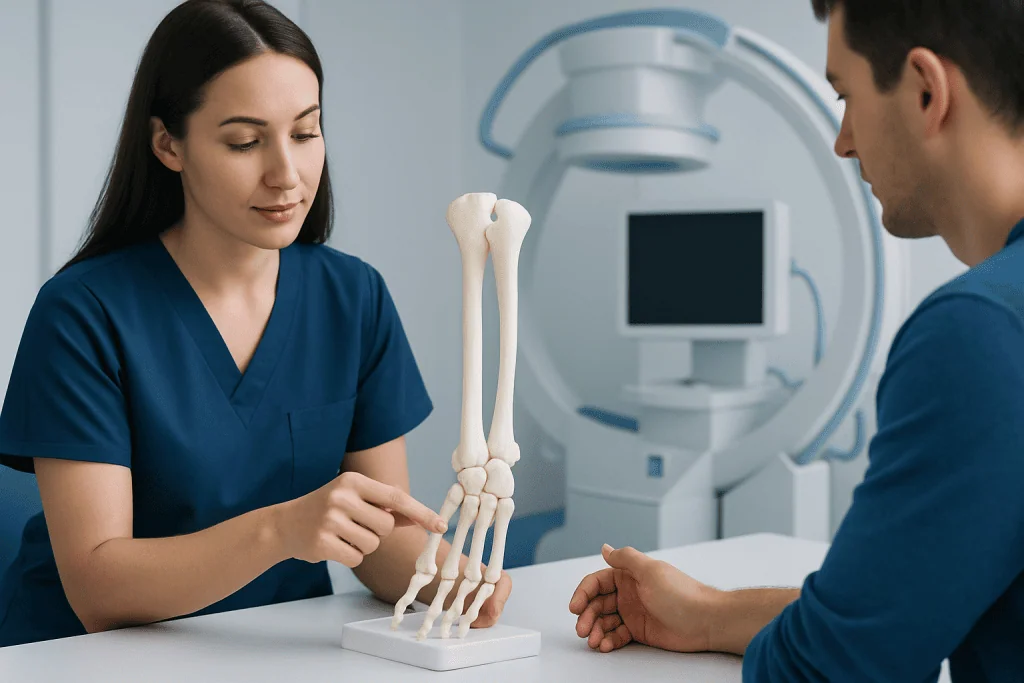
The humerus connects with the shoulder blade at the shoulder joint and with the radius and ulna at the elbow. Its rounded upper end helps create the shoulder’s wide range of motion, while its lower end forms part of the elbow, allowing bending and straightening. Strong muscles of the upper arm and shoulder attach to the humerus to produce lifting, reaching, and throwing movements.
In the forearm, the radius sits on the thumb side and the ulna on the little finger side. These two arm bones are linked by joints and a sheet of connective tissue called the interosseous membrane. This arrangement lets the radius rotate around the ulna when the forearm turns, a motion called pronation and supination. These actions are essential for daily tasks such as using a key, opening a jar, typing, or carrying objects.
The joints at each end of these bones must move smoothly while remaining stable. Cartilage reduces friction at the joint surfaces, ligaments hold the bones in alignment, and muscles provide power and control. When any part of this system is injured or inflamed, symptoms may include pain, weakness, stiffness, swelling, or reduced range of motion.
Common symptoms and problems affecting arm bones
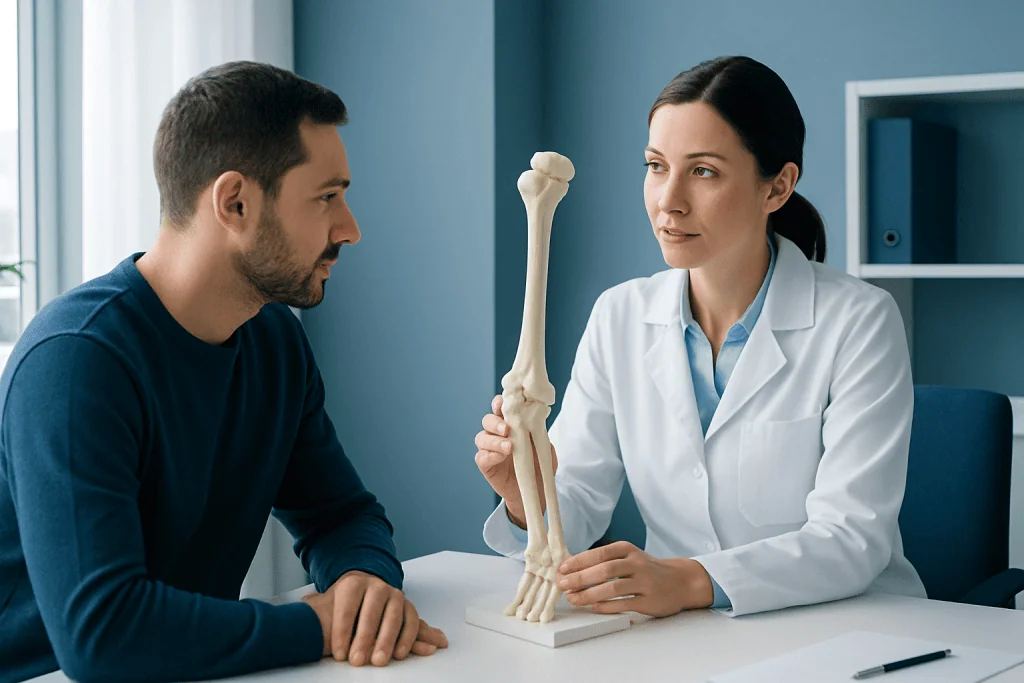
Symptoms related to arm bones can begin suddenly after an injury or develop gradually over time. Bone-related pain is often felt with movement or pressure, but it may also be present at rest, especially after a fracture or with significant inflammation. Swelling, bruising, visible deformity, and difficulty using the arm can suggest a more serious injury that needs prompt medical attention.
Fractures are among the most common arm bone problems. A break can affect the humerus, radius, or ulna and may range from a small crack to a more complex injury where the bone shifts out of position. Injuries near the wrist, elbow, or shoulder can also affect the nearby joint, which may complicate recovery. In some cases, a fracture may occur after a fall, sports injury, road traffic accident, or direct blow.
Not all arm symptoms come from a broken bone. Overuse, tendon inflammation, joint wear, and nerve compression can also cause pain around the bones. Examples include elbow pain from repetitive strain, shoulder pain linked to surrounding soft tissues, or wrist discomfort after long periods of forceful hand use. Symptoms that last more than a few days, return often, or interfere with sleep or function deserve evaluation.
- Pain after a fall or direct impact
- Swelling, bruising, or tenderness over a bone
- Reduced ability to bend, straighten, lift, or rotate the arm
- Numbness, tingling, or weakness in the hand or fingers
- A popping sound, deformity, or feeling that a joint is unstable
Causes, risk factors, and who may be affected
Arm bone injuries and disorders can affect people of all ages. In children, falls and playground injuries are common causes. In adults, sports, heavy lifting, repetitive movements, workplace tasks, and traffic accidents are frequent contributors. In older adults, balance problems and reduced bone strength can increase the chance of a fracture, especially after a minor fall.
Bone health also influences risk. Conditions that reduce bone density, such as osteoporosis, make fractures more likely. Other factors that may affect bone strength or healing include smoking, poor nutrition, low calcium or vitamin D intake, certain medications, hormonal changes, and some long-term medical conditions. For this reason, doctors may look beyond the immediate injury and consider overall bone health.
Joint and soft tissue problems can place extra stress on the arm bones as well. Shoulder instability, elbow overuse, arthritis, and previous injuries may change how force passes through the limb. Some patients with chronic pain around the upper arm may have nearby shoulder problems rather than a problem in the humerus itself. A careful assessment helps distinguish bone injury from muscle, tendon, ligament, or nerve conditions.
How doctors diagnose arm bone conditions
Diagnosis begins with a medical history and physical examination. A doctor will ask how the symptoms started, where the pain is located, whether there was trauma, and what movements make symptoms worse. The arm is then examined for tenderness, swelling, bruising, alignment, movement, circulation, and nerve function. This step is important because pain from one area may sometimes be felt elsewhere along the limb.
X-rays are usually the first imaging test when a fracture or dislocation is suspected. They can show broken bones, changes in alignment, and some joint problems. If the injury is complex or involves a joint surface, a CT scan may offer more detail. MRI may be useful when symptoms suggest damage to ligaments, tendons, cartilage, bone marrow, or nearby nerves, especially if X-rays do not fully explain the pain.
In selected cases, blood tests may be used to look for infection, inflammation, or metabolic bone problems. Bone density testing may also be considered if a low-impact fracture raises concern about weakened bones. If surgery is being considered, additional imaging and specialist review can help guide treatment planning, including options in orthopedic and traumatology care.
Treatment options for arm bone injuries and disorders
Treatment depends on the specific problem, its severity, the patient’s age and activity level, and whether joints, nerves, or blood vessels are affected. Many uncomplicated injuries can be managed without surgery. Rest, temporary immobilization with a sling or splint, ice, elevation, and pain relief may be enough for mild fractures, bruises, and overuse conditions. Follow-up is important to confirm that healing is progressing as expected.
More significant fractures may need reduction, a procedure used to restore normal alignment. Some breaks are stabilized in a cast or brace, while others need surgery if the bone is displaced, unstable, or extends into a joint. Surgical options may involve plates, screws, rods, or pins to hold the bone in place during healing. When a joint surface is involved, treatment aims not only to heal the bone but also to preserve smooth motion and long-term function.
Rehabilitation is often a key part of recovery. After a period of immobilization, stiffness and weakness are common, especially around the shoulder and elbow. Guided exercises and physical therapy and rehabilitation can help restore strength, flexibility, and confidence with daily activities. If symptoms are linked to severe joint damage rather than a fresh fracture, some patients may be assessed for procedures such as shoulder replacement in carefully selected situations.
Protecting arm bones: prevention and self-care
Many arm bone problems cannot be completely prevented, but practical steps can reduce risk. Wearing appropriate protective gear for sports, using seat belts, and making home environments safer for older adults may lower the chance of traumatic injuries. Good technique during exercise and gradual increases in training load can also help prevent overuse pain around the arm and elbow.
Bone health matters throughout life. A balanced diet with adequate calcium and vitamin D, regular weight-bearing activity, and avoiding smoking support stronger bones. People at risk of low bone density may benefit from discussing screening and prevention strategies with a doctor. For those recovering from an injury, following instructions about splints, activity limits, and exercises can reduce the risk of delayed healing or stiffness.
Self-care should be sensible and time-limited. Resting an injured arm for a short period may help, but prolonged immobilization without medical advice is not ideal. Gentle movement is often reintroduced as healing allows. Persistent pain, increasing swelling, or symptoms that limit normal tasks should not be managed with home remedies alone.
When to seek medical care
Medical care should be sought promptly after a significant fall, direct blow, sports injury, or accident if there is severe pain, swelling, deformity, or inability to move the arm. Numbness, tingling, a pale or cold hand, or obvious shortening or angulation of the limb can suggest an urgent problem. These signs may indicate a fracture, dislocation, or injury affecting blood flow or nerves.
Even if symptoms seem mild at first, a doctor should evaluate pain that does not improve, returns repeatedly, or makes it hard to sleep, work, or perform daily tasks. This is especially important for older adults, people with known bone weakness, and anyone who had a low-impact injury followed by marked pain. Early assessment can reduce the chance of complications and help the arm recover more fully.
For patients who need specialist evaluation, Acibadem International’s multidisciplinary teams in JCI-accredited hospitals assess and treat bone, joint, and trauma-related conditions for international patients. Depending on the findings, care may involve imaging, conservative management, rehabilitation, or specialist orthopedic treatment.
Frequently asked questions
What are the three main arm bones?
The three main arm bones are the humerus, radius, and ulna. The humerus is in the upper arm, while the radius and ulna are in the forearm. Together they support movement from the shoulder to the wrist.
Is the forearm part of the arm bones?
Yes. In everyday language, people often call the whole limb the arm, and the forearm contains two of the main arm bones: the radius and ulna. In medical use, the upper arm and forearm are often described separately to improve accuracy.
How can someone tell if an arm bone may be broken?
A possible broken arm bone may cause sudden pain, swelling, bruising, tenderness, or difficulty moving the limb after an injury. Deformity, a cracking sound, numbness, or weakness can also occur. Only a medical examination and imaging, usually an X-ray, can confirm a fracture.
Do all arm bone fractures need surgery?
No. Many arm bone fractures can heal with immobilization, rest, and follow-up care if the bone remains well aligned. Surgery is more likely when the fracture is displaced, unstable, involves a joint, or affects nearby nerves or blood vessels.
Why does the forearm rotate?
The forearm rotates because the radius and ulna are arranged to move together in a specialized way. This allows the hand to turn palm-up and palm-down, which is important for gripping, lifting, and many everyday tasks.
Can arm bone pain happen without an injury?
Yes. Arm bone pain may be related to overuse, joint problems, nearby tendon or muscle conditions, or reduced bone strength. Sometimes pain felt near a bone actually starts in a neighboring joint such as the shoulder, elbow, or wrist, so proper assessment is important.
References
- American Academy of Orthopaedic Surgeons
- National Institute of Arthritis and Musculoskeletal and Skin Diseases
- Mayo Clinic
- MedlinePlus
- National Health Service
This article is for general information only and is not a substitute for professional medical advice. Please consult a qualified doctor about your individual situation.
Joint and spine care in Turkey — expert assessment & treatment
JCI-accredited · board-certified surgeons · reply within 24h
Add us as a Preferred Source to see more of our trusted health content across Google Search, AI Overviews and Discover.

More from the Health Library

Pulmonary Edema — Explained by Medical Evidence, Not Myths

Best Exercises for Legs: What Patients Need to Know

Piercing Bump: What Patients Need to Know

Lomotil: A Complete Medical Overview

Nail Clubbing: A Complete Medical Overview

Prenatal Depression — Explained by Medical Evidence, Not Myths
Orthopedic Surgery & Traumatology Specialists at Acibadem

Assoc. Prof. Dr. Berkin Toker
Orthopedic Surgery & Traumatology
Assoc. Prof. Dr. Bertan Cengiz
Orthopedic Surgery & Traumatology
Dr. Betül Toygar
Physical Medicine & Rehabilitation
Fzt. Beyza Nur Gündüz
Physical Medicine & Rehabilitation