Resistance Bands: What Patients Need to Know

Resistance bands can help improve strength, balance, flexibility, and function with low equipment needs. They are useful for home exercise, travel, general fitness, and many supervised rehabilitation programs.
Key Takeaways
- Resistance bands can help improve strength, balance, flexibility, and function with low equipment needs.
- They are useful for home exercise, travel, general fitness, and many supervised rehabilitation programs.
- Safe use depends on correct form, gradual progression, and checking the band for wear before each session.
- People with pain, recent injury, surgery, or chronic medical conditions should ask a clinician or physical therapist which exercises are suitable.
- Bands should challenge muscles without causing sharp pain, numbness, dizziness, or loss of control.
Resistance bands are flexible exercise tools used to build strength, support rehabilitation, and improve mobility with relatively low impact on joints. For many people, they are a practical way to begin or continue exercise, as long as the band type, tension, and technique are appropriate for the person's health status and goals.
Overview: What Resistance Bands Are and Why People Use Them
Resistance bands are elastic exercise tools that create tension as they stretch. They are commonly used for strengthening, mobility work, balance practice, warm-ups, and rehabilitation. Because the resistance can feel gradual rather than abrupt, many people find bands approachable, especially when starting exercise or returning after a break.
One reason resistance bands are widely used is that they can support many different fitness levels. A beginner may use a light band for gentle shoulder or hip exercises, while an athlete may use a heavier band to challenge larger muscle groups. Bands can also be used sitting, standing, lying down, or alongside other training methods.
Another advantage is convenience. Resistance bands are lightweight, portable, and do not require much space. This makes them useful for home routines, travel, and people who prefer short, frequent exercise sessions instead of longer gym workouts.
From a health perspective, resistance bands are not only for fitness. They are often included in supervised recovery plans to help restore movement and muscle control after injury or surgery. In some cases, a doctor may recommend assessment for joint or spine problems before starting exercise, especially if symptoms suggest conditions such as a herniated disc or ongoing scoliosis.
How Resistance Bands Work in the Body
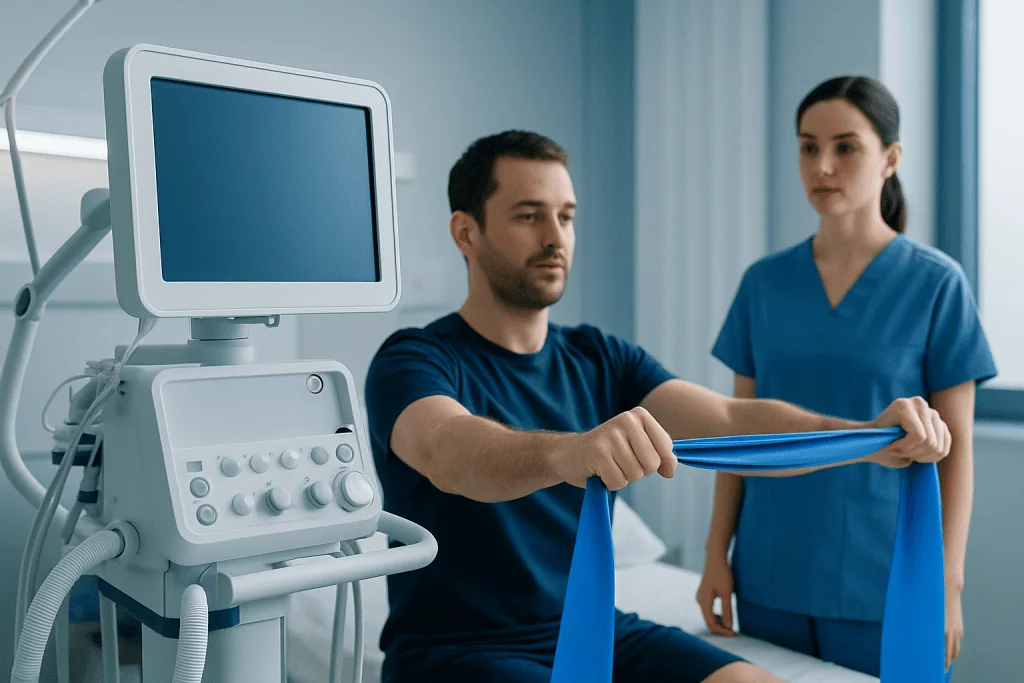
Resistance training challenges muscles so they must work against a force. With resistance bands, that force increases as the band stretches. This can activate muscles through a controlled range of motion and may help improve strength, coordination, and endurance over time.
Bands can also encourage slower, more deliberate movement. This is helpful because many people benefit from learning how to control posture, breathing, and joint alignment during exercise. In rehabilitation settings, bands are often used to retrain specific muscle groups that support the shoulders, hips, knees, and core.
Compared with some forms of heavier weight training, resistance bands may place less compressive load on joints during certain exercises. That does not mean they are risk-free, but it can make them a practical option for people who need a lower-impact approach. The best program still depends on the person’s age, baseline fitness, symptoms, and medical history.
Different types of bands include flat therapy bands, loop bands, mini bands, and tube bands with handles. Each style has different uses. For example, mini bands are often used around the thighs or ankles for hip activation, while longer bands may assist stretching or support pull-based exercises.
Potential Benefits of Resistance Bands

When used consistently, resistance bands can support several aspects of physical health. They can help improve muscle strength, joint stability, posture, and everyday function. For older adults and people recovering from deconditioning, these benefits may translate into easier movement during daily activities such as standing up, climbing stairs, and carrying light objects.
Bands can also be useful for mobility and balance training. Certain exercises may help improve body awareness and control, especially around the hips, shoulders, and trunk. In structured programs, this can support fall prevention, movement confidence, and safe return to regular activity.
Another benefit is adaptability. Resistance bands can be used for short exercise sessions at home, in the office, or during travel. They may suit people who are not ready for gym-based strength training or who need an affordable, space-saving option.
Common reasons people choose resistance bands include:
- Low-impact strength training
- Home exercise with minimal equipment
- Warm-up and muscle activation before sport
- Support for supervised rehabilitation
- Gradual progression from gentle to more challenging exercise
Who May Benefit Most and Who Should Be Cautious
Resistance bands may be especially helpful for beginners, older adults, people who travel often, and those following a physical therapy program. They can also support people who want to add variety to a walking or home fitness routine. In many cases, bands are introduced gradually to improve confidence with movement before progressing to other forms of strengthening.
Even so, not every exercise is suitable for every person. Someone with severe joint pain, unstable balance, recent surgery, uncontrolled blood pressure, chest symptoms with exertion, or a recent fracture may need medical guidance first. Exercises that seem simple can still aggravate symptoms if form is poor or if the resistance is too strong.
People with shoulder, neck, back, or knee pain should be particularly careful with movement patterns that involve twisting, overhead pulling, or deep bending under tension. If a person is already being evaluated for conditions affecting mobility, they may need targeted advice from a rehabilitation specialist. In some cases, a doctor may recommend physical therapy and rehabilitation to create a safer, individualized plan.
Pregnant individuals, people with osteoporosis, and those with neurological conditions may also need tailored exercise advice. A clinician can help decide which movements are appropriate, how often to exercise, and when to stop or modify an activity.
How to Use Resistance Bands Safely
Safe use starts with choosing the right band. A band should provide enough tension to challenge the muscles while still allowing smooth, controlled movement. If the band is so tight that form breaks down, the shoulders elevate, the back arches excessively, or the person has to hold their breath, the resistance is likely too high.
Before each session, the band should be checked for tears, cracks, thinning, or worn areas. Damaged bands can snap and cause injury. It is also important to secure the band correctly and avoid anchoring it to unstable furniture or objects that can move suddenly.
During exercise, good technique matters more than the number of repetitions. Movements should be slow and controlled, with steady breathing and attention to alignment. A person should stop if they feel sharp pain, tingling, dizziness, chest discomfort, or sudden weakness. Mild muscle effort is expected; pain is not the goal.
Helpful safety habits include:
- Start with low resistance and short sessions
- Warm up with gentle movement first
- Use a full but comfortable range of motion
- Rest between sessions to allow recovery
- Keep bands away from direct heat and sunlight when stored
- Ask for instruction if technique is uncertain
Building a Simple, Effective Routine
A balanced resistance band routine usually includes major muscle groups, not just one area of the body. Many programs combine pushing, pulling, hip and leg work, core stability, and mobility exercises. Starting with a few well-performed movements is often more useful than trying many exercises at once.
For general fitness, people often begin with two or three sessions per week on nonconsecutive days. A session may include a warm-up, several strengthening exercises, and a brief cool-down. Progress is usually made by increasing repetitions, improving control, or moving to a slightly stronger band rather than making large jumps in difficulty.
Common beginner-friendly exercises may include rows, chest press variations, seated or standing leg extensions, side steps with a loop band, biceps curls, and gentle shoulder external rotation. The exact choices should match the person’s goals and health status. For example, someone with chronic low back pain may need a more individualized core and hip program.
If pain persists despite modifying exercise, medical assessment may be appropriate. Depending on the cause, treatment options can include guided orthopedic evaluation or a structured rehabilitation plan. In more complex musculoskeletal cases, clinicians may also coordinate care with sports medicine specialists.
When to Seek Medical Care
Medical advice is important if pain begins suddenly during band exercise, especially if it is severe, associated with a popping sensation, or followed by swelling, marked weakness, or inability to bear weight. These features can suggest an injury that needs proper assessment rather than continued home exercise.
A doctor should also be consulted if symptoms last more than a few days, repeatedly return with activity, or interfere with sleep and daily function. Neck pain that travels into the arm, back pain with numbness or leg weakness, or joint pain with locking or instability should not be ignored.
Urgent medical attention is needed for chest pain, shortness of breath, fainting, sudden severe headache, loss of bladder or bowel control, or rapidly worsening neurological symptoms during or after exercise. These symptoms are not typical exercise discomfort and require prompt evaluation.
Near the end of a care journey, some people need more than general exercise advice. Acibadem International’s multidisciplinary specialists at JCI-accredited hospitals diagnose and treat musculoskeletal and rehabilitation-related concerns for international patients when further evaluation is needed.
Frequently asked questions
Are resistance bands effective for building strength?
Yes. Resistance bands can help build strength when exercises are done regularly with proper technique and gradually increased challenge. They may be especially useful for beginners, home exercisers, and people in rehabilitation.
Are resistance bands better than weights?
Neither option is universally better. Resistance bands and weights both have benefits, and the best choice depends on a person's goals, experience, joint health, and access to equipment. Some people use both as part of a balanced program.
Can older adults use resistance bands safely?
Many older adults can use resistance bands safely, especially with low resistance and good supervision at the start. Bands may support strength, balance, and day-to-day function. A clinician or physical therapist can help select appropriate exercises if there are medical concerns.
Can resistance bands help during rehabilitation?
They are often used in rehabilitation to improve muscle activation, control, and gradual strengthening. However, the exercises need to match the specific injury or surgery. A rehabilitation professional should guide the plan when symptoms are significant or recovery is complex.
What are the main risks of resistance band exercise?
The main risks include poor technique, using too much tension, and injury from a worn or poorly anchored band. These problems can lead to muscle strain, joint irritation, or a snapping band. Checking equipment and progressing slowly lowers risk.
How often should someone use resistance bands?
For general strength training, many people start with two or three sessions per week on nonconsecutive days. The right frequency varies by age, fitness level, exercise intensity, and any medical condition or injury. Rest and recovery are part of safe progress.
References
- World Health Organization
- Centers for Disease Control and Prevention
- American College of Sports Medicine
- National Institute on Aging
- American Physical Therapy Association
This article is for general information only and is not a substitute for professional medical advice. Please consult a qualified doctor about your individual situation.
Joint and spine care in Turkey — expert assessment & treatment
JCI-accredited · board-certified surgeons · reply within 24h
Add us as a Preferred Source to see more of our trusted health content across Google Search, AI Overviews and Discover.
Check your numbers in seconds
BMI, calories, due date, blood pressure and 30+ more clinical calculators — free, instant, doctor-reviewed ranges.