Rollator — Explained by Medical Evidence, Not Myths

A rollator is different from a standard walker because it has wheels, hand brakes, and often a built-in seat. It may help people who need support with walking but can still control a wheeled device safely.
Key Takeaways
- A rollator is different from a standard walker because it has wheels, hand brakes, and often a built-in seat.
- It may help people who need support with walking but can still control a wheeled device safely.
- Proper fit, brake use, posture, and home safety measures are important to reduce fall risk.
- A doctor or physical therapist can help decide whether a rollator, cane, or standard walker is the best option.
- New weakness, frequent falls, dizziness, or sudden changes in walking should be medically evaluated.
A rollator is a wheeled walking aid designed to support mobility, balance, and confidence during walking. It can be helpful for some people, but the safest choice depends on the person’s strength, balance, environment, and medical condition.
What a rollator is and what it does
A rollator is a type of walking aid with a frame, wheels, hand grips, and usually hand brakes. Many models also include a seat and storage basket. Unlike a standard walker, which is lifted or advanced in steps, a rollator rolls forward and is guided by the user. This can make walking smoother and less tiring for some people.
Its main purpose is to provide support during walking while allowing a more continuous gait. A rollator may help a person who feels unsteady, gets tired when walking, or needs a place to rest during longer distances. It is commonly used by older adults, people recovering from illness or surgery, and those with chronic conditions that affect balance, strength, or endurance.
A rollator is not the right choice for everyone. Because it moves on wheels, it requires enough hand control, attention, and balance to steer it safely and use the brakes when needed. For some people, a standard walker or another mobility device may provide better stability.
How a rollator differs from a walker or cane
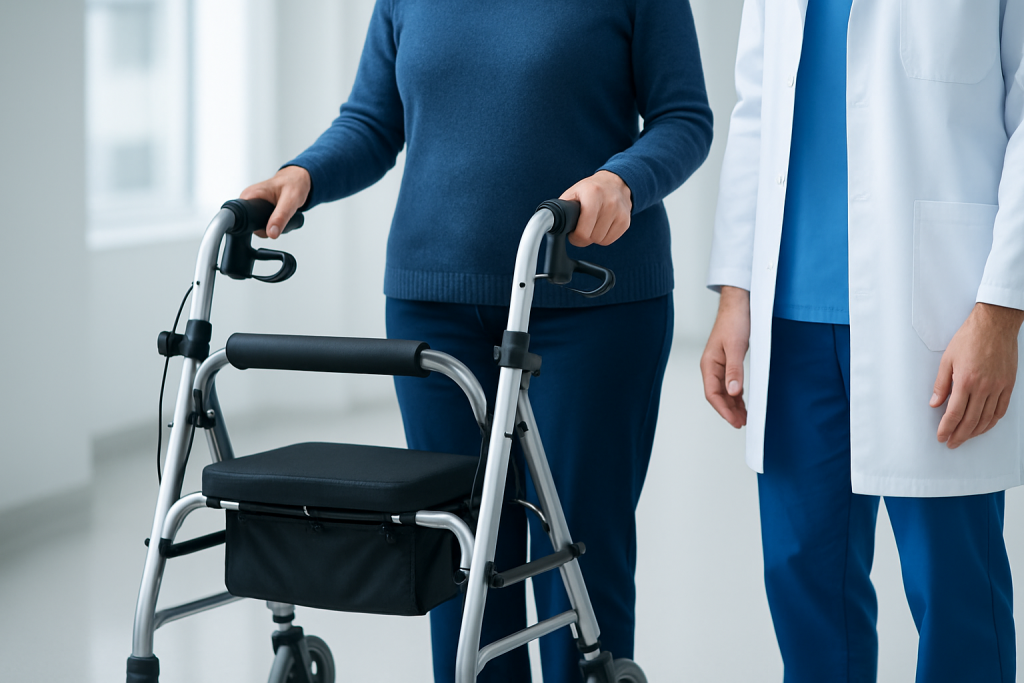
The term “walker” is often used broadly, but there are important differences between devices. A standard walker usually has four legs and no wheels, or wheels only on the front legs. It tends to offer more stability because it does not roll away easily. A rollator, in contrast, usually has three or four wheels and is designed to move with less lifting and less upper-body effort.
A cane provides lighter support and may suit a person with mild balance issues or pain on one side of the body. A rollator generally offers more support than a cane but less fixed stability than a standard walker. The best option depends on how much support is needed, how the person walks, and whether they can manage turns, slopes, and braking.
Choosing the wrong device can make walking harder rather than easier. Someone with significant weakness, confusion, severe balance loss, or poor hand grip may find a rollator difficult to control. A clinical assessment can help match the device to the person’s needs instead of relying on trial and error.
- Cane: for mild support needs
- Standard walker: for maximum stability during walking
- Rollator: for supported mobility with wheels, especially when endurance is limited
Who may benefit from a rollator

A rollator may benefit people who can walk but need extra support, especially over longer distances. Common examples include individuals with reduced stamina, mild to moderate balance problems, joint pain, leg weakness, or shortness of breath during activity. The built-in seat can be helpful for someone who needs rest breaks while shopping, traveling, or moving around large indoor spaces.
It may also be useful during recovery after certain operations or after periods of illness that reduce strength. In rehabilitation, therapists sometimes recommend a rollator as part of a broader plan that includes exercises, balance training, and home-safety changes. For some people with age-related gait changes, it can improve confidence and encourage movement rather than avoidance of activity.
However, a rollator should not be seen as a substitute for finding the cause of walking difficulty. Problems such as arthritis, vestibular disorders, nerve disease, stroke effects, Parkinsonian symptoms, or muscle weakness may need proper evaluation. If walking changes are related to a known condition such as Parkinson’s disease or painful joint damage such as osteoarthritis, treatment of the underlying problem remains important.
Evidence-based safety points and common myths
One common myth is that any mobility aid automatically prevents falls. In reality, a rollator can reduce effort and improve support, but only when it is appropriately selected, fitted, and used correctly. If the frame is too high or too low, if brakes are not used properly, or if the person leans too far forward, the device may increase risk instead of reducing it.
Another myth is that using a rollator causes dependence or weakness. For many people, the opposite may be true: the right device can allow safer activity, more walking, and more participation in daily life. Remaining active is important for muscle strength, cardiovascular health, and confidence. At the same time, if the device is being used because of a new or unexplained problem, the cause should still be assessed.
A third myth is that all rollators are the same. In practice, wheel size, frame width, brake style, seat height, and turning radius all affect safety and comfort. Outdoor use may require larger wheels and good brake function, while indoor use often requires a narrower frame that moves easily through doorways. For some patients, targeted rehabilitation and physical therapy and rehabilitation help them learn safer walking patterns and determine whether a rollator is the best option.
Choosing the right rollator and using it correctly
Fit matters. The hand grips should usually be around wrist level when the person stands upright with arms relaxed by the sides. This helps keep the elbows slightly bent and promotes a more natural posture. If the handles are too low, the person may hunch forward; if too high, shoulder strain and poor control can result.
Safe use starts with posture and technique. The person should stand inside the frame rather than pushing it too far ahead. Walking should be slow and steady, with attention to uneven surfaces, thresholds, wet floors, and crowded spaces. Before sitting on the built-in seat, the brakes should be locked and the device placed on level ground.
It is also important to check the device regularly. Brakes, wheels, folding mechanisms, and seat stability should work as intended. Loose parts or worn brake pads can make a rollator unsafe. A physical therapist or rehabilitation professional can teach turning, curb negotiation, transfers, and home navigation; in some cases, a broader stroke rehabilitation or balance program may be relevant when gait problems follow a neurological event.
- Use the brakes before sitting or standing up from the seat.
- Avoid hanging heavy bags from the handles, which can affect balance.
- Wear supportive shoes with good grip.
- Remove loose rugs and clutter at home.
- Use extra caution on ramps, gravel, and wet ground.
Medical evaluation, diagnosis, and related treatment options
If a person needs a rollator, the next question is often why walking has become harder. A clinician may review symptoms such as pain, dizziness, numbness, weakness, shortness of breath, or falls. The evaluation may include a medical history, medication review, balance testing, strength assessment, gait observation, and sometimes imaging or other tests depending on the suspected cause.
Underlying causes are diverse. They may include joint disease, spinal problems, inner-ear disorders, neuropathy, muscle conditions, heart or lung disease, and neurological disorders. In some cases, specialists look for issues such as spinal stenosis, recovery after a stroke, or movement disorders. If symptoms suggest a nerve, brain, or spine cause, further care may involve neurological rehabilitation as part of treatment planning.
Treatment depends on the diagnosis. It may include exercise therapy, medication review, pain management, treatment of dizziness, vision correction, management of chronic disease, or home modifications. The goal is not only to provide a mobility aid, but also to improve function and reduce future risks. Near the end of the care pathway, patients may also benefit from a review of whether the current device remains the best choice as their condition changes.
When to seek medical care
Medical advice is recommended if walking has recently become less steady, if falls are becoming more frequent, or if a person suddenly starts needing support to walk. New symptoms such as one-sided weakness, severe dizziness, chest discomfort, fainting, new confusion, or trouble speaking need prompt medical attention because they may signal an urgent condition.
A review is also important when a rollator feels difficult to control, seems to worsen posture, or does not reduce fatigue or instability. Pain in the hips, knees, back, or feet during use may suggest that the device is poorly fitted or that an underlying condition needs treatment. Reassessment can improve both safety and comfort.
People with progressive neurological disease, recent surgery, or recovery after hospitalization may benefit from formal mobility assessment rather than choosing a device alone. Acibadem International’s multidisciplinary specialists and JCI-accredited hospitals evaluate walking and balance problems for international patients and guide treatment when needed.
Frequently asked questions
What is a rollator used for?
A rollator is used to support walking in people who need help with balance, endurance, or stability. It can also provide a place to sit and rest during longer walks or daily activities.
Is a rollator safer than a standard walker?
Not always. A rollator may feel easier to move, but it is safest for people who can control a wheeled device and use the brakes properly. A standard walker may be better for someone who needs more fixed stability.
Can a rollator help prevent falls?
It can help reduce fall risk for some people, especially when it is correctly fitted and used as instructed. However, it does not guarantee fall prevention, and the reasons for falling should still be assessed by a clinician.
Who should not use a rollator?
A rollator may not be suitable for someone with severe balance problems, significant confusion, very weak hand grip, or difficulty using hand brakes. In these cases, another mobility aid may be safer.
How do you know if a rollator fits properly?
In general, the handles should be near wrist height when the person stands upright with arms relaxed. A proper fit allows a slight bend in the elbows and helps avoid stooping or shoulder strain.
Should a person see a doctor before getting a rollator?
It is often a good idea, especially if walking has changed recently or falls have occurred. A doctor or physical therapist can help identify the cause and recommend the safest device.
This article is for general information only and is not a substitute for professional medical advice. Please consult a qualified doctor about your individual situation.
Explore treatments in Turkey — costs, top hospitals & a free quote
JCI-accredited · board-certified surgeons · reply within 24h
Add us as a Preferred Source to see more of our trusted health content across Google Search, AI Overviews and Discover.

More from the Health Library

Advair: A Complete Medical Overview

Sitting at the Toilet — Explained by Medical Evidence, Not Myths

C Diff: A Complete Medical Overview

Throat lozenges: Symptoms, Causes, and Treatment — Complete Patient Guide

Typhoid: What Patients Need to Know