Mole vs Freckle: Key Differences and How Doctors Tell Them Apart

Freckles are usually flat and become more noticeable with sun exposure. Moles are made of clustered pigment cells and can be flat, raised, smooth, or slightly textured.
Key Takeaways
- Freckles are usually flat and become more noticeable with sun exposure.
- Moles are made of clustered pigment cells and can be flat, raised, smooth, or slightly textured.
- A new or changing dark spot should be assessed by a qualified clinician, especially if it looks different from others.
- Dermatologists often use visual exam and dermoscopy to distinguish harmless spots from those that need biopsy.
- Most freckles are harmless, but some moles need monitoring because they can rarely develop into skin cancer.
In a mole vs freckle comparison, freckles are usually small, flat, sun-related pigment spots, while moles are collections of pigment-producing cells that may be flat or raised. Doctors tell them apart by looking at color, borders, texture, change over time, and sometimes using dermoscopy or a biopsy.
Overview: mole vs freckle at a glance
When comparing a mole vs freckle, the simplest difference is this: freckles are flat patches of extra pigment, while moles are growths made from clusters of pigment-producing skin cells called melanocytes. Both can be brown or tan, and both are often harmless, but they do not form in the same way and are not managed in exactly the same way.
Freckles usually appear after sun exposure and may darken in summer or fade when sun exposure decreases. Moles can be present from childhood or appear later in life, and they tend to persist rather than fade seasonally. Some moles are completely flat, while others are raised, dome-shaped, or flesh-colored.
A practical way to understand the difference is to compare their usual features side by side:
- Freckle: flat, small, evenly colored, linked to sun exposure, often fades somewhat over time or in winter
- Mole: a true skin growth of melanocytes, may be flat or raised, often stays long term, may be tan, brown, black, pink, or skin-colored
- Freckle: commonly appears in clusters on sun-exposed areas such as the face, shoulders, and arms
- Mole: may appear anywhere on the body, including less sun-exposed areas
- Freckle: usually does not have a different texture from surrounding skin
- Mole: may feel smooth, slightly bumpy, or elevated
Because the two can overlap in appearance, especially when a mole is flat and small, a clinician looks not only at what a spot looks like today but also how it has behaved over time. That clinical context often matters as much as color alone.
What freckles are and what moles are
Freckles, also called ephelides, are tiny areas of increased pigment in the outer skin. They are especially common in people with lighter skin tones, red or blonde hair, or a family tendency toward freckling. Sunlight stimulates pigment production, which is why freckles often become darker after time outdoors and lighter during periods of less sun exposure.
Moles, also called melanocytic nevi, are made of grouped melanocytes. They can be congenital, meaning present at birth, or acquired later in life. A mole may start as a flat spot and then become slightly raised over time. It may remain stable for many years, gradually lighten with age, or change in a predictable benign way.
This is why a mole is not simply a “dark freckle.” Although both involve pigment, a freckle reflects increased pigment production in the skin, while a mole represents a collection of pigment cells. That difference helps explain why freckles tend to come and go with sun exposure, while moles are more persistent.
Some other pigmented lesions can also resemble either freckles or moles, including lentigines, seborrheic keratoses, and sun spots. In certain cases, a clinician may also want to rule out skin cancer or other concerning lesions, especially when a spot is new, changing, or unusual for that person.
How a clinician tells them apart
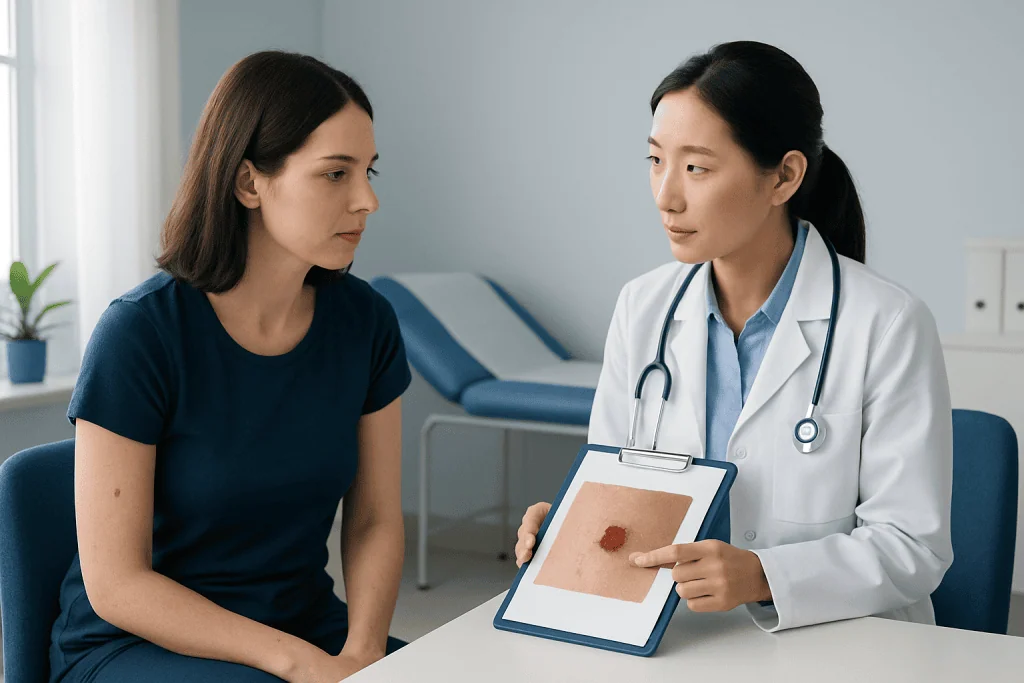
Doctors do not rely on one feature alone. They assess the spot’s color, shape, border, size, symmetry, surface, and location. They also ask when it first appeared, whether it changes with sun exposure, and whether it has recently grown, become raised, bled, crusted, or started to itch.
Freckles are usually very small, flat, and evenly pigmented. Their borders are often soft but regular, and many similar freckles are often found nearby on sun-exposed skin. A mole may also be evenly colored and harmless, but it is more likely than a freckle to have a distinct outline, persistent presence, or a palpable texture.
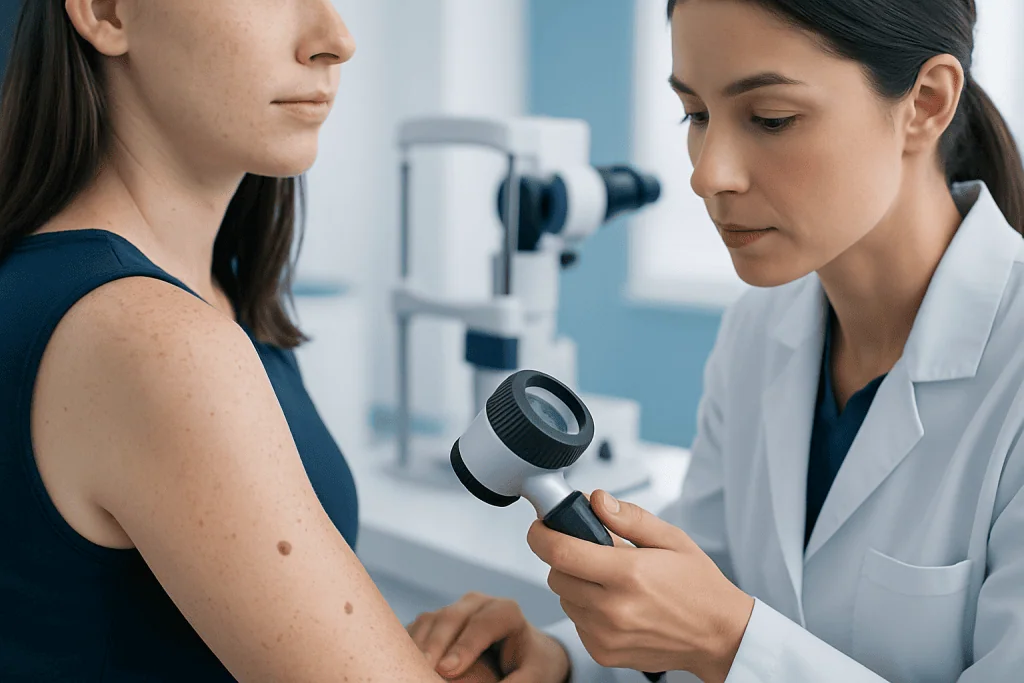
Dermatologists often use dermoscopy, a handheld magnifying device with light, to look beneath the skin surface. Dermoscopy can reveal pigment patterns that help distinguish freckles, moles, and lesions that need closer assessment. This step is especially useful when a spot is too subtle to classify confidently by the naked eye alone.
If the diagnosis is still uncertain or if the lesion has suspicious features, the doctor may recommend a skin biopsy or complete removal for laboratory analysis. In some situations, evaluation may involve dermatology assessment and, if needed, skin cancer treatment planning based on the final diagnosis.
Warning signs that matter more than the name
Many people focus on whether a spot is a mole or a freckle, but what often matters most clinically is whether it looks stable and typical. A harmless mole can be more important to monitor than a harmless freckle, and a new dark spot that seems unlike the rest deserves attention even if it resembles a freckle at first glance.
Doctors commonly use the ABCDE guide for moles and other pigmented spots:
- A – Asymmetry: one half does not match the other
- B – Border: edges are irregular, blurred, or notched
- C – Color: more than one color, or very uneven pigment
- D – Diameter: larger size can be a clue, though small lesions can also be important
- E – Evolving: any noticeable change in size, shape, color, height, or symptoms
Another useful clue is the “ugly duckling” sign. This means a spot looks different from the person’s other moles or freckles. Even when it does not meet every ABCDE point, a lesion that stands out from the rest may need professional review.
Symptoms such as bleeding, persistent crusting, tenderness, itching, or a sore that does not heal should also be taken seriously. These features do not automatically mean cancer, but they are strong reasons to arrange a skin examination.
What to do for a freckle and what to do for a mole
Most freckles do not need treatment. They are generally harmless and mainly reflect sun sensitivity and sun exposure. The usual approach is skin protection rather than removal. Daily broad-spectrum sunscreen, protective clothing, shade, and avoiding tanning help prevent freckles from darkening and reduce further sun damage.
Moles are managed differently because they are true melanocytic lesions. A stable, typical mole often just needs observation. People who have many moles, a family history of melanoma, fair skin, significant sun exposure, or a personal history of skin cancer may benefit from regular skin checks and self-monitoring.
If a mole is suspicious, irritated by clothing, or located in a place that is hard to monitor, a doctor may recommend removal. Removal is not usually necessary for a typical freckle. If there is concern about melanoma or another serious lesion, the doctor may organize oncology care alongside dermatology and pathology review.
Photographing a spot with good lighting and comparing it over time can be helpful, but self-checks do not replace a professional evaluation. It is safest not to try to diagnose or remove pigmented lesions at home.
Prevention and self-checks
Sun protection is one of the most useful steps for both freckles and moles. It can reduce freckling, lower cumulative ultraviolet damage, and make it easier to notice meaningful change in pigmented spots. Practical measures include broad-spectrum sunscreen, reapplication during outdoor activity, hats, sunglasses, and sun-protective clothing.
Monthly self-checks can help people become familiar with their own skin pattern. The goal is not to inspect every spot with anxiety, but to notice whether any lesion is new, changing, or clearly different from the rest. A full-length mirror and a hand mirror can help check the scalp, back, soles, and other difficult areas.
Taking baseline photographs can be especially useful for people with many moles. A clinician may also recommend professional mole mapping or periodic dermoscopic monitoring in selected cases. This can help avoid unnecessary worry while also identifying significant changes earlier.
Children and teenagers commonly develop new moles as they grow, and freckles often become more visible after sun exposure. Even so, any lesion that changes rapidly, bleeds, or looks unusual should be assessed. Good sun habits early in life support lifelong skin health.
When to seek medical care
Medical advice should be sought if a spot is new and dark, changing over weeks to months, bleeding without clear injury, itching persistently, crusting, or becoming irregular in shape or color. A lesion that looks different from a person’s other moles or freckles also deserves a professional opinion.
People at higher risk may need a lower threshold for evaluation. This includes those with many moles, atypical moles, a personal or family history of melanoma, a weakened immune system, or a history of significant sunburns or tanning bed use.
A clinician may be able to reassure the person after a simple examination, or may recommend dermoscopy, follow-up photography, or biopsy. If a suspicious lesion is found, prompt assessment helps guide the next step and can rule out conditions such as melanoma. Near the end of the care pathway, patients seeking coordinated assessment may find that Acibadem International’s multidisciplinary specialists and JCI-accredited hospitals diagnose and treat skin lesions for international patients.
In short, not every dark spot is dangerous, and most freckles and many moles are benign. The safest approach is to monitor what is familiar, protect the skin from sun damage, and have any concerning change checked by a qualified doctor.
Frequently asked questions
Can a freckle turn into a mole?
A freckle does not usually turn into a mole because they are different types of skin lesions. A freckle is a flat area of increased pigment, while a mole is a cluster of pigment cells. However, a new mole can appear near freckles, which may make it seem as though one changed into the other.
Are freckles always harmless?
Freckles are usually harmless and are commonly linked to sun exposure and skin type. Still, a spot that looks like a freckle but is new, irregular, very dark, or changing should be checked. Not every pigmented spot on sun-exposed skin is a true freckle.
How do doctors check whether a mole is concerning?
Doctors examine the lesion's color, symmetry, border, size, and whether it has changed over time. They may use dermoscopy to see skin structures more clearly. If the lesion remains uncertain or has suspicious features, a biopsy may be recommended.
Is a raised spot more likely to be a mole than a freckle?
Yes, a raised spot is more likely to be a mole than a freckle because freckles are typically flat. However, not every raised spot is a mole, and not every mole is raised. A clinician considers several features together rather than relying on elevation alone.
Should a child with many freckles or moles see a doctor?
Many freckles and moles can be normal in children, especially with fair skin or a family tendency. A medical review is sensible if a lesion is changing quickly, bleeding, very asymmetrical, or clearly different from the child's other spots. Routine pediatric or dermatology advice may also help families learn what to monitor.
Can skin cancer look like a freckle?
Yes, some early skin cancers can resemble a freckle or a small flat mole. This is one reason doctors focus on change, irregularity, and whether a spot stands out from nearby lesions. Any suspicious pigmented spot should be assessed rather than assumed to be harmless.
This article is for general information only and is not a substitute for professional medical advice. Please consult a qualified doctor about your individual situation.
Explore treatments in Turkey — costs, top hospitals & a free quote
JCI-accredited · board-certified surgeons · reply within 24h
Add us as a Preferred Source to see more of our trusted health content across Google Search, AI Overviews and Discover.

More from the Health Library

Do Vegetarians Eat Eggs? Here Is What the Evidence Says
What Is the Best Sleep Schedule? Here Is What the Evidence Says

Is Coke Zero Bad for U? Here Is What the Evidence Says

Why Is My Stomach Making Noise? Here Is What the Evidence Says

Prednisone Withdrawal Symptoms Explained: Common Triggers and Red Flags