Scaption: An Evidence-Based Guide for Patients

Scaption raises the arms in the scapular plane, usually about 30 to 45 degrees forward from the body’s side. It may help build shoulder strength, control, and endurance when included in an appropriate exercise plan.
Key Takeaways
- Scaption raises the arms in the scapular plane, usually about 30 to 45 degrees forward from the body’s side.
- It may help build shoulder strength, control, and endurance when included in an appropriate exercise plan.
- Good technique, light resistance, and a comfortable range of motion are more important than lifting heavy weights.
- Pain that is sharp, worsening, associated with weakness, or follows an injury should be assessed by a healthcare professional.
- Scaption is not suitable for every shoulder condition and should be adapted by a clinician when pain or limited motion is present.
Scaption is a controlled arm-lifting exercise performed slightly forward of the body rather than directly to the side. It is commonly used in shoulder conditioning and rehabilitation because it can train the deltoid and rotator cuff in a position that often feels more natural for the shoulder joint.
What Is Scaption?
Scaption is a shoulder movement in which the arms are lifted in the scapular plane. This plane sits between lifting the arms straight in front of the body and lifting them directly out to the sides. For most people, it means raising the arms roughly 30 to 45 degrees forward from the side of the body, often with the thumbs pointing upward or slightly forward.
The term combines “scapula,” meaning shoulder blade, with “elevation.” The shoulder blades and upper-arm bones are designed to move together during arm elevation. Because scaption follows a commonly used arm path in daily activity, it is frequently included in physiotherapy, sports conditioning, and shoulder-strengthening programs.
Scaption is an exercise, not a diagnosis. It may be useful for some people with reduced shoulder strength, after an individualized assessment, or as part of general fitness. However, it should not be used to push through significant pain, particularly after a fall, sudden injury, or shoulder surgery.
Why the Scapular Plane Matters
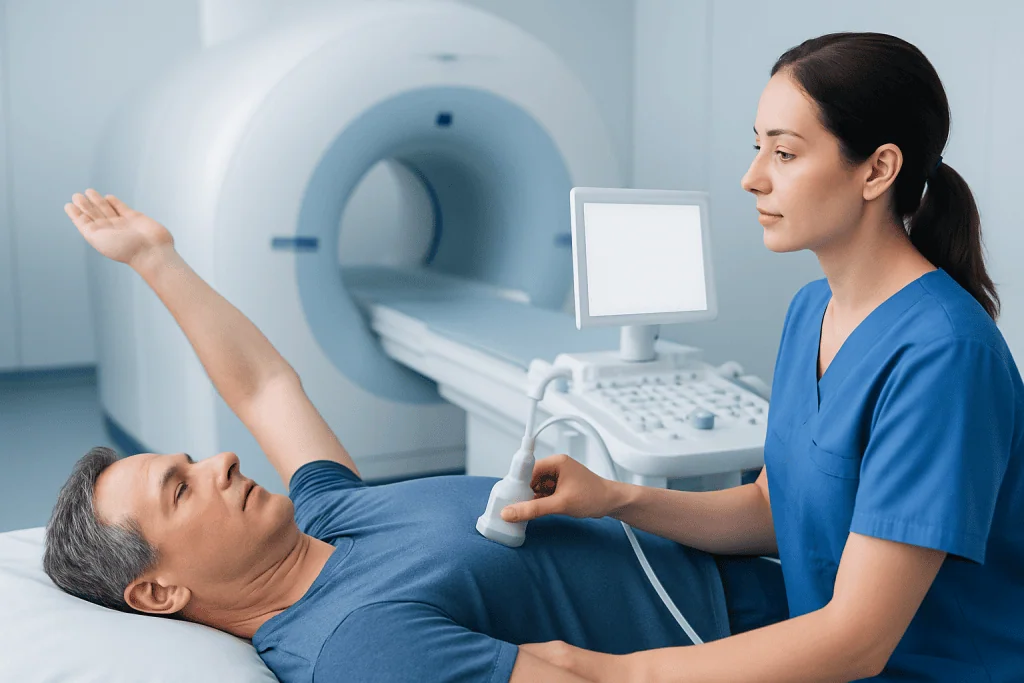
The shoulder is a complex system involving the upper arm bone, shoulder blade, collarbone, muscles, tendons, and joint capsule. When an arm is raised, the shoulder blade normally rotates and moves on the rib cage while the upper arm moves in the shoulder socket. This coordinated pattern is often called scapulohumeral rhythm.
For many people, lifting the arm slightly forward of the side can feel more comfortable than a strict side raise. In this position, the shoulder blade is often better aligned to support arm movement. The movement can involve the middle and front portions of the deltoid muscle, the rotator cuff muscles, and muscles that help stabilize the shoulder blade.
Comfort varies from person to person. A movement that feels comfortable for one shoulder may be painful for another because of stiffness, tendon irritation, joint arthritis, instability, or a recent injury. The goal is not to achieve one exact angle, but to use a smooth, controlled motion that is appropriate for the individual.
Potential Benefits and Appropriate Uses

When prescribed or selected appropriately, scaption can help improve shoulder muscle endurance, control, and functional strength. It is often performed with no weight at first, then progressed with very light dumbbells, resistance bands, or other forms of gradual resistance. The exercise may be useful in programs designed to support reaching, lifting, dressing, and overhead activities.
Physiotherapists may include scaption in rehabilitation for some people with shoulder pain or weakness, including selected rotator cuff-related problems. It may also be used after an assessment of conditions such as rotator cuff tears, where the safest exercise choices depend on the size of the tear, symptoms, function, and whether treatment is non-surgical or surgical.
Scaption is not automatically beneficial for every painful shoulder. During acute inflammation, after trauma, or early after surgery, the appropriate range and resistance may be limited. A rehabilitation clinician can determine whether scaption should be started, modified, postponed, or replaced with a different exercise.
- It may support shoulder and shoulder-blade muscle coordination.
- It can be adapted by changing range of motion, resistance, speed, or body position.
- It is usually most effective as one part of a broader shoulder program rather than as a stand-alone exercise.
How Scaption Is Commonly Performed
Scaption is commonly performed standing with the arms by the sides and the posture tall but relaxed. The person positions each arm slightly forward from the side of the body, rather than exactly sideways. With the elbows softly straight and the shoulders relaxed away from the ears, the arms are raised in a slow arc to a comfortable height and then lowered with control.
Many clinicians recommend a thumb-up or neutral hand position, which may feel more comfortable than turning the thumbs downward. The correct hand position, height of the lift, and resistance vary by individual. Some people begin with only the weight of the arm and lift below shoulder level; others may progress further if advised by their clinician and if the movement remains comfortable.
Useful technique cues include keeping the neck relaxed, avoiding a shrugging motion, moving smoothly rather than swinging, and maintaining gentle control through the lowering phase. Breathing normally can help prevent unnecessary tension. If the lower back arches substantially or the body leans to create momentum, the resistance or range may be too demanding.
There is no universal number of repetitions, sets, or amount of weight that is right for everyone. A physiotherapist, physician, or qualified exercise professional can tailor a plan according to symptoms, diagnosis, activity demands, and recovery stage. Physical therapy can provide supervised instruction and safe progression when shoulder function is limited.
Common Mistakes and How to Modify the Exercise
A common mistake is lifting too high, too quickly, or with more weight than the shoulder can control. This may lead to compensatory movements such as shrugging, leaning backward, rotating the trunk, or swinging the arms. These changes do not always mean harm has occurred, but they can reduce the intended training effect and may aggravate symptoms in a sensitive shoulder.
Another frequent issue is continuing despite sharp pain. Mild muscle effort or temporary fatigue can be expected during strengthening, but pain inside the joint, catching, sudden weakness, or pain that continues to worsen afterward should not be ignored. Lowering the arm only through a comfortable range, reducing resistance, or using one arm at a time may make the movement more manageable.
Scaption can also be modified by performing it lying down, using a resistance band, or receiving hands-on guidance from a clinician. For people recovering from surgery, the movement must follow the surgeon’s and rehabilitation team’s protocol. Exercises following shoulder surgery are timed carefully to protect healing tissues while restoring mobility and strength.
It is generally best to avoid self-correcting a persistent painful shoulder only by adding exercise. An accurate assessment can identify whether weakness, stiffness, tendon problems, joint changes, neck-related symptoms, or another issue is contributing to the difficulty.
Scaption and Shoulder Pain
Shoulder pain can arise from many causes, including tendon irritation, bursitis, joint arthritis, frozen shoulder, instability, referred neck pain, or injury. Scaption may be comfortable and useful in some circumstances, but it can be painful in others. Pain alone cannot reliably identify the cause, particularly when symptoms have lasted for several weeks or interfere with work, sleep, or daily tasks.
A clinician may assess active and passive movement, strength, posture, neck function, and the pattern of pain. Imaging such as X-ray, ultrasound, or MRI is not always needed immediately, but may be considered when the history and examination suggest a structural injury or when symptoms do not improve as expected.
Conservative management often includes education, activity modification, gradual exercise, and rehabilitation. In selected cases, further treatments may be considered based on the diagnosis. For example, a person with persistent symptoms related to tendon or joint problems may benefit from a structured shoulder rehabilitation plan rather than trying to follow a generic online exercise routine.
When to Seek Medical Care
Medical assessment is advisable for shoulder pain that is severe, persistent, recurrent, or limiting everyday activities. A person should also seek advice if the shoulder feels unstable, repeatedly catches or locks, or has a noticeable loss of strength or motion. Early assessment can help clarify the cause and guide an exercise plan that is safe and realistic.
Urgent medical care is important after a significant injury, especially if there is deformity, inability to lift the arm, rapidly increasing swelling, numbness, a cold or pale arm, or severe pain. Prompt assessment is also needed if shoulder discomfort occurs with chest pressure, shortness of breath, sweating, nausea, or pain spreading to the jaw or arm, as these symptoms may not be caused by the shoulder itself.
People who are recovering from an operation, have a known tendon tear, inflammatory arthritis, osteoporosis, or neurological symptoms should ask their treating team before beginning or progressing shoulder exercises. Acibadem International’s multidisciplinary specialists and JCI-accredited hospitals assess and treat shoulder conditions for international patients when specialist care is needed.
Frequently asked questions
What is the difference between scaption and a lateral raise?
A lateral raise lifts the arms directly out to the sides. Scaption lifts the arms slightly forward from the sides in the scapular plane. Many people find this diagonal path more comfortable, although the best option depends on the person’s shoulder health and exercise goals.
Should scaption be painful?
Scaption should not cause sharp, catching, or worsening pain. Mild muscle fatigue may occur during strengthening, but joint pain or symptoms that persist afterward suggest that the range, resistance, or exercise choice may need adjustment. A healthcare professional should assess ongoing pain.
What muscles does scaption work?
Scaption primarily involves the deltoid and the rotator cuff, along with muscles that stabilize and rotate the shoulder blade. The exact muscle contribution changes with arm position, range of motion, resistance, and individual movement patterns. It is best viewed as a coordinated shoulder exercise rather than an isolated-muscle exercise.
Can scaption help with a rotator cuff problem?
It can be part of rehabilitation for some rotator cuff-related symptoms, but it is not appropriate for every tear or stage of recovery. The exercise may need modifications in range, resistance, or timing. A clinician can recommend the safest program after evaluating the shoulder.
Should the thumbs point up during scaption?
A thumb-up or neutral grip is commonly used because it may feel more comfortable for many shoulders. However, there is no single hand position that is correct for everyone. The position should be guided by comfort, movement control, and advice from a qualified clinician when pain is present.
How often should a person do scaption exercises?
The appropriate frequency depends on the person’s diagnosis, current strength, symptoms, and overall rehabilitation plan. Someone recovering from an injury or surgery should follow instructions from their medical or physiotherapy team. If soreness lasts more than a short time or symptoms worsen, the program should be reviewed.
This article is for general information only and is not a substitute for professional medical advice. Please consult a qualified doctor about your individual situation.
Joint and spine care in Turkey — expert assessment & treatment
JCI-accredited · board-certified surgeons · reply within 24h
Add us as a Preferred Source to see more of our trusted health content across Google Search, AI Overviews and Discover.

More from the Health Library

Mediastinal Lymph Nodes: What Patients Need to Know

Lymphatic Drainage: An Evidence-Based Guide for Patients

H Pylori: What Patients Need to Know

Ylang: An Evidence-Based Guide for Patients

Hair Restoration for Men: Procedure, Recovery and Results