What Are the 4 Types of Cataract Lenses: An Evidence-Based Patient Guide

Cataract surgery replaces the clouded natural lens with a clear artificial intraocular lens, or IOL. Monofocal lenses provide one main focal distance; many people choose distance vision and use reading glasses.
Key Takeaways
- Cataract surgery replaces the clouded natural lens with a clear artificial intraocular lens, or IOL.
- Monofocal lenses provide one main focal distance; many people choose distance vision and use reading glasses.
- Multifocal and EDOF lenses may reduce dependence on glasses but can cause glare, halos or reduced contrast in some people.
- Toric lenses are designed to correct clinically significant corneal astigmatism and can be combined with other lens designs.
- A detailed eye examination and discussion of visual priorities are essential before choosing a cataract lens.
The four main types of cataract lenses are monofocal, multifocal, toric and extended-depth-of-focus (EDOF) intraocular lenses. The most suitable option depends on a person’s eye health, astigmatism, daily activities, expectations and willingness to use glasses for some tasks.
Overview: what are the 4 types of cataract lenses?
What are the 4 types of cataract lenses? The main categories are monofocal, multifocal, toric and extended-depth-of-focus (EDOF) intraocular lenses. Each is placed inside the eye during cataract surgery to replace the natural lens that has become cloudy.
Cataracts commonly cause blurred or dim vision, glare from lights, fading colors and difficulty seeing at night. Surgery is the only effective treatment for a cataract that is affecting vision or daily life. During surgery, the cloudy lens is removed and an artificial lens, called an intraocular lens (IOL), is implanted.
People may also see the question phrased as “what are the three types of lenses for cataract surgery” or “what are the three types of lens for cataract surgery.” This usually refers to the traditional comparison of monofocal, multifocal and toric lenses. EDOF lenses are now commonly discussed as a separate category because they offer an additional approach to improving functional vision across a range of distances.
Lens choice is individualized. An ophthalmologist considers the shape and health of the eye, the presence of astigmatism, retinal or optic nerve conditions, lifestyle needs and whether the person prioritizes the sharpest possible vision at one distance or less reliance on glasses across several distances.
How cataract surgery and lens implantation work
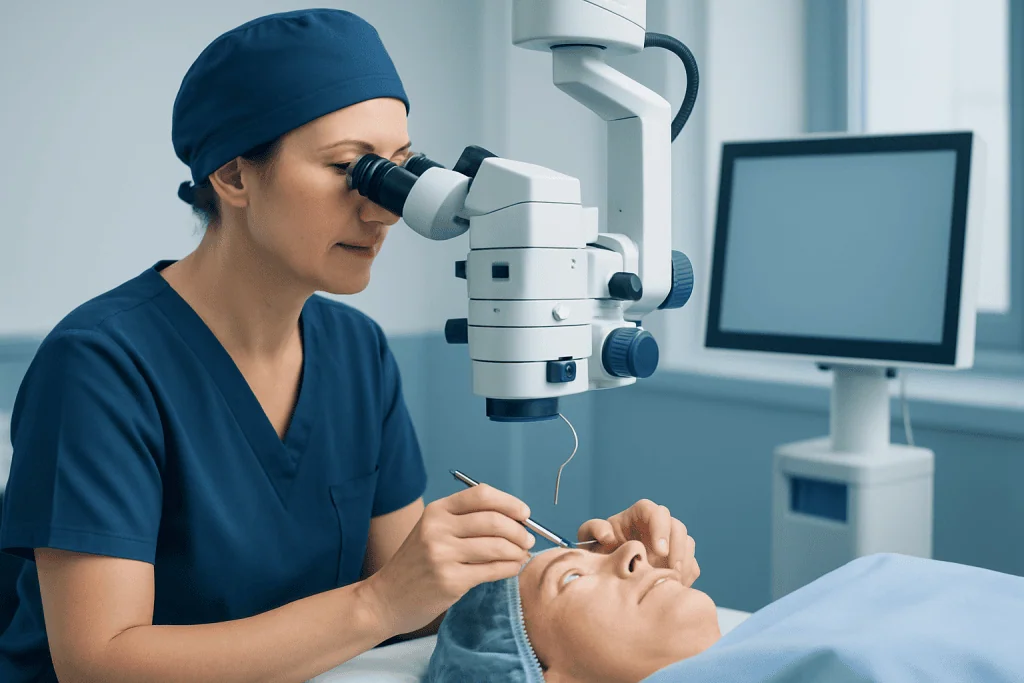
A cataract is a clouding of the eye’s natural lens. In modern cataract surgery, the surgeon usually makes a small incision, uses ultrasound energy to break up and remove the cloudy lens, and inserts a folded artificial lens into the lens capsule. The lens unfolds and remains in place permanently.
The procedure is generally performed with local anesthetic drops, sometimes with medication to help the patient relax. It is usually an outpatient procedure, meaning the patient returns home the same day. The operation itself often takes a short time, although preparation and recovery at the surgical center take longer.
The implanted lens is selected before surgery. Measurements of eye length, corneal curvature and astigmatism help the surgeon calculate lens power. These calculations aim to provide the planned focus, but healing and natural variation mean that a small residual glasses prescription can still occur.
For information on the operation, planning and aftercare, patients can read about cataract surgery.
The different types of lens for cataract surgery

Monofocal lenses have one primary focal point. They are most often selected for clear distance vision, so glasses are typically needed for reading and close work. They can also be targeted for near vision in selected patients, or one eye may be focused for distance and the other for nearer tasks, an approach called monovision. Monofocal lenses usually provide high-quality vision at their intended distance and tend to have fewer night-vision optical effects than multifocal designs.
Multifocal lenses split light into more than one focal point, with the goal of helping vision at distance, intermediate and/or near ranges. They may reduce dependence on glasses, particularly for reading and everyday tasks. However, some people experience halos, glare or reduced contrast sensitivity, especially in low light, and these lenses may not suit every eye.
Toric lenses are designed for people with corneal astigmatism, an uneven corneal curve that can blur vision. A toric IOL is aligned precisely during surgery to correct this refractive error. Toric technology can be available in monofocal, multifocal or EDOF-style lenses, so it is best understood as an astigmatism-correcting feature rather than only a single vision range.
EDOF lenses extend the range of focus rather than creating several distinct focal points. They are intended to provide good distance and intermediate vision, such as for walking, driving, computer use and many household tasks. Near vision may be helpful for larger print but reading glasses are still often needed for fine print. Some EDOF designs may cause fewer visual disturbances than some multifocal lenses, though side effects remain possible.
What lens do most people choose for cataract surgery?
Many people choose a monofocal IOL, often set for distance vision, because it is a well-established option that can provide clear vision for driving, television and outdoor activities. Reading glasses or progressive glasses are then commonly used for close tasks, such as books, phones and detailed craft work.
There is no single best choice for everyone. A person who strongly wishes to reduce glasses use may wish to discuss multifocal or EDOF options. Someone with meaningful astigmatism may benefit from a toric lens, regardless of whether the underlying design is monofocal or a presbyopia-correcting lens.
Previous eye surgery, dry eye disease, irregular astigmatism, glaucoma, macular degeneration or other retinal disease can influence the recommendation. These conditions do not always rule out advanced lenses, but they can affect the expected quality of vision and should be assessed carefully.
It is helpful for patients to describe their typical day: night driving, frequent computer work, reading, sports, hobbies and occupational demands. This information gives the surgeon a clearer picture of which visual trade-offs are most acceptable.
Which cataract lens has the least side effects?
No cataract lens is completely free of possible side effects, and the safest choice depends on the individual eye. In general, standard monofocal lenses are associated with a lower likelihood of halos and glare than multifocal lenses because they are designed around one main point of focus.
However, a monofocal lens may leave a person dependent on glasses for tasks outside its selected focus. This is not a complication, but it is an important practical consideration. Toric monofocal lenses may offer the same general optical profile while also addressing astigmatism when accurately aligned.
Multifocal and EDOF lenses can offer more functional vision without glasses, but may involve trade-offs such as glare, halos, starbursts, reduced contrast in dim conditions or the need for time to adapt. The likelihood and severity vary by lens design and patient factors.
An ophthalmologist can identify factors that may make unwanted visual effects more likely, including significant dry eye, corneal irregularity, retinal disease, optic nerve disease or a high need for very sharp night vision.
What type of lens do most doctors recommend?
Most ophthalmologists recommend the lens that best matches the patient’s eye measurements, eye health and visual goals rather than routinely recommending one lens for all patients. For many people, a monofocal lens remains an appropriate and reliable recommendation, especially when the priority is crisp distance vision with minimal optical side effects.
A toric lens is often recommended when corneal astigmatism is sufficient to affect postoperative vision. For patients who place a high value on reducing glasses dependence and who have suitable eyes, an ophthalmologist may discuss multifocal or EDOF lenses.
Shared decision-making is important. Patients should ask what distance the lens is intended to optimize, whether glasses will probably be needed, how astigmatism will be addressed, and what visual symptoms may be noticeable during adaptation.
A comprehensive examination may include corneal measurements, an assessment of the retina and optic nerve, and treatment of surface issues such as dry eye before final measurements. Accurate planning supports a more predictable refractive outcome.
What are the advantages and disadvantages of EDOF lenses?
The main advantage of EDOF lenses is that they can provide a continuous, useful range of vision from distance through intermediate distances. This may support activities such as driving, shopping, using a computer, cooking and seeing a car dashboard, while reducing the need for glasses compared with a distance-focused monofocal lens.
EDOF lenses may be a useful middle ground for some patients who want more range than a monofocal lens but are concerned about the visual phenomena associated with multifocal designs. Depending on the specific lens and the individual, glare and halos may still occur, particularly at night.
A key disadvantage is that fine near vision is not guaranteed. Many people still need reading glasses for small print, prolonged reading, sewing or close phone use. Results can also be less satisfactory if there is untreated ocular surface disease, significant retinal disease or another condition affecting image quality.
EDOF lenses may also be available in toric versions for eligible people with astigmatism. The surgeon can explain whether the patient’s eye anatomy and priorities make this combination appropriate.
Recovery, benefits, risks and when to seek medical care
Vision may be blurred immediately after surgery but often improves over the following days. Recovery continues over several weeks as the eye heals and vision stabilizes. Patients use prescribed eye drops, avoid rubbing the eye, follow advice about water exposure and strenuous activity, and attend follow-up appointments as scheduled.
The main benefit of cataract surgery is clearer vision when cataract clouding is responsible for visual symptoms. It can also improve color perception and reduce the visual disability caused by glare. As with any eye operation, there are risks, including infection, inflammation, pressure changes, swelling in the retina, retinal detachment, lens-position concerns and a need for further treatment. These complications are uncommon, but patients should understand them before consenting.
When to seek medical care: Patients should contact their eye surgeon promptly for increasing pain, sudden worsening of vision, increasing redness, flashing lights, a new shower of floaters, a dark curtain or shadow in vision, or discharge from the eye. These symptoms need timely assessment and should not be managed by waiting for the next routine appointment.
Acibadem International’s multidisciplinary specialists and JCI-accredited hospitals diagnose and treat cataracts for international patients. A consultation with a qualified ophthalmologist can help patients compare lens options in the context of their own eyes and everyday vision needs.
Frequently asked questions
Can cataract lenses be replaced after surgery?
An intraocular lens is designed to remain in the eye permanently. Lens exchange is possible in selected circumstances, but it is not routine and may carry additional surgical risks. The lens choice should therefore be made carefully before the initial procedure.
Will a person still need glasses after cataract surgery?
It depends on the selected lens, the target focus and the individual healing result. Many people with distance monofocal lenses need reading glasses, while multifocal or EDOF lenses may reduce glasses use. Some tasks, especially fine print or extended reading, may still require glasses.
Can toric lenses correct astigmatism?
Yes, toric intraocular lenses are designed to correct corneal astigmatism during cataract surgery. They must be carefully calculated and aligned within the eye. They can reduce astigmatism-related blur, although glasses may still be needed for some visual tasks.
Are multifocal cataract lenses suitable for everyone?
No. Multifocal lenses may not be ideal for people with certain corneal, retinal or optic nerve conditions, or for those who are especially sensitive to night-time glare and halos. An eye examination and discussion of visual expectations help determine suitability.
How long does it take to adapt to a new cataract lens?
Many people notice improvement within days, but vision can continue to stabilize for several weeks. Adaptation to multifocal or EDOF optics may take longer because the brain is learning to use a different visual system. Persistent or troubling symptoms should be discussed with the eye surgeon.
Does cataract surgery remove the cataract permanently?
The natural lens containing the cataract is removed, so the cataract itself does not return. Some people later develop clouding of the lens capsule behind the implanted lens, sometimes called a secondary cataract. This can usually be treated with a brief laser procedure when needed.
References
- American Academy of Ophthalmology
- National Eye Institute
- U.S. Food and Drug Administration
- European Society of Cataract and Refractive Surgeons
This article is for general information only and is not a substitute for professional medical advice. Please consult a qualified doctor about your individual situation.
Explore treatments in Turkey — costs, top hospitals & a free quote
JCI-accredited · board-certified surgeons · reply within 24h
Add us as a Preferred Source to see more of our trusted health content across Google Search, AI Overviews and Discover.

More from the Health Library



Related Specialists

Dr. Burak Sercan Erçin (m)
Aesthetic Plastic & Reconstructive Surgery
Assoc. Prof. Dr. Halenur Bozdağ
Gynecology & Obstetrics
Prof. Dr. Koptagel İlgün
Internal Medicine
Prof. Dr. Gökhan Demir
Medical Oncology