

Cost of Lung Cancer Screening Cost: What Patients Really Pay
Lung cancer screening usually uses a low-dose computed tomography (LDCT) scan, not a chest X-ray. The out-of-pocket cost can vary substantially because coverage, facility fees and follow-up testing differ between health systems and insurers.
Key Takeaways
- Lung cancer screening usually uses a low-dose computed tomography (LDCT) scan, not a chest X-ray.
- The out-of-pocket cost can vary substantially because coverage, facility fees and follow-up testing differ between health systems and insurers.
- Screening is intended for people at higher risk, especially certain current or former smokers; it is not a diagnostic test for symptoms.
- A screening scan is quick, painless and does not usually require recovery time.
- An abnormal result does not necessarily mean cancer, but it may lead to surveillance scans or further tests.
- New or persistent respiratory symptoms should be assessed by a clinician rather than waiting for a routine screening appointment.
The cost of lung cancer screening depends on the country, imaging center, insurance coverage, clinical eligibility and whether additional tests are needed after the scan. For people at high risk who meet local screening criteria, an annual low-dose CT scan may be covered by insurance or public health programs, but patients should confirm coverage and possible follow-up costs in advance.
Overview: what affects the cost of lung cancer screening?
The cost of lung cancer screening is not a single fixed amount. It is shaped by the healthcare system, the facility performing the scan, insurance or public-program eligibility, the need for a medical consultation, and whether the scan identifies a finding that needs monitoring or further assessment. The screening test itself is usually a low-dose computed tomography scan, often called LDCT or low-dose CT.
For people who meet established high-risk criteria, insurance plans or national screening programs may cover some or all of the initial scan. However, coverage rules vary. Even when the screening examination is covered, patients may still have costs related to appointments, deductibles, copayments, radiology interpretation, repeat imaging, or diagnostic tests prompted by the result.
Before scheduling, patients can ask the imaging center and insurer whether the examination is being billed as preventive screening or diagnostic imaging, whether preauthorization is required, and what costs may apply if follow-up is recommended. A written estimate can help clarify the expected cost of screening for lung cancer without making assumptions about individual coverage.
How much does a lung cancer screening cost out of pocket?
There is no universal out-of-pocket price for lung cancer screening. The amount a person pays may range from no direct cost for an eligible, covered preventive screening service to a self-pay charge determined by the facility, region and health plan. Therefore, the cost of lung cancer screening without insurance cannot be reliably estimated from a general online figure.
Patients considering self-pay screening can contact accredited imaging providers directly and request an itemized estimate for low-dose CT screening. It is useful to ask whether the estimate includes the scan, the radiologist’s report, the clinician order or consultation if required, and any administrative fees. They should also ask what the facility charges for repeat CT monitoring if a small lung nodule is found.
Importantly, a low-dose CT performed to evaluate symptoms such as coughing up blood, unexplained weight loss, chest pain, or persistent cough may be classified as diagnostic rather than screening. The coverage rules and the patient’s financial responsibility can differ. A clinician or billing team can help explain the distinction before the scan is arranged.
How lung cancer screening works and who may benefit
Lung cancer screening aims to find lung cancer at an earlier stage, before it causes symptoms and when treatment options may be broader. It uses LDCT, an imaging method that creates detailed pictures of the lungs with less radiation than a standard chest CT. It is different from a chest X-ray, which has not been shown to provide the same screening benefit for high-risk groups.
Eligibility is based on age, smoking history, current smoking status or time since quitting, overall health and local guidelines. Many major guidelines recommend annual LDCT for adults within a defined age range who have a substantial smoking history and who currently smoke or stopped within a specified number of years. Exact criteria differ by country and healthcare system, so individual assessment is important.
Screening is not generally recommended for people who have no meaningful smoking-related risk or who would be unable or unwilling to undergo evaluation and treatment if cancer were found. It also does not replace smoking cessation support. Stopping smoking reduces future risk at any age, and a healthcare professional can discuss practical support options.
People with symptoms should not rely on a screening program alone. They need a clinical evaluation because symptoms may require a different and sometimes more urgent diagnostic pathway. For background on the condition screening seeks to detect, see lung cancer.
What happens during a low-dose CT screening scan?
Before the appointment, the patient may complete a questionnaire about smoking history, symptoms, past imaging, family history and medical conditions. There is usually no need to fast, receive contrast dye, or take special medication for a routine LDCT screening scan. The team will review safety questions, including pregnancy or the possibility of pregnancy.
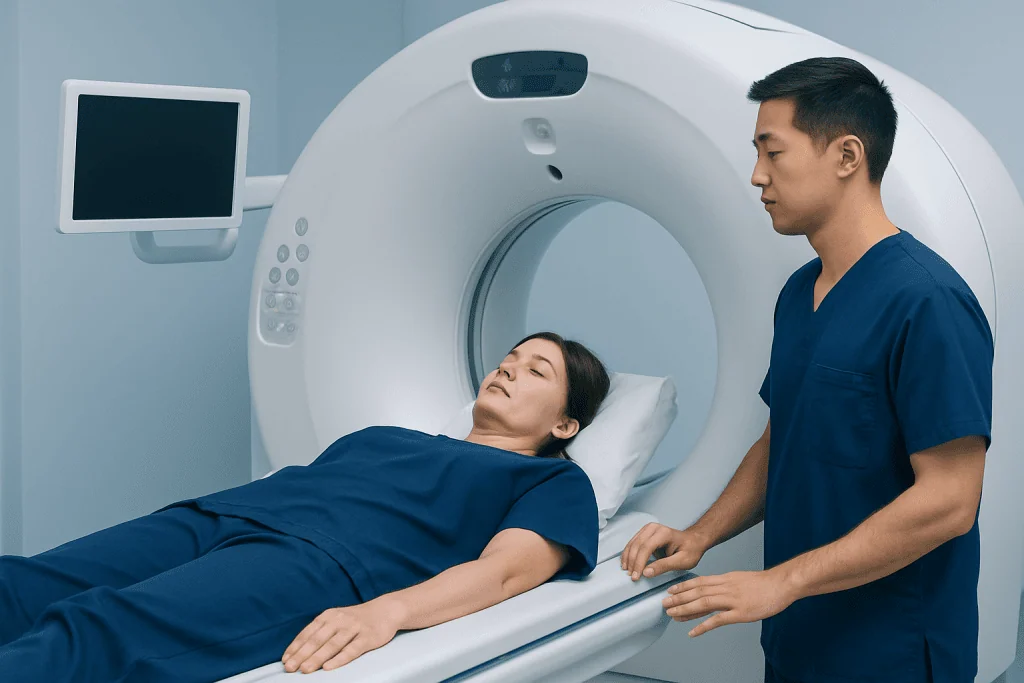
During the scan, the patient lies flat on a narrow table that moves through the CT scanner. They may be asked to raise their arms and hold their breath briefly. The technologist performs the scan from a separate room while remaining able to see and speak with the patient. The image-acquisition portion generally takes only a few minutes.
Afterward, the patient can usually return immediately to normal activities, including work, driving and eating. A radiologist reviews the images and sends a report to the ordering clinician or screening program. Results may be reported as normal, showing a finding that needs annual or shorter-interval monitoring, or requiring diagnostic evaluation.
A nodule or spot on the lung is relatively common on CT and often has a noncancerous explanation, such as prior infection or inflammation. Follow-up recommendations are designed to clarify whether a finding changes over time while avoiding unnecessary invasive procedures whenever possible.
Is lung cancer screening worth it?
For people who meet evidence-based high-risk eligibility criteria, lung cancer screening can be worthwhile because low-dose CT has been shown to reduce deaths from lung cancer compared with no screening in selected populations. The potential benefit is finding cancer earlier, when it may be more treatable. Whether it is worthwhile for an individual depends on their risk profile, health status, values and ability to follow through with recommended care.
Screening also has limitations. It can identify findings that are not cancer but still require repeat scans, specialist review or, less commonly, procedures. It may detect slow-growing cancers that might never have caused harm, and the test involves a small amount of radiation. These possibilities should be part of a shared discussion with a qualified clinician.
The value of screening is greatest when it is part of an organized process: appropriate risk assessment, high-quality LDCT imaging, timely result communication, follow-up of abnormal findings and access to smoking cessation support. A normal scan is reassuring but does not eliminate future risk, so eligible individuals may be advised to repeat screening annually.
Risks, benefits and possible follow-up costs
The principal benefit of LDCT screening is the chance of detecting lung cancer earlier in people at increased risk. The scan is noninvasive, does not usually involve injected contrast material, and requires no recovery period. It may also reveal other findings in the chest that deserve medical attention, although not every incidental finding is clinically important.
Potential downsides include false-positive results, meaning an abnormal-looking area is later found not to be cancer. These results can cause understandable worry and may lead to surveillance imaging, diagnostic CT, PET imaging, biopsy or specialist visits. Such additional care can contribute more to a patient’s total expenses than the initial scan, which is why financial planning should include possible follow-up pathways.
LDCT uses a lower radiation dose than standard chest CT, but radiation exposure is not zero. Repeated annual scans modestly add to cumulative exposure. Clinicians balance this risk against the expected screening benefit in those with a significant smoking history. Screening should be performed at a center experienced in low-dose CT protocols and nodule management.
If a suspicious result requires more testing, the next step may include repeat CT imaging, PET-CT, bronchoscopy, needle biopsy or surgical assessment, depending on the finding. These are diagnostic decisions made individually; an abnormal screening result is not a cancer diagnosis.
What is the 5 finger test for lung cancer?
The “5 finger test” for lung cancer is not a validated medical screening test and should not be used to diagnose or rule out lung cancer. Online descriptions vary, but they generally refer to looking at fingers or nails for changes that may be associated with clubbing. Clubbing is a broadening or rounding of the fingertips and increased curvature of the nails.
Although finger clubbing can occur in some people with lung disease, including some lung cancers, it also has many other possible causes and may not be present in lung cancer at all. It cannot identify early lung cancer and is not a substitute for low-dose CT screening in eligible people.
Anyone who notices new changes in their fingers, nails, breathing or general health should discuss them with a healthcare professional. The clinician can assess the symptoms in context and decide whether examination, imaging or other tests are appropriate.
What are the 7 warning signs of lung cancer?
Lung cancer may not cause symptoms in its early stages, which is one reason screening can be considered for people at high risk. When symptoms do occur, they are not specific to lung cancer and often have other explanations. Nonetheless, persistent or worsening symptoms deserve medical assessment.
Seven commonly discussed warning signs are a cough that does not improve or changes from its usual pattern; coughing up blood or rust-colored sputum; shortness of breath; chest, shoulder or back pain that is persistent or unexplained; recurrent chest infections; unexplained weight loss or reduced appetite; and ongoing fatigue or weakness. Hoarseness, wheezing, swallowing difficulty, facial or neck swelling, and new headaches or bone pain can also require evaluation depending on the clinical situation.
These signs do not confirm cancer, and many are caused by infections, chronic lung conditions, reflux, heart disease or other health concerns. However, it is safer to arrange a medical review rather than self-diagnose. A clinician may recommend an examination, chest imaging, lung function testing or referral based on the person’s symptoms and risk factors.
When to seek medical care
People should make a timely appointment with a doctor for a cough lasting several weeks, a changing long-term cough, unexplained breathlessness, persistent chest discomfort, repeated respiratory infections, unintentional weight loss or unusual fatigue. Current and former smokers should be particularly willing to discuss these changes, but anyone can seek assessment regardless of smoking history.
Urgent medical care is appropriate for coughing up more than a small streak of blood, severe or rapidly worsening shortness of breath, severe chest pain, fainting, confusion, or new swelling of the face and neck. These symptoms can have several causes and need prompt professional evaluation.
Patients who may qualify for annual LDCT can discuss screening, expected cost and follow-up planning with a primary care clinician, pulmonologist or oncology team. Acibadem International’s multidisciplinary specialists and JCI-accredited hospitals can assess lung findings and coordinate diagnostic and treatment planning for international patients.
Frequently asked questions
How much does lung cancer screening cost without insurance?
The cost of lung cancer screening without insurance varies by location, imaging center and the services included in the estimate. Patients can ask for a self-pay price for low-dose CT and confirm whether it includes the scan, radiologist interpretation and any required consultation. Follow-up tests after an abnormal result may be billed separately.
Does insurance cover a low-dose CT lung cancer screening?
Coverage depends on the insurance plan, local regulations and whether the person meets the plan’s eligibility criteria for preventive lung cancer screening. Some plans cover eligible annual low-dose CT screening, while deductibles, copayments or authorization requirements may still apply. It is best to verify coverage with both the insurer and imaging provider before the appointment.
What is the difference between lung cancer screening and a diagnostic chest CT?
Screening low-dose CT is performed in people without symptoms who meet high-risk criteria, with the aim of detecting cancer early. A diagnostic chest CT is ordered to investigate symptoms or an abnormal result and may use a different protocol. The medical purpose can affect insurance coverage, cost and the type of follow-up required.
Is a low-dose CT scan painful?
No. The scan is noninvasive and painless, and it generally does not require needles, contrast dye or sedation. The patient lies still and holds their breath briefly while the images are taken.
How soon can a patient return to normal activities after lung cancer screening?
Most people can return to normal activities immediately after a low-dose CT screening scan. There is no usual recovery period because the test does not involve surgery, sedation or contrast injection. The healthcare team will explain when and how results will be communicated.
Can a normal lung cancer screening scan rule out lung cancer completely?
A normal scan is reassuring but cannot eliminate all future risk or detect every possible cancer. Eligible people are often advised to repeat low-dose CT annually because changes can develop over time. New symptoms should still be assessed, even after a recent normal screening result.
References
- U.S. Preventive Services Task Force
- American Cancer Society
- National Cancer Institute
- Centers for Disease Control and Prevention
- World Health Organization
This article is for general information only and is not a substitute for professional medical advice. Please consult a qualified doctor about your individual situation.
Lung Cancer in Turkey — costs, top hospitals & a free quote
JCI-accredited · board-certified surgeons · reply within 24h
Add us as a Preferred Source to see more of our trusted health content across Google Search, AI Overviews and Discover.

Medical Oncology Department
Medical treatment of cancer with chemotherapy, immunotherapy and targeted therapies under a multidisciplinary tumor board.
60 specialists in this unitMore from the Health Library



Related Specialists

Assoc. Prof. Dr. Mehmet Altiparmak
Aesthetic Plastic & Reconstructive Surgery
Prof. Dr. Hale Göksever Çelik
Gynecology & Obstetrics
Dr. Fadime Sevgi Saçlı
Internal Medicine
Prof. Dr. Ozan Kocakaya
Internal Medicine