Hifu Treatment for Essential Tremors: How It Works, Results and What to Expect

HIFU is a non-incisional treatment that may reduce medication-resistant essential tremor, particularly hand tremor. The procedure uses MRI guidance and focused ultrasound to make a precise treatment in the brain's tremor pathway.
Key Takeaways
- HIFU is a non-incisional treatment that may reduce medication-resistant essential tremor, particularly hand tremor.
- The procedure uses MRI guidance and focused ultrasound to make a precise treatment in the brain's tremor pathway.
- Tremor improvement can often be assessed during the procedure and may be noticeable immediately afterward.
- Not everyone is a suitable candidate; evaluation includes tremor diagnosis, medical history, MRI assessment and discussion of goals.
- Possible side effects include temporary or persistent balance, sensation or speech-related changes, so experienced multidisciplinary assessment is important.
HIFU treatment for essential tremors, also called MR-guided focused ultrasound, is a non-incisional procedure that can reduce disabling tremor in one hand for carefully selected patients. It uses precisely targeted ultrasound energy to treat a small area of the brain involved in tremor while MRI provides real-time guidance and monitoring.
HIFU treatment for essential tremors: an overview
HIFU treatment for essential tremors is a minimally invasive, incision-free procedure designed to reduce tremor when symptoms remain troublesome despite medicines or when medicines cause unacceptable side effects. HIFU stands for high-intensity focused ultrasound. In clinical practice, it is usually performed as magnetic resonance-guided focused ultrasound (MRgFUS), meaning MRI is used to plan, guide and monitor treatment.
Essential tremor is a neurological movement disorder that commonly causes rhythmic shaking during activity, such as writing, drinking from a cup, using cutlery or holding an object. The procedure targets a tiny area in the thalamus, a deep brain structure that helps relay signals in circuits involved in tremor. Treating one side of this pathway typically aims to improve tremor on the opposite side of the body, most often the dominant hand.
Focused ultrasound is not a cure for essential tremor and does not address every symptom or cause of shaking. It is one option within a broader treatment plan that may also include medicines, occupational therapy and, for some people, deep brain stimulation. A movement-disorder neurologist can confirm whether the tremor is consistent with essential tremor and discuss suitable approaches.
How focused ultrasound works in the brain
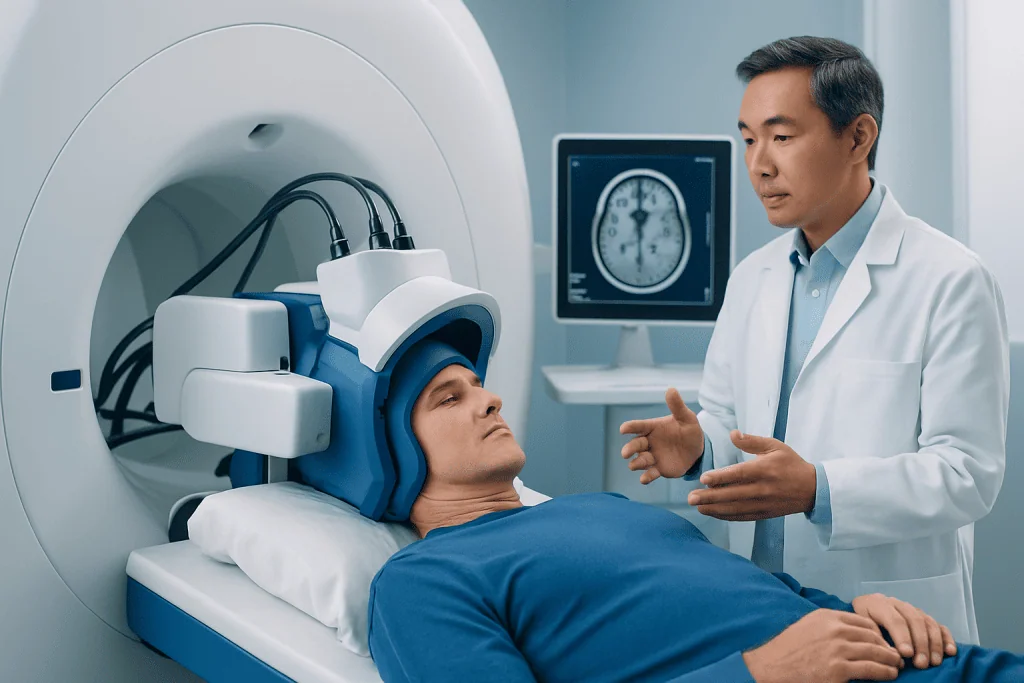
During MR-guided focused ultrasound, many ultrasound beams pass through the skull and converge at one carefully selected point in the thalamus. Individually, the beams have little effect on the tissue they pass through. At their focal point, however, the energy produces controlled heating that creates a very small therapeutic lesion intended to interrupt abnormal tremor signaling.
MRI serves two important roles. It provides detailed images for treatment planning, and MRI thermometry helps the clinical team monitor temperature changes at the target during ultrasound delivery. Early, lower-energy sonications may be used to test the target and assess changes in tremor before the final treatment is completed.
Because the treatment does not require a surgical incision or implanted device, it does not involve opening the skull. However, it is still a procedure performed in the brain and requires careful planning, specialized equipment and a team with expertise in neurology, neurosurgery, neuroradiology and anesthesia or procedural care. The relevant procedure may be discussed as MR-guided focused ultrasound treatment.
Who may be a candidate for HIFU?

HIFU may be considered for adults with a confirmed diagnosis of essential tremor whose hand tremor significantly affects everyday activities despite appropriate medication trials, or for those who cannot tolerate tremor medicines. The decision is individualized. A clinician considers how tremor affects eating, drinking, writing, work, self-care and quality of life, as well as the person’s treatment priorities.
Assessment commonly includes a neurological examination, review of medicines and medical conditions, and testing to distinguish essential tremor from other causes of shaking. Some people with Parkinsonian tremor or another movement disorder may need a different treatment approach. A brain MRI and CT-based skull assessment may also be required because skull characteristics can affect how effectively ultrasound energy reaches the target.
Suitability may be limited by certain implanted medical devices, MRI incompatibility, inability to remain still for the procedure, significant cognitive impairment, uncontrolled medical illness, bleeding risks or features that make focused ultrasound technically unsuitable. Prior stroke, balance difficulty or speech problems do not automatically exclude treatment, but they deserve particular attention because they may affect the balance of expected benefit and risk.
- Hand tremor that is disabling and does not respond adequately to usual treatment may support consideration.
- The procedure is usually planned for one side at a time, so it is most suitable when one hand is especially affected.
- Patients should be able to participate in real-time tremor assessments during the procedure.
- A multidisciplinary review helps identify whether HIFU, medication adjustment, rehabilitation or another procedure is most appropriate.
What happens before, during and after the procedure?
Before treatment, the care team reviews imaging, health history and treatment goals. On the day of the procedure, the patient’s head is typically shaved so the ultrasound energy can pass effectively through the scalp. A rigid head frame is applied with local anesthetic to keep the head still, and a cooling cap filled with circulating water helps protect the scalp and skull during treatment.
The patient lies on the MRI table with the head positioned in the focused ultrasound system. The person is generally awake, which allows the team to check tremor, strength, speech and sensation at intervals. The procedure may take several hours, including preparation, imaging, targeting and repeated ultrasound applications. The exact experience varies according to the treatment plan and individual anatomy.
Following treatment, patients are observed for neurological changes, headache, nausea, dizziness or walking difficulty. Many people go home the same day or after a short observation period, depending on local practice and their condition. Someone else should usually accompany the patient home, and the team provides personalized advice about activity, driving, medicines and follow-up appointments.
Benefits, recovery and possible risks
The main potential benefit is a meaningful reduction in tremor in the treated hand. Many patients notice improvement while still in the MRI suite as the target is tested and treated. Improvements may make practical tasks easier, such as drinking from a cup, eating, writing, using a phone or performing grooming activities. Results differ between individuals, and treatment does not necessarily eliminate tremor completely.
Recovery is often faster than after an open surgical procedure because there is no incision to heal. Mild fatigue, headache, nausea or scalp discomfort can occur shortly after treatment. Some people experience temporary unsteadiness, numbness or tingling, altered taste, weakness, speech changes or coordination difficulties. Symptoms often improve over days to weeks, but in some cases they can persist.
The downside of HIFU is that it creates a permanent lesion and, unlike deep brain stimulation, its effect cannot be adjusted or reversed after treatment. Bilateral treatment may carry additional risks, particularly for balance and speech, and is approached cautiously according to local approvals, evidence and patient factors. A careful conversation about alternatives, including medication and device-based therapies, is essential before proceeding.
Rehabilitation, including occupational or physical therapy, can be useful if a person needs help adapting to changes in hand function or recovering confidence with balance and daily activities. Follow-up also allows the team to monitor tremor response and any ongoing side effects.
When to seek medical care
Medical assessment is appropriate when shaking is new, worsening, interfering with work or daily tasks, or causing concern. A clinician can identify whether the movement is likely to be essential tremor or another condition, and can check for triggers such as medicines, thyroid disease, anxiety, stimulant use or alcohol withdrawal. Early assessment supports appropriate treatment and avoids self-diagnosis.
Urgent medical care is needed if tremor begins suddenly with weakness, facial drooping, trouble speaking, severe headache, confusion, loss of coordination or vision changes. These symptoms may indicate a neurological emergency rather than essential tremor. New symptoms after any procedure, such as marked difficulty walking, persistent weakness or worsening speech, should also be reported promptly to the treating team.
For people considering focused ultrasound, a consultation with a movement-disorder specialist is the appropriate next step rather than assuming that HIFU is suitable. Acibadem International’s multidisciplinary specialists and JCI-accredited hospitals evaluate and treat movement disorders for international patients, with treatment decisions based on individual clinical assessment.
Common questions about HIFU for essential tremor
How long does HIFU last for tremors? HIFU produces a permanent change at the targeted brain site, and tremor reduction can persist for years in many treated patients. However, essential tremor can progress over time, and tremor may recur or become more noticeable in untreated body areas. Long-term response varies, so regular follow-up remains important.
What is the downside of HIFU? HIFU is irreversible because it creates a small permanent lesion in the brain. Although it avoids an incision and implanted hardware, it can cause side effects such as imbalance, numbness, altered sensation, speech changes or coordination problems; some may last. It also generally treats one side at a time and may not be technically possible for every skull type or medical situation.
How do you know if HIFU is working? The treatment team checks tremor during the procedure through simple tasks such as holding an object, drawing or bringing a cup toward the mouth. A reduction in tremor can be visible immediately, although the full early response should be assessed over subsequent days and follow-up visits. Standardized tremor assessments and the patient’s ability to perform daily activities help measure benefit.
Does Medicare cover HIFU for essential tremor? Medicare coverage for MR-guided focused ultrasound can depend on the country, plan, indication, treatment center and current coverage policies. In the United States, some Medicare plans may cover the procedure for eligible people with medication-refractory essential tremor when medical-necessity requirements are met, but coverage is not universal. Patients should confirm authorization, out-of-pocket responsibilities and facility-specific requirements directly with Medicare or their insurer before scheduling treatment.
Frequently asked questions
Is HIFU the same as MR-guided focused ultrasound?
HIFU refers to high-intensity focused ultrasound, the energy used to treat a precise target. For essential tremor, the procedure is commonly performed with MRI guidance, so it is often called MR-guided focused ultrasound or MRgFUS. MRI helps plan the target and monitor treatment in real time.
Can HIFU treat tremor in both hands?
Focused ultrasound has traditionally been performed on one side of the brain to improve tremor in the opposite hand. Whether treatment on both sides is appropriate depends on regulations, available evidence, the treatment center and the individual’s health profile. Bilateral treatment may increase the risk of speech and balance-related side effects.
Will HIFU cure essential tremor?
No. HIFU can reduce tremor by treating a specific brain pathway, but it does not remove the underlying tendency to develop essential tremor. Tremor may still occur in other body areas or progress over time.
Is HIFU painful?
A local anesthetic is used when the head frame is placed, and patients are monitored closely throughout treatment. Some people feel pressure from the frame, warmth, headache or nausea during ultrasound delivery. The team can pause treatment and address symptoms if needed.
How soon can a person return to normal activities after HIFU?
Many people return home after short observation and resume light activities within a few days, depending on how they feel. Temporary fatigue, dizziness or unsteadiness may mean that driving, strenuous exercise and other higher-risk activities should be delayed. The treating team provides individualized recovery instructions.
What are alternatives to HIFU for essential tremor?
Alternatives include tremor medicines, occupational therapy and lifestyle measures that reduce known triggers. For selected people with severe, medication-resistant tremor, deep brain stimulation or other neurosurgical approaches may be considered. The best option depends on tremor pattern, medical history, preferences and local expertise.
References
- National Institute of Neurological Disorders and Stroke
- U.S. Food and Drug Administration
- American Academy of Neurology
- International Parkinson and Movement Disorder Society
This article is for general information only and is not a substitute for professional medical advice. Please consult a qualified doctor about your individual situation.
Tremor in Turkey — costs, top hospitals & a free quote
JCI-accredited · board-certified surgeons · reply within 24h
Add us as a Preferred Source to see more of our trusted health content across Google Search, AI Overviews and Discover.