Augmented Reality in Surgery: What It Is and How Surgeons Use It

Augmented reality in surgery combines real-time views with digital images such as CT, MRI, or 3D anatomical models. It may help surgeons visualize anatomy more clearly, plan incisions, and navigate around important structures.
Key Takeaways
- Augmented reality in surgery combines real-time views with digital images such as CT, MRI, or 3D anatomical models.
- It may help surgeons visualize anatomy more clearly, plan incisions, and navigate around important structures.
- This technology is used in selected specialties, including orthopedics, neurosurgery, ENT, and some minimally invasive procedures.
- Augmented reality is a support tool, not an autonomous system; surgeons still make all clinical decisions.
- Its benefits and limitations depend on the procedure, the equipment used, and the experience of the surgical team.
Augmented reality in surgery is a technology that places digital information, such as 3D anatomy or imaging, over the surgeon’s real-world view. It can support planning, navigation, teaching, and precision during selected operations, but it complements rather than replaces surgical judgment.
Overview: What augmented reality in surgery means
Augmented reality in surgery refers to technology that adds digital information to a surgeon’s view of the patient during an operation. Instead of replacing the real environment, as virtual reality does, augmented reality layers helpful visual guidance onto it. This may include 3D anatomical maps, outlines of tumors, blood vessels, bones, or planned surgical pathways based on preoperative scans such as CT or MRI.
The main goal is to improve orientation and precision. During surgery, even small differences in anatomy can matter. By showing important structures in context, augmented reality may help the surgical team understand where they are operating and how close they are to delicate tissues. This can be especially useful in areas where anatomy is complex or difficult to see directly.
Augmented reality is not a single device but a group of technologies. It may be displayed through special headsets, microscope systems, screens in the operating room, or projections linked to surgical navigation systems. In many cases, the digital images are built from the patient’s own scans, creating a personalized visual guide.
For patients, it can be helpful to think of augmented reality as an advanced navigation aid. Just as a map application can show a route over a live street view, surgical augmented reality can place relevant medical images over the surgeon’s real-time field of view. It supports the operation, but it does not replace the surgeon’s training, judgment, or experience.
How surgeons use augmented reality during an operation
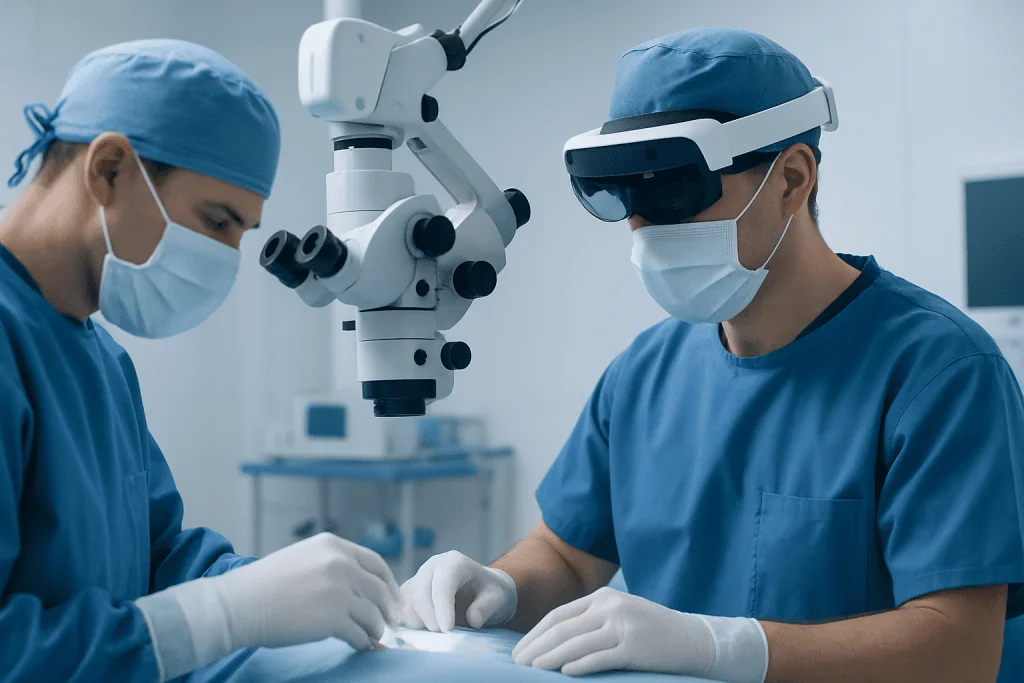
Surgeons may use augmented reality before surgery, during surgery, or both. In the planning stage, the team can review imaging data and create 3D reconstructions of the patient’s anatomy. This helps identify the safest approach, estimate the size and position of a lesion, and plan how to avoid nearby nerves, vessels, or other critical structures.
During the procedure itself, the system attempts to align the digital model with the patient’s body. This process is often called registration. Once aligned, the surgeon can see guidance showing where structures are expected to be beneath the surface or within the surgical field. In some systems, the images update alongside specialized instruments or navigation tools.
Augmented reality can also support minimally invasive and image-guided procedures. In operations done through small incisions or with endoscopic cameras, the technology may help the team maintain orientation when direct visibility is limited. In fields such as robotic surgery or advanced laparoscopic surgery, digital overlays may complement the detailed camera view and improve procedural planning.
Another important use is education and team communication. Augmented reality can make it easier for surgeons, trainees, anesthesiologists, and nurses to share a clear understanding of the anatomy and the planned steps of the operation. This may improve workflow and support training in complex procedures.
Where it is used: surgical specialties and examples
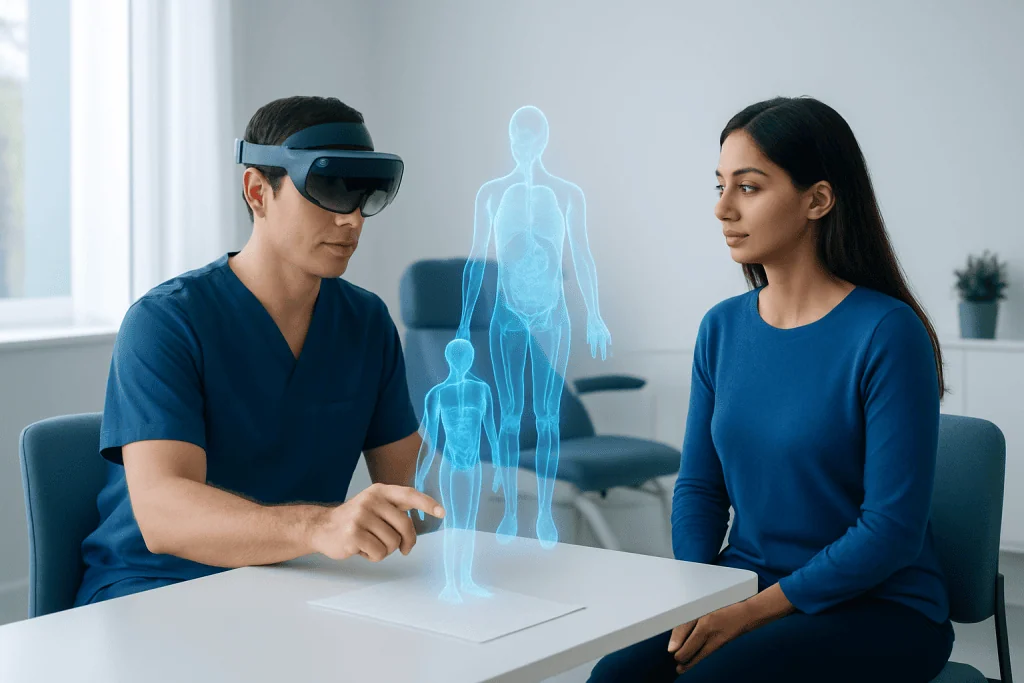
Augmented reality is being used or studied across several surgical specialties. In neurosurgery, it can help map the relationship between a brain lesion and nearby blood vessels or functional areas. This can be relevant in carefully selected cases involving brain tumors or vascular abnormalities, where accurate spatial understanding is especially important.
In orthopedic surgery, augmented reality may be used to assist with alignment, implant positioning, or navigation around joints and bones. For example, it can support planning in spine procedures or joint operations where angles and placement matter. In some settings, AR is used alongside orthopedic surgery techniques to improve anatomical guidance.
Ear, nose, and throat surgeons and maxillofacial surgeons may use augmented reality when operating near the sinuses, skull base, jaw, or facial structures. These are compact areas with important nerves and blood vessels close together. Overlaying imaging can help the surgeon visualize anatomy that may be hidden from direct view.
Other areas of use include liver surgery, urology, vascular surgery, and selected oncologic procedures. In each case, the purpose is similar: to improve the surgeon’s awareness of anatomy, support planning, and assist navigation. The exact role of AR varies by procedure, and not every operation benefits equally from it.
Potential benefits for patients and surgical teams
The most commonly discussed advantage of augmented reality in surgery is improved visualization. Surgeons often have to interpret scans mentally and translate them to the patient in real time. AR can reduce some of that mental burden by displaying relevant information directly in the operative context. This may support accuracy, confidence, and efficiency during technically demanding parts of a procedure.
Another potential benefit is better preservation of important structures. By highlighting where nerves, vessels, tumors, or planned margins are located, AR may help the surgeon avoid unnecessary tissue disruption. In selected cases, this can support more precise surgery while maintaining focus on safety and function.
Augmented reality may also improve preoperative preparation and intraoperative teamwork. When all members of the surgical team can review the same 3D plan, communication may become clearer. For teaching hospitals, AR can also help trainees understand anatomy and procedural steps more easily than with standard 2D images alone.
It is important to keep these benefits in perspective. Outcomes still depend on many factors, including the patient’s condition, the complexity of the operation, the quality of imaging, and the surgeon’s expertise. AR is best viewed as one useful tool within a broader system of modern surgical care that may also include neurosurgery navigation, robotics, endoscopy, and advanced imaging.
Limitations, safety considerations, and what AR cannot do
Although augmented reality is promising, it has limitations. One of the biggest challenges is accurate alignment between the digital model and the patient’s real anatomy. Body position, tissue movement, breathing, swelling, and changes that happen during surgery can all affect this alignment. If the overlay is not perfectly matched, the surgeon must rely on standard surgical landmarks and other imaging tools.
Image quality also matters. AR systems depend on the accuracy of CT, MRI, ultrasound, or other source images. If scans are incomplete or anatomy changes between the scan and the operation, the displayed guidance may be less reliable. This is why augmented reality is usually used as an adjunct rather than a standalone method.
There are also practical considerations. The technology requires specialized equipment, software integration, training, and workflow adjustments in the operating room. In some cases, setup can take extra time. Not all hospitals use the same platforms, and availability may differ depending on the procedure and the center’s expertise.
Most importantly, augmented reality does not make decisions or perform surgery independently. It does not replace surgical skill, careful judgment, or informed consent. Patients should understand that while AR can support precision and planning, it is one part of a larger surgical strategy tailored to the individual case.
How patients are evaluated for surgery that may use AR
Patients are not usually selected for augmented reality itself; they are selected for the operation they need. Whether AR is used depends on the type of surgery, the anatomy involved, and the tools available at the hospital. If the team believes AR may improve planning or navigation, it may be added as part of the surgical approach.
Evaluation begins with a full clinical assessment. This generally includes a review of symptoms, medical history, prior operations, medications, and physical examination. Imaging studies such as CT or MRI are often essential because the digital overlays are commonly built from these scans. In some specialties, additional imaging or functional tests may be needed to map structures more precisely.
During the consent discussion, the surgeon may explain whether image guidance, navigation, robotics, or augmented reality will be used. Patients can ask how the technology may help in their specific operation, whether it changes the risks or recovery, and what alternatives exist. These are reasonable and important questions.
At experienced centers, planning is often multidisciplinary. Radiologists, surgeons, anesthesiologists, and operating-room staff may all contribute to preparation. Near the end of the care journey, some international patients may choose centers such as Acibadem International, where multidisciplinary specialists and JCI-accredited hospitals diagnose and treat complex conditions using advanced surgical technologies when appropriate.
Questions to ask and when to speak with a doctor
Patients who are preparing for surgery can ask whether augmented reality or another image-guided technology is relevant to their case. Helpful questions include whether it is commonly used for this procedure, what specific problem it is intended to solve, and whether it changes the expected recovery. It is also useful to ask how the surgical team manages situations where anatomy changes during the operation.
People should speak with a qualified doctor whenever they have been advised to consider surgery, especially for conditions involving the brain, spine, joints, tumors, sinuses, or other anatomically complex areas. A consultation can clarify whether conventional surgery, image-guided surgery, or a technology-assisted approach is most appropriate.
Patients should also seek medical review if they are unsure about a recommended procedure, would like a second opinion, or have concerns about risks, benefits, and alternatives. Understanding the proposed operation is an important part of informed decision-making.
In general, the best approach is individualized care. Augmented reality may be very helpful in selected operations, but not every patient needs it. A surgeon can explain whether it offers a meaningful advantage based on the diagnosis, anatomy, and treatment goals.
Frequently asked questions
What is the difference between augmented reality and virtual reality in surgery?
Augmented reality adds digital information to the surgeon’s real view of the patient and operating field. Virtual reality creates a fully digital environment, which is more often used for simulation, planning, or training rather than direct live surgery.
Does augmented reality make surgery safer?
It may improve visualization and navigation in selected procedures, which can support safer and more precise surgical work. However, safety depends on many factors, including the patient’s condition, the operation itself, and the experience of the surgical team.
Is augmented reality used in every operation?
No. It is mainly used in specific procedures where detailed anatomical guidance may be especially helpful, such as some neurosurgical, orthopedic, ENT, and minimally invasive operations. Many surgeries are still performed effectively without it.
Can patients request augmented reality for their surgery?
Patients can certainly ask whether it is available and appropriate for their procedure. The decision depends on the diagnosis, imaging needs, the surgeon’s judgment, and whether the hospital has the right equipment and expertise.
Does augmented reality replace the surgeon?
No. Augmented reality is a guidance tool that helps display useful information during surgery. The surgeon remains fully responsible for planning, decision-making, and performing the operation.
Will using augmented reality change recovery time?
Not necessarily. Recovery is influenced more by the type of surgery, the area treated, the patient’s overall health, and any complications than by one technology alone. In some cases, better planning and precision may support smoother recovery, but this is not guaranteed.
References
- World Health Organization
- U.S. Food and Drug Administration
- National Institutes of Health
- American College of Surgeons
- Radiological Society of North America
This article is for general information only and is not a substitute for professional medical advice. Please consult a qualified doctor about your individual situation.
Explore treatments in Turkey — costs, top hospitals & a free quote
JCI-accredited · board-certified surgeons · reply within 24h
Add us as a Preferred Source to see more of our trusted health content across Google Search, AI Overviews and Discover.