Interventional Neuroradiology vs Endovascular Neurosurgery: What Is the Difference?

Both specialties use catheters and imaging guidance to treat certain brain and spinal vascular conditions without open surgery. The biggest difference is often the physician’s primary training pathway, not the procedure itself.
Key Takeaways
- Both specialties use catheters and imaging guidance to treat certain brain and spinal vascular conditions without open surgery.
- The biggest difference is often the physician’s primary training pathway, not the procedure itself.
- Commonly treated conditions include aneurysms, stroke, arteriovenous malformations, and narrowed blood vessels.
- Treatment decisions are usually made by a multidisciplinary team based on the patient’s condition and anatomy.
- For patients, hospital experience, emergency capability, and team coordination are often more important than the specialty title alone.
Interventional neuroradiology and endovascular neurosurgery are closely related specialties that diagnose and treat blood vessel problems in the brain, spine, head, and neck using minimally invasive techniques. The main difference usually lies in the doctor’s training background, while many procedures, tools, and treatment goals are shared.
Overview
Interventional neuroradiology and endovascular neurosurgery are subspecialties focused on treating disorders of the blood vessels and related structures of the brain, spinal cord, head, and neck. Both rely on imaging guidance and thin tubes called catheters, usually inserted through an artery in the wrist or groin, to reach the area that needs treatment. This approach can often avoid a large incision and may shorten recovery compared with some open operations.
The terms can sound very different, but in day-to-day practice there is significant overlap. A patient with a brain aneurysm, acute stroke, carotid artery narrowing, or certain vascular malformations may be treated by a physician who identifies as an interventional neuroradiologist, an endovascular neurosurgeon, or another similarly trained neurointerventional specialist. The exact title often reflects the doctor’s original specialty training rather than a major difference in the catheter-based techniques used.
Because these conditions can be complex, care is usually delivered by a team. Neurologists, neurosurgeons, neuroradiologists, anesthesiologists, intensive care specialists, and rehabilitation professionals may all contribute. For many patients, the most important question is not which label a specialist uses, but whether the center has experience, advanced imaging, and coordinated expertise for the specific problem.
What each specialty means
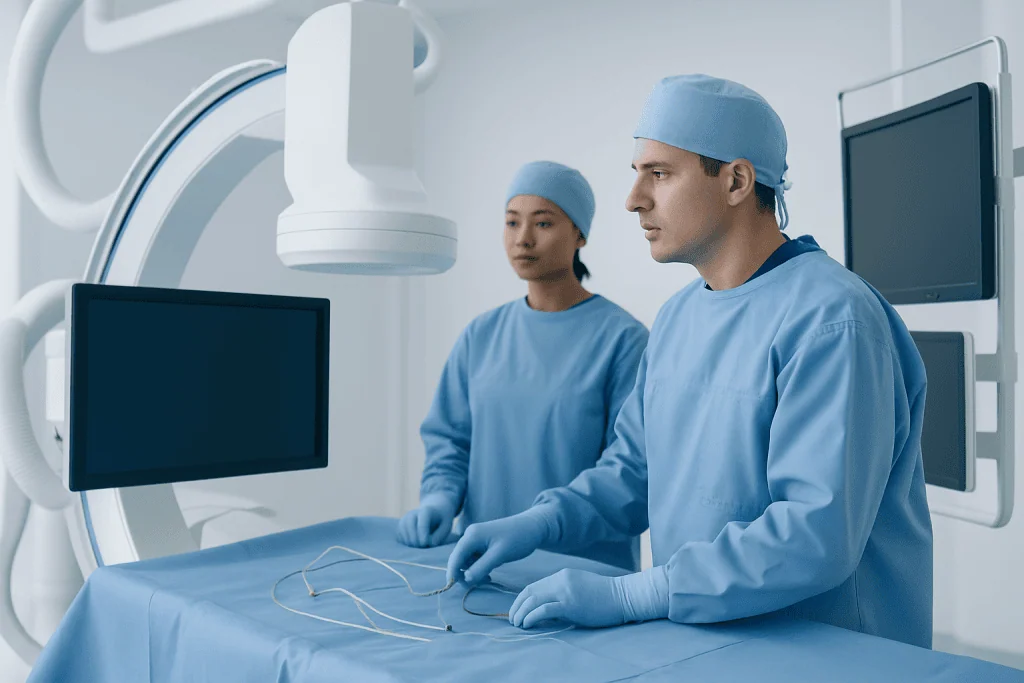
Interventional neuroradiology developed from radiology and neuroradiology. Physicians in this pathway first train in diagnostic imaging, often with advanced expertise in reading scans of the brain, spine, and blood vessels. They then complete additional training in minimally invasive image-guided procedures that diagnose and treat neurovascular disease. Their work combines detailed imaging interpretation with catheter-based treatment.
Endovascular neurosurgery developed from neurosurgery. Physicians in this pathway first train as surgeons specializing in the brain and nervous system, then pursue focused training in catheter-based vascular procedures. In addition to minimally invasive treatment, they may also have expertise in open brain and vascular surgery, which can be useful when a patient needs more than one type of procedure or when open surgery is the safer option.
In many hospitals, the practical skills of interventional neuroradiologists and endovascular neurosurgeons overlap substantially. Both may perform diagnostic angiography, aneurysm coiling, thrombectomy for stroke, embolization for vascular malformations, and stenting for narrowed vessels. Local regulations, credentialing, and the organization of the hospital can influence which specialists perform which procedures.
Some centers also include neurologists with advanced endovascular training under the broader term neurointerventionalists. This is why patients may hear several titles used for very similar care. Rather than viewing them as competing fields, it is often more accurate to think of them as related pathways within modern neurovascular medicine.
Conditions they commonly treat

Both specialties commonly manage disorders that involve blood flow to or within the nervous system. One major example is acute ischemic stroke caused by a clot blocking a large brain artery. In selected patients, a catheter-based procedure called thrombectomy can remove the clot and restore circulation. This is a time-sensitive treatment that may greatly affect recovery when used appropriately. Patients with stroke symptoms should always seek emergency care immediately.
Another common area is the treatment of brain aneurysms, which are weak spots in a blood vessel wall that can bulge and sometimes rupture. Endovascular techniques such as coiling, flow diversion, or other devices may be used to reduce the risk of bleeding or treat a rupture after it occurs. These approaches are often considered alongside surgical clipping depending on the aneurysm’s size, shape, location, and urgency.
Specialists in both fields also treat arteriovenous malformations and dural arteriovenous fistulas, which are abnormal blood vessel connections. In some cases, embolization is used to block part or all of the abnormal blood flow. They may also treat narrowed carotid or intracranial arteries, some spinal vascular malformations, certain head and neck tumors with preoperative embolization, and other rare neurovascular disorders.
Because each condition has several possible treatment routes, patients are often evaluated in a multidisciplinary setting. Someone with an aneurysm, for example, may be advised to have observation, endovascular therapy, or open surgery depending on the overall risk and expected benefit. This is one reason why discussion between specialties is so important.
How procedures are performed
Most neurointerventional procedures begin with detailed imaging such as CT, MRI, or catheter angiography. During treatment, the physician guides a catheter through the blood vessels while watching real-time X-ray images. Through this catheter, small devices or medications can be delivered precisely to the target area. The goal is to treat the problem while minimizing disruption to surrounding tissue.
Common procedures include cerebral angiography to map blood vessels, clot retrieval in stroke, aneurysm coiling, stent placement, and embolization using coils, glue-like agents, particles, or other materials. Some procedures are done under general anesthesia, while others may be performed with sedation depending on the condition, patient stability, and treatment plan.
Although these procedures are minimally invasive, they are still highly specialized and not risk-free. Potential concerns can include bleeding, vessel injury, stroke, contrast reactions, kidney strain from contrast dye, or recurrence of the underlying problem. Careful imaging review, patient selection, and experienced teams help reduce these risks.
After the procedure, patients are monitored closely. Some go home the same day or after a short stay, while others need intensive care, especially after stroke, ruptured aneurysm, or complex embolization. Follow-up imaging is often important because some treated lesions need long-term surveillance.
The main differences for patients
For patients, the biggest difference between interventional neuroradiology and endovascular neurosurgery is usually the specialist’s training background. An interventional neuroradiologist often comes from radiology, with strong expertise in diagnostic imaging and image-guided treatment. An endovascular neurosurgeon often comes from surgical training and may also perform open cranial or vascular procedures when needed.
In many cases, however, this difference does not change the immediate patient experience. The consultation, imaging review, informed consent, catheter-based procedure, hospital stay, and follow-up can look very similar. What matters most is whether the physician and center routinely treat that exact condition and whether the patient has access to the full range of options if plans need to change.
For example, a patient with a difficult aneurysm may benefit from a center where endovascular treatment and open microsurgery are both available and discussed together. Likewise, a patient with a vascular lesion that is hard to classify may benefit from an interventional neuroradiologist’s deep imaging perspective. In the best settings, these strengths complement each other rather than compete.
When choosing care, it can help to ask practical questions such as: How often does the team treat this condition? Is there 24/7 stroke or aneurysm coverage? Will the case be discussed by a multidisciplinary board? What follow-up imaging and long-term monitoring are recommended? These questions are often more useful than focusing on the title alone.
Diagnosis, planning, and treatment decisions
Accurate diagnosis is the foundation of neurointerventional care. Evaluation usually starts with symptoms, a neurological examination, and brain or vascular imaging. CT and CT angiography are commonly used in emergencies such as stroke or suspected bleeding. MRI and MR angiography may provide additional detail, especially for less urgent cases or for understanding surrounding brain tissue.
Catheter angiography remains an important tool when the blood vessel anatomy must be seen in very high detail or when a treatment may be performed in the same session. This test can help define the shape of an aneurysm, the route of an arteriovenous malformation, or the severity of narrowing in an artery. It may also clarify findings that are uncertain on noninvasive imaging.
Treatment planning depends on many factors, including the patient’s age, symptoms, medical history, medications, anatomy, and the natural risk of the condition if left untreated. In stroke, rapid decisions are essential. In unruptured aneurysms or vascular malformations, decision-making may be more individualized and may include monitoring instead of immediate intervention.
Options may include observation, medication, endovascular treatment, open surgery, or a combination of these. For selected patients, therapies such as embolization or aneurysm treatment may be recommended. The preferred plan is the one that offers the best balance of safety and expected benefit for that individual patient.
Recovery, follow-up, and self-care
Recovery after a neurointerventional procedure varies depending on the reason for treatment. Someone who has a planned angiogram or a straightforward elective aneurysm procedure may recover relatively quickly, with short-term advice to rest, hydrate, and avoid heavy strain for a brief period. A person treated for stroke or bleeding may need a much longer recovery, including rehabilitation for speech, mobility, memory, or daily activities.
Follow-up is important because successful treatment in the hospital is only one step in care. Patients may need repeat scans to confirm that an aneurysm remains sealed, that a stent is open, or that an arteriovenous malformation has been adequately blocked. The schedule for imaging depends on the condition and the type of treatment used.
Self-care often focuses on vascular health. This may include controlling blood pressure, managing diabetes, stopping smoking, staying physically active as advised, and taking prescribed medications correctly, especially blood thinners or antiplatelet medicines when indicated. Patients should never stop these medicines on their own without medical guidance.
At centers with advanced neurovascular services, long-term care is usually coordinated across several departments. Acibadem International’s multidisciplinary specialists and JCI-accredited hospitals diagnose and treat neurovascular conditions for international patients, with planning that may involve neurology, neurosurgery, imaging, and rehabilitation.
When to seek urgent medical attention
Some symptoms need emergency evaluation because they may signal stroke, brain bleeding, or another serious neurovascular event. Sudden weakness on one side, facial drooping, trouble speaking, severe sudden headache, loss of vision, new confusion, seizures, or sudden difficulty walking should be treated as urgent. Emergency assessment can determine whether time-sensitive procedures such as thrombectomy may help.
Patients should also contact their care team promptly after a procedure if they develop worsening headache, new neurological symptoms, chest pain, shortness of breath, heavy bleeding at the catheter site, fever, or increasing swelling and pain around the puncture area. These symptoms do not always mean a serious complication, but they deserve timely review.
For non-emergency questions, it is reasonable to seek a specialist opinion when a brain aneurysm, carotid narrowing, vascular malformation, or other neurovascular condition has been found on imaging. A consultation can help clarify whether the finding needs monitoring, medication, minimally invasive treatment, open surgery, or no intervention at all.
When possible, patients may wish to be evaluated in a center that offers both endovascular and surgical options. This helps ensure that recommendations are tailored to the condition itself rather than limited by the procedures available in a single department.
Frequently asked questions
Is interventional neuroradiology the same as endovascular neurosurgery?
They are not exactly the same, but they overlap a great deal. The main difference is usually the doctor’s original specialty training, while many of the catheter-based procedures and treatment goals are similar.
Which specialist is better for a brain aneurysm?
There is no single best title for every aneurysm. What matters most is the aneurysm’s size, shape, and location, along with the experience of the treating team and whether both endovascular and open surgical options are available.
Do both specialties treat stroke?
Yes, both may perform emergency clot-removal procedures for selected patients with ischemic stroke. Rapid evaluation in a stroke-capable hospital is critical because treatment effectiveness depends heavily on timing.
Are these procedures considered surgery?
They are generally considered minimally invasive procedures, and some people refer to them as a form of surgery because they actively treat disease inside the body. However, they usually do not require a large incision and are performed through blood vessels using catheters and imaging guidance.
Will a patient always need open brain surgery if endovascular treatment is not possible?
Not always. Some conditions can be monitored, treated with medication, or managed with a different minimally invasive approach, while others may be better treated with open surgery. The right plan depends on the specific diagnosis and the patient’s overall health.
How can a patient choose between specialists?
It often helps to focus on the hospital’s neurovascular team rather than a single title. Patients can ask about the team’s experience with the exact condition, emergency coverage, complication management, and whether cases are reviewed by multiple specialists.
References
- World Stroke Organization
- American Heart Association
- Society of NeuroInterventional Surgery
- Radiological Society of North America
- National Institute of Neurological Disorders and Stroke
This article is for general information only and is not a substitute for professional medical advice. Please consult a qualified doctor about your individual situation.
Interventional Neuroradiology in Turkey — costs, top hospitals & a free quote
JCI-accredited · board-certified surgeons · reply within 24h
Add us as a Preferred Source to see more of our trusted health content across Google Search, AI Overviews and Discover.