

Ablative vs Non-Ablative Laser Resurfacing: Depth, Downtime and Results Compared
Key Takeaways
- Ablative lasers vaporize the epidermis and heat the dermis, while non-ablative lasers heat the dermis through an intact, cooled surface; that single difference drives downtime, results and risk.
- Mayo Clinic reports that ablative treatment typically heals over about 1–2 weeks with redness that can persist for months, whereas non-ablative redness and swelling usually settle within days.
- Fractional devices treat a grid of microscopic columns and leave surrounding skin untouched, which shortens recovery and lowers scarring risk compared with treating the entire surface.
- Pigment change is the risk that most shapes the choice: hyperpigmentation is more common after ablative treatment and in darker skin tones, and hypopigmentation can appear months later and may be permanent.
- Collagen remodeling continues for months after either approach, so judging results at two weeks underestimates the final change from any resurfacing treatment.
- Recently tanned skin, active cold sores or acne, pregnancy and a keloid history are common reasons a clinician will ask you to wait, and who may legally operate a laser varies by US state.
Ablative laser resurfacing removes the skin's outer layer and heats the layer beneath, giving larger changes in wrinkles, scars and texture in exchange for roughly one to two weeks of raw, healing skin and months of redness. Non-ablative lasers heat the deeper layer while leaving the surface intact, so results are subtler, recovery is a few days, and several sessions are usual.
She has two browser tabs open and a wedding in six weeks. One tab shows a face wrapped in ointment and gauze, glowing like a sunburn; the other shows someone leaving a clinic with a light flush and a smile. Both pages promise smoother skin. Neither explains why one person looks like they lost a fight and the other looks like they went for a brisk walk.
That gap is the whole story of ablative vs non ablative laser resurfacing. The two approaches use the same basic tool, focused light converted to heat, but they aim it at different depths, ask very different things of your calendar, and carry different risks depending on your skin tone and history.
What follows is the version of that comparison a clinician would give you if they had forty unhurried minutes: what each laser actually does, who tends to benefit, what the following weeks look like, and which questions are worth asking before anyone picks up a handpiece.
What does ablative vs non ablative laser resurfacing actually mean?
Start with the words, because the marketing around them is louder than the definitions. Resurfacing means using controlled injury to prompt skin to repair itself into a smoother, more even version. A laser is a device that emits a single wavelength of light, which skin absorbs and converts into heat. Everything else follows from how much of that heat reaches the surface.
An ablative laser vaporizes the epidermis, the thin outer layer of skin you can see and touch, and heats the dermis, the thicker living layer beneath it that holds collagen and blood vessels. Because the surface is removed, the skin has an open wound to heal. The two main ablative wavelengths come from carbon dioxide (CO2) lasers and erbium lasers; both are absorbed strongly by water, which is why they strip tissue so efficiently (Cleveland Clinic).
A non-ablative laser skips the vaporizing step. Its wavelength passes through the epidermis with relatively little effect and deposits heat in the dermis, where it nudges collagen production without breaking the surface. You walk out with intact, if swollen and pink, skin (Mayo Clinic).
The distinction matters because it drives every practical difference people search for: downtime, discomfort, number of sessions, how dramatic the change is, and how the risk profile shifts for darker skin. It also explains why the phrase ablative vs non ablative laser resurfacing is not really a contest with a winner. They are two tools for two different jobs, and the honest question is which job you actually need done.
How does laser resurfacing work inside the skin?
Think of the dermis as a mattress. Over decades of sun, gravity and ordinary living, the springs (collagen fibers) loosen and the padding (elastin and ground substance) thins. Wrinkles are the sag you see from the outside; acne scars are places where the mattress was torn and repaired badly.
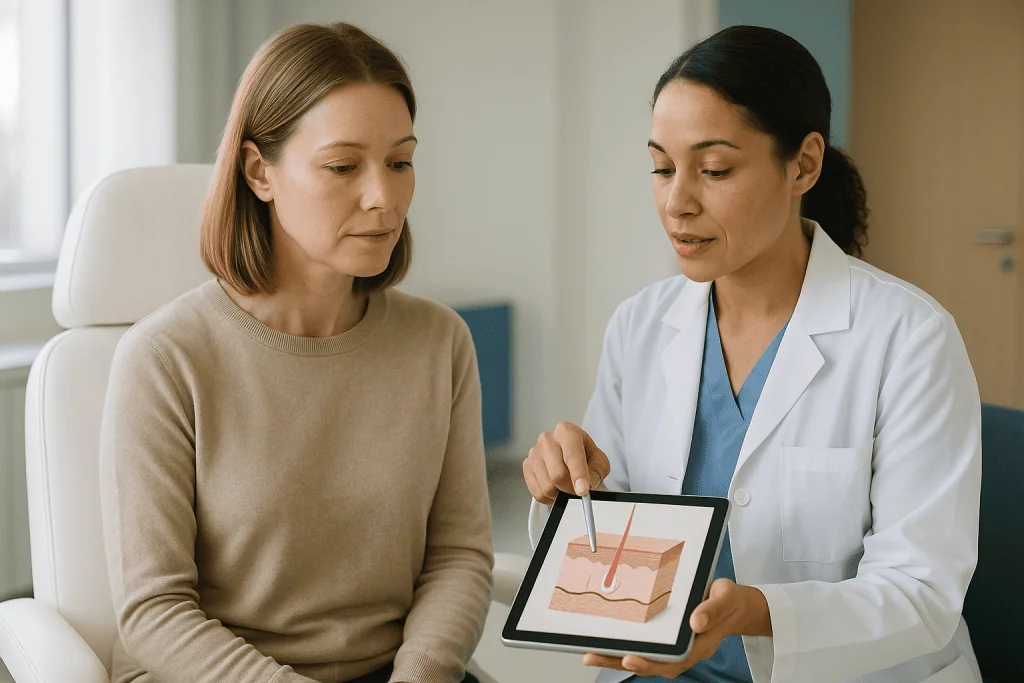
Resurfacing works by convincing the body that the mattress has been damaged in a controlled, predictable way. Heat denatures existing collagen and triggers a wound-healing cascade: inflammatory cells arrive within hours, fibroblasts (the cells that manufacture collagen) ramp up over the following weeks, and new collagen is laid down and remodeled for months afterward. That slow remodeling is why clinicians tell you the full result will not be visible for some time, whichever laser is used (Johns Hopkins Medicine).
With ablative treatment there is a second mechanism layered on top. Removing the epidermis also removes sun-damaged surface cells, uneven pigment and the rough upper edge of shallow scars. New epidermis grows back from cells in hair follicles and the wound margins, which is why intact follicles matter and why very deep ablation carries scarring risk.
Non-ablative treatment relies on heat alone. The device cools the surface, often with a chilled tip or a burst of cold spray, so the epidermis survives while the dermis below is heated enough to remodel. The trade-off is straightforward physics: protecting the surface limits how aggressively the dermis can be treated in one pass, which is why a series of sessions is the norm (Mayo Clinic).
How deep does each type of laser go?
Depth is not a dial anyone can simply turn to maximum. It is a product of wavelength, energy, pulse duration and how many passes the operator makes, all balanced against your skin’s ability to heal without leaving marks.
Ablative CO2 lasers penetrate into the upper dermis and leave a zone of heated tissue beneath the vaporized layer. That residual heat is useful, because it tightens collagen, but it also lengthens recovery and raises the chance of prolonged redness and pigment change. Erbium lasers are absorbed even more strongly by water, so they remove tissue with less surrounding heat; recovery tends to be shorter, and the trade-off is somewhat less collagen tightening per pass (Cleveland Clinic).
Non-ablative lasers work at wavelengths where water absorbs light more weakly, allowing energy to travel past the surface before it converts to heat. Some target the papillary dermis just below the epidermis, where fine lines and early sun damage live; others reach a little deeper toward the reticular dermis, where acne scars and coarser texture sit.
Depth also interacts with location. Facial skin heals well because it is rich in hair follicles and blood supply. The neck, chest and hands have fewer follicles and thinner skin, so clinicians usually treat them more conservatively regardless of laser type, and many decline to perform full-field ablative treatment there at all (Johns Hopkins Medicine).
The practical lesson: when a clinic describes a laser as deep or powerful, ask what that means for your skin at your intended treatment site, and what the plan is if the surface heals more slowly than expected.
Fractional CO2 laser vs non-ablative: why fractional changed the choice
For years the choice was stark. Full-field ablation sanded off the entire surface of the face and delivered striking change with a long, difficult recovery. Non-ablative devices were gentle to the point that some people finished a series wondering whether anything had happened.
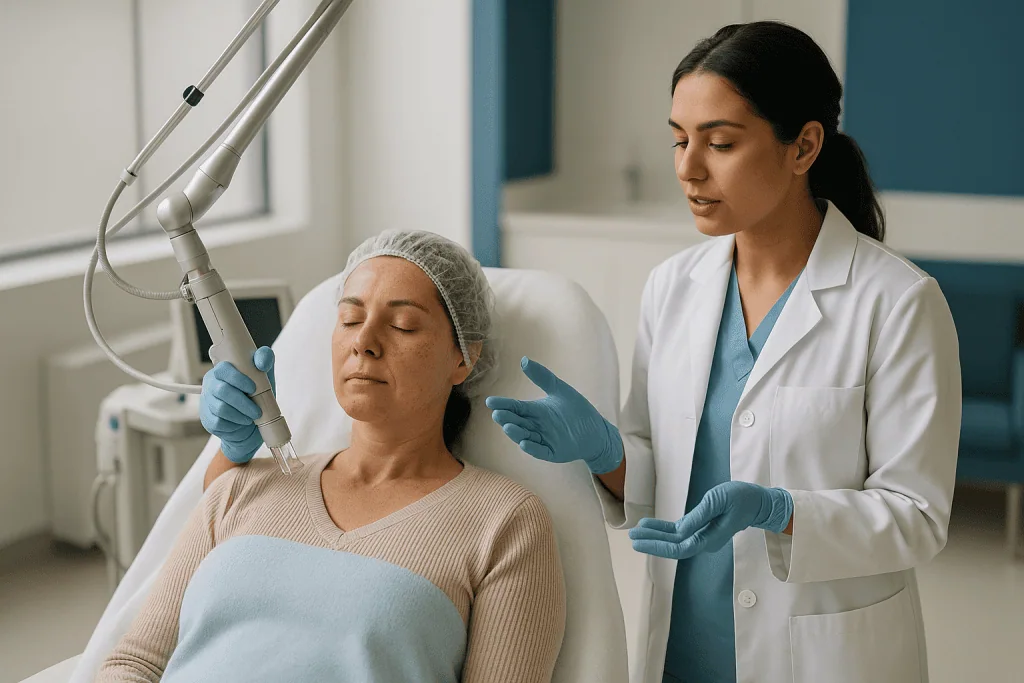
Fractional technology reshaped that landscape. A fractional laser, whether ablative or non-ablative, treats only a grid of microscopic columns of skin and leaves the tissue between them untouched. Those untreated bridges act as a reservoir of healthy cells, so the surface re-epithelializes quickly and the risk of scarring and pigment loss drops compared with treating every square millimeter (Mayo Clinic).
The result is a spectrum rather than two boxes. A fractional CO2 laser is still ablative, since each column is vaporized, but recovery is typically shorter than after full-field treatment because most of the surface was never removed. Fractional non-ablative lasers, meanwhile, can be run at higher energy than their full-field predecessors, narrowing the gap in results while keeping the surface intact.
Some newer platforms combine an ablative and a non-ablative wavelength in a single handpiece, treating different depths in one session. Reviews describe this hybrid approach as an attempt to capture the surface improvement of ablation with the deeper heating of non-ablative wavelengths, but it remains a variation on the same principles rather than a new category, and outcomes depend heavily on settings and operator judgment.
When you compare fractional CO2 laser vs non-ablative options, you are therefore choosing a point on a curve: how much change you want per session versus how much recovery you can absorb. The next section lays that curve out side by side.
Ablative vs non-ablative laser resurfacing at a glance
Tables flatten nuance, so treat this one as an orientation map rather than a decision tool. Every row shifts with the device, the settings and your own skin.
| Feature | Ablative (CO2, erbium; full-field or fractional) | Non-ablative (fractional or full-field) |
|---|---|---|
| What happens to the surface | Epidermis removed, in full or in columns | Epidermis left intact and cooled |
| Main target | Deeper wrinkles, sun damage, acne scars, uneven texture | Fine lines, mild texture, early sun damage, some pigment |
| Anesthesia commonly used | Topical numbing plus injected local anesthetic, nerve blocks or sedation for extensive work | Topical numbing cream, sometimes cooling only |
| Typical sessions | Often one, occasionally repeated after months | A series spaced weeks apart |
| Open wound care | Yes: ointments, dressings, gentle soaks | No open wound; moisturizer and sun protection |
| Surface healing | About 1–2 weeks (Mayo Clinic) | Hours to a few days (Mayo Clinic) |
| Residual redness | Can last months (Mayo Clinic) | Usually resolves within days |
| Pigment-change risk | Higher, especially in darker skin | Lower but not absent |
| Speed of visible change | Noticeable once healed, improving for months | Gradual, cumulative over the series |
Two rows deserve emphasis. First, the healing figures are typical ranges reported by mainstream medical sources, not promises; individual recovery varies with depth, aftercare and health. Second, the pigment row is where skin tone enters the conversation, and it belongs at the center of your consultation rather than as an afterthought once the appointment is booked.
Who is each approach usually for, and who is usually asked to wait?
Ablative resurfacing tends to be discussed when the concern is structural: etched lines around the mouth and eyes, rolling or boxcar acne scars, thickened sun-damaged skin, or surgical scars that have settled. It suits people who can schedule genuine time away from work and social life, who can commit to meticulous wound care, and whose skin tone carries a lower risk of lasting pigment change (Cleveland Clinic).
Non-ablative treatment is usually raised for earlier changes: fine lines, mild unevenness, enlarged-looking pores, early photoaging. It also becomes the default when someone cannot take extended downtime, when the treatment area is off the face, or when the risk of post-inflammatory hyperpigmentation (darkening of skin after any injury, more common in medium to deep skin tones) tips the balance toward a gentler approach (Johns Hopkins Medicine).
Clinicians classify skin tone using the Fitzpatrick scale, a six-step description of how skin responds to sun, from always burning to never burning. Higher Fitzpatrick types are not excluded from resurfacing, but device choice, energy settings and pre-treatment planning change, and many teams prefer conservative fractional or non-ablative options.
People who are commonly asked to wait, or to seek a different option, include those who are pregnant or breastfeeding, anyone with an active skin infection or cold sore in the treatment area, people with active inflammatory acne, anyone recently tanned or sunburned, and those with a history of keloid scarring or conditions that impair healing. A history of oral retinoid treatment for acne is a standard question at consultation; the traditional waiting period has been debated, and the decision rests with the treating clinician (Mayo Clinic). Realistic expectations are the final filter: resurfacing improves skin, it does not reverse decades or change facial structure.
What happens on the day of treatment?
The appointment begins before the laser is switched on. Your clinician will confirm the plan agreed at consultation, take standardized photographs, and check that no new cold sore, breakout or tan has appeared. If you have a history of herpes simplex around the mouth, an antiviral medicine is commonly prescribed to start beforehand, because heat and injury can trigger a flare; the choice and timing belong to the prescriber (Mayo Clinic).
Skin is cleansed and, for most treatments, a topical anesthetic cream is applied and left to take effect. For fractional ablative work, some teams add injected local anesthetic or nerve blocks; for full-field ablation, sedation or general anesthesia is sometimes used because the procedure is more extensive and uncomfortable. Non-ablative sessions are usually managed with numbing cream and cooling alone (Cleveland Clinic).
Protective eye shields go on. The handpiece is then moved methodically across the treatment area in overlapping passes. People describe non-ablative pulses as a hot snapping sensation, like a rubber band flicked against warm skin; ablative passes feel hotter and are followed by an immediate sting that the anesthesia blunts. Mayo Clinic reports that ablative treatment takes roughly 30 minutes to two hours depending on the area, while non-ablative sessions typically run 15 minutes to an hour and a half.
Afterward, ablative skin is coated in a thick healing ointment and often covered with a dressing; you will leave with written wound-care instructions and a follow-up date. Non-ablative skin is cooled, moisturized and protected with sunscreen, and most people head straight home or back to a quiet workday.
Ablative laser resurfacing downtime and non-ablative recovery: the following days and weeks
Here is where the two paths truly diverge, and where honest expectations prevent most of the anxious late-night phone calls.
After ablative treatment, the skin behaves like a fresh, deep abrasion. Expect swelling that peaks within the first two to three days, weeping or oozing, and a tight, itchy sensation as new epidermis forms. Care usually involves gentle soaks several times a day, reapplying ointment, sleeping with the head elevated, and avoiding anything that dries or picks at the surface. Mayo Clinic describes the treated area healing over about one to two weeks, after which the new skin is smooth but distinctly pink. That pinkness fades gradually and can persist for months, particularly after deeper CO2 treatment; many people cover it with mineral makeup once the surface has fully closed and their clinician agrees.
Non-ablative recovery is measured in hours and days rather than weeks. Skin looks flushed and feels warm, similar to a moderate sunburn, with swelling that is most obvious the next morning. Fractional non-ablative devices leave a fine, bronzed, sandpaper-like texture as microscopic columns of treated cells work their way to the surface and flake off. Mayo Clinic notes that redness and swelling typically settle within a few days and that most people return to normal activities immediately.
Both routes share three non-negotiables: strict sun protection, since healing skin pigments unpredictably; no picking or exfoliating until cleared; and a pause on active skincare ingredients such as retinoids and acids until the surface is intact. Your team will tell you when each can resume.
What results can you realistically expect, and how long do they last?
The most useful thing a clinician can say about results is that they arrive in two waves. The first is the change you see once the surface has healed: smoother texture, softened fine lines, more even tone. The second is the slow collagen remodeling described earlier, which continues to firm and refine the skin over subsequent months. Judging any resurfacing treatment at week two, whichever type, is like reviewing a meal before the main course.
Ablative treatment generally produces the larger single-session change. Mayo Clinic notes that improvements after ablative resurfacing can last for years, though the skin keeps aging and sun exposure keeps accumulating, so the phrase permanent is misleading. Deep scars are improved rather than erased; texture and edges soften, but a scar that reaches the deep dermis leaves some trace.
Non-ablative results are subtler and cumulative. Each session adds an increment, which is why a series is planned from the outset and why some people are disappointed if they stop after one. Maintenance sessions are often suggested to sustain the effect, at intervals decided with your team (Mayo Clinic).
No reputable source offers a single percentage for how much better skin will look, because outcomes depend on the target, the device, the settings and the person. Before-and-after images from clinics are selected examples, not averages, and should be read that way. What the evidence does support is the mechanism and the direction of change: controlled injury leads to collagen remodeling and improved surface quality, more so with deeper treatment, at the cost of more recovery and more risk (Johns Hopkins Medicine).
What are the risks, and how do they differ between ablative and non-ablative lasers?
Every resurfacing treatment carries risk, and the honest framing is that ablative and non-ablative lasers share the same list with the frequency and severity tilted toward the ablative side.
Redness, swelling and itching are expected rather than complications, but after ablative treatment they can be intense and, as noted, redness may last for months. Acne flares and milia (tiny white cysts) are common while thick ointments are in use. Infection is a genuine concern whenever the skin barrier is breached: bacterial infection, fungal overgrowth and, most often, reactivation of the herpes simplex virus that causes cold sores, which is why prophylactic antiviral medicine is routinely considered before ablative work (Mayo Clinic).
Pigment change is the risk that most shapes the choice between the two approaches. Hyperpigmentation, a temporary or lasting darkening, is more common after ablative treatment and in darker skin. Hypopigmentation, a loss of color, is less common but more troubling because it can appear months later and may be permanent, particularly after aggressive full-field ablation. Scarring is uncommon but real, and the risk rises with depth, with treatment off the face, and with poor wound care or infection (Cleveland Clinic).
A rare but specific ablative complication is ectropion, a turning outward of the lower eyelid caused by tightening of the skin beneath the eye. It is a reason eyelid skin is treated cautiously.
Non-ablative treatment can still cause blistering, crusting, pigment change and, rarely, scarring, especially if energy settings are too high for the skin type or cooling fails. Gentle does not mean risk-free; it means the odds are lower and the surface usually has less to repair.
What are the alternatives to laser resurfacing?
Lasers are one route to controlled injury, not the only one, and a good consultation will place them alongside the alternatives rather than presenting them as the inevitable answer.
Chemical peels use acids to remove skin at a chosen depth, from very superficial exfoliation to deep peels that resemble full-field ablation in recovery and risk. Dermabrasion mechanically sands the surface with a rotating instrument and has a similar profile to ablative resurfacing. Microneedling creates columns of injury with fine needles rather than heat; when combined with radiofrequency energy it heats the dermis as well, positioning it near the non-ablative end of the spectrum (Cleveland Clinic).
Intense pulsed light is often confused with laser because the devices look similar, but it uses a broad range of wavelengths rather than one, and it targets pigment and blood vessels more than texture. It does not resurface skin in the sense discussed here.
Topical treatments matter more than the glossy pages suggest. Prescription retinoids, a class of vitamin A derived medicines, increase cell turnover and support collagen over months of steady use; they are frequently part of preparation for, and maintenance after, resurfacing. Their use and timing are a decision for the prescribing clinician. Consistent broad-spectrum sun protection is the single intervention with the strongest evidence for slowing further photoaging, and it costs nothing in downtime (Johns Hopkins Medicine).
Doing nothing is also a legitimate option. If the changes bothering you are mild and your tolerance for risk or recovery is low, a clinician who says so is giving you good care, not a lesser service.
What people often get wrong about laser resurfacing
The myths cluster around a few themes, and each one is worth dismantling with what the evidence actually shows.
The celebrity myth comes first, because it drives a remarkable share of searches. People want to know which laser a particular actor uses, on the reasonable assumption that famous skin reflects a specific protocol. Private medical care is private; what circulates online is a mix of interviews, sponsored mentions and guesswork. Even if a regimen were known, another person’s skin tone, history and goals are not yours, and a treatment plan is not transferable like a recipe.
The second myth is that there is a single most effective resurfacing procedure. Effectiveness depends entirely on the target. Deep ablation is more effective for etched wrinkles and is a poor choice for someone who wants a modest refresh with no visible recovery. Asking which is best is like asking whether a chisel or sandpaper is the better tool.
Third, non-ablative is often assumed to be risk-free. It is lower risk, not no risk; blistering and pigment change still occur, especially when settings outrun skin type.
Fourth, a tan is not a shortcut to pretending you have lighter skin for the day. Recently tanned skin carries extra melanin that absorbs laser energy and raises the risk of burns and pigment change, which is why clinicians ask about sun exposure before treatment (Mayo Clinic).
Finally, who may operate a laser varies by jurisdiction. In the United States, rules on whether an esthetician may fire a non-ablative device, and under what supervision, are set state by state. A licensed practitioner working within a medically supervised setting, with clear plans for complications, is the standard to look for (NHS guidance on cosmetic procedures makes the same point about checking qualifications and safeguards).
Questions to ask your care team before choosing ablative or non-ablative treatment
A consultation is a two-way examination. You are assessing whether this clinician and this plan fit you as much as they are assessing your skin. The questions below are the ones that tend to surface the most useful answers.
- What specific change are you targeting in my skin, and why does this laser type suit that target better than the alternatives?
- How do you classify my skin tone, and how does that change the device, the settings and my risk of pigment change?
- Will this be full-field or fractional, and roughly how many passes or sessions are you planning?
- What anesthesia will be used, and who will monitor me if sedation is involved?
- What will the first three days look like, and what will I need to do at home, hour by hour?
- When can I expect to be presentable in public, and when will I see the settled result?
- Do I need any medicine before treatment, such as antiviral protection for cold sores, and who prescribes and follows it up?
- Which of my current skincare products or prescriptions should pause, and when do they restart?
- What complications have you managed after this procedure, how often, and what is your plan if one happens to me?
- Who do I call out of hours, and what would make you want to see me urgently?
- What are the realistic alternatives, including doing nothing for now?
Notice what is missing: any question about promotions, packages or bundles. Cost is a legitimate personal consideration, but it is not clinical information, and a plan should be judged on whether it fits your skin and your life before anything else. The decision about whether and how to proceed remains with you and your treating team together (Cleveland Clinic).
When to call your doctor after laser resurfacing
Most recovery is uncomfortable but uneventful, and your team will describe what to expect. Certain signs, though, warrant a call the same day rather than waiting for the scheduled follow-up, because early treatment of infection or a viral flare protects the final result.
Contact your treating team promptly if you notice any of the following:
- Pain that increases after the first two or three days instead of easing, or pain out of proportion to the treated area.
- Spreading redness beyond the treatment margins, warmth, or streaks tracking away from the area.
- Yellow or green discharge, thick crusts that keep reforming, or an unpleasant smell from the treated skin.
- Fever, chills or feeling generally unwell during recovery.
- Clusters of small blisters, especially around the mouth or nose, which can indicate a herpes simplex flare even if you have never had a cold sore.
- Any eye symptoms after treatment near the eyes: pain, light sensitivity, blurred vision, or a lower lid that appears to pull away from the eye.
- Areas that are healing much more slowly than the rest, look grey or white, or develop raised, thickened, itchy tissue in the weeks afterward.
- New dark or pale patches appearing as the skin heals.
Seek urgent care, by emergency services if needed, for signs of a severe allergic reaction to any medicine or dressing, such as swelling of the lips or tongue, difficulty breathing, or widespread hives, and for a rapidly spreading infection with fever and confusion.
Bring your written aftercare instructions and a list of everything you have applied to the skin. Never restart or stop a prescribed medicine on your own during recovery; ask the prescriber. Recovery decisions, like treatment decisions, sit with the team who know your skin and your history (Mayo Clinic; MedlinePlus general guidance on wound infection).
Frequently asked questions
What is non ablative laser resurfacing in plain terms?
Non-ablative laser resurfacing heats the deeper layer of skin, the dermis, without removing the surface layer. The device cools the epidermis while its wavelength deposits heat below, prompting collagen to remodel over the following months. Because the surface stays intact, there is no open wound; recovery is measured in days, results are subtler than with ablative lasers, and a series of sessions is usually planned rather than a single treatment.
What is a typical non ablative laser recovery time?
Redness and swelling after non-ablative treatment usually settle within a few days, and Mayo Clinic notes most people return to normal activities immediately. Skin often looks flushed and feels warm like a moderate sunburn, with the most swelling the next morning. Fractional non-ablative devices can leave a fine bronzed, sandpaper texture that flakes off over several days. Sun protection and a pause on active skincare ingredients are advised until your clinician clears them.
What laser treatment does Jennifer Aniston use?
There is no reliable medical record of what any celebrity has done to their skin, and clinicians cannot confirm or deny individual care. What circulates online blends interviews, sponsored mentions and guesswork. Even a fully documented regimen would not transfer to another person, because the right laser depends on skin tone, the specific concern, medical history and tolerance for downtime. A consultation based on your own skin is the only useful starting point.
What is the average cost of a non-ablative laser treatment?
This article does not provide prices, because cost varies widely with region, device, treatment area, number of sessions and the clinician’s training, and no figure would be meaningful for an individual. Cost is a legitimate personal consideration, but it is not clinical information. Ask a prospective provider for a written plan that specifies the device type, number of sessions, aftercare and complication management, and consider the total commitment rather than a single session.
What is the most effective skin resurfacing procedure?
There is no single most effective resurfacing procedure, because effectiveness depends on the target. Deeper ablative treatment generally produces the largest change for etched wrinkles, sun damage and acne scars, at the cost of longer recovery and higher pigment and scarring risk. Non-ablative treatment suits fine lines and mild texture with minimal downtime. Chemical peels, microneedling and topical retinoids are alternatives. The most effective option is the one matched to your goal and skin type by a qualified clinician.
Can estheticians use non-ablative lasers?
It depends where you live. In the United States, laser regulation is set state by state; some states allow licensed estheticians to operate certain non-ablative devices under physician supervision, others restrict laser use to medical professionals, and rules change. Whatever the setting, look for a practitioner working within a medically supervised environment, with documented training on the specific device, a clear plan for complications, and direct access to a doctor if something goes wrong.
Is laser resurfacing safe for darker skin tones?
Resurfacing can be performed on darker skin, but device choice and settings change. Higher Fitzpatrick skin types carry a greater risk of post-inflammatory hyperpigmentation after any injury, and ablative lasers raise that risk further, so many clinicians favor conservative fractional or non-ablative approaches, lower energy settings and careful pre-treatment planning. An honest consultation will discuss this risk directly and may include a test spot before treating a larger area.
How many sessions does ablative vs non-ablative laser resurfacing take?
Ablative resurfacing is often a single session, occasionally repeated after months once the skin has fully healed. Non-ablative treatment is typically planned as a series spaced weeks apart, because each session adds an increment of collagen remodeling, with maintenance sessions sometimes suggested afterward. The exact number depends on the device, your target and how your skin responds, and it should be agreed with your care team before you begin rather than decided session by session.
Does laser resurfacing hurt, and what anesthesia is used?
Discomfort scales with depth. Non-ablative pulses feel like a hot snap against warm skin and are usually managed with topical numbing cream and cooling. Fractional ablative treatment feels hotter and stings afterward, so teams commonly add injected local anesthetic or nerve blocks. Full-field ablation may be performed under sedation or general anesthesia because it is more extensive. Your clinician will choose the approach and explain who monitors you during and after treatment.
When can I wear makeup and resume skincare after laser resurfacing?
After non-ablative treatment, many clinicians permit mineral makeup within a day or two once the skin feels cool and intact. After ablative treatment, makeup must wait until the surface has fully re-epithelialized, typically after the one to two week healing window Mayo Clinic describes, and only with your team’s approval. Active ingredients such as retinoids and acids pause in both cases until the barrier has recovered. Follow the specific timeline your clinician gives you.
References
This article is for general information only and is not a substitute for professional medical advice. Please consult a qualified doctor about your individual situation.

More from the Blog
Timing Reconstruction After Skin Disease: Why Active Infection or Tumor Must Settle First
Reconstruction after skin cancer is usually timed to two conditions rather than a calendar date: the pathology report must confirm the tumor has been…
Scar Treatment Side Effects: Temporary Darkening, Redness and What to Report to Your Doctor
Most scar treatment side effects are temporary: redness, swelling, tenderness, itching and a period of darkening (post-inflammatory hyperpigmentation) that usually fades over weeks to…
Aftercare After Fibroblast Plasma Treatment: Crusts, Cleansing and the Week Without Makeup
Fibroblast treatment aftercare centers on leaving the small carbon crusts alone until they fall off on their own, cleansing gently with lukewarm water and…
Skincare After a Chemical Peel: Sunscreen, Simple Moisturizer and When Actives Can Return
After a chemical peel, most care teams advise gentle cleansing with lukewarm water, a plain fragrance-free moisturizer or the ointment they provide, and daily…

When Pigmentation Returns After Treatment: Sun, Hormones and What the Next Step Looks Like
Pigmentation often comes back after treatment because creams, peels and lasers reduce or remove existing pigment without switching off the pigment-making cells underneath. Ultraviolet…
Plexr Plasma Exeresis vs Surgical Blepharoplasty: Which Eyelids Suit a Non-Surgical Lift?
Plasma exeresis and surgical blepharoplasty address different problems. Plasma exeresis vaporizes tiny points of eyelid skin so it contracts, which suits mild skin laxity…