

Astigmatism Laser Recovery: Why Vision Fluctuates Before It Settles
Key Takeaways
- Astigmatism correction removes more tissue along the steeper corneal meridian, so small changes in swelling or surface smoothness during healing shift focus more noticeably than after simple short-sightedness treatment.
- Mayo Clinic guidance places full healing and visual stabilization at roughly two to three months, which is the benchmark to judge results against, not the first week.
- Vision that sharpens immediately after a blink and softens seconds later is a tear-film problem, not a corneal shape problem, and is the most common cause of fluctuating clarity.
- PRK regrows the entire surface epithelium and therefore involves more early discomfort and a longer fluctuating phase than LASIK, though both correct astigmatism to the same end point.
- Pain that increases after the second day, a sudden drop in vision, thick discharge or a sense the flap has moved are red flags that warrant a same-day call rather than more pain relief.
- Enhancement is generally considered only once measurements have stayed stable across more than one visit, commonly after three months, and only after surface dryness has been ruled out as the cause of residual blur.
Vision commonly fluctuates for weeks after laser treatment for astigmatism because the corneal surface, tear film and healing tissue are still changing shape and smoothness. Most people notice usable sight within a day or two, but clarity often shifts between mornings and evenings until the eye settles, typically over about two to three months. Persistent or worsening blur, pain or light sensitivity should be reported to the treating team.
Three days after her laser treatment, a 34-year-old graphic designer read the street sign at the end of her block without glasses for the first time since school. By that evening the same sign had gone soft at the edges. She spent the night searching whether something had gone wrong. The next morning the sign was crisp again.
That swing is one of the most common, and least explained, parts of astigmatism surgery recovery. Patients are told their sight will be “blurry for a bit,” which is true but unhelpful. What they are not told is why clarity can arrive, leave, and return within the same day, or why a cornea that has been reshaped in under a minute can take a season to make up its mind.
This explainer walks through the mechanics: what the laser changes, what the eye does afterward, which fluctuations are expected, and which ones deserve a phone call to the people who did the procedure.
What astigmatism actually is, and why corneal shape decides everything
Astigmatism is a focusing error caused by a cornea, the clear front window of the eye, that curves more steeply in one direction than the other. The NHS describes the shape as closer to a rugby ball than a football. Light entering through that uneven curve lands on the retina as two focal lines rather than a single point, so letters smear, headlights grow tails and fine print doubles at the edges.
Almost everyone has a little astigmatism. It only becomes a problem when the difference between the two curves is large enough to blur daily tasks. Opticians measure it in diopters, the unit of lens power, and record an axis, the angle of the steeper curve. A prescription that reads, say, -1.50 at 90 degrees is a map of exactly where the cornea needs to change.
That map matters for recovery in a way many patients do not anticipate. Correcting astigmatism is not a matter of removing tissue evenly. The laser flattens one meridian more than another, which means the healed surface has to settle into an asymmetric shape and hold it. Any swelling, dryness or uneven epithelial healing in the weeks afterward alters that asymmetry slightly, and because the eye is exquisitely sensitive to cylinder power and axis, a tiny shift in surface geometry can produce a noticeable change in clarity.
Spherical errors such as simple short-sightedness are, in this sense, more forgiving. Astigmatism correction asks the cornea to be precise in two dimensions at once. When patients ask why their friend who only had short-sightedness treated seemed to settle faster, this is often part of the honest answer.
How does laser eye surgery work when astigmatism is the target?
Laser eye surgery works by permanently reshaping the cornea so that light focuses on the retina without a lens in front of the eye. According to Mayo Clinic, the most widely used method, LASIK, begins by creating a thin hinged flap in the outer cornea. The surgeon folds this flap back, applies an excimer laser, a cool ultraviolet laser that vaporizes microscopic amounts of tissue without heat damage to surrounding layers, then lays the flap back into place, where it adheres on its own without stitches.
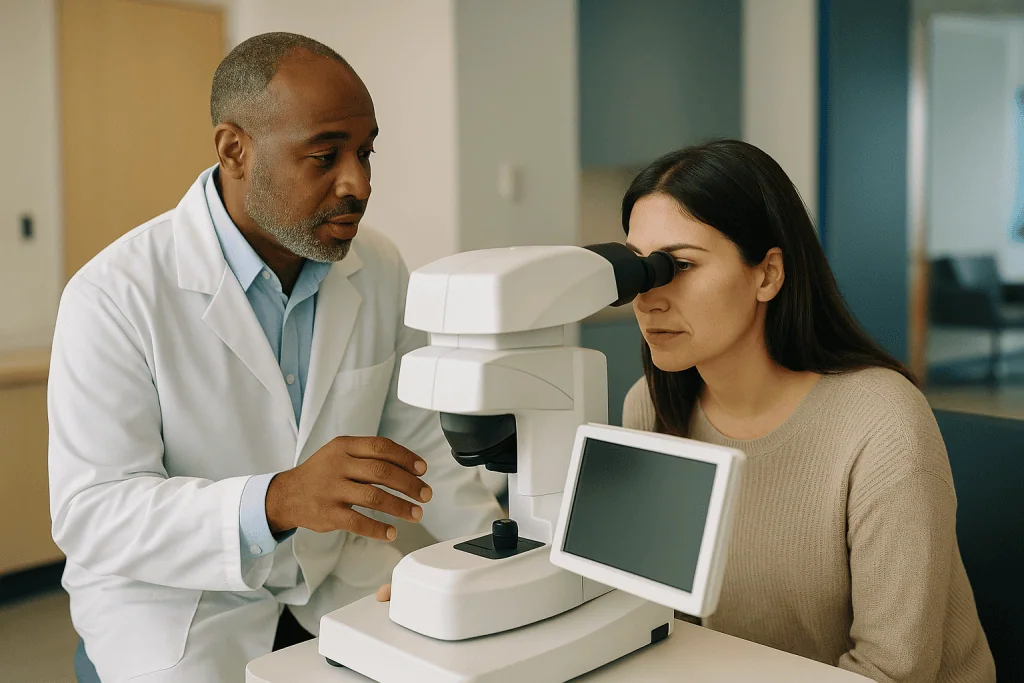
For astigmatism, the laser is programmed to remove slightly more tissue along the steeper meridian than the flatter one. The result is a more spherical surface. Modern systems track eye movement hundreds of times per second so that the pattern stays aligned to the axis even if the eye drifts.
Surface treatments such as PRK skip the flap. Instead the epithelium, the cornea’s outermost skin-like layer that is only a few cells thick, is removed and the laser is applied directly to the underlying tissue. The epithelium then regrows over several days under a protective contact lens, which Cleveland Clinic notes is why PRK involves more early discomfort and a slower visual recovery.
Either way, the laser portion of the procedure takes under a minute per eye. Numbing drops keep it painless, though patients commonly report pressure, a faint smell and a moment of dimmed vision while the flap is created.
What the procedure does not do is change the lens inside the eye or the retina. Any blur that originates there, including the normal age-related loss of near focus, is untouched. Patients over 40 who wonder why reading glasses are still needed after treatment are experiencing exactly that distinction.
Why does vision fluctuate during astigmatism surgery recovery?
Four processes overlap in the first weeks, and each one nudges focus in a slightly different direction.
The first is epithelial remodeling. After LASIK the flap edges heal, and after PRK the whole surface regrows. New epithelium is initially irregular, like fresh plaster that has not been sanded. Over days to weeks the cells thicken in some places and thin in others, smoothing the optical surface. Until that finishes, the effective curvature keeps changing.
The second is swelling. Treated corneal tissue holds extra fluid early on. Because swelling is rarely uniform, it can temporarily add or subtract a fraction of a diopter of cylinder and tilt the axis. As the fluid clears, so does the shift.
The third, and often the largest, is the tear film. Laser treatment cuts corneal nerves that normally signal the eye to blink and produce tears. Mayo Clinic lists dry eye as a common temporary side effect, and a dry or uneven tear layer behaves like a smeared windscreen. Vision frequently sharpens straight after a blink and degrades a few seconds later, or is clear in the morning and hazy by evening after screen use.
The fourth is the brain. Years of looking through astigmatic correction, or through no correction at all, train the visual cortex to interpret a particular pattern of blur. Presented with a new, sharper image, it takes time to recalibrate. Some patients describe the world as “too crisp” or oddly flat for a while.
Recognizing which of these is at work helps. Blink-dependent clarity points to tears. A steady improvement interrupted by foggy mornings points to overnight drying and swelling. Fluctuation that trends upward is reassuring. Fluctuation that trends downward is not, and belongs in the next conversation with the treating team.
What the first 24 hours after laser treatment usually involve
Nobody drives themselves home. MedlinePlus advises that someone else transports you, and that you rest the eyes for the remainder of the day. Within the first few hours many people describe a gritty, scratchy sensation, watering, mild burning and marked light sensitivity. Sunglasses help even indoors. The eyes may look pink; small red patches on the white of the eye are common after the suction used to create a flap and fade over one to two weeks.
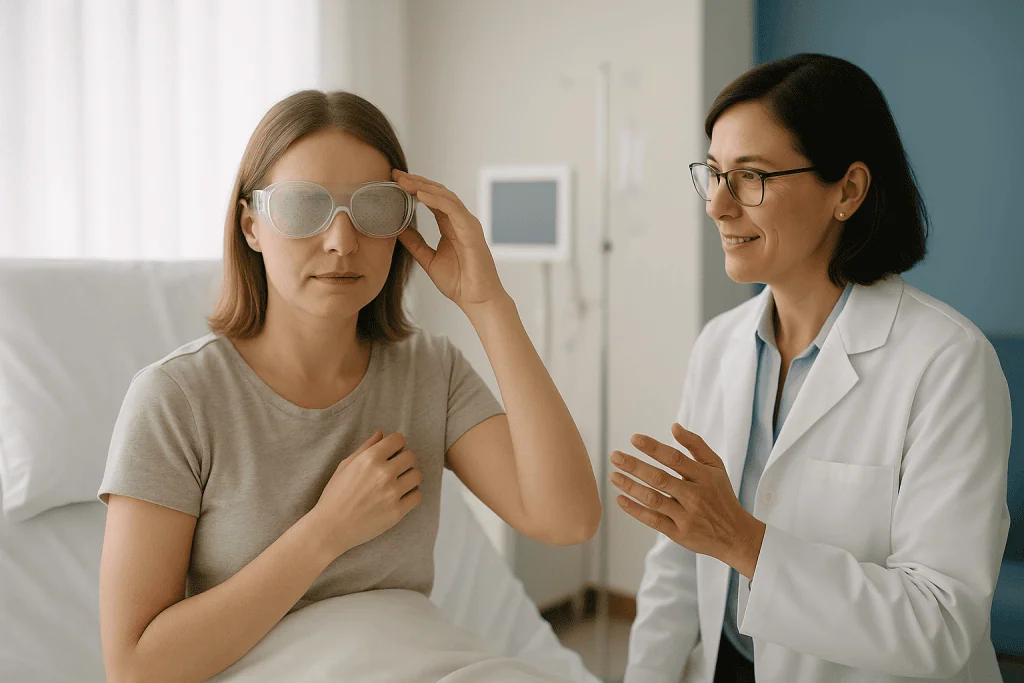
Vision in this window is typically foggy, as though looking through a steamed bathroom mirror. That is expected. The flap is still settling, the surface is swollen and the tear film is disrupted. Rubbing is the single most important thing to avoid, because the flap has not yet bonded firmly, and most teams provide clear shields to tape over the eyes for sleep in the first nights.
Drops are usually prescribed in two classes: an antibiotic to reduce infection risk while the surface heals, and an anti-inflammatory to limit swelling and scarring. Preservative-free lubricants are often added for comfort. The schedule for these belongs to the prescribing clinician and varies between individuals; following the written instructions matters more than any general advice.
A follow-up examination within the first day or two is standard. The surgeon lifts the lids, checks that the flap is smooth and in position, looks for inflammation beneath it and measures how the eye is already focusing. Mayo Clinic notes that many patients can see well enough for most tasks by the next day, even though fine detail remains soft.
Screens, reading and bright lights are tiring at this stage rather than dangerous. Most people are told they can resume light activity the following day while avoiding anything that risks a knock to the face or water in the eye.
LASIK recovery timeline: what weeks one to twelve typically look like
Healing follows a broadly recognizable arc, though every eye writes its own version. The ranges below are drawn from Mayo Clinic and NHS patient guidance and describe what is typical rather than what is promised.
| Stage | What is usually happening | What patients commonly notice |
|---|---|---|
| Day 1 | Flap sealing, surface swelling, tear disruption | Fog, grittiness, light sensitivity, functional but soft vision |
| Days 2–7 | Epithelium smoothing at flap edge, swelling clearing | Noticeable sharpening; halos and glare at night; dryness by evening |
| Weeks 2–4 | Corneal nerves begin regrowing, tear film stabilizing | Fluctuation between mornings and evenings; occasional “off” days |
| Months 1–3 | Final surface remodeling, neural adaptation | Clarity steadier; night symptoms fading; residual error becomes measurable |
| Months 3–6 | Stabilization for most eyes | Decision point for any enhancement if vision has settled short of target |
Mayo Clinic states that it usually takes about two to three months for the eye to heal fully and for vision to stabilize, and that final results depend partly on how much correction was needed. Higher astigmatism generally means a larger tissue change and, often, a longer settling period.
Two features of this timeline deserve emphasis. Night symptoms, meaning halos around lights and starbursts from headlights, are driven by the mismatch between a healing cornea and a pupil that widens in the dark; they usually diminish as the surface smooths. And the “off” days in weeks two to four are the stage most likely to generate worried searches, precisely because they arrive after a few good days have raised expectations.
PRK vs LASIK recovery: why surface treatments take longer to settle
The two procedures reshape the cornea to the same end point, but they reach it by different routes, and the route changes the recovery.
With LASIK, the epithelium stays largely intact on the flap, so the optical surface is nearly complete the moment the flap is repositioned. Discomfort is mild and brief, and functional vision returns quickly. The trade-off is the flap itself: for the first weeks it is vulnerable to being dislodged by a direct blow or vigorous rubbing, and the deeper cut interrupts more corneal nerves, which is one reason dry eye symptoms are frequently more pronounced early on.
With PRK, the entire central epithelium is removed. Cleveland Clinic describes a healing period of several days during which the surface regrows under a bandage contact lens, accompanied by more significant discomfort, tearing and light sensitivity. Vision during that period is often poor. Once the epithelium has closed, clarity improves over weeks rather than days, and the fluctuations described earlier can be more pronounced and last longer, because the new surface has more remodeling to do.
Why choose the slower route? PRK leaves no flap, which can matter for people with thinner corneas, those in contact sports or occupations with a risk of eye trauma, and some with pre-existing surface conditions. Surgeons weigh those factors against the recovery burden. Neither procedure is universally superior; the NHS notes that suitability depends on individual eye measurements and lifestyle.
For astigmatism specifically, both approaches can correct the asymmetric curve. The practical difference for patients is expectation management: a PRK patient who judges the result at week two will be comparing against a surface that is not yet finished, while a LASIK patient at the same point is closer to the final picture.
Dry eyes after laser eye surgery: the biggest driver of changing clarity
If one factor explains most day-to-day visual swings during astigmatism surgery recovery, it is the tear film. The surface of the eye is only optically smooth when coated with a stable layer of tears. Break that layer and the cornea, however perfectly shaped underneath, presents an irregular surface to incoming light.
Laser treatment interrupts the fine sensory nerves that run through the cornea and signal the brain to blink and the lacrimal glands to produce tears. Mayo Clinic lists a temporary decrease in tear production as a common effect, with the eyes feeling unusually dry as they heal. Nerves regrow slowly, over months, so the sensation often outlasts the visible healing.
The clinical pattern is distinctive. Vision is clearest in the first second after a blink and softens as the tear film breaks up. Long stretches at a screen, during which blink rate roughly halves, make the problem worse. Air conditioning, wind, heating and low humidity all accelerate evaporation. Many patients report that evenings are hazier than mornings, then find the reverse when overnight lid closure dries the surface in a different way.
Management is mainly mechanical. Preservative-free lubricating drops, used as the care team directs, restore the smooth layer. Deliberate full blinks during screen work help. A humidifier in dry rooms, wraparound sunglasses outdoors and avoiding fans aimed at the face are low-cost habits with a real effect. For people whose dryness persists beyond the expected window, clinicians have further options, including anti-inflammatory drops and tiny plugs placed in the tear drainage ducts; those decisions rest with the treating team after examination.
Patients with pre-existing dry eye are usually screened carefully beforehand, and in some cases asked to treat the dryness first, because starting from a healthier surface shortens the fluctuating phase.
Who is usually a candidate, and who is usually asked to wait
Laser correction suits many adults with astigmatism, but the screening process excludes or postpones a meaningful share of people who inquire, and the reasons are mostly about recovery rather than about the laser itself.
The NHS and Mayo Clinic describe typical candidates as adults, generally over 18 and often older, whose prescription has been stable for at least a year or two, whose corneas are thick enough to remove tissue safely, and whose eyes are otherwise healthy. Stability matters because the laser corrects today’s error; if the eye is still changing, the result drifts with it.
People commonly asked to wait include those who are pregnant or breastfeeding, since hormonal shifts alter corneal shape and tear production temporarily; those with uncontrolled dry eye, blepharitis or other surface disease that would complicate healing; and anyone whose prescription changed significantly in the past year. Contact lens wearers are usually asked to stop lenses for a period before assessment so the cornea can return to its natural curve and be measured accurately.
Some people are usually advised against laser treatment altogether. Mayo Clinic highlights keratoconus, a progressive thinning and bulging of the cornea, and conditions that impair healing such as poorly controlled diabetes or certain autoimmune disorders. Very high astigmatism may exceed what the laser can safely correct, in which case lens-based procedures or continued spectacle or contact lens use are discussed as alternatives.
Age cuts both ways. Younger eyes may still be changing. Older eyes develop presbyopia, the normal loss of near focus, which laser treatment does not address, and later cataract, which can change the calculation entirely. The assessment visit, with corneal mapping and a dilated examination, is where these factors are weighed. The decision is a shared one, and the surgeon’s judgment about suitability is itself part of the treatment.
Do's and don'ts after laser eye surgery, and the reasons behind them
Most post-operative instruction sheets look like a list of rules. They read differently once the reasoning is attached. The following reflects guidance published by Mayo Clinic and MedlinePlus; the written instructions from your own care team take precedence where they differ.
- Do keep the eye shields on while sleeping for the first nights. The flap bonds progressively; an unconscious rub against a pillow is the classic cause of early displacement.
- Do use every prescribed drop as directed. Antibiotic drops protect the healing surface; anti-inflammatory drops control the swelling that distorts focus. Stopping early because the eye “feels fine” is a common error, and changes should be made only with the prescriber.
- Do wear sunglasses outdoors. Light sensitivity is normal, and UV protection supports healing.
- Don’t rub your eyes, ideally for several weeks. This is the rule surgeons repeat most.
- Don’t swim, use hot tubs or submerge your face for roughly one to two weeks per Mayo Clinic guidance, because pooled water carries organisms the healing surface cannot yet resist.
- Don’t wear eye makeup for about a week, and replace old products, which can harbor bacteria.
- Don’t resume contact sports until cleared; a stray elbow in the first weeks is a flap risk.
- Do limit, but don’t ban, screens. Screens do not damage the healing eye; they dry it. Short sessions with deliberate blinking are reasonable from day two for most people.
Showering is fine with eyes closed and face kept out of the direct stream. Driving resumes only once the care team confirms vision meets the legal standard, which for many people is within the first few days but is never assumed.
How to relieve discomfort after laser eye surgery without compromising healing
Discomfort after LASIK is usually described as grit, burning or a feeling that something is in the eye, peaking in the first few hours and easing within a day or two. After PRK it is more intense and lasts for several days while the epithelium regrows. Neither should feel like sharp, escalating pain.
The first line of relief is simple: closing the eyes. MedlinePlus advises resting with eyes shut for several hours after the procedure, and many patients find a few hours of sleep carries them past the worst of the early soreness. Darkening the room reduces the light sensitivity that amplifies everything else.
Lubricating drops, when the care team has approved them, soothe the surface and reduce the scratchy sensation. Cold compresses placed over closed eyelids, never pressing on the eye itself, can dull burning; a clean cloth cooled in the refrigerator is sufficient. Avoid anything that drips into the eye.
Over-the-counter pain relief is often suggested by surgical teams for the first day or two. Which class is appropriate, and whether any is needed, depends on individual health and other medicines, and is a question for the prescriber rather than a general article. Some PRK patients receive a short course of stronger anesthetic or anti-inflammatory drops; these are given under supervision because prolonged anesthetic use slows healing.
What patients should not do is pick up a leftover eye drop from an earlier problem, borrow a relative’s medication or rub for relief. Rubbing gives a few seconds of comfort and risks the flap. Equally, discomfort that worsens after the second day, rather than easing, is not a reason to reach for more pain relief; it is a reason to call, because increasing pain is one of the few early warnings of infection or flap trouble.
What people often get wrong about astigmatism surgery recovery
“If it’s blurry on day three, the surgery failed.” Fluctuation in the first weeks is the expected consequence of healing tissue and an unstable tear film, not evidence of a problem. Mayo Clinic’s guidance that stabilization takes about two to three months is the more useful benchmark.
“Astigmatism can’t be treated with a laser.” It can, and routinely is. The persistence of this myth comes from older technology and from confusing astigmatism with keratoconus, a disease in which laser treatment is generally avoided.
“Good vision at one week means I’m finished healing.” Early clarity reflects a smooth flap, not a finished cornea. Night glare, dryness and small drifts in focus can continue well after daytime sight is good.
“Screens will damage my eyes after surgery.” They dry the surface by suppressing blinking; they do not harm the healing tissue. The fix is shorter sessions and conscious blinks, not avoidance.
“If one eye is clearer than the other, something went wrong.” Asymmetric healing is common. Eyes rarely start from identical prescriptions or heal at identical rates, and the difference usually narrows.
“Laser surgery means never needing glasses again.” It corrects the error present at the time. It does not stop presbyopia after 40, cataract later in life, or the small regression that can occur in some eyes. Mayo Clinic notes that a second procedure is sometimes considered when vision settles short of the target, and that reading glasses may still be needed with age.
“Enhancement means the first surgery was done badly.” Healing is biological, and the amount of correction an individual cornea retains varies. An enhancement is a planned possibility discussed before the first procedure, not an admission of error.
Blurry vision after LASIK that doesn't settle: regression, residual error and enhancement
Most fluctuation resolves. Occasionally it settles into a steady but imperfect result, and three terms are worth understanding before that conversation.
Residual error means the eye has stabilized with some astigmatism or sphere still present. It can result from the cornea healing slightly differently than modeled, from a small amount of under- or over-correction, or from tissue remodeling that partially fills in the treated zone. Regression describes a specific pattern in which early clarity gradually drifts back toward the original prescription over months; it is more likely with higher starting corrections and is a biological response rather than a technical failure.
Measuring any of this reliably requires a stable eye. Checking refraction at week two tells the surgeon what the cornea is doing today, not what it will do. For that reason enhancement, a second laser treatment to refine the result, is generally not considered until measurements have been stable across more than one visit, commonly after the three-month mark. Whether enhancement is appropriate depends on corneal thickness remaining, the size of the error and whether it actually affects daily life; a small residual cylinder that only shows on a chart may not justify further surgery.
Not all persistent blur is refractive. Dry eye can mimic residual astigmatism almost perfectly, and surgeons routinely treat the surface and remeasure before concluding that the shape is wrong. Less commonly, blur with distortion reflects a flap irregularity, epithelial cells growing beneath the flap, or inflammation, each of which has a different management path.
The honest message is that a stable but imperfect outcome is a known possibility that patients consent to beforehand. The treating team’s job at three months is to distinguish surface from shape, decide whether anything should be done, and explain the trade-offs. The decision stays with them and with you.
Questions to ask your care team before and after treatment
Recovery goes more smoothly when expectations are set in the consultation room rather than corrected online at midnight. These questions are not a script; they are prompts for a conversation your surgeon should welcome.
Before the procedure
- How much astigmatism do I have, and is all of it on the cornea or does some come from the lens inside the eye?
- Is my prescription stable enough, and what did my corneal mapping show?
- Am I better suited to a flap procedure or a surface procedure, and why?
- Do I have signs of dry eye now, and should that be treated first?
- What is the realistic range of outcomes for someone with my measurements, and what residual error would prompt a discussion about enhancement?
- Will I still need reading glasses, now or later?
After the procedure
- What should my vision be doing at one week, one month and three months?
- Which fluctuations are expected, and which should prompt a call?
- How long should I continue each drop, and what should I do if I miss one?
- When can I drive, exercise, swim and return to contact sports?
- What symptoms distinguish normal dryness from infection or flap problems?
- Who do I contact out of hours?
Write the answers down. The first-day follow-up is often a blur, literally, and patients frequently cannot read their own instruction sheet that evening. Having a companion take notes, or asking the clinic to send a plain summary, avoids the confusion that leads people to stop drops early or to resume activities too soon. It also creates a record against which later fluctuations can be judged calmly.
When to call your doctor during astigmatism surgery recovery
Most of what this article describes is normal healing. A small number of symptoms are not, and the distinction is usually about direction and intensity: expected symptoms ease over days, while problems escalate.
Contact the surgical team the same day, or the emergency service they provided, if you notice any of the following, which Mayo Clinic and MedlinePlus list among warning signs:
- Pain that increases after the first day or two rather than fading, or sudden sharp pain
- A marked drop in vision after a period of improvement, or new distortion in one eye
- Increasing redness, a thick or colored discharge, or a lid that becomes swollen
- Severe light sensitivity that worsens rather than eases
- A sensation that the flap has moved, particularly after rubbing, a knock to the eye or waking with the eye against a pillow
- A persistent feeling of something in the eye combined with watering that does not respond to lubricants
- Flashes of light, a shower of new floaters, or a shadow across part of the vision, which are signs of retinal problems unrelated to the cornea but requiring urgent assessment
Early infection and flap displacement are treatable when caught quickly and considerably harder to manage after a delay, which is why teams would rather hear from an anxious patient about a false alarm than miss a true one. There is no penalty for calling.
For the ordinary swings in clarity, dryness and night glare, the scheduled follow-up visits are the right place. Keep a brief note of when vision is better or worse during the day; that pattern helps the clinician separate surface problems from shape problems. Whatever the finding, the next step, whether more lubrication, a change in drops, patience or a discussion about enhancement, is a decision made with the treating team, who can examine the eye rather than guess at it.
Frequently asked questions
What are the do's and don'ts after LASIK eye surgery?
Do use prescribed drops as directed, wear eye shields when sleeping in the first nights, and wear sunglasses outdoors. Don’t rub your eyes, swim or use hot tubs for about one to two weeks, wear eye makeup for about a week, or play contact sports until cleared. Screens are permitted in short sessions with deliberate blinking. Your care team’s written instructions override any general list.
How does laser eye surgery work for astigmatism?
An excimer laser removes microscopic amounts of corneal tissue in a pattern that flattens the steeper curve more than the flatter one, leaving a rounder surface that focuses light to a single point. In LASIK this happens beneath a thin hinged flap; in PRK the surface layer is removed first and regrows afterward. The laser itself takes under a minute per eye.
How long does the LASIK recovery timeline take for astigmatism?
Functional vision often returns within a day or two, but Mayo Clinic advises that full healing and stable vision typically take about two to three months. Higher astigmatism usually means a larger tissue change and a longer settling period. Night glare, dryness and day-to-day fluctuation commonly continue after daytime vision is already good.
Is blurry vision after LASIK normal in the first weeks?
Yes, fluctuating or hazy vision is expected while the corneal surface smooths, swelling clears and the tear film recovers. Blur that varies through the day, improves after blinking or is worse after screen use is typical. Blur that worsens steadily, appears suddenly after improvement, or comes with pain, redness or discharge should be reported to the treating team the same day.
Why are dry eyes after laser eye surgery so common?
The procedure cuts fine corneal nerves that normally trigger blinking and tear production, so the surface dries more easily until the nerves regrow over months. A dry, uneven tear film scatters light and makes vision fluctuate. Preservative-free lubricants, humidified rooms and conscious blinking help; persistent dryness has further options that the care team can discuss after examination.
How is PRK vs LASIK recovery different?
LASIK preserves most of the surface layer on a flap, so discomfort is mild and vision returns within days. PRK removes the surface layer, which regrows over several days under a bandage lens, bringing more discomfort and a slower, more fluctuating visual recovery over weeks. Surgeons may prefer PRK for thinner corneas or trauma-prone lifestyles because it leaves no flap.
How to prepare for LASIK so that recovery goes smoothly?
Stop contact lenses for the period your surgeon specifies so corneal measurements are accurate, treat any existing dry eye or lid inflammation beforehand, and arrange transport home and a day of rest. Avoid eye makeup and lotions on the day. Ask in advance exactly which fluctuations to expect and who to call out of hours, and write the answers down.
How to relieve pain after laser eye surgery?
Rest with eyes closed in a darkened room for the first hours, use approved lubricating drops, and apply a cool compress over closed lids without pressing on the eye. Surgical teams often suggest over-the-counter pain relief for a day or two; the appropriate type is a question for the prescriber. Pain that increases after the second day needs a call, not more medication.
Can astigmatism come back after laser surgery?
A degree of regression, where early clarity drifts partially back toward the original prescription over months, occurs in some eyes and is more likely with higher starting corrections. The cornea does not revert to its old shape, but biological remodeling can reduce the correction retained. If measurements stabilize short of target, the surgeon may discuss an enhancement procedure.
When can I drive, exercise and swim after astigmatism laser surgery?
Driving resumes only once the care team confirms vision meets the legal standard, often within the first few days but never assumed. Light exercise is usually fine within a day or two, avoiding sweat and knocks to the eye. Mayo Clinic advises avoiding swimming and hot tubs for roughly one to two weeks, and contact sports until the surgeon clears them.
References
- MedlinePlus: LASIK eye surgery
- NHS: Laser eye surgery and lens surgery
- Cleveland Clinic: LASIK eye surgery
This article is for general information only and is not a substitute for professional medical advice. Please consult a qualified doctor about your individual situation.

More from the Blog

Who Is a Candidate for ReLEx SMILE? Prescription Range, Corneal Maps and Tear Film
A typical candidate for SMILE eye surgery is an adult with stable nearsightedness, with or without astigmatism, whose corneal maps show a regular shape…

Light Sensitivity and Tearing in the First Days After LASEK: Expected or a Warning Sign?
Light sensitivity and tearing are expected in the first days after LASEK, because the cornea's thin surface layer is healing and its nerve endings…

How Laser Treatment for Diabetic Retinopathy Is Done and Why It Sometimes Takes Sessions
Diabetic retinopathy laser treatment uses a focused beam to seal leaking retinal vessels or to treat oxygen-starved peripheral retina so abnormal new vessels shrink.…

Life With an Intraocular Lens: Halos, Night Driving and How the Brain Adapts
Living with an intraocular lens usually means clearer vision within days of cataract surgery, with full recovery taking around four to six weeks according…

Vitrectomy Recovery With a Gas Bubble: Face-Down Positioning, Drops and Weekly Milestones
After a vitrectomy with a gas bubble, the surgeon usually asks you to hold a specific head position, often face down, for several days…
How OCT and Fundus Examination Map Macular Disease Before Any Treatment Is Planned
Optical coherence tomography (OCT) and a dilated fundus examination together map macular disease by showing the retina in two complementary ways: the fundus exam…