

Can Laminate Veneers Chip? Hard Foods, Nail Biting and Night-Time Grinding to Avoid

Key Takeaways
- Porcelain veneers resist crushing well but crack under bending and point loads, which is why a single hard seed on an edge can do more harm than a whole crunchy meal chewed on the molars.
- Veneers bonded entirely to sound enamel are generally more durable than those bonded partly to dentin or old filling material, so pre-treatment tooth condition matters more than any aftercare tip.
- Sleep bruxism applies heavy, repeated forces for hours without the protective reflexes of waking life, and Mayo Clinic notes many people do not know they grind until a dentist or bed partner spots it.
- A custom night guard redistributes grinding force and wears in place of the porcelain, but it reduces rather than removes risk and does nothing for daytime clenching.
- Cleveland Clinic cites a typical porcelain veneer lifespan of roughly 10 to 15 years, with composite usually shorter, and the spread depends largely on habits, bite forces, and gum health.
- Whitening lightens natural teeth but not porcelain, so a veneer that looks yellower over time is usually stained at the margin or surrounded by teeth that have changed shade.
Yes, laminate veneers can chip. They are thin shells of porcelain or composite bonded to the front of teeth, and the same things that crack natural enamel can fracture them: biting ice, hard candy or bones, opening packages with the teeth, nail biting, and night-time grinding. Good laminate veneers aftercare means avoiding those habits, wearing a night guard if your dentist recommends one, and keeping regular check-ups.
The envelope was the problem. She had spent a small fortune, she said, and here she was at the kitchen counter, tearing open a padded mailer with her front teeth the way she had done a thousand times. She stopped mid-tear, ran her tongue over the new porcelain, and felt nothing wrong. But the question stayed with her all afternoon: what, exactly, is this material able to take?
It is one of the most common things people wonder about in the weeks after their veneers are fitted, and it deserves a straighter answer than most online guides give. Laminate veneers aftercare is not mysterious, but it is not nothing either. The shells are thin by design, they rely on a chemical bond rather than a mechanical grip, and they sit in a mouth that generates forces most of us never think about.
This article walks through what the material can and cannot tolerate, why night-time grinding worries dentists more than the occasional crusty baguette, and which warning signs mean a phone call rather than a wait-and-see.
What is a laminate veneer, and why can it chip?
A laminate veneer is a wafer-thin shell, usually porcelain (a glass-like ceramic) or composite resin (a tooth-colored plastic mixed with glass filler), that is bonded to the visible front surface of a tooth to change its color, shape, or alignment. The word laminate simply means layered onto the tooth, in the same way a laminate floor is a thin finished surface over a structural core.
That thinness is the whole point and also the vulnerability. Cleveland Clinic describes the preparation as removing a small amount of enamel from the front of the tooth so the veneer sits flush rather than bulky. The finished shell is often thinner than a fingernail. Once bonded to enamel it behaves as part of the tooth and can be surprisingly strong, because the tooth underneath supports it the way a wall supports tile.
Porcelain, though, is brittle in a specific way. It tolerates compression well, meaning it resists being squeezed, but it copes poorly with bending and with sharp, sudden point loads. A molar-shaped grinding force spread across a broad surface is one thing; a single hard seed landing on an edge is another. Composite veneers are a little more forgiving of impact but wear and stain more readily over time.
So the honest answer to the title question is yes. Veneers chip for the same reasons natural teeth chip, and they can also debond, meaning the adhesive layer fails and the shell loosens or comes off in one piece. Most of the risk clusters around three behaviors: biting very hard objects, using the front teeth as tools or nail clippers, and grinding or clenching during sleep. The rest of this article takes those one at a time.
How a laminate veneer actually stays on: the bonding story
Understanding the bond explains most aftercare advice. A veneer is not glued in the household sense. The dentist etches the enamel with a mild acid to create a microscopically rough surface, applies a bonding agent that soaks into those tiny pores, then seats the veneer with a resin cement that is hardened with a curing light. The result is a chemical and micromechanical union between ceramic, resin, and enamel.
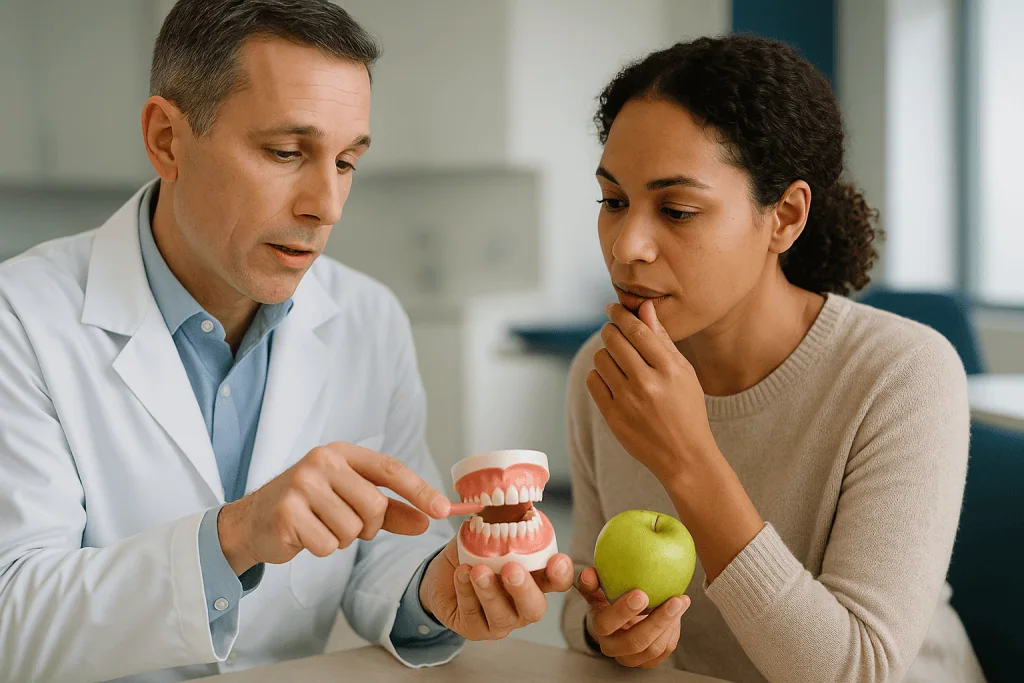
Two consequences follow. First, the bond to enamel is stronger and more predictable than the bond to dentin, the softer inner layer of the tooth. When a veneer must be bonded partly onto dentin, for example because a tooth was already worn or heavily filled, dentists generally expect a less durable result. This is one reason a candid pre-treatment assessment matters more than any aftercare tip.
Second, the bond has no give. Natural teeth sit in a slightly springy ligament and flex a tiny amount under load; the tooth and veneer flex together, but the ceramic itself does not stretch. Repeated bending stress, of the kind produced by grinding, fatigues the material over months and years in the way a paperclip weakens if you bend it back and forth. A chip that appears suddenly at breakfast may have been developing for a long time.
The margins deserve mention too. The margin is the line where the veneer edge meets the natural tooth, usually tucked near the gum. Cement at that line can wear or dissolve slowly, leaving a tiny ledge where plaque collects and where staining can creep under the edge. That is why flossing and gum health, covered later, are part of veneer care rather than a separate topic.
Cleveland Clinic notes that the process is not reversible because enamel has been removed, so protecting what has been placed is protecting the tooth beneath it as well.
Who laminate veneers are usually for, and who is asked to wait
Veneers are typically offered to people whose front teeth are healthy but discolored in a way whitening will not fix, mildly chipped or worn, slightly misaligned, unevenly sized, or gapped. Cleveland Clinic lists these as the common cosmetic reasons. The teeth need enough sound enamel to bond to, and the bite needs to be stable enough that the veneers are not asked to absorb heavy forces.
Several situations usually prompt a dentist to pause or suggest something else, and they map neatly onto the chipping risks in this article:
- Active tooth decay or gum disease. These are treated first, because bonding onto an unhealthy tooth or inflamed gum invites early failure.
- Untreated night-time grinding or heavy clenching. Many dentists will want the bruxism managed, often with a night guard plan, before placing porcelain in the firing line.
- Very little enamel left, large existing fillings, or a tooth that has been root-canal treated. A crown, which wraps the whole tooth, may be the more durable option.
- A bite in which the lower front teeth strike the upper front teeth edge-on. Orthodontic treatment sometimes comes first.
- Habits such as nail biting, pen chewing, or ice crunching that the person is not yet ready to change.
None of these are judgments. They are load calculations. A dentist is estimating how much force a thin ceramic shell will face and whether the tooth beneath can support it. Being asked to wait is usually a sign the clinician expects the veneers to last longer once the groundwork is done, and that decision rests with the treating team after an examination, not with a general article.
People with a known temporomandibular disorder, a problem with the jaw joint and its muscles, may also be asked to have that assessed first, since the same muscles that ache in TMD are the ones that generate grinding force.
Laminate veneers aftercare: what the first two weeks usually look like
The veneer is fully bonded the moment the curing light switches off, so there is no long healing period as there is after surgery. What does take time is adjustment. The lips, tongue, and bite all have to learn a slightly new landscape.

In the first few days, many people notice sensitivity to cold. Enamel has been thinned, and the tooth may react to iced water or a cold breath for a while. Cleveland Clinic describes this as a common and usually temporary effect. It typically settles over days to a couple of weeks; if it worsens or lingers beyond that, it is something to raise with the dentist rather than tolerate.
The bite is the other thing to attend to. Even a fraction of a millimeter of extra height on a veneer can make one tooth meet its opposite number first, concentrating chewing force on that single edge. Dentists check this before you leave, but the sensation of a high spot sometimes only becomes obvious once the numbness wears off and you eat a real meal. Report it early; a small adjustment is routine and prevents a chip later.
Gums may feel slightly tender where the margins were finished. Gentle brushing keeps the area clean without irritating it.
A practical note about temporary veneers, if your treatment involves them. Temporaries are usually acrylic held on with weaker cement so they can be removed easily. They are far more likely to loosen or crack than the final porcelain, and dentists commonly advise a softer diet and avoiding sticky foods while wearing them. Advice for temporaries is stricter than advice for finals, and it is worth asking which stage you are in before assuming a rule applies.
Your dentist will usually schedule a review visit to check the margins, the bite, and the gums once everything has settled. Keep it, even if all feels well.
Can laminate veneers chip on hard foods? What to avoid and what is fine
Here the internet tends to overshoot. Some guides read as though veneer owners must live on soup. The evidence-based position is narrower: veneers cope well with ordinary chewing, including crisp and crunchy foods, and cope badly with a short list of very hard or very sticky things, particularly when bitten with the front teeth.
The distinction that matters is where and how the force lands. Molars are built for crushing. Front teeth, veneered or not, are built for incising, which is a shearing cut through something yielding. Biting down through a whole apple or a hard crust with the incisors delivers a bending load to the veneer edge, exactly the stress ceramic resists least.
| Category | Examples | Guidance |
|---|---|---|
| High risk, avoid biting with front teeth | Ice, hard candy, popcorn kernels, bones, nut shells, olive pits, hard crusts | Cut or eat with back teeth; never crunch ice |
| Moderate risk, adapt the technique | Whole apples, raw carrots, corn on the cob, crusty bread, ribs | Slice into pieces and chew on molars |
| Sticky, risk to margins and temporaries | Toffee, caramel, chewing gum, taffy | Limit, especially while wearing temporaries |
| Staining, mainly for composite | Coffee, tea, red wine, curry, berries | Rinse with water after; porcelain resists stains better |
| Generally fine | Cooked vegetables, soft fruit, meat off the bone, pasta, rice, salad | Eat normally |
Ice deserves its own sentence because it combines two hazards: it is hard, and it is cold, so it shocks a thinned tooth at the same time as it loads the edge. Chewing ice is a habit worth breaking for the sake of natural teeth too; MedlinePlus lists hard objects among the common causes of cracked teeth.
Acidic foods and drinks do not damage porcelain, but they do soften the enamel around the margins and the cement at the edge over years. Rinsing with water after citrus or fizzy drinks is a low-effort protective habit that the NHS recommends for teeth in general.
Nail biting and other habits that can mess up veneers
Nail biting is the quiet one. It rarely produces a dramatic fracture; instead it applies a repeated, off-axis shearing force to the very edge of the upper front teeth, precisely where veneers are thinnest. Over months, that can produce micro-chipping along the incisal edge, a rough feel to the tongue, or a hairline crack that later propagates. Because the force is small each time, people seldom connect the damage to the habit.
The same mechanics apply to a whole family of behaviors that dentists group together as parafunctional habits, meaning uses of the teeth for anything other than eating and speaking:
- Opening packaging, bottle caps, or tape with the teeth.
- Holding pins, nails, or hair clips between the front teeth.
- Chewing pens, pencils, or the arms of glasses.
- Biting thread or fishing line.
- Pushing the tongue or fingernails against the veneer edges as a fidget.
What links them is a point load on a thin edge, sometimes with a twisting component. Porcelain tolerates almost none of that. Composite tolerates a little more but wears down instead, so the veneer slowly loses its shape and shine.
Breaking a nail-biting habit is genuinely hard, and shame is not a useful tool. Habit-reversal approaches used in behavioral health, such as noticing the trigger, keeping hands occupied, and keeping nails trimmed so there is less to bite, are reasonable first steps, and a primary care clinician or dentist can point toward further support if the habit is linked to anxiety.
One more category: sports. Contact and ball sports carry an obvious risk of a blow to the front teeth. A custom-fitted mouthguard made by a dentist protects both veneers and natural teeth, and it is not an over-the-counter boil-and-bite type that fits well over veneered teeth, so ask about this if you play.
Night-time grinding: why bruxism is the biggest threat to veneers
If an editor were allowed one opinion in this article, it would be this: of everything that can damage a veneer, sleep bruxism matters most, and it is the one people most often do not know they have.
Bruxism is the medical term for grinding or clenching the teeth, and sleep bruxism is when it happens involuntarily during sleep. Mayo Clinic notes that people who grind at night often are unaware of it until a bed partner hears the sound or a dentist spots the wear. The forces involved are substantial and, crucially, they are applied for prolonged periods without the protective reflexes that limit how hard we bite while awake.
For a veneer, this is the worst possible loading pattern: repeated, heavy, side-to-side stress on a brittle material over thousands of nights. Cracks that would never form under a single hard bite grow slowly under this fatigue. Debonding at the margins is also more common, because the cement is being flexed night after night.
The NHS and Mayo Clinic list several factors associated with bruxism: stress and anxiety, sleep disorders including snoring and obstructive sleep apnea, alcohol, caffeine, smoking, and certain medicines, including some antidepressant classes, which may increase grinding as a side effect. Any question about a medicine and grinding belongs with the prescribing clinician; do not adjust medication on your own.
Signs a dentist looks for include flattened or chipped tooth edges, a sore or tired jaw on waking, morning headaches around the temples, and indentations on the tongue or cheek lining. A person considering veneers who recognizes several of these is well served by mentioning it before treatment. Managing grinding is not a reason to be denied cosmetic care; it is the step that makes the care last.
Awake clenching, often during concentration or driving, adds to the total load and is easier to notice and reduce with awareness.
Veneers and teeth grinding: do night guards actually protect them?
A night guard, also called an occlusal splint, is a custom-made plastic appliance worn over the teeth during sleep. It does not stop grinding. What it does is redistribute the force across a broad, smooth surface and place a sacrificial layer between the upper and lower teeth, so the appliance wears instead of the porcelain. Mayo Clinic and the NHS both describe splints and mouth guards as a mainstay of protecting teeth from grinding damage.
For someone with veneers, a few details matter more than the general case:
- Fit. A guard made from an impression of the veneered teeth sits precisely and spreads load evenly. A poorly fitting guard can itself concentrate pressure on one veneer edge.
- Which arch. Guards are commonly made for the upper teeth, but the dentist will decide based on where the veneers are and how the bite meets.
- Thickness and material. Harder acrylic guards last longer and are usual for heavy grinders; softer ones are sometimes used for lighter clenching. This is a clinical choice, not a preference.
- Wear. Guards need checking at routine visits because they wear through, and a worn guard offers less protection than it appears to.
The honest limits: a night guard reduces the risk of damage; it does not remove it. It does nothing during the day, and awake clenching still adds load. And it is not a treatment for whatever is driving the grinding. Where stress is a factor, stress management and sleep hygiene are part of the picture. Where snoring or witnessed pauses in breathing are present, Mayo Clinic notes the association between bruxism and sleep apnea, and a sleep assessment may be appropriate. That conversation starts with a primary care clinician or dentist.
People sometimes stop wearing the guard once the veneers feel solid. The forces have not changed; only the sense of urgency has. The guard is a permanent part of laminate veneers aftercare for anyone who grinds.
How long do laminate veneers last?
The figure most often quoted is a decade or more. Cleveland Clinic gives a typical range of roughly 10 to 15 years for porcelain veneers, with composite veneers generally lasting less long before they need replacement because the resin wears and stains. Those are ranges observed across many patients, not a promise for any one person, and the spread within them is wide.
What pushes an individual toward the longer or shorter end is largely the content of this article. In plain terms:
- Bonding substrate. Veneers bonded entirely to sound enamel tend to outlast those bonded partly to dentin or old filling material.
- Bite forces. Grinders and clenchers who are not protected sit at the shorter end.
- Habits. Nail biting, ice chewing, and tool-use of the teeth accumulate damage.
- Gum health. Recession exposes the margin, creating a visible line and a ledge for plaque.
- Maintenance. Regular check-ups catch marginal wear or a hairline crack while repair is still simple.
It also helps to be clear about what the end of a veneer looks like. It is rarely a dramatic event. More often the margin becomes visible as the gum settles, a small chip appears at an edge, or the shade no longer matches neighboring teeth that have aged. At that point the options are repair, which can sometimes be done with composite for a small chip, or replacement of the veneer. Because enamel was removed at the outset, a veneered tooth will always need some restoration; the question is when, not whether.
Anyone considering veneers should think of them as a long-term but not permanent restoration, with the expectation of at least one replacement cycle over a lifetime. Framing it that way makes the day-to-day care feel less like anxious vigilance and more like ordinary maintenance of something valuable.
What are the downsides of dental laminate veneers?
People searching this question deserve the full list, stated plainly, because a good decision rests on knowing the trade-offs rather than only the appeal.
Irreversibility comes first. Enamel is removed to make room for the shell, and enamel does not regrow. Cleveland Clinic states directly that the procedure is not reversible. If a veneer fails, the tooth will need another veneer or a crown; going back to an untouched tooth is not an option.
Sensitivity follows. Thinned enamel can leave the tooth reactive to hot and cold, usually temporarily, occasionally longer. Where preparation reaches close to the nerve, a small proportion of teeth may later need root canal treatment, though this is uncommon when the tooth was healthy to start with.
Fracture and debonding are the risks this article centers on. They are more likely in grinders and in those who use their teeth as tools, but they can happen to anyone.
Shade mismatch over time is a subtle downside. Porcelain does not change color, but natural teeth around it slowly yellow, and whitening does not lighten porcelain. A single veneer can eventually stand out against aging neighbors, which is one reason dentists sometimes discuss treating several teeth together.
Gum margin exposure occurs when gums recede with age, revealing the junction between veneer and tooth as a fine line. It is cosmetic rather than harmful but can prompt earlier replacement.
Finally, veneers do not treat underlying problems. Decay, gum disease, and a misaligned bite continue beneath and around them. A veneer on a tooth with an unstable bite is a veneer under strain.
Alternatives worth understanding include professional whitening for color alone, composite bonding for small chips, orthodontic treatment for alignment, and crowns for heavily damaged teeth. Which is appropriate depends on examination and is a decision for the treating dentist.
How to care for veneers day to day: brushing, flossing, and gum health
Porcelain cannot decay. The tooth it is bonded to can, and so can the exposed edges near the gum. Daily care therefore looks very much like good care for natural teeth, with a few refinements.
Brush twice a day with a fluoride toothpaste and a soft-bristled brush, which is the NHS baseline for everyone. Fluoride strengthens the enamel at the margins, where decay most often begins around a veneer. Avoid abrasive whitening pastes and anything gritty marketed as polishing; they dull the glaze on porcelain over time and roughen composite, making it stain faster.
Clean between the teeth once a day with floss or interdental brushes. Slide the floss down the side of the tooth and gently past the gum line, then pull it out sideways rather than snapping it back up over the veneer edge. Marginal plaque leads to gum inflammation, and inflamed gums recede, exposing the margin.
Electric toothbrushes are fine and often helpful for consistent technique; there is no evidence they harm veneers when used with a soft head and light pressure.
Mouthwash is optional. An alcohol-free fluoride rinse is a reasonable choice if your dentist suggests one; alcohol-containing rinses may soften composite over time.
Smoking stains composite readily, stains the cement line on porcelain, and, per the CDC, is the leading modifiable risk for gum disease, which threatens the margins of every veneer. Quitting support is available through primary care.
Keep routine dental visits. Hygienists use polishing pastes and instruments appropriate for porcelain, and the dentist checks each margin, looks for hairline cracks, and assesses wear on any night guard. Many veneer failures that end in replacement began as something repairable that no one looked at in time.
Whitening, if you want it, should be discussed with the dentist first: it will lighten natural teeth but not porcelain, and timing matters if veneers are planned so shade can be matched to the lighter result.
What is the 4-8-10 rule for veneers?
This phrase circulates widely online and means different things to different people, so a candid answer begins by saying that no dental guideline body defines a 4-8-10 rule. It is a planning shorthand used in cosmetic dentistry, not a clinical standard.
In its most common usage, the numbers refer to how many upper front teeth are treated at once. Four covers the two central and two lateral incisors, the teeth most visible in a modest smile. Eight adds the canines and first premolars, reaching the corners of a broad smile. Ten extends to the second premolars for people whose smile shows many teeth. The idea is that veneers should stop where the smile stops, so there is no visible step between treated and untreated teeth.
Why does this matter for an article about chipping? Two reasons. First, the canines carry a disproportionate share of side-to-side force when the jaw slides during chewing and grinding. Veneering canines is common and can be very successful, but it places porcelain on the teeth that guide the bite, so the dentist must design the edges to share load rather than take it alone. Second, treating more teeth means more margins to keep clean and more surfaces exposed to night-time forces, which makes grinding management even more relevant.
Some people use 4-8-10 to describe other design proportions, and marketing versions exist that are not worth repeating here. Whatever the number, the honest principle is that the count of veneers is decided by how much of your smile shows, the condition of each tooth, and your bite, not by a formula. A dentist may reasonably recommend two, six, or twelve, or suggest that whitening alone would achieve the aim. Ask how the number was chosen and what happens at the transition to untreated teeth.
What people often get wrong about veneers and chipping
Myth: Porcelain is stronger than enamel, so veneers are tougher than natural teeth. Porcelain bonded to sound enamel is strong in compression, but it is brittle under bending and point loads. A natural incisor edge often survives a knock that chips a veneer edge, because the enamel is backed by flexible dentin and the whole tooth moves slightly in its socket.
Myth: Once the veneers feel normal, the risk is over. The adjustment period ends; the physics does not. Fatigue cracks from grinding accumulate over years, and the tenth year of nightly clenching is no safer than the first.
Myth: Veneers cannot get cavities. The porcelain cannot, but the tooth beneath and the enamel at the margin can, and decay at a margin is a common reason for replacement. Fluoride and flossing remain essential.
Myth: A night guard is only for people with obvious jaw pain. Mayo Clinic notes that many people with sleep bruxism have no symptoms they notice. The dentist’s assessment of wear patterns is a better guide than how the jaw feels.
Myth: Whitening will brighten veneers that have dulled. Whitening agents do not change porcelain. If a veneer looks yellower, the cause is usually staining at the margin, a stained cement line, or surrounding natural teeth having lightened after whitening.
Myth: A chipped veneer always means a new veneer. Small edge chips can sometimes be smoothed or repaired with composite; the decision depends on size and location and belongs to the dentist who examines it.
Myth: Composite veneers are a fragile budget option. Composite is less brittle than porcelain and often easier to repair in the mouth. Its trade-offs are wear and staining over time, not sudden fracture. Which material suits a given person depends on their bite, habits, and goals, and there is no universal winner.
Questions to ask your care team before and after veneers
A ten-minute conversation before treatment does more for the lifespan of veneers than any aftercare guide. Bring these along, and add your own.
- Do I show signs of grinding or clenching, and should that be managed before we start?
- Will each veneer bond to enamel, or does any tooth have dentin or old filling material at the bonding surface?
- How will my bite be checked so that no veneer carries more force than its neighbors?
- Would whitening, bonding, or orthodontic treatment achieve what I want with less enamel removal?
- Porcelain or composite for my situation, and why?
- How many teeth do you recommend treating, and how did you arrive at that number?
- What does the temporary stage involve, and what should I avoid while wearing temporaries?
- Should I have a custom night guard, and will it be made from the final veneers?
- What sensitivity is expected, and at what point should I call you about it?
- How should I clean the margins, and are there toothpastes or rinses to avoid?
- What is your typical approach when a veneer chips: repair, re-bond, or replace?
- How often do you want to see me, and what will you check at each visit?
- If I want to whiten in future, how does that interact with the veneers?
- I play a contact sport; do I need a custom mouthguard?
After treatment, keep a short list of what you notice in the first month: any high spot when biting, cold sensitivity and whether it is fading, roughness the tongue finds, or a click when the veneers meet. Bring it to the review appointment. Dentists work best with specific observations, and a small adjustment made early is the difference between a veneer that lasts and one that chips at a stress point no one knew was there.
When to call your doctor or dentist about a veneer problem
Most veneer issues are not emergencies, but a few signs justify a same-day or next-day call to the dental practice rather than waiting for a routine visit.
Call promptly if a veneer feels loose, rocks when you press it, or comes off entirely. Keep the piece if you have it; an intact veneer can sometimes be re-bonded, and the exposed tooth is sensitive and vulnerable in the meantime. Do not try to reattach it yourself with any household adhesive.
Call if a chip leaves a sharp edge that cuts the tongue or lip, or if a crack is visible and the tooth aches when you bite. A rough edge can be smoothed quickly, and a crack examined before it spreads.
Sensitivity that is getting worse rather than better after the first couple of weeks, pain that lingers for more than a few seconds after cold, spontaneous throbbing, or pain when biting down are signs the tooth pulp may be irritated and need assessment.
Gum that is red, swollen, bleeding readily, or tender around a veneer margin points to inflammation at the edge and should be checked before it leads to recession.
Red-flag signs that warrant urgent care, from a dentist or, if unavailable, an urgent care or emergency service: facial swelling, a bad taste or pus near the gum, fever with tooth pain, a blow to the face that has loosened or displaced a tooth rather than just the veneer, or any bleeding that does not stop. These indicate infection or trauma to the tooth itself, and MedlinePlus advises prompt evaluation for swelling and fever associated with dental pain.
Jaw pain, morning headaches, or a bed partner reporting loud grinding are not emergencies but deserve a mention at your next visit, since they are the earliest signal that the veneers are under nightly strain. Every decision about repair, replacement, or protection rests with the dentist who examines you.
Frequently asked questions
What are the downsides of dental laminate veneers?
The main downsides are irreversibility, sensitivity, and the possibility of chipping or debonding. Enamel removed to fit the veneer does not regrow, so the tooth will always need a restoration afterward. Thinned enamel can react to cold, usually temporarily. Porcelain can fracture under grinding or hard bites, gums can recede to reveal the margin, and veneers cannot be whitened, so shade may eventually mismatch neighboring teeth.
What is the 4-8-10 rule for veneers?
It is an informal cosmetic planning shorthand, not a clinical guideline. Most often it refers to treating four, eight, or ten upper front teeth so that veneers extend as far as the smile shows and there is no visible step to untreated teeth. The right number for a given person depends on how much of the smile is visible, the condition of each tooth, and the bite, and it is a decision for the treating dentist.
What can mess up veneers?
Night-time grinding is the leading threat, followed by using the front teeth to bite ice, hard candy, bones, or packaging, and habits such as nail biting and pen chewing. Poor cleaning at the margins allows decay and gum inflammation that expose the edge. Abrasive toothpastes dull porcelain and roughen composite, and smoking stains both. A sports blow without a mouthguard can fracture a veneer outright.
How long do laminate veneers last?
Cleveland Clinic gives a typical range of about 10 to 15 years for porcelain veneers, with composite veneers generally needing replacement sooner because they wear and stain. These are population ranges, not guarantees. Veneers bonded to sound enamel, protected from grinding by a night guard, spared from tool use of the teeth, and kept clean at the margins tend toward the longer end of the range.
Can I eat apples and crusty bread with veneers?
Yes, with a change of technique. Slice apples, carrots, and crusty bread into pieces and chew them on the back teeth rather than biting through with the front teeth. The risk comes from bending force on the thin veneer edge, not from the food itself. Ice, hard candy, popcorn kernels, bones, and nut shells are best avoided entirely with the front teeth.
Do I really need a night guard for veneers and teeth grinding?
If your dentist has found signs of grinding or clenching, a custom night guard is a standard protective measure. It spreads force over a broad surface and wears instead of the porcelain. It does not stop grinding or cover daytime clenching, and it needs checking at routine visits for wear. Whether you need one is a clinical judgment based on your wear patterns and bite.
What should veneer aftercare instructions include for the first two weeks?
Expect some cold sensitivity that should ease over days to a couple of weeks, report any high spot in the bite promptly, brush gently with a soft brush and fluoride toothpaste, floss carefully at the margins, and avoid very hard or sticky foods, especially if temporaries are in place. Keep the review appointment so the dentist can check margins, bite, and gums once everything has settled.
What happens if a veneer chips or comes off?
Call the dental practice promptly and keep any pieces. An intact veneer can sometimes be re-bonded, and small edge chips can often be smoothed or repaired with composite. Larger fractures usually mean replacement. Do not attempt to reattach a veneer with household adhesive, and avoid biting on the exposed tooth, which will be sensitive and more vulnerable to damage until it is seen.
Can veneers get cavities or gum disease?
The porcelain itself cannot decay, but the natural tooth beneath and the enamel at the margin can, and decay at the edge is a common reason veneers are replaced. Gums around veneers respond to plaque like any other gums, and inflammation can lead to recession that exposes the margin. Daily fluoride brushing, interdental cleaning, not smoking, and regular check-ups protect both.
Can I whiten my teeth if I have veneers?
Whitening lightens natural teeth but has no effect on porcelain or composite, so it can create a mismatch if you whiten after veneers are placed. If you want whiter teeth, dentists usually suggest whitening first and then matching veneer shade to the result. If veneers already in place look dull, the cause is more likely marginal staining, which a professional clean may address.
References
- Cleveland Clinic: Dental Veneers
- NHS: Teeth grinding (bruxism)
- NHS: How to keep your teeth clean
- MedlinePlus: Dental care – adult
This article is for general information only and is not a substitute for professional medical advice. Please consult a qualified doctor about your individual situation.

More from the Blog

Preparing for Oral and Maxillofacial Surgery: Imaging, Blood Tests and Anesthesia Review
Oral surgery preparation usually involves three checks: imaging (a panoramic X-ray, sometimes a cone beam CT scan) to map teeth, nerves and bone; blood…

When Does Gum Recession Need Treatment? Sensitivity, Root Exposure and Bone Support
Gum recession needs treatment when it is still progressing, when exposed root surfaces are sensitive or decaying, when the remaining gum is too thin…

Is the Space Maintainer Loose or Bent? What Parents Watch For and When to Book a Visit
A loose or bent space maintainer is seldom a true emergency, but it should not wait weeks. A loosened band traps food and irritates…

Soft vs Hard Night Guards for Bruxism: How Dentists Choose the Splint Type
Dentists usually choose a hard acrylic night guard for moderate to heavy grinding because it resists wear and holds the jaw in a stable…

How to Brush After Gum Recession Treatment: Technique Changes That Protect the Result
After a gum graft, most people are asked not to brush the grafted teeth at all for roughly the first one to two weeks,…

Bleeding Gums Myths: Stopping Brushing, Harder Brushing and Other Habits to Unlearn
Bleeding gums are usually a sign of gingivitis, early gum inflammation caused by plaque, not a reason to stop brushing or to scrub harder.…