

Does External Radiation Therapy Make You Radioactive? Myths About Hugging and Contact
Key Takeaways
- External beam radiation therapy delivers energy only while the machine is on, so no radiation remains in your body after a session and hugging, kissing and sharing a bed are safe immediately.
- Only internal treatments, such as permanent radioactive seed implants or swallowed or injected radioactive liquids, can make a person a temporary source of radiation, and those always come with written precautions.
- Precautions after radioactive liquid treatments are typically measured in days, while permanent seed implants fade over weeks to months, with limits aimed at prolonged closeness to children and pregnant people rather than all contact.
- Fatigue is the most consistently reported side effect of radiation therapy, building over a course and often lasting weeks after the final session.
- Skin redness in the treated area is inflammation and repair, like a sunburn appearing after you have come indoors, not a sign that radiation is still present.
- A second cancer caused by radiation is a rare, delayed late effect that arises in the treated person's own tissue years later and cannot be passed to anyone else.
External beam radiation therapy does not make you radioactive. The machine delivers a beam only while it is switched on, and nothing radioactive is placed inside the body, so no radiation remains in you afterward. You can hug, kiss, share a bed and hold children immediately. Precautions apply only to some internal treatments, such as radioactive implants or radioactive liquids, and your team will explain those.
She had the first session on a Tuesday morning and by lunchtime she was standing in her kitchen, arms folded, refusing to pick up her grandson. Not because she felt unwell. She felt fine. She simply did not know whether she was safe to hold him, and nobody had thought to say.
That scene plays out in living rooms every week. People finish a few minutes on a treatment table and then spend the evening keeping a careful distance from the people they love, sleeping in the spare room, waving at the dog from the doorway. The question underneath it all, does radiation therapy make you radioactive, is one of the most searched and least clearly answered in cancer care.
The physics turns out to be simple, and the answer is reassuring for the overwhelming majority of patients. The nuance matters for a small group, and this article will be honest about who they are.
Does radiation therapy make you radioactive? The plain answer
For external beam radiation therapy, the answer is no. Not a little. Not for an hour. Not at all.
External beam radiation therapy is the type most people picture: you lie on a table, a large machine moves around you, and a beam of high-energy X-rays is aimed at the tumor from outside the body. The National Cancer Institute, the NHS and Mayo Clinic all state the same thing in plain words: this treatment does not leave radiation in your body, and you are not a hazard to anyone once you leave the room.
The confusion is understandable. The word radioactive sits close to the word radiation, and most of us learned both from films rather than from physics class. But they describe different things. Radiation is energy traveling through space, the way light travels from a lamp. Radioactive describes a material that keeps giving off that energy on its own, the way a lamp would if it had no off switch.
A treatment machine is a lamp with an off switch. When the beam is on, energy passes through the tissue and deposits damage in cancer cells. When the beam is off, the energy is gone. Your body does not store it, does not glow with it, and cannot pass it on.
The important exception is internal radiation, where a radioactive source is placed inside the body or swallowed or injected. Some of those treatments do call for temporary precautions around other people, and we will come to them. If you are unsure which type you are having, that is the first question to ask, and your care team will know immediately.
How external radiation actually works, in plain language
Most external treatments today come from a machine called a linear accelerator, a device that speeds up electrons and converts their energy into a focused X-ray beam. The beam is shaped by metal leaves inside the machine head so that it matches the outline of the tumor from each angle.
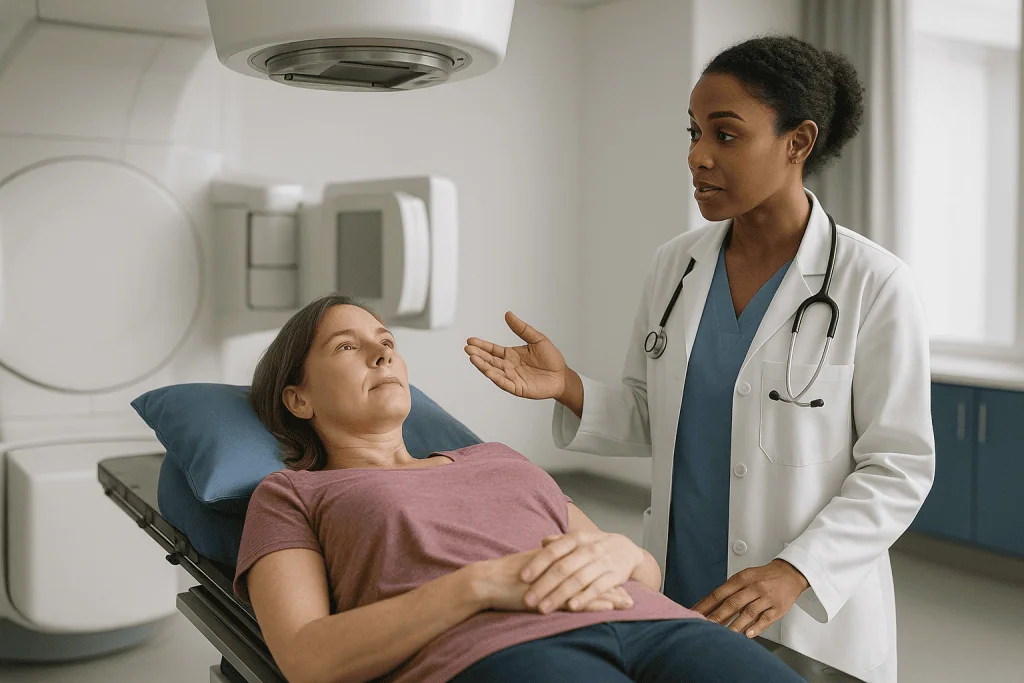
Inside the tumor, the beam knocks electrons loose from atoms in the cells. That process, called ionization, damages DNA, the instruction manual a cell uses to divide. Cancer cells divide fast and repair poorly, so they tend to die when their DNA is broken. Healthy cells in the path of the beam are damaged too, but they are generally better at repair. Splitting the total treatment into many small daily sessions gives healthy tissue time to recover between visits while the tumor keeps taking hits. This is why a course commonly runs across several weeks, typically with one session on each weekday, according to the NHS.
Here is the part that answers the radioactivity question. X-rays are packets of energy, not particles of matter. They pass through, deposit energy, and are absorbed or scattered away within a fraction of a second. They do not turn the atoms in your body into new radioactive atoms. The beam behaves like the X-ray at a dentist’s office or an airport scanner, just far more powerful and far more precisely aimed.
Compare that with a radioactive source such as a tiny seed of a radioactive metal. The seed contains unstable atoms that break down on their own schedule, releasing energy continuously until they are spent. That is a fundamentally different mechanism, and it is the only one that can make a person a temporary source of radiation.
Why nothing lingers after the machine switches off
A useful way to picture it is sunlight on skin. Stand outside on a bright day and energy from the sun lands on you constantly. Step into the shade and it stops. Your skin does not keep emitting sunshine, even though it may later show a burn from the exposure. Therapeutic X-rays follow the same logic: the exposure is instantaneous and the effect on cells unfolds later, but the energy itself is not stored.
Patients sometimes ask whether the beam could still be lingering in the treatment room, or whether the metal parts of the machine become radioactive over time. The room is designed with thick shielding so that staff can work next door safely, and the beam exists only during the seconds it is switched on. Radiographers step out during those seconds not because you become dangerous, but because they would otherwise receive small repeated exposures across thousands of patients over a career.
You may notice that no one asks you to shower differently, use separate cutlery, or flush the toilet twice after external treatment. Those instructions belong to certain internal treatments and their absence is itself a clue. Cleveland Clinic and Mayo Clinic both describe external beam therapy as a treatment after which patients go straight home and resume normal contact with family.
One honest footnote: at the very highest beam energies, physicists can measure trace amounts of short-lived activation in the machine head itself. This is a concern for equipment engineers, not for patients or their families, and it is managed within the shielding of the treatment room. It does not make treated people radioactive in any meaningful or measurable way outside that room.
Hugging after radiation therapy: partners, children, pregnancy and pets
After an external beam session you can hug your partner in the parking lot, pick up a toddler, sit next to someone who is pregnant on the bus, and let the cat sleep on your chest. No waiting period, no distance rule, no separate bathroom.

This point deserves stating clearly because the fear has real consequences. Cancer treatment is isolating enough. People describe partners moving to the sofa, grandparents cancelling visits, and children being told to stay back, all for a risk that does not exist with external treatment. Touch, closeness and ordinary routine are part of coping, and there is no medical reason to give them up.
Intimacy and sex are also not restricted on radiation-safety grounds after external treatment. There may be other reasons your team suggests caution, for example soreness in the treated area if the pelvis is involved, or advice about contraception during and after treatment because radiation can affect a developing pregnancy. Those are questions about your comfort and about protecting a future pregnancy, not about protecting a partner from radiation.
If you are breastfeeding, tell your team. External beam therapy does not put radiation into breast milk, but if the breast itself is being treated there may be practical reasons to discuss feeding, and radioactive tracers or radioactive iodine are a different matter entirely.
Pets, children and elderly relatives all fall under the same simple rule: if your treatment is delivered from a machine outside your body, everyone around you is safe from radiation the moment you leave the treatment couch. The people who need protecting after external treatment are not your family. They are your own skin and energy levels, which is where the real side effects live.
When radiation does stay in the body: internal treatments explained
Internal radiation therapy, sometimes called brachytherapy, places a sealed radioactive source directly inside or next to a tumor. Systemic radiation therapy, sometimes called radionuclide therapy, uses an unsealed radioactive liquid that is swallowed or injected and travels through the bloodstream to reach cancer cells. These are the situations in which a patient can, for a time, give off measurable radiation.
Brachytherapy comes in two broad forms. In temporary brachytherapy, a source is placed for minutes or days and then removed; once it is out, no radiation remains and you are safe to be around. In permanent brachytherapy, small seeds are left in place and lose their strength over weeks to months. Prostate seed implants are the most familiar example. The NHS explains that while the seeds are active, patients may be advised to limit close, prolonged contact with children and with people who are pregnant, and to follow specific instructions from their team about how long those limits last.
Systemic treatments, such as radioactive iodine for some thyroid conditions, leave the body mainly through urine, saliva and sweat over days. Instructions can include a short hospital stay in a single room, drinking plenty of fluids, flushing twice, sleeping separately for a set period, and avoiding close contact with young children and pregnant people for a defined number of days. The NHS describes these precautions as temporary and specific to the type and amount of treatment given.
The pattern to notice is that every internal treatment comes with a written radiation-safety sheet. If you did not receive one, that is because you did not need one. Even so, asking your team to confirm which category your treatment falls into is always a fair question, and it settles the matter in one sentence.
How long are you radioactive after radiotherapy? A comparison by type
Because the answer depends entirely on the type of treatment, a side-by-side view helps more than a single number ever could. The timeframes below are typical ranges described by the NHS and the National Cancer Institute; the exact instructions for any individual come from the treating team and the local radiation protection service.
| Type of treatment | Is radiation left in the body? | Typical precautions around others |
|---|---|---|
| External beam (linear accelerator, including IMRT, stereotactic and proton therapy) | No | None. Normal contact with everyone, including children and pregnant people, immediately after each session. |
| Temporary brachytherapy (source inserted then removed) | Only while the source is in place | Visiting may be limited during the implant, usually in hospital. No restrictions once the source is removed. |
| Permanent brachytherapy (seeds left in place) | Yes, fading over weeks to months | Team-specified limits on prolonged close contact with children and pregnant people for a defined period. |
| Systemic radionuclide therapy (swallowed or injected radioactive liquid) | Yes, clearing mainly through urine over days | Possible short single-room stay; written instructions on fluids, hygiene, sleeping arrangements and contact for a set number of days. |
Two features stand out. First, external beam therapy is in a category of its own, with no residual radiation at any point. Second, even where precautions exist, they are measured in days for liquid treatments and weeks to months for permanent seeds, and they are aimed at limiting prolonged closeness with the most sensitive people rather than banning all contact. A permanent seed patient is not forbidden from seeing grandchildren; they are asked not to have one sitting on their lap for hours at a stretch while the seeds are strongest.
Definitions used above: IMRT, or intensity-modulated radiation therapy, shapes the beam’s strength across the tumor. Stereotactic therapy delivers a few very precise, high-dose sessions. Proton therapy uses charged particles instead of X-rays but, like all external beam methods, leaves nothing behind.
Who external radiation is usually for, and who is usually asked to wait
Radiation therapy is one of the three pillars of cancer treatment alongside surgery and drug therapy, and roughly half of people with cancer receive it at some point, according to the National Cancer Institute. It is used with several different aims. Sometimes the goal is to control or eliminate a tumor on its own. Sometimes it shrinks a tumor before surgery, or clears microscopic cells left behind afterward. Sometimes the purpose is comfort: easing bone pain, relieving pressure on a nerve, or shrinking something that is blocking an airway.
The decision to recommend it depends on the type of cancer, where it is, how sensitive those cells are to radiation, what else is being planned, and the person’s general health. A multidisciplinary team, usually including a radiation oncologist, surgeons, medical oncologists, radiographers and physicists, weighs all of this together.
Some people are asked to wait or are steered toward a different plan. Pregnancy is the clearest example: radiation can harm a developing baby, so treatment to areas near the abdomen or pelvis may be delayed until after delivery, or shielded and planned with particular care if it cannot wait. People who have already had a full course of radiation to the same region of the body may not be able to receive more there, because nearby healthy tissue has a lifetime tolerance. Certain rare inherited conditions that impair DNA repair, and some active connective-tissue diseases, can make the skin and organs unusually sensitive, which changes the calculation.
Someone who is acutely unwell, recovering from surgery, or in the middle of another treatment may be asked to let the body settle first. None of these are refusals; they are timing decisions. Each one is made person by person, and the treating team is the only group with the full picture.
What actually happens at a treatment session
Before any beam is switched on there is a planning visit. You lie on a scanner in the exact position you will use for treatment, and a CT scan maps the area. Radiographers may make a few tiny permanent ink dots on the skin, or use a custom plastic mask for head and neck treatment, so that the same position can be reproduced every day. Physicists and the oncologist then design the beam angles and shapes on a computer, a process that can take days.
On a treatment day you change into a gown if needed, lie on the couch, and the team lines up the marks with lasers in the room. They step out, speak to you through an intercom, and watch on cameras. The machine hums and rotates. You feel nothing from the beam itself; there is no heat, no tingling, no sensation at all. Mayo Clinic notes that a typical appointment lasts about 10 to 30 minutes, most of which is positioning rather than beam time, with the radiation itself delivered in a few minutes.
Then you get up and leave. There is no recovery bay, no observation period, no changing of sheets for radiation reasons. Many people drive themselves, go to work, or stop for groceries on the way home.
Courses vary. Some are a single session; others run daily for several weeks, with weekends off to let normal tissue recover. Newer techniques allow fewer, larger sessions for certain cancers, which your oncologist will explain if that is being proposed. Whatever the schedule, each visit follows the same rhythm of position, beam, home, and none of it changes your safety around other people.
What the following days and weeks usually look like
Because the beam damages cells that then take time to die and be replaced, side effects rarely appear on day one. The NHS describes a pattern in which effects build gradually over the first couple of weeks of a course, peak toward the end or shortly after the final session, and then ease over the following weeks.
The first days often feel anticlimactic. People expect to be knocked flat and instead feel tired in a way that is hard to pin down. Around the second and third week, the treated skin may redden or darken and become dry or itchy, much like a sunburn confined to a rectangle. Depending on where the beam is aimed, more specific effects can arrive: a sore mouth or altered taste with head and neck treatment, nausea with treatment near the stomach, more frequent urination or loose stools with pelvic treatment, hair loss only within the treated patch.
Fatigue tends to be the constant. It accumulates, it is not fixed by a single good night’s sleep, and it often lingers for weeks after treatment ends. Gentle daily movement, such as a short walk, is consistently associated with less fatigue rather than more.
After the last session, the tissue keeps reacting for a while, so the second week after finishing can feel worse than the last week of treatment. Then it turns. Skin heals, energy creeps back, appetite returns. Most acute effects settle within weeks to a couple of months, though this varies with the site and the person.
Some late effects can appear months or years later, such as firmness of tissue in the treated area or changes in an organ that received a dose. Your team will tell you which ones apply to your plan and what follow-up looks like.
What is the most common side effect of radiation therapy?
Fatigue. Across cancer types and body sites, tiredness is the side effect most consistently reported, and the NHS, Mayo Clinic and Cleveland Clinic all place it first on their lists.
It is worth understanding why, because the mechanism explains why it feels different from ordinary tiredness. Radiation therapy kills cells, and the body then spends energy clearing debris and rebuilding tissue in the treated area. Add the daily travel to appointments, disrupted sleep, worry, and often the effects of surgery or drug therapy at the same time, and the result is a deep, cumulative fatigue that builds through a course and can persist for weeks after it ends.
Skin reactions are the second most familiar effect and the one most often confused with radioactivity. A patch of skin that turns pink, then red or darker, then dry and peeling, looks alarming and invites the question of whether radiation is still at work in the tissue. It is not. The skin is simply repairing damage that happened during the seconds of beam time, the same way a sunburn reddens hours after the sun has set. Treated skin needs gentleness: lukewarm water, mild unscented products the team approves, soft clothing, and protection from sun. It does not need to be kept away from other people.
Beyond those two, side effects are local to the area treated. Radiation to the brain does not cause diarrhea; radiation to the pelvis does not cause a sore throat. This predictability is one of the treatment’s practical advantages and is why your oncologist can tell you in advance what to expect. Hair falls out only where the beam enters or exits. Nausea is largely a concern when the stomach or bowel is in the field.
Fatigue can also be a sign of something else, such as anemia or low mood, so persistent exhaustion is always worth raising rather than enduring.
Can radiation therapy cause a second cancer? What the evidence shows
This is the honest, uncomfortable question behind many of the radioactivity fears, and it deserves a straight answer. Radiation is a known carcinogen, and treatment doses can, in a small number of people, contribute to a new and different cancer many years later. The National Cancer Institute describes this as a rare late effect, and it is one reason oncologists work so hard to shape the beam tightly and spare healthy tissue.
Three points put the risk in proportion. First, it is delayed: second cancers linked to radiation typically appear years to decades after treatment, not in the months around it. Second, it is small compared with the risk being treated. An untreated or undertreated cancer is an immediate threat; a second cancer is a distant possibility, and the balance of benefit almost always favors treatment when it is recommended. Third, the risk is highest in people treated at a young age, who have the most years ahead in which a late effect could emerge, which is why pediatric oncologists take particular care with fields and techniques.
What the evidence does not support is any idea that radiation risk spreads to other people. A second cancer arises in the treated person’s own cells, in tissue that received a dose. Nobody acquires cancer risk by hugging, sleeping beside, or caring for someone who has had external beam therapy, because they receive no radiation at all.
Modern planning has reduced the volume of healthy tissue exposed compared with older methods, and long-term follow-up programs exist to monitor survivors. If you want to know your own estimated risk, ask your oncologist directly. They can speak to your specific site, technique and age in a way no general article can.
Is it safe to be around someone after radiation therapy? What visitors should actually think about
For external treatment, yes, completely, and the more useful question flips the direction of concern. The person having treatment is not a risk to visitors. Visitors can, in some circumstances, be a risk to the person having treatment.
Radiation therapy on its own does not usually suppress the immune system in a major way, unless a large area of bone marrow is in the field. But many people receive it alongside chemotherapy, or after surgery, or while generally run down, and in those situations the ordinary germs a visitor carries matter far more than any imagined radiation. A friend with a streaming cold, a grandchild fresh from a daycare outbreak, or a relative with a stomach bug can cause real harm to someone whose defenses are lowered. The considerate question is not “Is it safe for me to visit?” but “Am I well enough to visit?”
Treated skin is another practical consideration. A firm hug across a chest that is three weeks into breast radiation may sting; a kiss on a cheek being treated for a head and neck cancer may be unwelcome for a while. These are comfort issues, not safety ones, and the simplest approach is to ask the person what feels good.
The last thing worth naming is loneliness. People in treatment often describe others pulling away out of a vague sense that closeness might be unsafe. Sitting in the waiting room, driving to appointments, sharing a meal, and simply being physically present are all safe and all valuable. If the person has had a radioactive implant or a radioactive liquid, they will have a printed sheet spelling out any temporary limits, and following that sheet is all that is required.
What people often get wrong about radiation therapy and radioactivity
Myths cluster around this treatment more than almost any other, largely because the mechanism is invisible. Here are the ones that come up most, with what the evidence says.
“You have to sleep alone during treatment.” Not with external beam therapy. Sharing a bed is safe from the first night. Separate sleeping is sometimes advised for a set number of days after radioactive iodine or during the strongest period of a permanent seed implant, and only then.
“Radiation builds up in you over the weeks.” The biological effect on treated tissue does accumulate, which is why side effects grow; the radiation itself does not. Each session’s energy is absorbed and gone within seconds.
“The redness means the radiation is still in the skin.” The redness is inflammation and repair, the same process as a sunburn appearing after you have come indoors.
“It will make me infertile forever.” Fertility can be affected when the pelvis or the pituitary gland is in the field, and sometimes permanently, but treatment elsewhere does not affect fertility. This is a conversation to have before starting, since options may exist.
“You cannot be near pregnant women or babies.” After external beam therapy there is no restriction at all. After certain internal treatments there are temporary, written limits on prolonged closeness.
“Bodily fluids are dangerous.” Urine, sweat, saliva and semen carry no radiation after external treatment. They can carry small amounts for days after systemic radionuclide therapy, which is why those patients receive hygiene instructions.
“Radiation therapy is a last resort.” It is often a first-line treatment, sometimes used alone with the intention of eliminating a tumor entirely.
Every one of these myths has cost someone a hug they could have had.
Questions to ask your care team
Most radiation departments hold a consultation before treatment and a review during it. Arriving with questions written down turns those appointments from lectures into conversations. These are the ones that tend to matter most.
- Is my treatment external beam, brachytherapy, or a radioactive liquid, and does that mean any precautions around other people?
- If there are precautions, exactly how long do they last, who do they apply to, and will I receive them in writing?
- What is the aim of this treatment for me: to control the cancer, to prepare for or follow surgery, or to relieve symptoms?
- How many sessions are planned, over how many weeks, and how long will each visit take?
- Which side effects are likely given the area being treated, when do they usually start, and when should they settle?
- What can I do about fatigue and skin care from the first week onward?
- Will this treatment affect fertility, sexual function or a future pregnancy, and are there steps to consider before starting?
- Are there late effects I should know about, and what follow-up will monitor them?
- Can I keep working, driving, exercising and traveling during the course?
- Who do I call, at any hour, if something worries me between sessions?
It also helps to bring someone with you. People absorb only a fraction of what is said in a medical appointment, and a second pair of ears, or a phone set to record with permission, catches the rest.
If an answer is unclear, say so. Radiographers in particular spend every day explaining these things and are used to being asked the same question three different ways. The goal is for you to walk out knowing, in one sentence, whether you can hug your family tonight. For nearly everyone reading this, the sentence is yes.
When to call your doctor: red-flag signs during and after radiation therapy
Radiation therapy is delivered as an outpatient treatment for most people, which means much of the time you are at home managing effects yourself. Knowing what is expected and what is not keeps that safe. Your department will give you a contact number that works outside office hours; keep it on the fridge and in your phone.
Call the same day, or use the emergency number you have been given, if you notice any of the following:
- A fever, chills or shivering, especially if you are also having chemotherapy, because infection can become serious quickly when defenses are low.
- Treated skin that breaks open, weeps, bleeds, or develops increasing pain, spreading redness or an unpleasant smell, which can signal infection in damaged skin.
- Difficulty swallowing that stops you drinking, or vomiting that prevents you keeping fluids down for more than a day.
- New shortness of breath, chest pain, or a cough with blood after treatment to the chest.
- Severe or persistent diarrhea, blood in the stool, or inability to pass urine after pelvic treatment.
- A sudden severe headache, new confusion, weakness on one side, a seizure, or vision change after treatment to the head.
- Pain that your usual measures no longer control.
- Swelling, warmth or pain in a calf, or sudden breathlessness, which can indicate a blood clot; cancer and reduced mobility both raise this risk.
Contact the team within a day or two, rather than waiting for the next scheduled review, for fatigue so profound you cannot get out of bed, low mood that is not lifting, weight loss you did not intend, or any new symptom you cannot explain.
None of these signs is a reason to feel you have done something wrong or that treatment has failed. Most have straightforward explanations and treatments. The point of calling early is that every one of them is easier to manage at the start than after a weekend of waiting. Your treating team would far rather hear from you about something minor than not hear about something serious.
Frequently asked questions
Is it safe to be around someone after radiation therapy?
Yes, after external beam radiation therapy there is no risk to anyone, including children and pregnant people, because no radiation stays in the body. The only situations with temporary limits are internal treatments such as permanent seed implants or radioactive liquids, and patients receiving those are given written instructions on exactly what to avoid and for how long.
How long are you radioactive after radiotherapy?
After external beam radiotherapy you are never radioactive, not even for a moment after the machine stops. After systemic radioactive liquid treatments, activity clears mainly through urine over a period of days. After permanent brachytherapy seeds, the sources lose strength over weeks to months. Your treating team sets the specific duration of any precautions based on the treatment and local safety rules.
Can I hug someone after radiation therapy?
Yes. Hugging after external beam radiation therapy is completely safe from the first session onward, for partners, children, older relatives and pets alike. The only reason to be gentle is comfort, since treated skin can become sore a couple of weeks into a course. If you have had a radioactive implant or liquid, follow the written contact guidance from your team.
What is the number one side effect of radiation therapy?
Fatigue is the most common side effect across all types of radiation therapy. It develops gradually, accumulates through the course, and often persists for weeks after treatment ends. Skin reactions in the treated area are the second most frequent effect. Other side effects depend on the body region being treated and are usually predictable in advance.
What are the chances of getting cancer from radiation therapy?
A second cancer linked to radiation therapy is a rare, late effect that typically appears years to decades after treatment, and the risk is generally small compared with the benefit of treating the existing cancer. Risk is higher for people treated at a young age. Your oncologist can give a personalized estimate based on the site, technique and your age, which no general figure can replace.
Do I need to sleep in a separate bed during radiation therapy?
No, not with external beam radiation therapy. Sharing a bed is safe from the first night because no radiation remains in your body. Separate sleeping arrangements are sometimes advised for a limited number of days after radioactive iodine or during the strongest phase of a permanent seed implant, and if that applies to you, your team will give you written instructions.
Does radiation therapy make you radioactive to pregnant women or babies?
External beam radiation therapy does not make you radioactive to anyone, so there are no restrictions around pregnant people or babies. Temporary limits on prolonged close contact with these groups exist only after certain internal treatments, such as radioactive liquids or permanent seed implants, because a developing baby and young children are more sensitive to radiation exposure.
Why does my skin turn red if the radiation is gone?
The redness is your skin repairing damage that occurred during the seconds the beam was on, much like a sunburn that appears hours after leaving the sun. It reflects inflammation and cell turnover, not radiation still in the tissue. Treated skin needs gentle care and sun protection, and increasing pain, breakdown or weeping should be reported to your care team.
Can radiation therapy patients safely be around pets?
Yes, pets are entirely safe around someone having external beam radiation therapy, and there is no need to keep them off the bed or sofa. After radioactive liquid treatments, some teams advise limiting very close contact with small animals for the same short period that applies to young children, purely as a precaution, and your written instructions will say so if relevant.
Is proton therapy different when it comes to radioactivity?
No. Proton therapy is a form of external beam treatment that uses charged particles instead of X-rays, but like all external methods it delivers energy only while the beam is on and leaves no radiation in the body. You can be around family immediately after a session, exactly as with standard external beam radiation therapy.
References
This article is for general information only and is not a substitute for professional medical advice. Please consult a qualified doctor about your individual situation.

More from the Blog
Limb-Sparing Surgery for Sarcoma: How the Tumor Is Removed and Function Is Preserved
Limb-sparing surgery for sarcoma removes a bone or soft-tissue tumor together with a rim of healthy tissue around it, then rebuilds what was taken…
Follow-Up After Kidney Cancer Treatment: Why Imaging and Lab Tests Continue
Follow-up after kidney cancer treatment continues because the disease can return in the kidney bed, the remaining kidney, the lungs, bones or elsewhere, usually…
Swallowing Trouble During Esophageal Cancer Treatment: What to Report and When
Swallowing problems during esophageal cancer treatment are common and usually come from the tumor narrowing the esophagus, from radiation-related soreness and swelling, or from…
Immunotherapy Infusion Day: Blood Work, the Infusion and the Monitoring Afterward
On an immunotherapy infusion day, most people have blood drawn first, then wait while the team reviews results and the pharmacy prepares the drug.…
How Targeted Therapy Is Given: Daily Tablets, Infusions and the Routine Between Visits
Targeted therapy is given in one of several ways, depending on the medicine: as daily tablets or capsules taken at home, as infusions through…
Radioactive Iodine After Thyroid Cancer Surgery: How the Treatment Day Unfolds
Radioactive iodine treatment after thyroid cancer surgery usually means swallowing a single capsule or liquid in a nuclear medicine unit, after one to two…