

Fasting Rules Before Pediatric Dental Sedation and the Health Questions Parents Answer
Key Takeaways
- The 2-4-6 pattern means clear fluids stop about two hours before sedation, breast milk about four, and formula, milk or a light meal about six, with the team's written times taking priority over any general rule.
- Fasting protects the airway because sedatives dull the cough and gag reflexes that normally keep stomach contents out of the lungs.
- Milk, formula and plant-based milk alternatives are treated as food, not clear fluids, because their fat and protein slow stomach emptying.
- Oral sedation follows full fasting rules because its depth in children is unpredictable, while nitrous oxide alone usually needs only a light stomach.
- Questions about snoring, reflux, asthma, loose teeth and family anesthesia reactions each target a specific mechanism of harm and determine whether sedation happens in a dental office or a hospital.
- An undisclosed snack is one of the few ways a parent can genuinely raise a child's anesthesia risk, so reporting it promptly and accepting a postponement is the safe choice.
Most children are asked to stop solid food and formula about six hours before dental sedation, breast milk about four hours before, and clear fluids about two hours before, a pattern often called the 2-4-6 rule. Fasting lowers the risk of stomach contents entering the lungs while protective reflexes are dulled. The dental and anesthesia team sets exact times, and health questions about breathing, reflux and medicines shape that plan.
It is 6:40 in the morning and a five-year-old is standing at the refrigerator asking for the purple juice. His mother has a printed sheet on the counter with two times circled in pen, and she is doing the arithmetic in her head for the third time: appointment at 9, so juice had to stop at 7, but was that the small cup or the whole box? She says no. He cries. She wonders whether she is being needlessly strict or dangerously loose.
That kitchen standoff is the real face of fasting before dental sedation for a child. The rules look simple on paper and feel maddening in practice, partly because nobody explained why the clock matters or what the pre-sedation health questions are actually looking for.
This explainer walks through the reasons, the typical timings anesthesia guidance uses, what the questionnaire is screening for, and what the day and the days after usually look like, so the next circled times on a sheet make sense rather than just feel like orders.
Why does fasting before dental sedation matter for a child?
Every sedative, from the gas mask to a full general anesthetic, works by turning down the brain’s alertness. The trouble is that the same dial also turns down the reflexes that keep the airway clear. Awake, a child who brings up a little stomach acid coughs, swallows and carries on. Deeply sedated, the muscle at the top of the stomach relaxes, the gag and cough reflexes slow, and material can slide up the food pipe and down into the lungs. Clinicians call that aspiration, meaning stomach contents entering the airway.
Aspiration is uncommon, but when it happens it can cause a chemical injury to lung tissue or a blockage, and both can become emergencies within minutes. The NHS and Mayo Clinic both list this as the core reason patients are told not to eat or drink before general anesthesia, and the same logic applies to deeper forms of dental sedation.
An empty stomach cannot remove the risk completely, because the stomach still makes acid and swallowed saliva, but it sharply reduces the volume and the size of particles that could come up. That is why fasting instructions treat a bite of toast differently from a sip of water: solids and fatty liquids linger for hours, while clear liquids leave the stomach quickly.
Fasting before dental sedation for a child is therefore not a ritual of obedience or a test of parental discipline. It is airway protection, planned in advance, for a moment when the child cannot protect the airway alone. Once that clicks, the circled times on the instruction sheet stop feeling arbitrary and start feeling like a seatbelt.
How do kids get sedated for dental work?
“Sedation” covers a wide range, and the fasting rules track the depth. Johns Hopkins describes the spectrum from minimal sedation, where the patient is relaxed but fully awake, through moderate and deep sedation, to general anesthesia, where the patient is unconscious and cannot be roused.
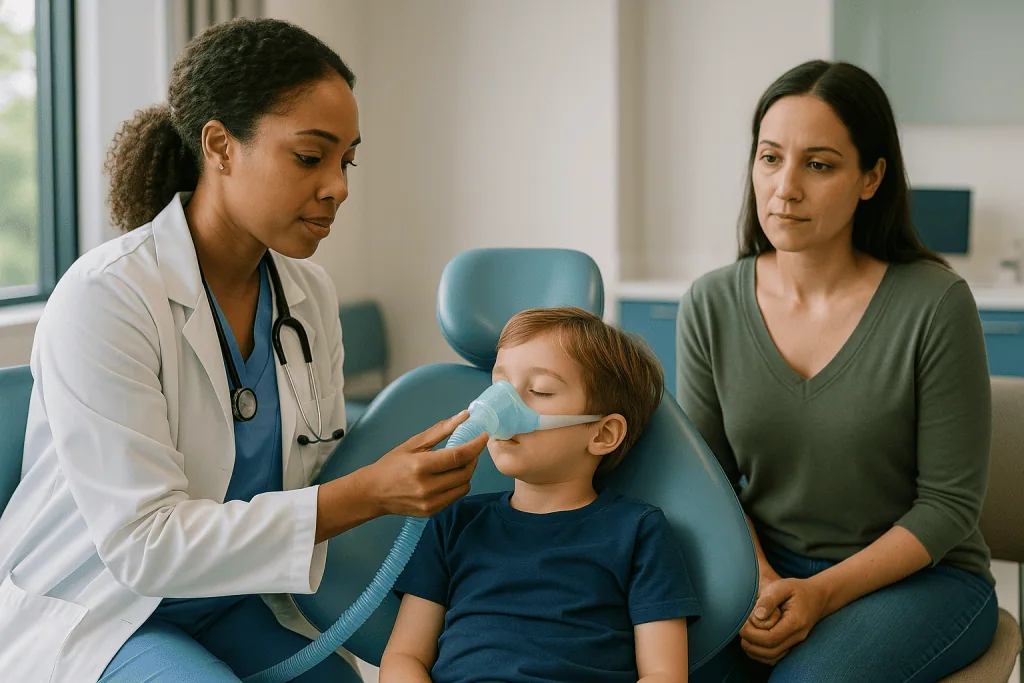
At the lightest end sits nitrous oxide, sometimes called laughing gas, breathed through a small nose mask. The child stays awake, talks, and the gas effect fades within minutes once it is switched off. Minimal sedation of this kind usually needs a lighter fasting approach, though teams still often ask for a light stomach because nausea is a known side effect.
Oral sedation, a liquid or tablet medicine in the sedative or antihistamine class, produces drowsiness and reduced anxiety. Depth varies from child to child, which is exactly why teams treat it as potentially moderate to deep and apply standard fasting rules. MedlinePlus notes that conscious sedation can drift deeper than intended, so monitoring of breathing and oxygen levels is routine.
Intravenous sedation, through a small cannula in the hand or arm, allows the anesthesia provider to adjust depth minute by minute. General anesthesia, usually given in a hospital or surgery center by an anesthesiologist, means the child is fully asleep, often with a breathing tube or airway device in place, while the dentist works on many teeth in one visit.
The choice depends on the child’s age, temperament, the amount of dental work, and their health history. Parents are not expected to choose the technique; the dental team recommends one and an anesthesia provider agrees or adjusts. Whatever is chosen, the same principle holds: the deeper the sedation, the more the empty-stomach rule matters.
What is the 2-4-6 rule for sedation?
Ask a pediatric anesthesiologist about fasting and you will hear three numbers: two, four, six. The rule is a memory aid for the minimum hours before sedation that different intakes should stop, based on how quickly the stomach empties them.
| Intake | Typical minimum fasting time | Why the difference |
|---|---|---|
| Clear fluids (water, diluted apple juice, clear electrolyte drink) | 2 hours | Leave the stomach fastest; contain no fat or protein |
| Breast milk | 4 hours | Low fat, digests faster than formula |
| Infant formula, cow’s milk, light meal | 6 hours | Protein and fat slow gastric emptying |
| Fatty or large meal | Often longer; team specifies | Fried food and large portions can sit for many hours |
The NHS general anaesthesia guidance puts it plainly: usually no food for at least six hours beforehand, with water possibly allowed until about two hours before. The four-hour breast-milk window comes from the same body of anesthesiology society guidance that hospitals adapt into their own instruction sheets, and it reflects the fact that breast milk clears the stomach faster than formula.
Two details trip parents up. First, milk is not a clear fluid. If you can see through it, it counts as clear; if it is cloudy or contains pulp, it does not. Second, these are minimums, not targets. A clinic may ask for longer, especially for an early appointment, because a child who wakes at 6 and eats at 6:15 for a 10 o’clock slot has left almost no margin.
Your team’s written times override any general rule, including this table. When they differ, follow the sheet and ask why. Some programs also encourage clear fluids up until the two-hour mark rather than a total fast from midnight, because a well-hydrated child is calmer, has better veins, and feels less awful afterward.
How long to fast before dental sedation depends on the type of sedation
Parents often assume one universal fasting rule. In reality, the plan bends with the depth of sedation, and understanding that prevents both overkill and dangerous shortcuts.

With nitrous oxide alone, the child remains awake and keeps protective reflexes, so aspiration risk is very low. Many dental practices simply ask for no heavy meal in the couple of hours before, mainly because nitrous can cause nausea in some children, and a full stomach makes vomiting more likely and more unpleasant. A total overnight fast for nitrous alone is uncommon.
Oral sedation sits in a gray zone. A medicine that makes one child pleasantly sleepy can make another child difficult to rouse. Because depth cannot be guaranteed, most pediatric dental programs apply the full 2-4-6 pattern as if the child might reach deep sedation. Skipping the fast because “it is only a syrup” misunderstands how unpredictably children respond.
Intravenous sedation and general anesthesia follow standard anesthesia fasting rules without exception. Mayo Clinic and the NHS describe the same logic for any procedure under general anesthesia: solid food stops around six hours before, clear fluids around two hours before, and the anesthesia team may give tighter instructions.
Timing quirks matter too. Afternoon appointments feel merciful but demand more discipline, because a child who ate breakfast at 7 and lunch is off the table will be hungry and irritable by 1 o’clock. Ask whether your child can have a clear-fluid drink up to the two-hour mark; many teams prefer it. Also confirm what happens if the schedule slips. If the procedure is delayed, the fast simply lengthens, which is safe but tiring, so pack a favorite snack for afterward and a plan for distraction during the wait.
Who is usually offered dental sedation, and who is asked to wait
Sedation is a tool for getting necessary dental treatment done safely, not a convenience for a busy morning. The children most often offered it are those who cannot cooperate long enough for the work to be done well: very young children with several cavities, children with high dental anxiety or a strong gag reflex, and children with developmental or sensory conditions who find the sounds and sensations of drilling intolerable. A child who needs many teeth treated may be steered toward general anesthesia so everything can be completed in one visit rather than across five distressing ones.
Then there is the other list: the children a team will pause on. Anesthesia providers grade overall health using a scale that ranges from a healthy child to one with serious systemic illness, and that grade steers where and how sedation happens. In broad terms, a healthy child or one with a mild, well-controlled condition can often be sedated in a dental setting with appropriate monitoring, while a child with a significant heart, lung, or neuromuscular condition is usually cared for in a hospital by an anesthesiologist.
Common reasons a team asks to wait rather than proceed include an active cold with cough or fever, wheezing in the past couple of weeks, a recent stomach bug, or a new medicine the team has not reviewed. Airway irritation from a respiratory infection raises the chance of coughing spasms and oxygen dips under sedation, so postponing is protective, not fussy.
Very small infants, children with known airway differences, and children who snore loudly or stop breathing in sleep are routinely referred for anesthesia assessment before any date is set. Who gets sedated, and where, is a clinical judgment made by the dental and anesthesia team together; parents supply the history that makes that judgment sound.
Why the health questionnaire asks about snoring, reflux and colds
The pre-sedation form can feel like an interrogation. Does your child snore? Ever wheeze? Any reflux? Loose teeth? Family history of problems with anesthesia? Each question maps onto a specific mechanism of harm, and knowing that makes honest answers easier.
Snoring, restless sleep and pauses in breathing point toward obstructive sleep apnea, a condition where the airway narrows during sleep. Children with large tonsils and adenoids are especially prone. Sedatives relax airway muscles further, so a child who partially blocks in ordinary sleep may block more under sedation. Cleveland Clinic lists sleep apnea among the factors that raise anesthesia risk, which is why the team may want the child seen in a hospital setting.
Asthma and recent wheeze matter because irritated airways spasm more easily when instruments or an airway device touch them. Reflux, the backward flow of stomach acid into the food pipe, increases the volume of material that could be aspirated and may lead the team to lengthen fasting or add protective steps.
Loose baby teeth are asked about because one could dislodge during airway management and be inhaled. Medicines, including inhalers, seizure drugs, and stimulants for attention conditions, are recorded because they interact with anesthetic agents; whether to take them on the morning of the procedure is a decision the prescribing clinician and anesthesia team make, never a parent’s guess.
The family history question targets rare inherited reactions to certain anesthetics, including a dangerous rise in body temperature known as malignant hyperthermia. A relative who “had a bad time with anesthesia” is worth mentioning even if the details are hazy.
Allergies, prior hospital stays, birth history in a child under two, and recent illnesses complete the picture. None of these answers gets a child “in trouble”; they get the child the right setting and the right provider.
What actually happens on the day, from check-in to waking up
Knowing the sequence lowers everyone’s heart rate. A typical pathway for deeper dental sedation runs like this.
At check-in, a nurse or assistant confirms the last time the child ate and drank to the minute. Expect to be asked twice, by two different people; that redundancy is deliberate. Weight is measured because anesthesia planning depends on it. Temperature, pulse, and oxygen level are recorded, and someone listens to the chest. If the child has a runny nose or cough that was not there at booking, this is when the team decides whether to proceed.
The anesthesia provider then talks with you and examines the airway, looking at mouth opening, tonsils, and neck movement. For general anesthesia, most young children fall asleep breathing a flavored gas through a mask before any needle is placed; older children may have a numbing cream and an intravenous line first. Some programs give a calming pre-medicine in the waiting area; whether and what is used is the team’s call.
During treatment, MedlinePlus describes the standard monitoring for sedation: continuous oxygen saturation, heart rate, blood pressure, and often exhaled carbon dioxide, with a trained person whose only job is to watch the child, not the teeth. The dentist works while the anesthesia provider manages breathing and depth.
Recovery happens in a monitored area. Children wake at different speeds, and a period of confusion or crying on waking, sometimes called emergence agitation, is common and short-lived. Discharge criteria typically include stable vital signs, the ability to swallow, and being awake enough to be safely carried or walked to a car. The NHS notes that patients need a responsible adult to take them home and stay with them, which for a child means two adults if the driver would otherwise be alone.
Is dental sedation safe for children, including a 4-year-old?
This is the question underneath all the others, and it deserves an honest answer rather than reassurance. Serious complications from pediatric sedation and anesthesia are rare in well-monitored settings with trained providers, and the NHS describes modern general anesthesia as very safe overall, with serious problems uncommon. Rare does not mean zero, and most of the safety lies in the system around the child: who gives the sedation, who monitors, what rescue equipment is on hand, and whether the health screening was done properly.
Age alone is not a barrier. Four-year-olds undergo anesthesia every day for ear tubes, hernias and dental work. Regulators in several countries have issued cautions about repeated or lengthy anesthetic exposure in children under three, based largely on animal studies and mixed human data, and the mainstream interpretation is that a single, necessary procedure of typical length has not been shown to harm development. That evidence is genuinely uncertain, and it is fair to say so, which is why teams try to complete needed dental work in one visit rather than several.
The more concrete risks are the ones the questionnaire targets: airway obstruction in a child with sleep apnea, breathing spasms in a child with an active cold, and aspiration in a child who did not fast. Nausea, sore throat, and a hoarse voice after a breathing tube are common and short-lived, as Mayo Clinic notes for general anesthesia generally.
The alternative to sedation is not always “nothing.” Options may include treating fewer teeth per visit with local anesthetic and behavioral techniques, minimally invasive approaches that delay drilling, or monitoring a cavity that is not yet symptomatic. These carry their own trade-offs, including untreated infection and pain. Weighing them for a specific child is the treating team’s job, done in conversation with you.
My child ate or drank by mistake. Now what?
A grandparent hands over a cookie. A sibling shares a juice box in the back seat. The child finds a stray cracker under the sofa cushion. It happens constantly, and the only wrong response is silence.
Tell the team immediately, with specifics: what, how much, and exactly when. Do not round the time in the direction that keeps the appointment. A clear fluid at the two-and-a-half-hour mark is a different conversation from a bowl of cereal with milk ninety minutes ago. The anesthesia provider will calculate whether the procedure can go ahead as planned, be pushed later in the day to let the stomach empty, or rescheduled.
Postponement is common and is not a failure. Teams would far rather lose a morning slot than manage an aspiration. Some parents feel embarrassed and are tempted to keep quiet, particularly after a long wait for the appointment. Consider the arithmetic: the downside of admitting a snack is inconvenience; the downside of hiding it is a rare but potentially severe lung injury under anesthesia with no one prepared for it.
Chewing gum, hard candy and lozenges count. They stimulate saliva and stomach secretions and can be swallowed whole, so most anesthesia guidance treats gum as breaking the fast. Toothbrushing is usually fine if the child spits rather than swallows toothpaste and water; check your team’s sheet.
A practical trick for the morning: clear the counter and the car of food the night before, brief every adult in the house, and give the child a job, such as carrying the comfort toy, to distract from the empty stomach. If a clear-fluid window is allowed, use it fully at the last permitted minute. A child who is hydrated and knows the plan tends to cope better than one who has fasted since midnight in silence.
Breast milk, formula, sippy cups and the gray areas
Feeding rules for babies and toddlers generate the most anxious phone calls, and rightly so, because the categories are counterintuitive.
Breast milk gets its own line in the 2-4-6 pattern because it empties from the stomach faster than formula or cow’s milk. Formula, whether cow’s-milk based, soy, or specialized, is treated as a light meal with the six-hour window. A parent who assumes “milk is milk” may stop breastfeeding two hours early or give formula two hours late; both are avoidable with one question to the team.
Toddler milk in a sippy cup at bedtime is a classic pitfall for early appointments. If a child drinks milk at 3 a.m. after waking, a 9 o’clock case is already tight. Teams often suggest offering water instead if the child wakes, keeping it within the clear-fluid window.
Which liquids are actually clear? Water, diluted apple juice without pulp, and clear electrolyte drinks qualify. Orange juice with pulp, smoothies, milk, milk alternatives such as oat or almond drinks, and anything with fat or protein do not. Jello and popsicles are debated; some teams accept them as clear fluids, others do not, so ask rather than assume.
Children with diabetes, metabolic conditions, or a history of low blood sugar need a specific plan, because prolonged fasting can be harmful for them. The prescribing clinician and anesthesia team work out timing and monitoring together; parents should never adjust insulin or other medicines on their own for a fasting morning.
Medicines in general fall outside the food rule. Many can be taken with a small sip of water within the fasting period, and some should be taken because stopping them is riskier than a sip. Which ones, and when, is decided by the team, and the questionnaire is where that conversation starts. Bring the actual bottles or a photo of the labels to the pre-visit.
What to eat after dental sedation and how the next days usually look
The instruction sheet stops at the procedure, but parents live with the afternoon and the following week.
In the first hours, expect drowsiness, wobbliness, and possibly irritability or tears; the NHS describes grogginess and impaired judgment as normal after general anesthesia and advises close supervision. Children should not be left alone, should not play on climbing frames or ride bikes that day, and should be watched on stairs. Nausea is the most common early complaint. Start with clear fluids in small sips, then move to soft, bland food such as yogurt, applesauce or plain pasta once fluids stay down. Cold, soft foods soothe a mouth that is sore from dental work. Avoid anything hard, crunchy or very hot for the first day, both for comfort and because a numb lip or cheek can be bitten without the child noticing.
Local anesthetic numbness from the dental work itself usually fades over a few hours; remind the child not to chew on the numb side. A sore throat or hoarse voice can follow a breathing tube and typically settles within a day or two. Mild gum soreness where teeth were treated is expected and is managed according to the team’s written advice, not by improvising with cabinet medicines.
Sleep may be disrupted the first night, with more waking or clinginess than usual; that generally resolves. Most children return to normal activity and school within a day, sometimes two, though a child who had several extractions may need longer before eating normally.
Follow-up usually involves a phone check within a day or so and a dental review in the following weeks to confirm healing and plan preventive care, because the whole point of a big sedation visit is to avoid needing another one.
What people often get wrong about fasting before dental sedation for a child
Myths cluster around this topic because the rules look simple and the reasons are rarely explained. Here are the misunderstandings clinicians hear most, corrected.
“Nothing after midnight is the safest rule.” Longer is not automatically better. Prolonged fasting leaves children thirsty, cranky and mildly dehydrated, which can make intravenous access harder and recovery rougher. Current guidance from the NHS and anesthesia societies allows clear fluids until about two hours before, and many teams actively encourage it.
“It’s only laughing gas, so the rules don’t apply.” Partly true: nitrous alone rarely requires a full fast, but most practices still ask for a light stomach because nausea is a known side effect. The danger is applying that logic to oral sedation, which can unpredictably deepen.
“Milk is a liquid, so it’s fine until two hours before.” Milk, formula and milk alternatives contain fat and protein that slow stomach emptying; they follow the six-hour rule, breast milk the four-hour rule.
“A little juice won’t matter; I just won’t mention it.” Anesthesia teams plan airway management around an empty stomach. Undisclosed intake is one of the few ways a parent can genuinely increase risk.
“Sedation means the dentist doesn’t have to be gentle.” Sedation removes awareness and anxiety; it does not change the standard of dental care, and behavioral support still matters during induction and recovery.
“Kids bounce back instantly.” Most do recover quickly, but a day of supervision, a bland diet and disrupted sleep are normal, and planning for them prevents a rough evening.
“If the questionnaire is long, they think something is wrong with my child.” The form is identical for every child. Its length reflects how many small factors change the safest setting for sedation, not any suspicion about yours.
Questions to ask your care team
A ten-minute conversation before the appointment prevents most of the morning-of confusion. These are the questions worth bringing, phrased so the answers are concrete.
- What level of sedation are you planning, and who will be giving it and monitoring my child? Ask specifically whether a separate trained person watches breathing while the dentist works.
- What are my child’s exact cut-off times for solid food, formula or milk, breast milk, and clear fluids, and which drinks count as clear for your program?
- Should my child take regular morning medicines, and if so, with how much water? Which ones should be skipped, and who decides?
- What should I do if my child has a runny nose, cough or fever in the days before? Is there a number to call the evening prior?
- If my child accidentally eats or drinks, whom do I contact and how quickly can the plan be adjusted?
- Where will the procedure happen, and what emergency equipment and rescue capability are on site for a child of this age?
- Can I be present while my child falls asleep and when they wake up?
- How long will recovery observation last, and what criteria must be met before we leave?
- What is normal in the first 24 hours, and which signs would you want a call about?
- Is sedation the only reasonable option for this treatment plan, or are there ways to do less at a time with local anesthetic alone? What are the trade-offs of waiting?
Write the answers down. Under stress on the day, memory for times and instructions is unreliable, and having the sheet in your own handwriting, with the team’s phone number on it, is worth more than any general guide, including this one.
When to call your doctor
Most children have an uneventful recovery, but a small number of signs need prompt attention rather than a wait-and-see approach. Call emergency services or go to an emergency department immediately if your child has difficulty breathing, is breathing fast or noisily, has blue or gray lips or face, cannot be woken or is unusually floppy and unresponsive, or has a seizure. These can indicate airway compromise, aspiration or a medication effect that needs urgent care.
Contact the dental or anesthesia team the same day, using the after-hours number on your sheet, for persistent vomiting that prevents keeping fluids down for more than a few hours, a fever developing after the procedure, bleeding from the mouth that does not settle with gentle pressure on gauze, confusion or agitation lasting well beyond the early recovery period, or a rash, facial swelling or hives, which could signal an allergic reaction. Coughing that begins after the procedure and does not settle, or any complaint of chest discomfort, also warrants a call because aspiration can present hours later.
In the days that follow, seek advice for pain that increases rather than eases, swelling of the face or jaw, foul taste or discharge from a treated site, refusal to drink leading to dry mouth and fewer wet diapers or trips to the bathroom, or a sore throat and hoarseness that persist beyond a couple of days. Numbness that has not resolved by the next morning should also be reported.
Before the procedure, call if a cold, cough, fever, vomiting or diarrhea appears in the preceding days, if your child starts a new medicine, or if anything in the health questionnaire has changed since it was completed. Teams would rather hear from you and reschedule than discover a problem in the chair. Every decision about whether to proceed, postpone or change the plan rests with the treating team; your job is to give them the information to make it well.
Frequently asked questions
What is the 2-4-6 rule for sedation in children?
It is a memory aid for minimum fasting times before sedation or anesthesia: clear fluids until two hours before, breast milk until four hours before, and formula, cow’s milk or a light meal until six hours before. The NHS guidance on general anaesthesia uses the same six-hour food and two-hour water pattern. Your child’s team may set longer times, and their written instructions override the general rule.
What is the Rule of 7 in pediatric dentistry?
The phrase is not a fasting rule and is used inconsistently. Most often it is a teaching mnemonic about tooth development and eruption timing around age six to seven, when the first permanent molars and lower front teeth typically appear. If a dentist mentions a Rule of 7 in a sedation conversation, ask what they mean, because it should not replace the 2-4-6 fasting pattern or the team’s written instructions.
How long to fast before dental sedation if my child is only having laughing gas?
Nitrous oxide alone usually does not require a full fast because the child stays awake and keeps protective airway reflexes. Most practices ask for no heavy meal in the couple of hours beforehand, mainly because nausea is a recognized side effect. If nitrous is combined with an oral sedative, the standard fasting pattern generally applies. Confirm the plan with your dental team.
Is dental sedation safe for children as young as four?
Serious complications are rare when sedation is given by trained providers with continuous monitoring and proper health screening, and four-year-olds undergo anesthesia routinely for necessary procedures. Regulatory cautions about repeated or lengthy anesthesia in children under three reflect uncertain evidence, and mainstream guidance does not consider a single, necessary procedure of typical length to be shown harmful. Risks and alternatives for your child are the team’s call.
How do kids get sedated for dental work?
Options range from nitrous oxide breathed through a nose mask, to oral sedative medicine taken as a liquid or tablet, to intravenous sedation through a small cannula, to general anesthesia in a hospital or surgery center. The technique depends on age, temperament, the amount of dental work and the child’s health history. The dental team recommends an approach and an anesthesia provider confirms or adjusts it.
Does breast milk count as a clear fluid before sedation?
No. Breast milk has its own category, typically a four-hour window, because it leaves the stomach faster than formula but slower than water. Formula and cow’s milk follow the six-hour food rule. Clear fluids are limited to liquids you can see through, such as water or diluted pulp-free apple juice. Ask your team which specific drinks they accept as clear.
What happens if my child eats something by accident before sedation?
Tell the team right away with the exact item, amount and time. They will decide whether to proceed, delay the case to let the stomach empty, or reschedule. Postponement is common and protective, not a failure. Hiding intake removes the team’s ability to plan airway management for a full stomach, which is one of the few ways a parent can raise the child’s risk.
Should my child take regular medicines on the morning of sedation?
That is decided by the prescribing clinician and the anesthesia team, not by parents, because some medicines are safer continued with a sip of water and others are paused. Bring a list or photos of every medicine, including inhalers and supplements, to the pre-sedation visit. Never adjust insulin, seizure medicines or other daily prescriptions on your own for a fasting morning.
What can my child eat after dental sedation?
Start with small sips of clear fluid once your child is awake and not vomiting, then move to soft, bland, cool foods such as yogurt, applesauce or plain pasta. Avoid hard, crunchy or hot foods for the first day, both for a sore mouth and because a numb cheek or lip can be bitten unnoticed. Nausea is common early on and usually settles within hours.
Why does the team ask if my child snores?
Snoring, restless sleep and pauses in breathing can indicate obstructive sleep apnea, often linked to large tonsils and adenoids. Sedatives relax airway muscles further, so a child who partially blocks during ordinary sleep may block more under sedation. Cleveland Clinic lists sleep apnea among factors that raise anesthesia risk, which is why this history can shift the procedure to a hospital setting with an anesthesiologist.
References
- NHS – General anaesthesia
- MedlinePlus – Conscious sedation for surgical procedures
- Cleveland Clinic – Anesthesia
- MedlinePlus – Anesthesia
This article is for general information only and is not a substitute for professional medical advice. Please consult a qualified doctor about your individual situation.

More from the Blog

Enlarged Adenoids in Children: Snoring, Mouth Breathing and When Surgery Is Considered
Adenoids are a small pad of immune tissue behind a child's nose that often swells between ages three and seven and shrinks by the…

Is It Kawasaki Disease or Scarlet Fever? How Doctors Tell Fever-and-Rash Illnesses Apart
Kawasaki disease and scarlet fever can both cause several days of fever, a red rash, a strawberry tongue and later peeling skin, but they…

Safe Sleep and Swaddling: The Rules That Reduce SIDS Risk
Swaddling itself has not been shown to lower SIDS risk; what reduces risk is the sleep setup around it. Place a swaddled baby on…

Pinworms: The Common Childhood Infection Explained
Pinworms are tiny white intestinal worms, about the length of a staple, that spread when microscopic eggs pass from hands to mouth. The classic…

What Do EEG, Sleep-Deprived EEG and MRI Show in Pediatric Epilepsy? Each Test Explained
In pediatric epilepsy, an EEG records the brain's electrical activity through scalp sensors and can show seizure-prone patterns, though a normal result does not…

Do Kids Need Vitamins? Iron, Vitamin D and the Evidence
Most children who eat a reasonably varied diet do not need a daily multivitamin, and trials in well-nourished kids show no measurable benefit. Two…