

How Laser Surgery Corrects Astigmatism by Smoothing an Uneven Cornea

Key Takeaways
- Astigmatism means the cornea curves more steeply in one direction than another, producing two focal points instead of one, and laser surgery evens the two curves by removing more tissue along the steeper meridian.
- The excimer laser works by breaking molecular bonds with cool ultraviolet light, removing layers thinner than a cell without heating the tissue.
- Correcting astigmatism uses extra corneal depth along one axis, which is why people with similar glasses strength can be given different advice depending on corneal thickness.
- Mayo Clinic describes LASIK vision stabilizing over roughly two to three months, so a result should not be judged in the first week.
- Irregular astigmatism from keratoconus is generally a reason to avoid laser reshaping rather than a target for it, and specialty lenses or corneal stiffening are the usual routes instead.
- Reshaping the cornea does not prevent presbyopia or cataracts, so reading glasses in later life remain likely even after a well-aligned correction.
Laser surgery corrects astigmatism by reshaping the front surface of the eye, the cornea, so that it curves more evenly. A computer-guided excimer laser removes microscopic amounts of tissue from the steeper meridian, flattening the oval curve toward a rounder one so light focuses at a single point on the retina. It treats the refractive error itself, but whether it suits a given person depends on an eye examination and the treating team's judgment.
She has worn glasses since the third grade, and she can still describe the first time a street lamp stopped being a smeared starburst and became a single clean dot. Now, decades later, she is sitting in a dim examination room watching a ring of lights reflect off her own cornea on a screen, and the technician is explaining that her eye is shaped a little like the back of a spoon rather than a ladle.
That shape has a name, astigmatism, and it is the reason her vision has never been quite sharp at any distance. Her question is the one many people bring to the consultation: how laser surgery corrects astigmatism, and whether a beam of ultraviolet light can really redraw a curve that she was born with.
The honest answer is more mechanical, and more interesting, than the advertising version. It involves fractions of a millimeter, a precise map of the eye, and a healing process that the laser cannot control.
What astigmatism is: a cornea shaped like the back of a spoon
The cornea is the clear dome at the very front of the eye, and it does most of the eye’s focusing before light ever reaches the lens behind it. In an eye without astigmatism, that dome curves the same amount in every direction, like a slice from a basketball. Light passing through it converges on a single point at the back of the eye, the retina, which is the light-sensitive layer that sends images to the brain.
With astigmatism, the cornea curves more steeply in one direction than in the other, closer to a slice from a football or the bowl of a spoon. Light entering along the steep meridian focuses at one depth, and light entering along the flatter meridian focuses at another. The eye ends up with two focal points instead of one, which the brain experiences as blur, smearing or ghosting at every distance. According to Cleveland Clinic, astigmatism is common, affecting roughly one in three people in the United States to some degree.
Two details matter for understanding treatment. First, astigmatism is measured in diopters, a unit of focusing power, and it has an axis, the angle at which the steep meridian sits. A glasses prescription records both. Second, most astigmatism is corneal, but a smaller share comes from the lens inside the eye, and the lens kind cannot be fixed by reshaping the cornea. That is one reason the pre-operative measurements are so thorough: the surgeon has to know which structure is causing the problem before deciding whether a laser is the right tool at all.
How laser surgery corrects astigmatism in plain language
Think of the spoon again. If you wanted to make the bowl of a spoon rounder, you would sand down the ridge running along its length until the long curve matched the short one. That is essentially how laser surgery corrects astigmatism. The laser removes a thin, precisely patterned layer of corneal tissue, taking more from the steep meridian and less from the flat one, until the two curves meet in the middle and light converges on a single point.
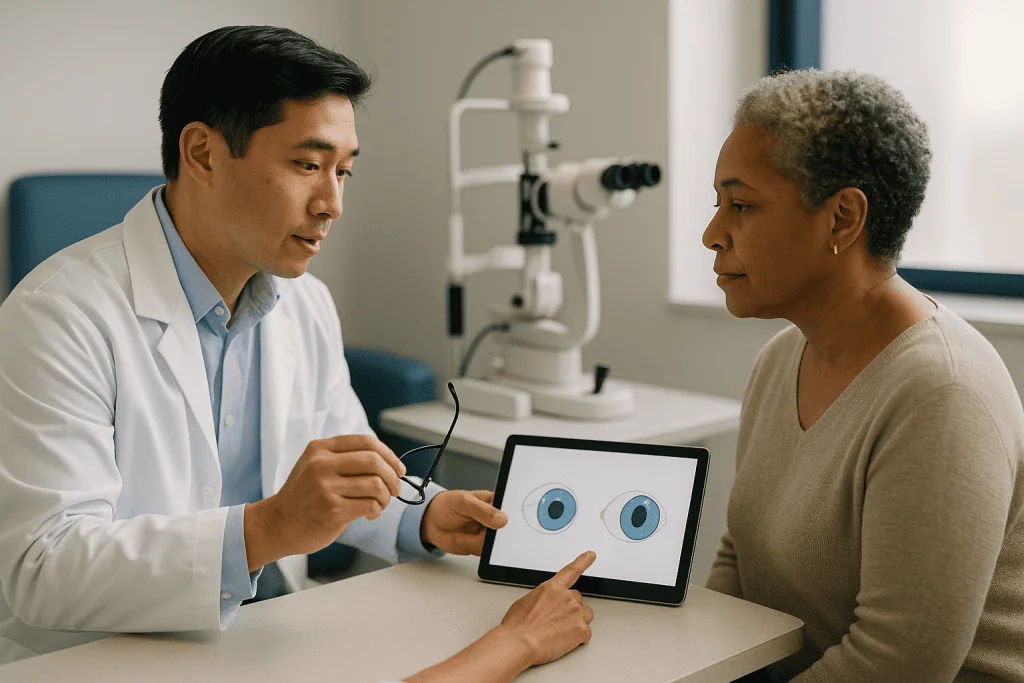
The instrument that does this is an excimer laser, a cool ultraviolet laser that breaks the molecular bonds in tissue without heating it. Each pulse vaporizes a layer thinner than a cell, and the computer fires thousands of pulses in a pattern calculated from the eye’s own map. For astigmatism, that pattern is not a simple circle but an elongated or cylindrical shape, oriented along the axis recorded in the prescription. Short-sightedness and long-sightedness can be treated in the same session by adjusting how much is removed from the center versus the edges.
Modern systems add two refinements. An eye tracker follows the eye hundreds of times a second and pauses the laser if the eye drifts. Some systems also register the position of the iris, the colored ring around the pupil, before surgery and again on the operating table, because the eye rotates slightly when a person lies down. For astigmatism, that rotation matters: a cylindrical correction placed a few degrees off its axis loses part of its effect.
The cornea is only about half a millimeter thick, so the amount of tissue involved is tiny. What the laser cannot do is guarantee how the surface heals afterward, which is why outcomes are discussed in ranges rather than promises.
What actually happens on the day, step by step
Most people are surprised by how undramatic the procedure feels. Mayo Clinic describes LASIK as taking around 30 minutes or less in total, and much of that time is positioning and checking rather than lasering. You lie on a reclining bed under the laser, awake, with anesthetic drops numbing the surface of the eye. A small spring device, a speculum, holds the eyelids open so blinking cannot interrupt the procedure.
In LASIK, the surgeon first creates a thin hinged flap in the outer cornea, using either a precise mechanical blade or a femtosecond laser, which is a second type of laser that cuts by creating a plane of microscopic bubbles inside the tissue. During this step the vision in that eye goes dim or dark for a few seconds, and there is a feeling of pressure. The flap is folded back, exposing the deeper cornea.
Then the excimer laser is applied. You are asked to stare at a target light; the eye tracker does the rest. The laser makes a clicking sound and there may be a faint smell, often compared to burnt hair, which is simply the vaporized tissue. The actual astigmatism correction typically lasts well under a minute per eye. The flap is laid back into place, where it adheres on its own within minutes without stitches.
In surface procedures such as PRK, there is no flap. The outer skin of the cornea is gently removed, the laser is applied directly, and a soft bandage contact lens is placed to protect the surface while new cells grow in. Both eyes are often treated in the same sitting, after which you will need someone to take you home.
PRK vs LASIK for astigmatism: how the main approaches compare
Three laser techniques are in widespread use, and they all apply the same smoothing principle to the cornea. The differences lie in how the surgeon reaches the tissue that needs reshaping, and those differences shape recovery and suitability more than they shape the correction itself.
| Technique | How the cornea is reached | Typical early recovery pattern | Often considered when |
|---|---|---|---|
| LASIK | Thin hinged flap lifted; laser reshapes the layer beneath; flap replaced | Vision often usable within a day or two; mild grittiness and dryness common in the first weeks (Mayo Clinic) | Cornea thick enough to leave a safe margin under the flap; no occupation with high risk of eye impact |
| PRK (and similar surface treatments) | Outer surface cells removed; laser applied directly; bandage lens worn while cells regrow | Discomfort and blur for several days as the surface heals; sharpness returns more gradually (MedlinePlus) | Thinner corneas, irregular surfaces, dry eye concerns, or professions and sports where a flap is undesirable |
| SMILE (lenticule extraction) | Femtosecond laser carves a small disc inside the cornea, removed through a keyhole incision | Comparable to LASIK in timing; smaller incision | Short-sightedness with moderate astigmatism; availability and surgeon experience vary |
For astigmatism specifically, the question people ask most is PRK vs LASIK. Both can treat the cylindrical component of a prescription; the excimer pattern is the same. PRK avoids a flap, which matters if the cornea is on the thin side, because the flap itself uses up tissue that could otherwise serve as a safety reserve. LASIK trades a slower surface healing for a quicker return of comfortable vision. Neither is universally better, and the NHS notes that the choice depends on individual eye measurements and lifestyle rather than on one technique being newer.
Who laser surgery is usually for, and who is usually asked to wait
Suitability is decided by measurements, not by motivation. The first requirement is a stable prescription. Mayo Clinic advises that laser vision correction is generally not offered to people under 18, and surgeons usually want to see that glasses or contact lens strength has not shifted meaningfully for about a year, because reshaping an eye that is still changing simply builds in a future error.
Candidates whose astigmatism is regular, meaning the steep and flat meridians sit at right angles to one another like a true football, are the most straightforward to plan for. The cornea must also be thick enough that, after the planned amount of tissue is removed, a generous layer remains. Overall eye health matters too: the surface should be reasonably well lubricated, the retina healthy, and eye pressure normal.
People commonly asked to wait or to consider other options include:
- Those who are pregnant or breastfeeding, since hormonal changes can temporarily alter the cornea and the prescription (Mayo Clinic).
- Anyone whose glasses have changed noticeably in the past year.
- People with significant dry eye, because surgery can worsen it for a period.
- Those with keratoconus or a cornea that looks suspicious for it on mapping, discussed in the next section.
- People with uncontrolled autoimmune conditions or diabetes that affects healing, where the treating team weighs the risks individually.
- Anyone with very high prescriptions, where the amount of tissue required exceeds what is safe (NHS).
Age at the other end is not a strict barrier, but after the mid-forties the eye’s own lens stiffens and near focus fades, a change called presbyopia that laser reshaping of the cornea does not reverse. Someone in that group may be guided toward lens-based surgery or toward accepting reading glasses after treatment. The decision always rests with the examining team, who can see the maps that the rest of us cannot.
Why corneal thickness and keratoconus change the answer
Every laser correction removes tissue, and tissue does not grow back in the deeper cornea. Surgeons therefore plan around a residual thickness, the layer that will remain after the flap and the ablation are accounted for. Leave too little, and the cornea can slowly bulge forward under the eye’s internal pressure in the months or years after surgery, a complication called ectasia that creates new, irregular astigmatism worse than the original.
Astigmatism is relevant here because correcting it costs extra tissue. A cylindrical correction is carved into the cornea along one axis, and the larger the astigmatism, the deeper the groove along that meridian. Someone with a modest spherical prescription but a large astigmatic component may use more corneal depth than their overall glasses strength suggests. That is why two people with similar vision can receive different advice.
Keratoconus is the other reason the pre-operative map matters so much. It is a condition in which the cornea thins and steepens into a cone, producing irregular astigmatism that no glasses lens fully corrects. Removing tissue from a cornea that is already structurally weak would accelerate the process, so a diagnosis of keratoconus, or even an early pattern suggestive of it, is generally treated as a reason not to perform laser reshaping. People in this situation are usually directed toward specialty contact lenses or a separate procedure that stiffens the cornea with riboflavin and ultraviolet light.
The instrument that reveals all of this is corneal topography or tomography, a scan that builds a three-dimensional map of thickness and curvature across the whole surface. On that map, regular astigmatism looks like a tidy bow tie. Irregular astigmatism looks lopsided. Surgeons spend more time reading that map than operating the laser, and a good consultation should include a walk-through of what yours shows.
Laser eye surgery astigmatism recovery: what the first days and weeks look like
The laser part is finished in minutes; the healing takes months, and knowing the typical shape of that curve prevents a lot of anxiety. Mayo Clinic describes a first follow-up visit within a day or two, when the surgeon checks that a LASIK flap has settled and that the surface is healing. In those first hours, eyes commonly burn, water and feel as if an eyelash is trapped under the lid. Vision after LASIK is often usable the next morning, though with a haze that clears gradually.
Surface procedures follow a slower script. With PRK, the outer cells regrow over roughly the first week, and MedlinePlus notes that discomfort and blurry vision are expected during that period. Sharpness then improves over several weeks rather than days, and the bandage contact lens is removed once the surface has closed.
Whichever technique is used, certain patterns recur:
- Dry, gritty eyes are common for the first month or so and sometimes longer; lubricating drops are part of almost every recovery plan (Mayo Clinic).
- Glare, halos and starbursts around lights at night usually peak early and fade over weeks to months.
- Rubbing the eyes is discouraged, especially after LASIK, until the flap has fully adhered.
- Swimming, hot tubs and eye makeup are typically paused for a few weeks; Mayo Clinic suggests avoiding contact sports for about four weeks.
- Vision may fluctuate between days as the surface hydrates and dries.
Mayo Clinic puts the point at which vision has usually stabilized at around two to three months, and the NHS describes vision settling over a period of weeks. During that window, it is normal for astigmatism correction to feel slightly incomplete on some days and perfect on others. Driving, returning to screens and resuming work are cleared by the treating team based on how the eye looks, not on a fixed calendar.
Can laser eye surgery fix astigmatism completely?
The careful answer is that laser surgery is designed to reduce astigmatism to a level where it no longer meaningfully blurs vision, and in many eyes that is close to zero. Whether a particular eye ends up with no measurable astigmatism, a small residual amount, or a need for a touch-up depends on factors that cannot all be predicted from the chair.
Three variables account for most of the uncertainty. The first is the amount being treated. Larger astigmatic corrections are harder to hit exactly, because a small error in axis alignment or in healing is magnified. The second is healing itself. The cornea responds to surgery by remodeling its surface over weeks, and that remodeling can slightly shift the final shape in a way that varies from person to person. The third is the lens inside the eye. If part of the astigmatism originated there, reshaping the cornea addresses only the corneal share.
Mayo Clinic and the NHS both describe outcomes in terms of most people achieving vision good enough for everyday tasks without glasses, while being explicit that some people will still need glasses for some activities, that the correction can be slightly over or under the target, and that a second procedure is occasionally considered once the eye has fully stabilized. Neither source frames the operation as a guarantee of perfect unaided sight, and this article will not either.
It also helps to separate two meanings of the word fix. Laser surgery changes the refractive error; it does not change how the eye ages. Presbyopia will still arrive, and the lens may still develop cataracts later in life. People who understand the procedure as reshaping the focusing surface, rather than as a permanent exemption from eye care, tend to come away with a realistic picture of what has and has not been done.
Risks and side effects, stated plainly
Laser vision correction is a common elective operation on an organ that cannot be replaced, so the risk conversation deserves plain language. The NHS and Mayo Clinic group the possibilities into side effects that are expected and usually temporary, and complications that are uncommon but matter.
Expected side effects include dry eye, which stems partly from the fact that creating a flap or removing surface cells severs tiny corneal nerves that signal the eye to make tears. These nerves regrow over months. Night-vision disturbances such as halos and glare are also expected early and usually settle. Light sensitivity and fluctuating vision fall into the same category.
Less common complications include:
- Under-correction or over-correction, where the achieved result differs from the plan; a later enhancement may be discussed once the eye is stable.
- Induced or residual astigmatism, including irregular astigmatism if healing is uneven or the ablation is decentered.
- Flap problems after LASIK, such as wrinkles, displacement from eye rubbing or trauma, or cells growing beneath the flap.
- Infection or inflammation of the cornea, which is why drops and hygiene instructions are stressed so firmly.
- Corneal ectasia, the progressive bulging described earlier, which is rare and is the main reason thin or irregular corneas are screened out.
- Regression, a partial drift back toward the original prescription over time.
- Rarely, a lasting reduction in best-corrected vision, meaning vision that cannot be fully restored even with glasses.
Mayo Clinic notes that serious, vision-threatening complications are rare, and that most side effects resolve, without putting figures on it that would apply to every person. The right way to read such a list is not as a prediction but as the content of an informed-consent conversation. Your own surgeon can tell you which items on it are more or less relevant to your eye, which is far more useful than any general number.
Does astigmatism come back after LASIK?
The tissue the laser removes stays removed, so in the strict sense the correction is permanent. What people are usually asking is whether blur can return, and the answer is that it can, for reasons that have little to do with the laser undoing itself.
Regression is the first. In the months after surgery, the cornea’s surface layer can thicken slightly as it heals, nudging the curvature part of the way back toward where it started. This effect is more noticeable after larger corrections and after surface procedures, and it is one reason surgeons wait several months before judging whether a result is final. Mayo Clinic lists it among recognized outcomes.
Natural change is the second. Laser surgery reshapes the cornea at one moment in a life; it does not freeze the eye. Some prescriptions continue to drift slowly in adulthood, and a small new astigmatism can appear decades later as the lens inside the eye ages. Cataracts, which are a clouding of that lens, can also change the eye’s focus, and people who have had laser surgery can and do have cataract surgery later, though their earlier treatment must be factored into the lens calculations.
Eye rubbing and trauma are the third. A displaced flap in the early weeks after LASIK can create new astigmatism, which is why the no-rubbing rule is repeated so often.
The practical implication is that laser surgery does not retire a person from routine eye examinations. The NHS advises ongoing checks after any laser procedure, and anyone noticing a gradual return of ghosting or smearing at night should mention it rather than assume nothing can be done. Often a small residual can be corrected with glasses for specific tasks; occasionally an enhancement is appropriate; and sometimes the cause turns out to be something else entirely, such as dry eye, which mimics astigmatism remarkably well.
Alternatives when laser surgery is not the right fit
Being told to wait, or to look elsewhere, is not a dead end. Astigmatism has been corrected without lasers for more than a century, and the options have improved alongside the surgical ones.
Glasses remain the simplest. A lens that is itself cylindrical, with power in one meridian only, cancels the cornea’s unevenness exactly, and because the axis is fixed in the frame it never rotates. Toric contact lenses do the same job on the eye; they are weighted or shaped so that they settle in one orientation, and both soft and rigid versions exist. Rigid gas-permeable lenses have a particular advantage for irregular astigmatism, because the tear film between lens and cornea fills in the irregularities and creates a smooth optical surface the eye otherwise lacks. Scleral lenses, large rigid lenses that vault over the cornea and rest on the white of the eye, extend that principle to corneas that are too distorted for ordinary lenses.
Surgical alternatives work on the lens rather than the cornea. A phakic intraocular lens is a thin implant placed inside the eye in front of the natural lens, leaving the cornea untouched; toric versions correct astigmatism. Refractive lens exchange replaces the natural lens with an artificial one, in the same way cataract surgery does, and a toric artificial lens can be chosen. The NHS lists lens surgery as the usual alternative for people whose prescriptions are too high for laser treatment or who are older and already developing presbyopia. For small amounts of astigmatism at the time of cataract surgery, surgeons sometimes make tiny relaxing incisions at the edge of the cornea to even out the curve.
Each of these has its own profile of benefits and risks. The point of listing them is not to rank them but to make clear that a laser is one instrument among several, chosen for the eye in front of the surgeon rather than for its reputation.
What people often get wrong about laser surgery for astigmatism
A surprising number of people arrive at a consultation believing that astigmatism cannot be lasered at all. That was broadly true in the earliest era of excimer lasers, which could only remove tissue in symmetrical circles. Current systems carve cylindrical patterns routinely, and regular astigmatism is a standard part of what they treat. The myth persists because older relatives were turned away decades ago.
The opposite error is just as common: assuming the laser can fix any astigmatism. It cannot. Irregular astigmatism from keratoconus, scarring or previous surgery is usually a reason to avoid laser reshaping, not a target for it, because the weak or uneven tissue does not respond predictably.
People also tend to picture the laser burning or cutting. An excimer laser works by breaking molecular bonds with ultraviolet light, which is why there is no heat damage and why the tissue removed is measured in fractions of a thousandth of a millimeter. The brief smell during surgery feeds the burning idea, but nothing is being heated.
Another misconception is that results are instant and final. Vision the next morning after LASIK can be striking, but Mayo Clinic describes stabilization over two to three months, and surface procedures take longer. Judging the outcome in week one is like judging a cake while it is still in the oven.
Many assume laser surgery stops the need for reading glasses later in life. It does not, because presbyopia is a lens problem, not a corneal one.
Finally, some believe that one technique is simply the best and that being offered another means being short-changed. In reality, being steered toward PRK rather than LASIK, or toward a lens implant rather than any laser, usually reflects something specific the surgeon saw on the corneal map. The recommendation is information about your eye, and it is worth asking what prompted it.
Questions to ask your care team before deciding
A good consultation should leave you able to explain your own corneal map to a friend. The questions below are not a test for the surgeon; they are a way of making sure the decision is built on your measurements rather than on a general pitch.
- How much of my blur is astigmatism, and is it coming from my cornea, my lens or both?
- Is my astigmatism regular or irregular, and what does my topography scan show?
- How thick is my cornea, and how much tissue would be left after the planned correction?
- Has my prescription been stable long enough, based on my records, to proceed?
- Which technique are you recommending for my eye, and what specifically made you choose it over the others?
- How will the axis of my astigmatism be aligned during surgery, and what happens if my eye rotates when I lie down?
- What side effects do you expect me to have in the first month, and which would you want to hear about straight away?
- How dry are my eyes now, and how do you expect surgery to affect that?
- What would a result slightly short of target mean for me, and how long would you wait before considering any further treatment?
- Will I still need glasses for reading, driving at night or any other task, now or as I get older?
- How many follow-up visits are planned, and who do I contact outside clinic hours?
- If you were advising a family member with my scans, what would concern you most?
Bring your current glasses, any old prescriptions you can find, and a note of how long you have been out of contact lenses, since soft lenses can temporarily mold the cornea and the team will ask you to stop wearing them for a period before measurements. Write the answers down. The decision about whether and how to proceed rests with you and the treating team together, and it is a better decision when the reasoning is visible to both.
When to call your doctor after laser eye surgery
Most of what you feel in the first days after laser surgery is expected: grittiness, watering, light sensitivity, and vision that is clearer in the morning and softer by evening. The treating team will have given you a direct number, and the instruction that matters most is to use it early rather than wait for the next scheduled visit if something seems wrong. Both Mayo Clinic and the NHS single out a short list of signs that warrant prompt contact.
Call the same day, or seek urgent eye care, if you notice any of the following:
- Pain that is worsening rather than easing, especially after the first day or two, or pain that is not relieved by the measures you were given.
- A sudden drop in vision, or vision that was improving and then clearly deteriorates.
- Increasing redness of the eye, particularly with discharge, a swollen lid or a white or gray spot visible on the cornea; these can indicate infection or inflammation.
- A sensation that something has moved in the eye after rubbing it, being poked, or any knock to the face, since a LASIK flap can shift in the early weeks.
- New or dramatically worsening halos, double images or ghosting in one eye that do not settle.
- Flashes of light, a shower of new floaters, or a curtain or shadow across part of your vision, which are signs that need assessment regardless of recent surgery.
- Extreme light sensitivity that prevents you opening the eye.
None of these signs is a diagnosis in itself. Many turn out to be dryness, a loose surface cell or an eye that is simply healing more slowly. The point of calling is that the few that are not, infection and flap displacement in particular, are far easier to manage when seen within hours than within days. If in doubt, phone. The team would rather look at an eye that turns out to be fine than hear about a problem late, and every decision about treatment from that point onward belongs with them.
Frequently asked questions
Can LASIK fix astigmatism, or only short-sightedness?
LASIK can treat regular astigmatism as well as short- and long-sightedness, often in the same session. The excimer laser removes tissue in a cylindrical pattern aligned to the axis of the astigmatism, flattening the steeper curve of the cornea. Irregular astigmatism, such as that caused by keratoconus, is a different matter and is usually a reason to avoid laser reshaping. Suitability depends on corneal mapping by the treating team.
What does laser eye surgery astigmatism recovery feel like in the first week?
Expect grittiness, watering, light sensitivity and fluctuating vision in the first days, with LASIK vision often usable by the next morning and PRK vision blurrier for about a week while surface cells regrow. Mayo Clinic describes a check within a day or two and dry eye lasting a month or more. Vision generally settles over two to three months rather than days.
Is PRK or LASIK better for astigmatism?
Neither is universally better; both apply the same laser pattern to correct the astigmatic component. PRK avoids creating a flap, which preserves corneal tissue and suits thinner or irregular corneas and certain occupations, but surface healing is slower and less comfortable. LASIK offers faster visual recovery when corneal thickness allows. The recommendation usually follows from your individual corneal map rather than from one technique being newer.
Does astigmatism come back after LASIK?
The removed tissue does not return, but blur can reappear for other reasons. Some corneas regress slightly as they heal in the months after surgery, natural age-related changes in the eye’s lens can introduce new astigmatism decades later, and eye rubbing in the early weeks can shift a flap. Dry eye also mimics astigmatism. Ongoing eye examinations remain important after any laser procedure.
How does the surgeon know the axis of my astigmatism is lined up correctly?
Corneal topography maps the steep and flat meridians before surgery, and modern lasers track the eye continuously during treatment. Some systems register iris features while you sit upright and again when you lie down, correcting for the small rotation that occurs. Alignment matters because a cylindrical correction placed off its axis loses part of its effect, so this step is checked carefully.
Why might I be told my cornea is too thin for laser surgery?
Every correction removes tissue, and surgeons plan to leave a generous residual layer so the cornea stays structurally stable under the eye’s pressure. Astigmatism correction cuts a groove along one axis that uses extra depth, so a thin cornea combined with a large astigmatic component may not leave a safe margin. In that case, surface treatments or lens-based options may be discussed instead.
Will I still need reading glasses after laser surgery for astigmatism?
Quite possibly, especially after the mid-forties. Laser surgery reshapes the cornea, but reading difficulty with age, presbyopia, comes from the lens inside the eye stiffening and is not reversed by corneal treatment. Some people choose a deliberate difference between the two eyes to reduce dependence on readers, which the surgeon can simulate beforehand with contact lenses. Ask your team what to expect.
What does the laser actually remove, and does it burn the eye?
An excimer laser emits cool ultraviolet light that breaks the bonds holding corneal molecules together, vaporizing tissue in layers thinner than a single cell without heating the surrounding cornea. The faint smell some people notice during surgery is vaporized tissue, not burning. The total depth removed is a fraction of the cornea, which is itself only about half a millimeter thick.
Can astigmatism caused by the lens inside the eye be treated with a laser on the cornea?
Only partly. If part of the astigmatism originates in the natural lens rather than the cornea, reshaping the cornea addresses only the corneal share, and some blur may remain. Pre-operative measurements are designed to separate the two sources. Where lens astigmatism is significant, or a cataract is developing, a toric artificial lens placed during lens surgery may be the more suitable approach.
When should I worry about symptoms after laser eye surgery?
Contact your surgical team the same day if pain is worsening rather than easing, vision suddenly drops, the eye becomes increasingly red with discharge or a visible spot on the cornea, or you feel something shift after rubbing or knocking the eye. Flashes, new floaters or a shadow across your vision also need urgent assessment. Mild grittiness and fluctuating vision in the first weeks are usually expected.
References
This article is for general information only and is not a substitute for professional medical advice. Please consult a qualified doctor about your individual situation.

More from the Blog
Why Timing Matters in Retina Surgery: Which Repairs Are Urgent and Which Can Be Planned
Retinal detachment surgery urgency depends on whether the macula, the center of the retina responsible for detailed vision, is still attached. Macula-on detachments are…

Toric Lenses, Glasses or Laser for Astigmatism: When Each Option Makes Sense
Astigmatism treatment options fall into three groups: glasses, contact lenses (including toric soft lenses and rigid or scleral lenses for irregular corneas), and surgery…

Smart Lens Is Not a Gadget: Common Misconceptions About Lens Replacement Surgery
A so-called smart lens is not an electronic device. It is a fixed artificial intraocular lens, usually a multifocal, trifocal or extended-depth-of-focus design, implanted…

Robotic vs Conventional Eye Surgery: Where Computer Assistance Helps and Where It Does Not
Robotic and laser-assisted eye surgery hand certain cutting and measuring steps to a computer-guided device, while the surgeon still plans and completes the operation.…

Life After LASEK: Sunglasses, Screens and Why Surface Healing Deserves Extra Patience
After LASEK surgery, sun protection means wearing UV-blocking, preferably wraparound, sunglasses outdoors from the first day, keeping them on through the weeks when the…

What to Expect From an Intraocular Lens: Distance, Near and the Glasses You May Still Need
An intraocular lens replaces the eye's natural lens, usually after cataract removal, and is set to focus at a chosen distance. Most people see…