

Is Cataract Surgery Painful? Numbing Drops, Sedation and What You Actually Feel

Key Takeaways
- Modern cataract surgery is performed under local anesthetic with the patient awake, and NHS guidance puts the typical operation at 30 to 45 minutes.
- Anesthetic drops or gel numb the eye surface within minutes; an injection around the eye is added when deeper numbness or a stiller eye is needed.
- A lid speculum holds the operated eye open so blinking is physically impossible, while the other eye blinks normally beneath the drape.
- People commonly feel pressure, coolness, and bright shifting light during surgery, but cannot see the surgeon's instruments because the eye cannot focus that close.
- Grittiness, watering, redness, and blurred vision for a few days are expected; the NHS gives four to six weeks as the typical full recovery period.
- Severe or worsening pain, sudden vision loss, increasing redness with discharge, or new flashes and floaters are red flags that warrant a same-day call to the surgical team.
Cataract surgery is not usually painful. The eye is numbed with anesthetic drops or gel, sometimes with a small injection around the eye, and many people also receive light sedation to help them relax. Most describe pressure, brightness, or a cool sensation rather than pain. Mild grittiness or aching for a few days afterward is common; sharp or worsening pain should be reported to the surgical team promptly.
The appointment letter sits on the kitchen table for a week before she opens it properly. Her reading glasses are strong enough now that the newspaper still looks like it has been printed through fog, and night driving stopped last winter. She wants the surgery. What she does not want is to lie still while someone works on her open eye, and the question she cannot quite bring herself to ask her daughter is the one everybody types into a search bar late at night: is cataract surgery painful?
It is a fair question, and the honest answer has more texture than a simple no. Modern cataract surgery is one of the most frequently performed operations in the world, and it is designed to be done with a patient who is awake, comfortable, and often surprised by how little they felt.
This explainer walks through exactly how the eye is numbed, what sedation does and does not do, what people report feeling on the table, and which sensations in the days afterward are ordinary rather than alarming.
Is cataract surgery painful? What most people actually feel
Ask people the week after their operation and the most common word is not pain. It is pressure. A cataract is the clouding of the eye’s natural lens, and the surgery replaces that lens with a clear artificial one through a tiny opening at the edge of the cornea. Because the eye is thoroughly numbed beforehand, the sharp nerve signals that normally shout when something touches the eye are switched off.
What remains are the sensations anesthetic drops cannot fully block. Many people describe a feeling of gentle pushing when instruments rest against the eye, a sense of coolness when fluid is rinsed across the surface, and a bright, sometimes kaleidoscopic light from the operating microscope. The NHS describes the procedure as usually done under local anesthetic, with the patient awake and comfortable, and typically lasting 30 to 45 minutes. Mayo Clinic notes that people may perceive light and movement during the operation but do not see the surgeon’s actual work.
Pain scores in the operating room are rarely the issue. The moments patients tend to remember as uncomfortable are smaller: the cold drops going in, the paper drape resting near the face, the awkwardness of holding still. The instinct to blink is handled by a small device, discussed later, and the eye does not dry out because it is kept moist throughout.
Afterward, the picture shifts slightly. As the anesthetic wears off over a few hours, a gritty, sandy, or mildly aching feeling is common, and the NHS lists grittiness, watering, blurred vision, and redness as expected for a few days. That is a bruised-feeling eye, not an emergency. Severe or increasing pain is a different matter, and the section near the end explains when a phone call is warranted.
How the eye is numbed: drops, gel and injections around the eye
Numbing an eye is easier than numbing a tooth, and that surprises people. The cornea, the clear front window of the eye, is one of the most densely nerve-supplied surfaces in the body, but those nerves sit right at the surface, so a local anesthetic placed on the eye reaches them in minutes. Local anesthetic simply means a medicine that blocks nerve signals in one area while the rest of the body stays fully awake.

Topical anesthesia is the most common approach in many centers. Drops or a thicker gel are applied to the eye several times in the waiting area and again on the operating table. The stinging that people notice with the first drop settles quickly as the surface goes numb. Sometimes the surgeon also places a small amount of preservative-free anesthetic inside the eye during the operation, which deepens the numbness of the iris, the colored ring that can otherwise feel pressure when the pupil is manipulated.
For some patients, drops alone are not enough. An injection of local anesthetic around the eye, beneath the thin membrane covering the white of the eye or into the soft tissue behind it, numbs the eye more completely and also dampens eye movement. The NHS explains that an injection may be used when drops alone would not be sufficient, for instance if a person finds it difficult to keep the eye still. The injection itself is given after the surface has been numbed, so the sensation is usually pressure rather than a sharp prick.
General anesthesia, meaning being fully asleep, is uncommon for routine cataract surgery in adults. It is reserved for situations such as severe anxiety that cannot be settled, inability to lie flat, certain neurological conditions, or children, according to Mayo Clinic and NHS guidance. Which route is chosen is a decision the anesthetic and surgical team make with the patient beforehand.
Do you get cataract surgery sedation, and what does it actually do?
Sedation is the part people picture most vividly and understand least. In cataract surgery it is almost never the deep, dreamless state of a major operation. Instead, teams often offer light sedation, a small amount of a relaxing medicine given by mouth or through a vein, that takes the edge off nerves while leaving the patient awake enough to follow simple instructions like looking at the light.
That awareness is deliberate. The surgeon needs the patient to hold the eye reasonably still and to respond if asked to look slightly up or down. Heavy sedation can make a person drift, jerk unexpectedly, or breathe irregularly under the drape, which is less safe than a calm, cooperative patient. Mayo Clinic notes that people are usually awake during the procedure, and Cleveland Clinic describes sedation as something that helps patients relax rather than sleep.
What sedation does well is blunt the anticipatory fear. Many patients report that time compressed, that the operation felt like ten minutes rather than half an hour, or that they remember the music in the room more than the surgery. Some remember very little at all, which is a known effect of certain sedative classes rather than a sign that they were unconscious.
Sedation is not automatic everywhere. Some surgeons prefer drops plus a calm conversation, and many patients do perfectly well that way. Others routinely offer a mild sedative. The choice depends on the patient’s health, anxiety level, medicines already being taken, and local practice. It is a good question to raise at the pre-assessment visit. The answer, and the type and amount of any sedative, belong to the anesthetic team; nothing here should be taken as guidance about starting or adjusting any medicine.
What actually happens during cataract surgery, step by step
The operation itself is brief and highly standardized. After the eye is numbed and the pupil dilated with drops, the skin around the eye is cleaned with antiseptic and a sterile sheet is placed over the face with an opening for the eye. A small spring device holds the lids apart. From this point on, the patient looks up at the microscope light and the surgeon works through the microscope.
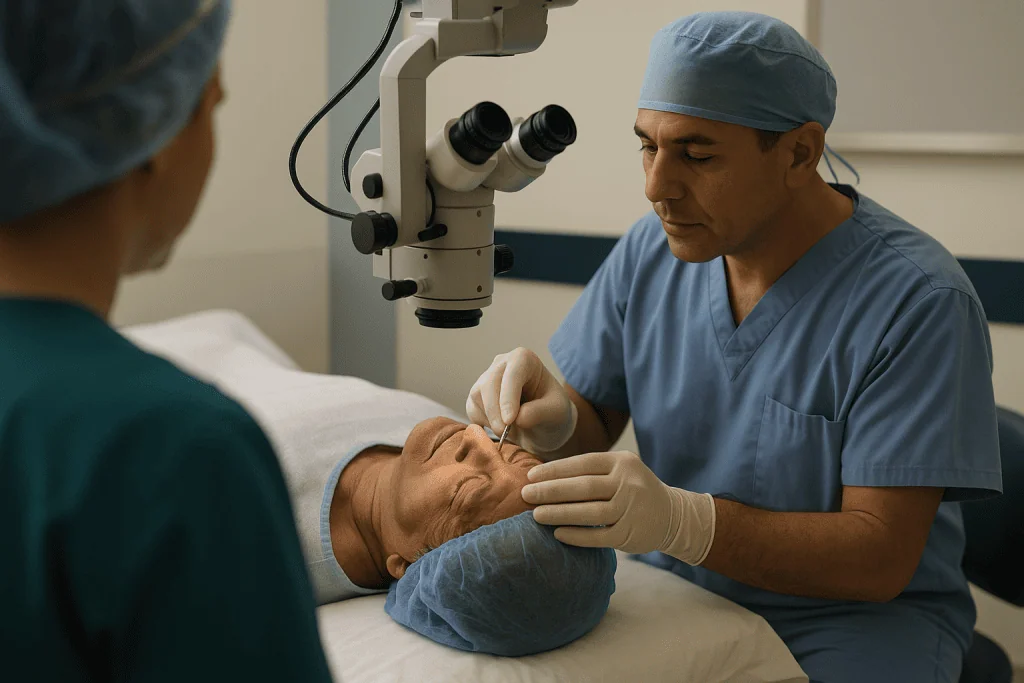
The technique used in most modern operations is called phacoemulsification, which simply means breaking the cloudy lens into fragments with ultrasound and gently suctioning them out. The steps typically run like this:
- A tiny incision, usually only a couple of millimeters, is made at the edge of the cornea.
- A clear gel is placed inside the eye to protect its structures and keep space open.
- A circular opening is made in the thin capsule, the transparent bag that holds the natural lens.
- The ultrasound probe breaks up the cloudy lens and removes it, leaving the back of the capsule as a support.
- A folded artificial lens is inserted through the same incision and unfolds into position inside the capsule.
- The gel is rinsed out and the incision is checked; it usually seals itself without stitches.
The NHS puts the typical duration at 30 to 45 minutes, and MedlinePlus describes it as an outpatient procedure with patients going home the same day. Both eyes are rarely done in a single session; if the second eye needs surgery, it is usually scheduled after the first has begun to settle.
During these steps the patient may hear the soft beeping of the ultrasound machine, the surgeon and nurse speaking in short phrases, and running water. None of the steps require the patient to do anything except keep the head still and look where directed, which is why the numbing and the calm matter more than anything else on the table.
Can I blink during cataract surgery, and are you awake the whole time?
Two fears sit under this question. The first is that a blink will ruin the operation. The second is that being awake means being aware of everything in an uncomfortable way. Neither holds up.
Blinking is handled by a small instrument called a lid speculum, a gentle spring that holds the upper and lower lids apart. Once it is in place, the patient physically cannot blink the operated eye, and because the surface is numbed and kept wet with fluid, the urge to blink fades. People often report that they stopped thinking about it within a minute. The other eye is free to blink normally under the drape. If someone squeezes hard against the speculum, the surgeon notices and pauses; it is a common reflex, not a mistake.
Eye movement is a separate issue. With drops alone, the eye can still move, so the surgeon asks the patient to fix their gaze on the microscope light. Following that single instruction keeps the eye steady enough. When an anesthetic injection is used around the eye, movement is largely blocked as well, which is one reason surgeons choose that route for patients who struggle to hold a gaze.
On the question of being awake: yes, most people are. What they experience is very different from watching an operation. Mayo Clinic notes patients may see light and movement but not the surgical steps, because the eye cannot focus on instruments a few millimeters away and the microscope light washes out detail. Many describe swirling colors, shifting brightness, or a soft blur. Sound is present but muted by the drape. If sedation has been given, the memory of it all is often hazy. Anyone who finds the idea of awareness intolerable should say so at the planning visit, where alternatives can be discussed with the anesthetic team.
Who cataract surgery is usually for, and who is usually asked to wait
A cataract on its own is not a reason to operate. The NHS and Mayo Clinic both frame the decision around function: surgery is generally offered when the clouded lens interferes with daily life, whether that means struggling to read, drive, recognize faces, or manage glare from headlights. Some cataracts progress slowly over years and never reach that threshold; others, particularly in people with diabetes or after eye trauma, can move faster.
Surgery is also considered when a cataract is blocking the view of the back of the eye and preventing treatment of another condition, or when a very advanced cataract is contributing to raised pressure in the eye. In those cases the timing is driven by the other problem rather than the cataract alone.
People are commonly asked to wait, or to prepare first, in several situations. An active eye surface infection, uncontrolled inflammation, or severe dry eye is usually treated before surgery so the eye heals predictably. Uncontrolled diabetes or blood pressure, or a recent heart or stroke event, may prompt the team to stabilize general health first, because an outpatient operation still requires lying still for half an hour or more. Someone who cannot lie reasonably flat because of breathing or spinal problems may need adjustments to positioning or a different anesthetic plan.
Mild cataracts that cause little trouble are often simply monitored, with updated glasses in the meantime. The NHS notes there is no advantage to removing a cataract early if it is not affecting vision. Waiting is not neglect; it is the guideline-supported default until the balance tips.
The decision belongs to the person and their eye care team together, weighing how much the cataract limits life against individual risks. Nothing about the anesthetic or comfort questions changes that core judgment.
Numbing and sedation options at a glance
Because the anesthetic plan shapes what the operation feels like more than any other single factor, it helps to see the usual options side by side. The table below summarizes how each approach is typically described in NHS and Mayo Clinic patient guidance. The choice for any individual is made by the surgical and anesthetic team after reviewing health history, anxiety, and the complexity of the eye.
| Approach | How it is given | What people commonly feel | Usually considered when |
|---|---|---|---|
| Topical anesthesia | Numbing drops or gel on the eye surface, sometimes with anesthetic placed inside the eye | Brief sting from drops, then pressure, coolness and bright light; eye can still move | Routine cataracts in patients able to keep a steady gaze |
| Local anesthetic injection around the eye | Injection beneath the eye’s covering membrane or into tissue behind the eye, after surface numbing | Pressure during injection; deeper numbness, eye movement reduced, sometimes temporary double vision or drooping lid afterward | Difficulty holding the eye still, more complex surgery, strong preference for less awareness |
| Light sedation (added to either above) | Relaxing medicine by mouth or through a vein | Calm, drowsy, time feels shorter; still able to follow instructions | Anxiety about the procedure |
| General anesthesia | Fully asleep, monitored by an anesthetist | No awareness; longer recovery period the same day | Children, severe anxiety, inability to lie still or flat, certain medical conditions |
Two points stand out from the table. First, the majority of adults sit in the top row, sometimes with light sedation added, and report the operation as uncomfortable at most rather than painful. Second, the injection route trades a moment of pressure for a quieter, stiller eye, which some patients strongly prefer once they understand it. Neither option is superior in every case; the right one is the one that suits the person on the table.
Eye pain after cataract surgery: what is normal in the first days
The numbing wears off over a few hours, and this is when most people form their real impression of pain. The honest description is a scratchy, gritty, slightly bruised eye. The NHS recovery guidance lists mild grittiness, watering, blurred or double vision, redness, and a feeling like something is in the eye as normal for the first few days, and notes these usually improve within a few days to weeks.
Why the grittiness? The tiny incision at the corneal edge is healing, the surface cells disturbed by fluid and instruments are recovering, and the drops used before and after surgery can dry the eye’s surface. Some people notice a dull ache around the brow or a sensitivity to bright light, which is why sunglasses are commonly suggested outdoors. A protective shield worn at night for the first week or so, as many surgeons recommend, prevents accidental rubbing during sleep.
Discomfort from the drape’s adhesive on the skin, or a mildly sore neck from lying still, sometimes gets blamed on the eye. If an anesthetic injection was used, the lid may droop and the eye may feel heavy or see double for a day as the medicine fades, which the NHS describes as temporary.
Over-the-counter pain relief is something the team will usually address before discharge; this article deliberately gives no guidance on which product or how much. Post-operative eye drops, typically an anti-inflammatory and sometimes an antibiotic, are prescribed to settle inflammation and lower infection risk over the following weeks, on a schedule set by the surgeon.
The pattern that matters is direction. Normal discomfort is mild and steadily easing. Pain that is severe, sharp, or getting worse rather than better, especially with a sudden drop in vision, is not part of the expected course and is covered in the red-flag section below.
How long does cataract surgery take to recover from? A typical timeline
Recovery is quick by the standards of most operations, but it is not instant, and knowing the shape of it prevents needless worry. The following ranges are typical, drawn from NHS and Mayo Clinic patient guidance; individual experiences vary and the surgeon’s own advice takes precedence.
Same day. Most people go home within an hour or two, wearing a clear shield or pad. Vision is usually blurry from the dilated pupil and the healing cornea. Someone else should drive.
Day one. A check-up is often arranged by phone or in person. Many notice vision already clearer than before surgery, though it fluctuates. Grittiness and light sensitivity are common. Drops begin as instructed.
First week. The NHS advises avoiding rubbing the eye, keeping soap and water out of it, and wearing the shield at night. Reading, watching television, and light walking are generally fine. Colors often look surprisingly vivid because the yellowed lens is gone.
Weeks two to six. Vision continues to settle as the incision heals and inflammation subsides. The NHS gives four to six weeks as the typical full recovery period, and suggests waiting for the eye to stabilize before a glasses prescription is updated, since the eye’s focus can shift during this time. Swimming and strenuous activity are commonly restricted through this window.
Months later. A small proportion of people develop clouding of the capsule behind the new lens, known as posterior capsule opacification, which causes gradual blurring and can be treated with a brief laser procedure. The NHS lists this as the most common later issue.
Driving resumes only when the treating team confirms vision meets legal standards. If the second eye is scheduled, the interval is set once the first eye is judged stable, and the same timeline repeats.
What can't you do after cataract surgery, and how long should you stay indoors?
The restrictions are fewer than most people expect, and the reasoning behind each one makes them easier to follow. The goal for the first few weeks is simple: keep the eye clean, avoid pressure on it, and let the tiny wound seal.
The NHS recovery advice, echoed by Mayo Clinic and Cleveland Clinic, commonly includes:
- Do not rub or press on the eye, and wear the shield at night as advised, usually for about a week.
- Keep soap, shampoo, and tap water out of the eye when washing; showering is fine with care.
- Avoid swimming for around four to six weeks, since pool and open water carry infection risk.
- Skip eye makeup for a few weeks and avoid dusty or gritty environments such as gardening in wind or sanding.
- Avoid strenuous exercise and heavy lifting for the first couple of weeks, because straining raises pressure inside the eye.
- Do not drive until the surgeon confirms vision meets the legal standard.
- Use the prescribed drops exactly as directed and attend follow-up appointments.
Staying indoors is not actually required. There is no medical reason to hide from daylight; the eye is not damaged by ordinary sunlight, only irritated by glare. Sunglasses outdoors in the first days make the brightness comfortable and offer a physical barrier against wind and dust. Going for a walk, sitting in the garden, or shopping are generally considered fine within a day or two, provided the eye is protected from being knocked.
Reading, screens, and television do not harm the healing eye. They may feel tiring because focus is unstable, but that is fatigue, not damage. Bending over is usually acceptable for everyday tasks; the caution is about heavy straining rather than tying shoelaces. When in doubt about a specific activity, the surgeon’s team can give a direct answer for the individual eye.
Should I be nervous about my cataract surgery?
Nervous is a reasonable state of mind before any operation on an eye, and pretending otherwise helps no one. The more useful question is whether the fear matches the facts, and here the evidence is reassuring without being dismissive.
Cataract surgery is among the most common operations performed worldwide, and the technique has been refined over decades. The NHS states that the risk of serious complications is estimated at around 1 in 50 operations, and that most of these can be treated, with a much smaller risk of permanent loss of vision. Those figures describe a procedure that is safe by surgical standards, not one that is risk-free, and honesty about both halves is what allows a person to consent with clear eyes.
On the comfort side, the combination of thorough numbing, an optional relaxant, a still and short procedure, and a team that talks the patient through each step is designed specifically for awake surgery. People who were terrified beforehand frequently say afterward that the waiting was the worst part.
Practical steps that many find steady the nerves:
- Ask at the pre-assessment exactly what anesthetic approach is planned and whether sedation is offered.
- Tell the team about claustrophobia, back pain, a persistent cough, or anything that would make lying still difficult, so it can be planned for.
- Arrange a companion for the journey home and the first evening.
- Agree a signal, such as raising a hand, if something feels wrong during the operation.
- Bring a list of current medicines so the anesthetic team has the full picture.
Anxiety that feels unmanageable is itself a medical detail worth sharing, because it can change the anesthetic plan. It is not a weakness to be hidden, and it is never a reason to be embarrassed in front of a team that manages it routinely.
What people often get wrong about cataract surgery pain
Old stories travel well, and cataract surgery carries a few that date from an era of larger incisions, stitches, and days in a hospital bed. Setting them straight matters, because myths keep people from surgery that could restore their independence.
Myth: the eye is removed and put back. It is not. The eye stays exactly where it is. The surgeon works through an opening a couple of millimeters wide at the edge of the cornea.
Myth: you feel the ultrasound breaking up the lens. The lens itself has no nerve supply, so the fragmentation is painless. What people feel is gentle pressure from instruments resting on the numbed eye and the rinse of cool fluid.
Myth: a laser burns the cataract away. Routine cataract removal uses ultrasound, not a laser. A laser is sometimes used later to clear capsule clouding, which is a separate brief procedure.
Myth: you have to be put to sleep. General anesthesia is uncommon in adults, according to NHS and Mayo Clinic guidance. Most people are awake with local anesthesia, often with light sedation.
Myth: if you blink you will be blinded. The lid speculum prevents blinking of the operated eye, and the surgeon pauses if the patient squeezes. Blinking is a non-issue once the device is in place.
Myth: it hurts for weeks afterward. The NHS describes grittiness and mild discomfort for a few days, easing steadily. Persistent or worsening pain is a signal to call, not something to endure.
Myth: you must stay in a dark room. Light does not harm the healing eye; sunglasses manage glare. Ordinary daily life outdoors resumes quickly.
Each of these corrections points the same way: the realistic expectation is a brief, awake, low-pain procedure followed by a mildly irritated eye for a few days, with clear instructions on when something falls outside that pattern.
Questions to ask your care team before cataract surgery
The pre-assessment visit is short, and nerves make people forget what they meant to ask. Bringing written questions is not fussy; surgeons and nurses generally welcome it, because informed patients are calmer patients. The list below covers what most people later wish they had raised, with comfort and pain near the top.
- Which anesthetic approach do you plan for me, drops alone or with an injection around the eye, and why?
- Will sedation be offered, what will it feel like, and will I remember the procedure?
- What will I see and hear during the operation, and how will I know it is going well?
- What should I do if I feel pain or need to cough or move during surgery?
- How long will I be at the surgical center in total, including preparation and recovery?
- What sensations are normal that evening and in the first week, and which ones mean I should call?
- Which eye drops will I use afterward, for how long, and what should I do if I miss one?
- Should I continue my usual medicines on the day, including any blood thinners or prostate medicines that can affect the pupil?
- When can I drive, return to work, exercise, swim, and fly?
- What type of artificial lens are you recommending, and will I still need glasses for reading or distance?
- If my other eye also needs surgery, how is the timing decided?
- Who do I contact out of hours if I have a problem, and what number should I call?
The medication questions deserve a specific note. Certain drugs for prostate or bladder symptoms can affect how the iris behaves during surgery, and some blood-thinning medicines shape the choice between drops and an injection. The team needs to know about every medicine and supplement, but any decision to pause, continue, or adjust them is theirs to make, never something to attempt alone based on reading.
When to call your doctor after cataract surgery
Most recoveries are uneventful, and most phone calls to surgical teams after cataract surgery end with reassurance. That is exactly why the team wants to hear from patients: the rare serious problems are treatable when caught early, and a call costs nothing.
Contact the surgical team or seek urgent eye care the same day if any of the following occur, which NHS, Mayo Clinic, and MedlinePlus guidance flag as warning signs:
- Pain that is severe, sharp, or steadily increasing rather than easing, particularly if pain relief is not helping.
- A sudden or marked worsening of vision after it had begun to improve.
- Increasing redness of the eye, especially combined with pain and light sensitivity.
- Thick discharge, pus, or a sticky eye with swelling of the lids.
- A sudden shower of new floaters, flashes of light, or a shadow or curtain across part of the vision, which can signal a problem with the retina, the light-sensing layer at the back of the eye.
- Nausea or vomiting with eye pain and blurring, which can indicate a sharp rise in pressure inside the eye.
- Any direct blow or injury to the operated eye.
Infection inside the eye after cataract surgery, called endophthalmitis, is rare but is the reason surgeons stress the antibiotic drops and the same-day rule for redness with pain. Retinal detachment is also uncommon but time-sensitive. Neither improves with waiting to see how the morning looks.
Ordinary grittiness, mild aching, watering, and fluctuating blur that gradually improve over days do not need an urgent call, though they are worth mentioning at the scheduled follow-up. If a symptom feels wrong and does not fit the pattern described before discharge, the discharge paperwork usually lists a direct number; using it is the expected course, not an overreaction. Every decision about treatment after surgery rests with the treating team who examined the eye.
Frequently asked questions
Is cataract surgery painful while it is happening?
Usually not. The eye is numbed with anesthetic drops or gel, sometimes with a small injection around it, so sharp sensation is blocked. Most people report pressure, a cool rinse, and bright light rather than pain. If anything feels uncomfortable, the surgeon can pause and add more anesthetic, so speaking up during the operation is encouraged.
Are you awake during cataract surgery?
Yes, most adults are awake, according to NHS and Mayo Clinic guidance. Light sedation is often offered to help with relaxation, but the surgeon needs the patient alert enough to keep the eye still and look at the microscope light. General anesthesia is uncommon and reserved for children or people who cannot lie still or tolerate the procedure awake.
Can I blink during cataract surgery?
No, and you do not need to. A small spring device called a lid speculum gently holds the eyelids of the operated eye apart, and the eye is kept moist throughout, so the urge to blink fades. The other eye blinks normally under the drape. If you squeeze against the device, the surgeon simply pauses until you relax.
What does cataract surgery sedation feel like?
Light sedation typically produces calm drowsiness rather than sleep. Time often seems shorter, worries feel distant, and some people remember little of the procedure afterward, even though they were awake and following instructions. It is given by mouth or through a vein by the anesthetic team, who decide whether and how much is appropriate for each person.
How long does cataract surgery take from start to finish?
The operation itself usually takes 30 to 45 minutes according to the NHS, though many routine cases are quicker. Including preparation, dilating drops, and a short recovery period, the total time at the surgical center is commonly a few hours. Patients go home the same day, and someone else should drive.
Is eye pain after cataract surgery normal?
Mild discomfort is normal. The NHS lists grittiness, a sandy feeling, watering, redness, and mild aching as expected for a few days as the incision heals. What is not normal is severe, sharp, or steadily worsening pain, especially with reduced vision or increasing redness, which should be reported to the surgical team the same day.
What can't you do after cataract surgery?
For the first weeks, avoid rubbing the eye, getting soap or water in it, swimming, eye makeup, dusty environments, and strenuous exercise or heavy lifting. Driving waits until the surgeon confirms vision meets the legal standard. The NHS suggests around four to six weeks for full recovery. Reading, screens, and gentle walks are generally fine.
How long do you have to stay indoors after cataract surgery?
There is no requirement to stay indoors. Daylight does not harm the healing eye; it can simply feel glaring, so sunglasses help in the first days. Going outside for walks or errands is generally fine within a day or two, provided the eye is protected from wind, dust, and knocks. Follow the specific advice your surgeon gives.
Should I be nervous about my cataract surgery?
Some nervousness is natural and common. The NHS estimates serious complications at around 1 in 50 operations, most of which are treatable, and the procedure is designed for comfortable awake surgery with numbing and optional sedation. Telling the team about anxiety, claustrophobia, or difficulty lying still allows them to adjust the plan, which many people find calms the fear.
Does the anesthetic injection around the eye hurt?
Most people describe pressure rather than a sharp sting, because the surface is numbed with drops first. Afterward the eye may feel heavy, the lid may droop, and double vision can occur for a day as the medicine wears off, which the NHS describes as temporary. The surgeon chooses this route when a stiller, more deeply numbed eye is helpful.
References
- NHS: Cataract surgery: What happens
- NHS: Cataract surgery: Recovery
- NHS: Cataract surgery: Risks
- MedlinePlus: Cataract removal
This article is for general information only and is not a substitute for professional medical advice. Please consult a qualified doctor about your individual situation.

More from the Blog

Preparing for LASEK: Contact Lens Breaks, Corneal Thickness Checks and Planning Days Off
LASEK preparation usually involves three things: pausing contact lenses for a period your surgeon sets (often a few weeks, longer for rigid lenses) so…

How Eye Alignment Is Measured: The Tests Behind a Strabismus Disorder Diagnosis
Eye alignment is measured with a short set of clinic tests. The cover test, in which one eye is covered while the examiner watches…

What PRK Results Usually Look Like Once Healing Finishes and How Long They Hold
PRK reshapes the cornea after its surface layer is removed, so vision is blurry for the first several days and sharpens gradually rather than…

What Injections for Macular Degeneration Can Realistically Do: Slowing Loss, Not Undoing It
Injections for wet macular degeneration block a growth signal that makes fragile new blood vessels leak under the retina. In large trials, most treated…

What Cornea and External Disease Specialists Treat: Infections, Pterygium and Dystrophies
A cornea and external disease specialist is an ophthalmologist with extra fellowship training in the clear front window of the eye and the surface…

What Chalazion Removal Involves: Numbing, the Incision Inside the Eyelid and the Patch
A chalazion removal procedure is a short outpatient operation for a blocked oil gland in the eyelid. The lid is numbed with a local…