

Planning Eye Surgery Abroad: Records to Send Ahead, Stay Length and Follow-Up Back Home

Key Takeaways
- Mayo Clinic describes the first LASIK follow-up at one to two days, with vision continuing to settle for two to three months, so early good sight is not the end of healing.
- The NHS puts full recovery after cataract surgery at about four to six weeks and advises no swimming during that period, while most people see better within days.
- A gas bubble left after retinal surgery is the one absolute reason not to fly: cabin pressure changes expand the gas and can damage the optic nerve, per Cleveland Clinic guidance.
- The CDC advises carrying copies of your medical records and arranging home follow-up before travelling for any procedure, because complications most often surface after the flight home.
- Long-haul journeys over about four hours independently raise clot risk; walking every two to three hours and ankle exercises are the CDC's core prevention advice.
- A video call can triage but cannot examine the cornea, eye pressure or retina, so the early post-operative checks after eye surgery must be in person.
Planning eye surgery abroad means three practical jobs: sending your full eye records ahead, staying long enough for the first surgeon-led checks, and booking follow-up at home before you leave. Most laser and cataract procedures need an in-person review within days, while retinal surgery with a gas bubble rules out flying for weeks. Your treating team sets the timing; the paperwork and the handover are yours to arrange.
The folder on the kitchen table is already thick: a passport, a printout of flight options, and a single page from last year’s optician visit with a prescription scrawled across it. The surgeon’s coordinator has asked for “your records.” Which records? From how far back? And the question nobody has quite answered yet: how many nights do you actually need to stay after the operation before it is reasonable to go home?
If you are weighing up eye surgery abroad, what to know comes down less to the procedure itself and more to the logistics around it. Eyes heal in a predictable rhythm, but that rhythm has fixed points: a check the next day, a check within the week, a pressure measurement, a look at the retina. Miss them, or scatter them across two countries without a plan, and a routine recovery becomes guesswork.
This explainer walks through what to send ahead, how long surgeons typically want you within reach, what flying does and does not do to a healing eye, and how to hand your care back to a clinician at home without anything falling between the gaps.
Eye surgery abroad: what to know before anything else
Start with a distinction that medical travel marketing tends to blur. An eye operation is a short event; eye care is a long relationship. Laser vision correction takes roughly 30 minutes for both eyes, and cataract removal about the same for one eye, according to the NHS. The follow-up stretches for weeks or months. Whoever operates needs to know your eyes beforehand, and whoever sees you afterwards needs to know exactly what was done.
That is why the paperwork matters as much as the procedure. The CDC’s travel health guidance on medical tourism puts it plainly: carry copies of your medical records, including the operation report and the names of any medicines used, and arrange follow-up care in your home country before you go. It also flags the most common failure point, which is a complication that surfaces after the patient has flown home, in front of a clinician who has never seen the eye and has no notes.
Two more realities shape everything that follows. First, the eye is one of the few organs where a surgeon can see directly inside, so the quality of a follow-up depends on an examination, not a phone call. A slit lamp (a microscope with a bright slit of light used to examine the front of the eye) and a dilated retinal check cannot be done over video. Second, the timing of complications is not random. Infection inside the eye, raised pressure, a slipped laser flap, or a retinal tear each have typical windows, and the follow-up schedule is built around those windows.
None of this is an argument for or against having surgery in another country. It is an argument for treating the arrangements with the seriousness the eye deserves, and for letting the treating team, not a travel itinerary, set the dates.
What actually happens during the most common eye operations
Three procedures account for most eye surgery people travel for, and each heals differently, so the records and stay length differ too.
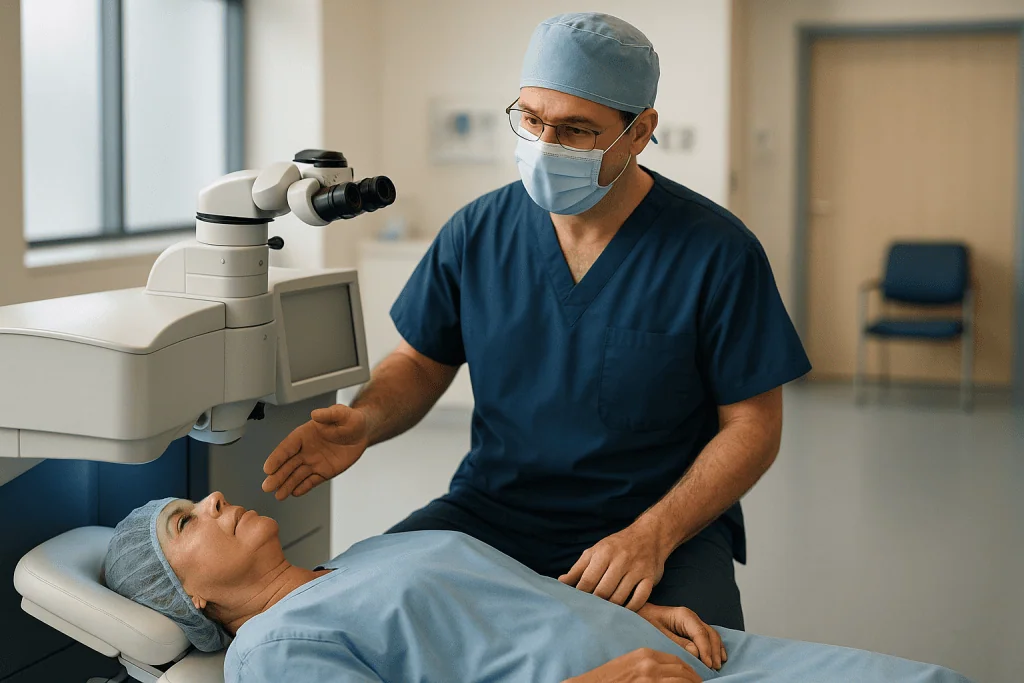
Laser vision correction reshapes the cornea, the clear front window of the eye, so light focuses on the retina without glasses. In LASIK, a thin flap is lifted, tissue beneath is reshaped with an excimer laser, and the flap is laid back without stitches. In surface procedures such as PRK or LASEK, the outer cell layer is removed or moved aside and regrows over several days. Mayo Clinic describes the operation as taking about 30 minutes, with numbing drops and a small device holding the lids open.
Cataract surgery removes the eye’s natural lens once it has clouded and replaces it with a clear artificial lens. A probe breaks the lens up with ultrasound through a cut of a few millimeters, and the new lens unfolds inside the eye. MedlinePlus notes the operation usually takes under an hour and is almost always done under local anesthetic, with the patient awake.
Lens replacement for people who are not candidates for laser surgery uses the same technique as cataract surgery but on a clear lens. Retinal procedures, such as repair of a detached retina or removal of the vitreous gel, are a separate category. Many involve injecting a gas bubble to hold the retina in place, which changes the travel rules completely, as a later section explains.
What links all three is the same aftercare logic: the eye is sealed but fragile, a course of drops controls inflammation and infection risk for a period the surgeon sets, and the first examinations are not optional. The procedure is the fast part. Healing is where the planning pays off.
Are you able to see during eye surgery?
Yes, in a limited and strange way, and knowing this ahead of time takes much of the fear out of the room. For laser and cataract surgery the eye is numbed with drops rather than put to sleep, so it still receives light. What it cannot do is focus normally while the surgeon is working on it.
During LASIK, Mayo Clinic describes a few seconds of dimness or blackout when the suction ring is applied to create the flap, followed by a blurry view of a blinking light that the patient is asked to stare at while the laser works. People often report seeing swirling colors or a soft glow. The eyelids are held open by a small speculum, so blinking is not a worry, and the laser tracks small eye movements rather than depending on perfect stillness.
In cataract surgery, the bright microscope light washes out detail, so most people describe shapes, movement and shifting color rather than instruments. Because the clouded lens is being removed, the view often brightens noticeably midway through. A sedative is sometimes offered for relaxation; general anesthesia is reserved for specific situations the anesthetic team decides on.
For someone having surgery in an unfamiliar place, language is worth raising at this point. The surgeon will give short instructions during the operation: look at the light, look down, keep still. Ask beforehand how those will be given if you and the surgical team do not share a first language, and whether an interpreter or a pre-agreed set of cues will be used. It is a small detail that makes a real difference to how calm the few minutes feel.
Afterwards, vision is typically hazy, watery and light-sensitive for the rest of the day. That is why nobody drives themselves from eye surgery, and why the first night’s accommodation should be arranged before, not after, the operation.
How do I know if I need eye surgery?
You do not decide this alone, and no checklist can replace a dilated examination. The honest answer is that surgery becomes a conversation when a problem stops being manageable with simpler measures, and that judgment belongs to an eye specialist who has measured your eyes.

For cataracts, the NHS frames the decision around function: surgery is usually offered when the clouding affects daily life, such as reading, driving or recognizing faces, rather than at a fixed level of vision. Some people live comfortably with early cataracts for years. Others, particularly those who drive at night and are troubled by glare, reach the threshold sooner.
For laser vision correction, the question is different because glasses and contact lenses already work. The procedure is elective, which means the specialist’s job is to confirm the eye is suitable and the prescription stable, and then to explain trade-offs rather than to recommend. Mayo Clinic lists the factors that weigh against it: a prescription still changing, thin or irregular corneas, significant dry eye, certain autoimmune conditions, pregnancy, and some medicines.
Retinal conditions are the exception where urgency drives the decision. A detached retina is a sight-threatening emergency; the Cleveland Clinic describes it as needing treatment within days, sometimes hours. Nobody plans a trip around that.
What you can do before any consultation, at home or abroad, is gather evidence. A stable prescription over at least a year, recorded by an optician, is the single most useful fact for a laser candidate. For cataracts, a recent note of your corrected visual acuity (the smallest letters you can read on the chart with your best glasses) and any glare testing gives the surgeon a baseline. Bring the measurements; let the specialist interpret them.
Who is usually a candidate, and who is usually asked to wait
Surgeons turn people away or defer them more often than travel brochures suggest, and the reasons are protective rather than bureaucratic. Understanding them before you book flights can save a wasted journey.
For laser correction, Mayo Clinic’s guidance is a useful anchor. Candidates are generally adults whose glasses prescription has been stable for about a year, with healthy corneas of adequate thickness and no active eye disease. People are commonly asked to wait if they are pregnant or breastfeeding, because hormonal shifts alter the cornea and the prescription; if they have uncontrolled dry eye, which laser surgery can worsen; or if corneal mapping suggests an early thinning condition called keratoconus, where removing tissue is unsafe. Contact lens wearers are asked to stop lenses for a period before measurements so the cornea returns to its natural shape, a point that matters when scans are being done in one country and surgery in another.
For cataract surgery, there is rarely a hard “no,” but there are reasons to pause: an uncontrolled infection on the eye surface, very unstable diabetes, or a recent change in another eye condition that needs to settle first. Surgeons also want to know about alpha-blocker medicines, a class used for prostate and blood pressure problems, because they can make the iris floppy during surgery. The medicine is not stopped; the surgeon simply adjusts technique, which is why the medication list belongs in the records you send ahead.
For any eye operation, the person who cannot realistically attend follow-up is the one surgeons worry about most. If your travel plan leaves no room for a return visit should healing stall, expect a careful surgeon to say so. That caution is a sign of a good team, not an obstacle.
Medical records for eye surgery: what to send ahead
Think of the records as answering two questions the overseas team will ask: is this eye suitable, and what will the home team need afterwards? Most of what follows can be requested from your optician, your family doctor and any eye clinic you have attended. Ask for copies early; some practices take weeks.
The core eye documents are your current spectacle or contact lens prescription with the date it was measured, and ideally the two or three before it, so the surgeon can see whether it has drifted. If you have ever had a corneal topography (a map of the cornea’s curvature) or a pachymetry reading (a measurement of corneal thickness), include it. For cataract candidates, any note of visual acuity, glare symptoms and eye pressure readings is valuable. Previous eye surgery reports, including childhood squint operations or laser treatment for retinal problems, change the surgical plan and must be included.
Then the general medical file: a current medicine list with generic names, allergies, and a summary of chronic conditions such as diabetes, autoimmune disease, or clotting disorders. The CDC’s medical tourism guidance recommends carrying this summary with you as well, not just emailing it.
Finally, the practical items that are easy to forget: a recent HbA1c if you have diabetes, since poor control slows corneal healing; a record of any blood-thinning medicines, which the surgeon will want to know about even if nothing changes; and the contact details of the clinician at home who has agreed to see you afterwards.
Send scans or photographs that are legible, label each file with your name and date of birth, and keep an identical set on your phone and in print. The second copy is for the clinician who sees you at home, and for the airport, where an emergency can happen before anyone has your notes.
Pre-travel records and stay planning at a glance
The table below summarizes what surgeons commonly need before each type of operation and the typical in-person checks that anchor how long people stay. The timing column reflects published patient guidance rather than a promise; your own surgeon will set dates based on how your eye looks.
| Procedure | Key records to send ahead | Typical early checks (per cited guidance) | What usually governs leaving |
|---|---|---|---|
| Laser vision correction (LASIK, PRK/LASEK) | Stable prescription history, corneal topography and thickness if available, dry eye history, medicine list | Mayo Clinic: review at 1–2 days; vision stabilizes over 2–3 months | Flap or surface healing confirmed in person; surgeon’s clearance |
| Cataract or clear lens replacement | Visual acuity, eye pressure readings, prior eye surgery reports, diabetes control, alpha-blocker and anticoagulant use | NHS: vision improves within days; full recovery about 4–6 weeks | Pressure and wound checked; drop schedule explained; home follow-up booked |
| Retinal surgery with gas bubble | Full retinal history, imaging, urgency assessment; rarely planned travel | Cleveland Clinic: bubble absorbs over several weeks | No flying or altitude until the bubble is gone, confirmed by examination |
Two patterns stand out. The first is that laser surgery has the shortest fixed anchor, a next-day review, but the longest tail of visual fluctuation, so the person going home should know that haloes and dryness over the following weeks are expected rather than alarming. The second is that cataract surgery’s quieter healing hides a specific early risk, infection inside the eye, which is why most surgeons want to see the eye themselves in the first week and why the handover to a home clinician needs to be concrete.
Use the table to shape questions, not to set your own dates. A surgeon who has examined your eye may want you to stay longer than any typical range, and that advice should win.
How long to stay after eye surgery abroad: what surgeons usually want
Nobody can give a universal number, and anyone who does is selling something. What surgeons want is to personally see the eye at the points where early problems declare themselves. Build your stay around those appointments, with a margin for the unexpected, and the question answers itself.
For LASIK, Mayo Clinic describes a follow-up one to two days after surgery, when the surgeon checks that the flap is smooth and the surface is healing, then further visits over the following months. The first check is the one that realistically must happen where the surgery was done. Surface procedures such as PRK have a longer early phase because the outer cell layer regrows over several days, during which the eye is sore and vision is poor; surgeons often want to see that layer closed before they are comfortable with a patient leaving.
For cataract surgery, the NHS notes that most people can see within a few days and recover fully in about four to six weeks. The checks that matter early are eye pressure, which can spike in the first days, and signs of infection, which typically appear within the first week. Many surgeons ask to see the eye in the first few days and again around the one-week mark. If your home clinician has agreed to do the later check, the stay can be shorter; if not, it cannot.
Build in room for the second eye too. Some surgeons operate on both eyes in one session for laser correction, but for cataracts the eyes are commonly done separately, sometimes weeks apart. Ask whether the plan is one trip or two before anything is booked.
One more variable is the traveler, not the eye. Fatigue, dehydration and a long transit make dry, light-sensitive eyes miserable. Even when the surgeon is satisfied, a day of quiet before a long journey is a kindness to yourself.
Can you fly after eye surgery? The gas bubble rule and dry cabins
Flying after eye surgery is a question with one absolute rule and a lot of nuance, and it helps to separate them.
The absolute rule concerns gas. Some retinal operations leave a bubble of gas inside the eye to press the retina back into place. Gas expands as cabin pressure falls at altitude, and in a closed eye that expansion drives pressure up to levels that can damage the optic nerve within minutes. The Cleveland Clinic is explicit: no flying and no travel to high altitude until the bubble has fully absorbed, which can take several weeks depending on the gas used. Surgeons give patients a wristband or card for exactly this reason, and anesthetists need to know too, because certain anesthetic gases pose the same danger. If you have had retinal surgery, the only person who can clear you to fly is the surgeon who looked inside the eye and confirmed the bubble is gone.
For laser and cataract surgery, there is no gas, and cabin pressure itself is not the issue. The real concerns are more ordinary. Aircraft cabin air is extremely dry, and a freshly lasered cornea or a newly operated eye is already prone to dryness; Mayo Clinic lists dry eyes as one of the most common after-effects of LASIK, often lasting weeks to months. Preservative-free lubricating drops used as your surgeon advises, and avoiding the direct air vent, make a long flight more comfortable. Crowded cabins and shared surfaces also matter in the first week after cataract surgery, when the wound is sealed but the eye is vulnerable to infection, so clean hands and no eye rubbing are the practical priorities.
The single most important thing about flying, though, is not physiological. It is that once you are in the air you have left the surgeon behind. Flying is safe when the eye has been checked, the next appointment exists, and you know what would send you to an emergency department on landing.
Clots, mobility and the long journey home
Eye surgery itself does little to raise the risk of a blood clot; the operation is brief, you are awake, and you walk out. The journey home is a different matter. Long-haul travel is an independent risk factor for deep vein thrombosis, a clot in a leg vein that can travel to the lungs, and the CDC notes that the risk rises with journeys of more than about four hours and climbs further with recent surgery, hormone therapy, pregnancy, obesity, older age and a personal or family history of clots.
The basics are not glamorous and they work. Stand and walk the aisle every two to three hours, as the CDC advises. When seated, flex and extend your ankles and tighten your calf muscles for a minute or two at a time; the muscle pump is what moves blood out of the lower legs. Drink water steadily. Alcohol and sedatives reduce both mobility and the urge to move, which is why they are poor companions on a post-operative flight. Loose clothing at the waist and knees helps circulation, and an aisle seat makes getting up less awkward.
People with a known clotting tendency, or who are already on anticoagulant medicines, should raise travel plans with their own physician before surgery, not after. Whether anything should change around the operation is a decision for that physician and the surgeon together; this is not territory for self-adjustment. Graduated compression stockings are sometimes suggested for higher-risk travelers, and the right fit matters, so ask rather than guess.
Notice what belongs in the post-flight red-flag list alongside eye symptoms: a swollen, warm or painful calf, sudden breathlessness, or chest pain on breathing in. These are not eye complications, but they are the complications of the trip, and they are the ones that cannot wait for a scheduled appointment.
What the first days and weeks usually look like
Recovery has a texture that is easier to tolerate when you know it is coming. The timelines below come from published patient guidance; your own curve may be faster or slower, and only your surgeon can say which side of normal you are on.
After LASIK, Mayo Clinic describes the first hours as itchy, gritty and watery, with blurred vision and light sensitivity that eases over the first day. Many people see noticeably better by the next morning, which is why the next-day check feels so reassuring. Haloes and glare around lights at night are common for weeks, and dryness can persist for months. Vision continues to settle for two to three months, so a slightly changing picture in week three is expected, not a sign something has gone wrong. Rubbing the eye is the one thing to avoid absolutely while the flap seals.
After surface laser procedures, the first three to five days are the hard part: a bandage contact lens, real discomfort, and poor vision until the surface cells regrow. Improvement then comes in steps rather than all at once.
After cataract surgery, the NHS describes grittiness, watering, blurred vision and a red or bloodshot eye in the first days, with vision improving within a few days and full healing taking about four to six weeks. Drops, usually an antibiotic to reduce infection risk and an anti-inflammatory to calm the eye, are used for a period the surgeon specifies; the schedule is theirs to set and yours to follow exactly. The NHS advises avoiding swimming for four to six weeks, keeping soap and shampoo out of the eye, and not driving until a clinician confirms your vision meets the legal standard, which is particularly relevant if you plan to hire a car on return.
The pattern across all three is the same: fast initial gains, then a slow settling that tests patience more than it tests the eye.
Cataract surgery abroad follow-up: arranging care back home before you leave
The handover is where medical travel most often goes wrong, and it is almost entirely preventable with a few conversations held in the right order. The right order is: home clinician first, then surgery.
Before anything is booked, speak to an eye care professional at home, whether that is an optometrist, your family doctor, or an ophthalmology service you already attend, and ask directly whether they will see you for post-operative checks after surgery done elsewhere. Some will; some have policies against it; some will do routine checks but not manage complications. You need to know which, in advance. The CDC’s guidance on medical tourism is unambiguous that follow-up care should be arranged before travel, because arriving home with a problem and no clinician willing to take it on is the scenario that turns a manageable issue into an emergency department visit.
Then ask the operating surgeon for a written discharge summary before you leave, not emailed later. It should state the procedure, the date, the lens power and model implanted if a lens was used, any complications during surgery, the drops prescribed and for how long, and the schedule of checks they expect. A copy of the pre-operative measurements, including the corneal and lens calculations, should travel with it. If the second eye is still to be done, the plan for it belongs on the same page.
Ask how the surgeon can be reached if the home clinician has a question, and whether they will accept a call or secure message from another doctor. Good teams expect this. Store the summary where you can show it on a phone at two in the morning if you need to.
None of this is extra. It is the part of the surgery you are responsible for, and it is the part that protects the result.
What people often get wrong about eye surgery abroad
Myths cluster around this topic because so much of what people read is written to sell a trip. Here are the ones that cause real harm, with what the evidence actually says.
“If I can see fine the next day, I am healed.” Early good vision is common after both laser and cataract surgery and says nothing about the risks that follow. Infection inside the eye after cataract surgery typically appears days after the operation, not hours, and often begins with increasing pain and worsening vision in an eye that had been improving. Mayo Clinic’s LASIK guidance notes that vision continues to change for months. Feeling fine is a reason to keep appointments, not to skip them.
“Flying after eye surgery is dangerous.” For laser and cataract surgery, flying is not the danger; leaving before the surgeon has checked the eye is. The genuine flying prohibition applies to gas bubbles after retinal surgery, where the Cleveland Clinic is explicit that altitude must be avoided until the gas is gone.
“Any optician can do the follow-up.” Routine checks, perhaps. Managing raised pressure, a flap problem or inflammation needs an ophthalmologist, and not every service will take on another surgeon’s patient. Agree this before you travel.
“A video call is a follow-up.” A phone camera cannot see the cornea’s surface, the chamber inside the eye, or the retina. Video is fine for triage. It is not an examination.
“Laser surgery means never needing glasses.” The NHS is careful here: most people achieve good distance vision, but reading glasses still arrive with age because the lens inside the eye stiffens regardless of what was done to the cornea, and some people need a second treatment or still wear glasses for some tasks.
“The surgery is the expensive part, so the follow-up can be cheap.” Whatever the arrangements, the follow-up is where sight is protected. Economize anywhere else.
Questions to ask your care team before you confirm anything
A good consultation, in any country, should leave you able to answer these. If it does not, keep asking.
- Which exact procedure are you recommending for me, and what in my records or scans made you choose it over the alternatives, including no surgery?
- Which records do you still need, and who on your team will confirm they have been received and reviewed before I travel?
- Will the person doing my pre-operative measurements be the surgeon who operates, and will the measurements be repeated on arrival if my scans are more than a few months old or if I wear contact lenses?
- What are the in-person checks after surgery, on which days, and which of them must happen with you rather than with a clinician at home?
- If healing is slower than expected, how many extra days would you want me to stay, and how would that be arranged?
- What written documents will I leave with, and will they include the operation report, lens details, drop schedule and your direct contact for my home clinician?
- Who do I call, at what hours, if something goes wrong after I have flown home, and will you speak to a doctor in my country if needed?
- What are the specific warning signs for this procedure that should send me to an emergency department rather than waiting for a scheduled visit?
- If I need a second eye done, or a second treatment on the same eye, what would that involve, and is it part of the plan we are agreeing now?
- Are there any medicines on my list you would want my own physician to review before surgery, and will you write to them directly rather than through me?
Notice that none of these is about the quality of the surgeon’s hands. That is deliberate. You cannot assess surgical skill in a consultation, but you can assess whether a team takes the before and after as seriously as the operation. A team that welcomes the questions and answers them in writing is telling you something important about how it will behave if a problem arises.
When to call your doctor: red-flag signs after eye surgery
Most recovery symptoms are mild and improve each day. The signs below are different because they can signal infection, dangerously high pressure, a problem with a laser flap or a retinal tear, each of which has a short window in which treatment preserves sight. If any appears, contact your operating team or an eye emergency service the same day, whichever is reachable faster, and show them your discharge summary. Do not wait for a scheduled appointment, and do not board a flight with new symptoms unexamined.
Seek care urgently for increasing pain rather than easing pain, especially pain with nausea or vomiting, which can indicate raised eye pressure; for vision that was improving and then worsens, or becomes suddenly blurred, dim or foggy; for a red eye that deepens rather than fades, particularly with a sticky or pus-like discharge; for marked new light sensitivity in an eye that had been settling; or for any injury, bump or hard rub to a laser-treated eye, since the flap can shift. After any eye surgery, the Mayo Clinic and Cleveland Clinic both describe the warning signs of a retinal detachment: a sudden shower of new floaters, flashes of light, or a shadow or curtain moving across part of your vision. These are emergencies at any time, abroad or at home.
Add the travel-related signs: a swollen, warm or painful calf, sudden breathlessness, or chest pain on breathing, which can mean a blood clot and need emergency care regardless of the eye.
Finally, call even when you are unsure. The clinicians who treat eye complications would far rather examine a normal eye than hear about an abnormal one a week late. Your treating team owns every decision about what happens next; your job is to make sure they hear about it in time.
Frequently asked questions
Can you fly after eye surgery?
It depends on the operation and on whether the surgeon has examined the eye since. After laser or cataract surgery there is no gas inside the eye, so cabin pressure is not the concern; dryness, infection precautions and leaving before your first checks are. After retinal surgery with a gas bubble, flying is prohibited until the bubble has fully absorbed, which Cleveland Clinic guidance says can take several weeks. Only your surgeon can clear you.
How much does LASIK eye surgery cost in Europe?
This article deliberately does not quote prices, because a headline figure tells you nothing about what matters clinically: whether pre-operative scans are repeated, how many in-person checks are included, what happens if an enhancement is needed, and who manages complications after you fly home. Ask any provider to put those items in writing. The treating team, not the figure, determines how safe the plan is.
What medical records should I send ahead for eye surgery abroad?
Send your current and previous glasses or contact lens prescriptions with dates, any corneal mapping or thickness measurements, visual acuity and eye pressure readings, reports of any previous eye surgery, a current medicine list with generic names, allergies, and a summary of chronic conditions such as diabetes or clotting disorders. The CDC recommends carrying the same documents with you in print and on your phone.
How long should I stay abroad after cataract surgery?
Long enough for the surgeon to check the eye personally in the first days, when pressure spikes and early infection declare themselves, and ideally around the one-week mark unless a clinician at home has agreed in advance to do that check. The NHS describes full recovery taking about four to six weeks, but that later phase can be monitored at home if the handover is arranged. Your surgeon sets the date.
Are you able to see during eye surgery?
Partly. Laser and cataract surgery are done with numbing drops rather than general anesthesia, so the eye still senses light but cannot focus while the surgeon works. Mayo Clinic describes a brief dimming when suction is applied during LASIK, then a blurry blinking light to stare at. During cataract surgery most people see bright light, colors and movement rather than instruments, and the view often brightens as the cloudy lens is removed.
How do I know if I need eye surgery?
You cannot know from symptoms alone; the decision needs a dilated examination by an eye specialist. The NHS frames cataract surgery around whether clouding interferes with daily life rather than a fixed vision level. Laser correction is elective, so suitability depends on a stable prescription and healthy corneas, which Mayo Clinic lists as key factors. Sudden flashes, floaters or a shadow in vision are emergencies needing same-day assessment.
Can my optometrist at home do the follow-up after lasik surgery abroad?
Sometimes for routine checks, but not always, and not for complications, which need an ophthalmologist. Policies vary widely and some services decline to take on another surgeon’s post-operative care. The CDC’s medical tourism guidance recommends confirming home follow-up before travelling. Ask directly, get a yes in writing, and make sure the operating surgeon provides a discharge summary your home clinician can work from.
Why can't you fly with a gas bubble in your eye?
Gas expands as the surrounding pressure falls, and an aircraft cabin at cruising altitude is pressurised to the equivalent of a mountain, not sea level. Inside a closed eye, that expansion pushes eye pressure sharply upward, which can starve the optic nerve of blood within minutes. The Cleveland Clinic advises avoiding flights and high altitude until the surgeon confirms the bubble has absorbed, which can take several weeks.
What should I do on a long flight home after eye surgery?
Protect the eye and protect your legs. Keep hands clean, avoid rubbing, close the overhead vent and use the lubricating drops your surgeon advised, since Mayo Clinic notes dry eye is a common after-effect. For clot prevention, the CDC recommends walking every two to three hours, flexing your ankles while seated and drinking water, with alcohol and sedatives best avoided. Carry your discharge summary in your hand luggage.
What are the warning signs after eye surgery that need urgent care?
Increasing pain, especially with nausea, vision that worsens after improving, a deepening red eye or sticky discharge, marked new light sensitivity, or a blow or rub to a laser-treated eye. A sudden burst of floaters, flashes of light or a curtain across your vision can signal retinal detachment and are emergencies, as Mayo Clinic and Cleveland Clinic describe. Contact your surgeon or an eye emergency service the same day.
References
- NHS: Laser eye surgery and lens surgery
- NHS: Cataract surgery, recovery
- CDC: Blood clots and travel
- Cleveland Clinic: Retinal detachment
This article is for general information only and is not a substitute for professional medical advice. Please consult a qualified doctor about your individual situation.

More from the Blog

Monofocal, Multifocal, Toric and EDOF Intraocular Lenses: What Each Design Changes
Intraocular lens types differ in how they handle focus. A monofocal lens gives one sharp distance, usually far, with glasses for near tasks. A…

Which Swelling Is Normal After Oculoplastic Surgery and Which Changes Need a Same-Day Call
After eyelid surgery, soft puffiness, bruising that spreads and changes color, mild tightness, and blurry vision from ointment are expected and usually ease over…

Flying After Vitrectomy: Why a Gas Bubble Grounds You and How Long Patients Stay Nearby
Flying after vitrectomy is usually unsafe while a gas bubble remains in the eye, because lower cabin pressure lets the bubble expand and can…

Steroids, Antihistamines and Glaucoma: Which Everyday Medicines Your Eye Doctor Asks About
Several everyday medicines can raise eye pressure or narrow the eye's drainage angle, which matters most for people with glaucoma or anatomically narrow angles.…

Reading Your Eye Examination Report: Refraction Numbers, Pressure and Retinal Images
An eye examination report usually has three parts. Refraction numbers (SPH, CYL, AXIS, ADD) describe how strongly light must be bent to focus on…

What Strabismus Treatment Can Achieve: Alignment, Depth Perception and Why Some Need More
Strabismus treatment can usually straighten misaligned eyes, ease double vision and support the two eyes working together, but results vary from person to person.…