

Preparing for a Contact Lens Fitting: Prescriptions to Bring and What to Tell Your Doctor
Key Takeaways
- A contact lens prescription includes base curve, diameter, material and brand, which a glasses prescription cannot supply, so a fitting is required even when your glasses numbers are current.
- Lens power often differs from glasses power because a contact sits on the tear film rather than about 12 millimeters in front of the eye, and the gap widens with stronger prescriptions.
- Dilation is part of a comprehensive eye exam, not a standard contact lens fitting, so bring sunglasses and a driver only if the clinic tells you the two are being combined.
- The CDC links sleeping in lenses to a six- to eight-fold increase in the risk of serious eye infection, which is why your examiner asks bluntly about naps.
- The so-called 3:1:1 and 4 to 1 rules are not recognized clinical terms; the evidence-backed rules are your written replacement schedule, no water contact and no overnight wear.
- Trial lenses and a follow-up visit are where the fit is actually decided, so keep a daily note of wearing hours, comfort and vision changes to bring back.
Preparing for a contact lens fitting means bringing your current glasses, any previous contact lens prescription or boxes, a list of medicines and eye drops you use, and honest notes on dry eye, allergies, screen hours and sleep habits. Expect eye measurements, trial lenses and a follow-up visit; dilation is usually not needed. Final lens choices rest with your eye care professional.
The night before her appointment, Maya lines things up on the kitchen counter the way other people pack for a trip: her glasses, an old lens box she found in a drawer, a photo of a prescription her sister once texted her, and a sticky note that says “ask about swimming.” She is not sure which of these matter. She has worn glasses since fourth grade and has never once put a finger near her eye on purpose.
That mix of readiness and mild dread is common. Preparing for contact lens fitting is less about paperwork than most people assume and more about giving the examiner an accurate picture of your eyes, your days and your habits. The counter full of items helps, but the sticky note helps more.
What follows is what actually happens in the chair, what to carry in, what to say out loud, and which decisions belong to you and which belong to the person measuring your cornea.
What actually happens when you are preparing for contact lens fitting
A contact lens fitting is a separate assessment from a routine eye exam, and it is built around one question: which lens material, shape and size will sit on this particular cornea comfortably and safely? The cornea is the clear dome at the front of the eye that a contact lens rests on, and no two have quite the same curve.
The visit usually starts with the same refraction you know from glasses, the “which is clearer, one or two?” sequence that measures your focusing error. Then the examiner moves to measurements that glasses never required. A keratometer or corneal topographer, instruments that map the curvature of the front of the eye, give the numbers that decide base curve and diameter, two terms explained later. A quick look at tear film quality and lid health follows, often with a yellow dye called fluorescein under blue light, because a lens on a dry or irritated surface tends to fail regardless of how good the prescription is.
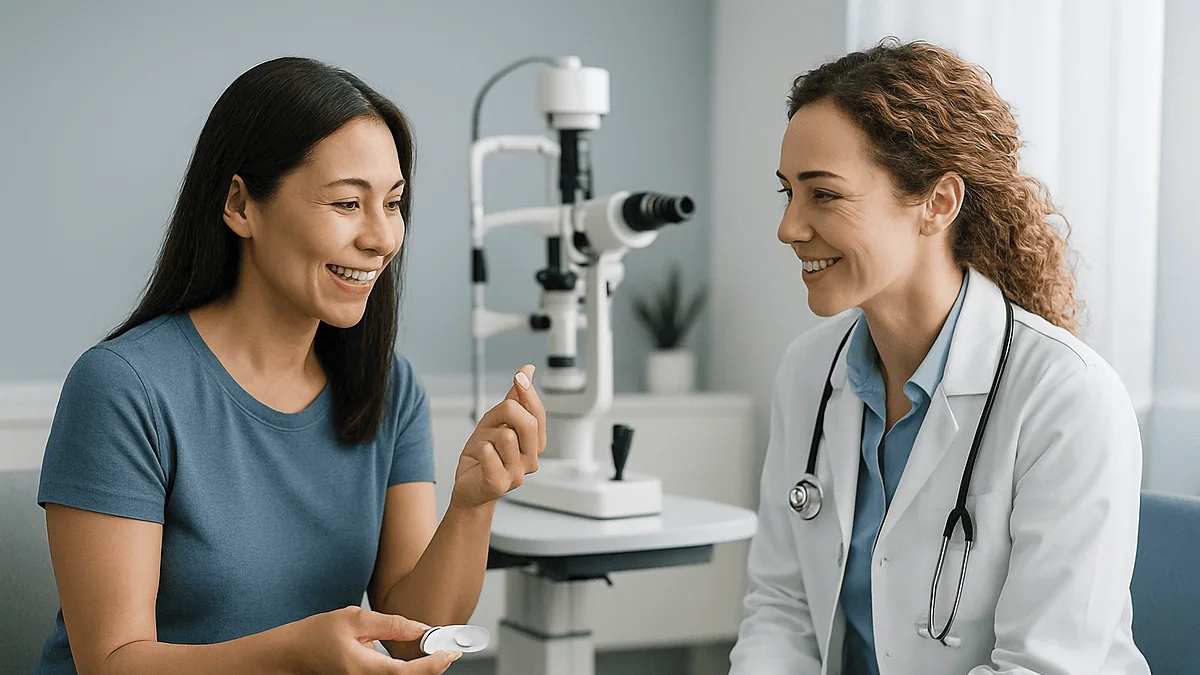
Next come trial lenses. You sit with them for a stretch while the examiner checks movement, centering and vision through a slit lamp, the upright microscope you lean your chin into. A lens that slides too freely or hugs too tightly is swapped. Before you leave, you learn insertion, removal and cleaning, and you practice until you can do both on your own.
Nothing about this is painful. The most physically awkward moment for most first-time wearers is the first touch of a fingertip to the eye, and that passes faster than anyone expects. Mayo Clinic’s overview of a comprehensive eye exam describes the standard instruments you will meet, and the contact lens portion simply adds measurements and a trial on top.
Why a contact lens prescription is different from a glasses prescription
People often arrive with a glasses prescription and assume it can be copied straight onto a lens order. It cannot, and understanding why makes the whole visit make sense.

Glasses sit roughly 12 millimeters in front of the eye; a contact lens sits directly on the tear film. That distance changes the effective power, and the difference grows with stronger prescriptions. Someone with a mild correction may see almost the same number on both; someone with a high degree of nearsightedness or farsightedness will see a noticeably different figure on the lens box. Nearsightedness (myopia) means distant objects blur, farsightedness (hyperopia) means close objects blur, and astigmatism means the eye focuses unevenly because the cornea is shaped more like a spoon than a ball. MedlinePlus groups these together as refractive errors, the term for any focusing fault the eye cannot correct on its own.
A contact lens prescription also carries data that glasses never need: base curve (how steeply the lens is curved to match your cornea), diameter (how wide the lens is), the specific material and brand that were trialed, and a replacement schedule. Because a lens is a medical device that touches the eye, the prescription is tied to the exact product that was fitted, not just to a set of powers.
This is why a fitting cannot be skipped even when your glasses numbers are current, and why switching to a different lens type later usually means being refitted rather than simply reordering. It also explains why the finished prescription comes with an expiry date, which varies by state and by the judgment of the prescriber, and why renewing it involves another look at the eye surface rather than a phone call.
What to bring to a contact lens fitting: prescriptions and records
Think of this as giving the examiner your eyes’ back story. Everything on the list below saves a measurement, a guess or a repeated question.
- Your current glasses, even if you dislike them. The prescription can be read directly off the lenses with a lensmeter, and the examiner can compare that reading with what you report seeing.
- The most recent glasses prescription on paper or on your phone, dated, so the examiner can judge how fast your vision has been changing.
- Any previous contact lens prescription, box or foil wrapper. Boxes carry the brand, material, base curve and diameter, which tells the examiner what already fit well or poorly on your cornea.
- The lenses themselves, if you still wear them, in their case. Ask the clinic beforehand whether to arrive wearing them or leave them out; many clinics request a lens-free period before measurement because lenses can temporarily reshape the corneal surface and distort readings.
- A written list of medicines, eye drops and supplements, including over-the-counter antihistamines and anything for acne, mood, blood pressure or hormones. Several of these reduce tear production, which matters more for contacts than for glasses.
- Insurance or vision plan details, since fittings are frequently billed separately from a routine exam.
- Sunglasses and a driver, in the uncommon event dilation is added to the same visit.
One small thing people forget: notes from earlier eye problems. A past corneal scratch, a stye that kept returning, a lazy eye treated in childhood, a laser procedure, all belong in the conversation. A photo of an old discharge summary is enough. The point is not to overwhelm anyone with paper but to make sure no relevant fact depends on your memory under bright lights.
What to tell your doctor: the health history that changes the fitting
The measurements are objective. Your history is not, and it often decides more than the numbers do.

Start with how your eyes feel on an ordinary day. Scratchiness by evening, redness after air travel, watering in wind, a gritty sensation on waking: each hints at dry eye, which the NHS describes as the tear film either producing too little fluid or evaporating too quickly. Dry eye does not rule out contacts, but it changes which material and schedule make sense, so mention it even if it seems minor.
Then describe your days. Hours in front of screens, because blinking slows during concentrated screen use. Air conditioning, dusty workplaces, long drives, night shifts. Whether you want lenses for every waking hour or only for sport, weekends or evenings out. Someone who plans to wear lenses twice a week is a different patient from someone who wants them from alarm to bedtime.
Be candid about sleep and water. Say whether you are likely to nap in lenses, and whether you swim, surf or use hot tubs. The CDC reports that sleeping in contact lenses raises the risk of a serious eye infection by six to eight times, and that water exposure carries its own infection risk. The examiner is not there to scold; they are there to choose a lens and a schedule that fits the life you actually live.
General health counts too. Diabetes, thyroid disease, autoimmune conditions such as rheumatoid arthritis, pregnancy, hormonal changes, seasonal allergies and any skin condition around the eyelids can all affect the ocular surface. So can prior eye surgery, including laser refractive procedures.
Finally, say what worries you. Fear of touching the eye, a bad experience years ago, a relative who had an infection: these shape how much time is spent on training, and that time is well spent.
Who contact lenses usually suit, and who is usually asked to wait
Most people with a refractive error can wear some form of contact lens, and the range of designs has widened considerably. Soft lenses correct nearsightedness, farsightedness and astigmatism; multifocal designs handle the age-related loss of near focus called presbyopia; and rigid gas permeable lenses, firm lenses that hold their own shape and let oxygen pass through, serve people whose corneas are irregular.
A fitting is particularly useful for anyone whose glasses limit them: athletes, people whose glasses fog or slip, those with strong prescriptions who dislike thick edges, and people with a large difference between the two eyes, where glasses can create mismatched image sizes that contacts avoid.
Some people are usually asked to wait, and the reasons are practical rather than permanent:
- An active eye infection, a healing corneal scratch or recent eye surgery, until the surface has recovered and the surgeon or examiner agrees.
- Uncontrolled dry eye or blepharitis, inflammation of the eyelid margins, which is often managed first so a lens has a healthier surface to sit on.
- Severe seasonal allergy during its peak, when swollen, itchy eyes make assessment and comfort unreliable.
- Prescriptions that are still changing quickly, where a fitting may be delayed or kept to short-cycle lenses.
Age by itself is rarely a barrier. Children and teenagers can be fitted when they, and a parent, can manage hygiene reliably; the deciding factor is maturity and routine, not a birthday. Older adults with steady hands and no severe dry eye do well, though the loss of near focus usually means a conversation about multifocal lenses or reading glasses over contacts.
None of these groups is being told no. They are being told “not yet” or “not this type,” and the judgment belongs to the examiner who has seen the surface of the eye up close.
How long does a contact lens fitting take, and do they dilate your eyes?
Plan for the fitting to take longer than a glasses check. The core assessment, measurements and trial lens evaluation often run around an hour, and first-time wearers should expect extra time for insertion and removal training until they can do both unaided. Clinics vary, and a complex fit for astigmatism, presbyopia or an irregular cornea can take longer or need an additional appointment, so ask when you book rather than assuming.
Dilation, the use of drops that widen the pupil so the examiner can see the retina at the back of the eye, is not part of a standard contact lens fitting. It belongs to the comprehensive eye exam, which Mayo Clinic describes as including a dilated retinal check, and most clinics keep that separate because the fitting needs you to see clearly through trial lenses and judge comfort. Dilating drops blur near vision and make light uncomfortable for several hours, which would make lens evaluation unreliable.
The two visits are sometimes combined when a full exam is also due. If so, the fitting portion is usually done before the drops go in. Ask ahead so you can bring sunglasses and arrange not to drive if dilation is planned.
What you will have during the fitting are brief, harmless additions: fluorescein dye to highlight the tear film, sometimes a drop of numbing anesthetic if pressure is being checked, and bright lights at close range. The dye can tint the edge of your eyelids yellow for a short while and may stain a contact lens, which is one reason you may be asked not to wear your own lenses in.
The follow-up visit, usually scheduled a week or two after you take trial lenses home, is shorter: a look at the eye surface, a check of vision and lens fit, and a decision about whether the prescription is finalized.
What is the 3:1:1 rule for contacts, and what is the 4 to 1 rule?
Both phrases turn up in search boxes, and both deserve an honest answer: neither is a recognized term in mainstream eye care guidance from the CDC, the NHS, Mayo Clinic or Cleveland Clinic. They appear to be shorthand that circulates on social platforms and in casual advice, sometimes meaning different things to different people, which is exactly why they are worth untangling.
Some people use “3:1:1” to summarize a wearing routine (for example, days worn, days rested, and a lens-free day each week) and others use it for case hygiene. The “4 to 1” phrase sometimes refers to a hand-washing or rinsing habit and sometimes to a rough comparison of glasses hours against lens hours. Because the definitions shift, none of them should be treated as a clinical rule, and your examiner may never have heard the labels at all.
What the evidence does support is simpler and better established:
- Replace lenses on the schedule your prescriber sets. The schedule is specific to the material you were fitted with.
- Do not sleep in lenses unless they were specifically prescribed for overnight wear. The CDC links overnight wear to a six- to eight-fold rise in infection risk.
- Keep water away from lenses and cases: no showering, swimming or rinsing with tap water.
- Rub and rinse reusable lenses with fresh solution, never top up old solution, and replace the case regularly.
- Take lenses out at the first sign of redness, pain or blurred vision.
The real “rule,” if there is one, is that the written instructions on your prescription are tailored to your eyes and your lens, and a memorable ratio from the internet is not. If a friend swears by one of these shorthand rules, bring it to the fitting and ask whether anything in it conflicts with your plan.
Contact lens types compared: what the fitting is choosing between
Knowing the main categories helps you follow the examiner’s reasoning and ask sharper questions. This is a neutral comparison of design families, not of products, and the right choice depends on your cornea, your prescription and how you plan to wear lenses.
| Lens type | What it is | Typically considered for | Trade-offs to discuss |
|---|---|---|---|
| Soft daily disposable | Thin, flexible lens discarded after one wearing | Occasional wearers, allergy sufferers, first-time users, people who dislike cleaning | Higher ongoing waste; fewer parameter options for unusual prescriptions |
| Soft reusable (two-week or monthly) | Flexible lens cleaned nightly and replaced on a set cycle | Daily wearers wanting a wider range of powers and designs | Requires strict cleaning; deposits and hygiene lapses raise infection risk |
| Soft toric | Soft lens with a stabilized shape to correct astigmatism | Moderate to higher astigmatism | Can rotate and blur briefly on blinking; fit takes more trial |
| Soft multifocal | Lens with zones for near and distance focus | Presbyopia, usually from the mid-40s onward | Some compromise in sharpness at one distance; adaptation period |
| Rigid gas permeable (RGP) | Firm lens that holds its shape and transmits oxygen | Irregular corneas such as keratoconus, high astigmatism, some dry-eye cases | Longer adaptation; initial awareness of the lens on the eye |
| Scleral | Large rigid lens that vaults the cornea and rests on the white of the eye | Severe irregularity or surface disease, specialist fitting | Specialist handling and cleaning; fitting takes several visits |
Keratoconus, mentioned in the table, is a condition in which the cornea thins and bulges into a cone shape, and it is one of the more common reasons a fitting shifts from soft to rigid designs. Oxygen transmission matters across every row: the cornea has no blood vessels and takes its oxygen from the air through the tear film, so a lens that starves it for long hours produces redness and, over time, new blood vessels growing toward the center. That single fact drives much of the examiner’s advice about wearing hours.
Preparing for contact lens fitting on the day: how to arrive
Small choices on the morning of the visit make the measurements cleaner and the trial more comfortable.
Arrive with clean, unmade-up eyes if you can, or at least without mascara and eyeliner. Makeup particles end up on trial lenses and under the lids, and the fluorescein dye will stain whatever is already there. Skip heavy moisturizer or oil-based products around the eyes for the same reason.
Follow the clinic’s instruction about existing lenses. If you were told to leave them out beforehand, do it; a soft lens worn into the appointment can flatten the cornea slightly for a time, and a rigid lens can do so more, which shifts the curvature readings the whole fit is built on. Wear your glasses instead and bring the lenses and case with you.
Wash your hands before you walk in and again before any training. Ask whether the clinic prefers you trim long nails; a sharp edge is the most common cause of a scratched cornea during early lens handling.
Eat normally and take your usual medicines unless the clinic specifically says otherwise. Do not stop any eye drops on your own, including drops for glaucoma, a group of conditions involving pressure-related damage to the optic nerve; tell the examiner what you use and let them decide whether anything about your routine affects the plan.
Bring something to occupy a wait, because trial lenses often need to settle for a period before the examiner reassesses them. Bring your sticky note too, the one with the questions you keep forgetting. And if you know you tend to flinch, say so at the start; examiners have a repertoire of techniques for anxious first-timers, from a slower pace to a mirror and a lot of patience.
Trial lenses and the first week: what the following days usually look like
You will likely leave with trial lenses rather than a final prescription. The gap between the first visit and the follow-up is where the real fitting happens, because an eye reacts to a lens over days, not minutes.
The first day or two often bring heightened awareness of the lens, mild watering and a tendency to blink more. This usually fades as the lid learns to glide over the edge. Soft lenses tend to feel comfortable quickly; rigid lenses take longer, and an examiner may suggest a gradual build-up of wearing hours so the cornea and lids adapt. Follow the wearing-time plan you were given rather than inventing your own.
Keep a simple log. Note the hours worn, how the eyes felt at the end of the day, any redness, and whether vision fluctuated after blinking or on screens. These observations are more useful at the follow-up than a vague “it was fine.” A toric lens that rotates, a multifocal that is sharp at distance but soft up close, a lens that dries by mid-afternoon: each has a fix, but only if the examiner hears about it.
Practice insertion and removal at home in daylight, over a clean surface, with the plug in the sink. Fumbling is normal in week one. What is not normal is pain, a sensation of something trapped under the lid that does not clear when the lens is removed, or vision that stays blurred after the lens comes out; those belong to the red-flag section below.
At the follow-up, the examiner rechecks the surface with dye, confirms the fit under the slit lamp and either finalizes the prescription or trials a different design. Two or three rounds are not unusual for astigmatism or presbyopia. Only then does the prescription become final, and in the United States you are entitled to a copy of it once the fitting is complete.
Reading your contact lens prescription: what the numbers mean
The finished prescription looks like a short line of code. Decoding it lets you check that a reorder matches what was fitted and helps you understand why a change at the next visit matters.
- Power (sphere): the focusing correction, written in diopters, the unit of lens strength. A minus sign means correction for nearsightedness; plus means farsightedness.
- Cylinder and axis: present only on toric lenses for astigmatism. Cylinder is the extra correction for the uneven focus; axis, in degrees from 0 to 180, is the direction it is applied.
- Add: on multifocal lenses, the extra near-focus strength.
- Base curve (BC): the curvature of the back of the lens in millimeters, chosen to match your cornea. A lens that is too flat slides; one that is too steep clings.
- Diameter (DIA): the width of the lens in millimeters.
- Brand and material: the specific product trialed on your eye. Material affects oxygen flow and water content, which is why a substitute is not equivalent even at the same power.
- Replacement schedule and wearing time: daily, two-week, monthly; and whether overnight wear is permitted (for most lenses, it is not).
- Expiry date: after which the prescription cannot be refilled without a new assessment.
A detail worth checking: the right and left eyes are often different, including in base curve, and a reorder that swaps them is a frequent source of discomfort. The power may also differ from your glasses for the reason described earlier, so do not be alarmed when the two documents disagree.
If anything on the sheet is unclear, ask before you leave. The examiner would rather spend two minutes explaining axis than see you back with a lens that was ordered wrong.
What people often get wrong about contact lens fittings
Myths around contacts are durable, partly because they sound reasonable. Here are the ones that most often shape a first visit, and what the evidence actually shows.
“My glasses prescription is enough.” It is the starting point, not the prescription. Lens power shifts with distance from the eye, and base curve, diameter and material come only from a fitting.
“A lens can get lost behind my eye.” The conjunctiva, the thin membrane that lines the lids and covers the white of the eye, forms a closed pocket. A lens can fold under the upper lid, which is uncomfortable but retrievable; it cannot travel behind the eye.
“Contacts are bad for my eyes.” Worn and cleaned as prescribed, they are a safe option for the roughly 45 million people in the United States the CDC estimates use them. The harm comes from habits, not from the lens: overnight wear, water exposure and stretched replacement cycles are the behaviors tied to serious infection in CDC data.
“If it feels fine, it fits fine.” Comfort and fit are different. A lens that is slightly too tight can feel wonderful on day one and starve the cornea of oxygen by day thirty. This is the whole reason for the follow-up visit.
“Dilation is always part of it.” As covered above, it is part of a comprehensive exam, not of a routine fitting.
“Dry eye means contacts are off the table.” Often it means a different material, a daily disposable or treating the surface first, decided case by case.
“Once fitted, I can switch to any similar lens.” A different brand at the same power is a different device on your cornea. Changing designs usually means a refit, which is why the examiner notes the exact product.
Each of these corrections is less a reprimand than an invitation to ask. The best fittings are conversations.
Questions to ask your care team before you leave
A fitting moves quickly, and the questions that matter most tend to surface in the parking lot. Having them written down changes that. Choose the ones that fit your situation.
- Which lens type did you choose for me, and what about my cornea, tear film or prescription led you there?
- Did you see anything on the surface of my eyes, such as dryness or lid inflammation, that I should know about or manage?
- How many hours a day is reasonable to wear these lenses, and should I build up gradually?
- What is the replacement schedule, and what happens to risk if I stretch it?
- Are these lenses ever appropriate for napping or sleeping? If not, what should I do if I fall asleep in them by accident?
- Which solution type is compatible with this material, and how do I rub, rinse and store it correctly?
- What should I do about swimming, showering and hot tubs?
- How will I know if the fit is wrong rather than just new?
- What are the signs that mean I should take the lenses out and call you the same day?
- When is the follow-up, and what should I track between now and then?
- Will I receive a copy of my final prescription, and when does it expire?
- If my eyes change, or I want multifocals later, do I need a full refit?
- Should I keep an up-to-date pair of glasses as backup, and how current does that prescription need to be?
Two questions are worth asking even if you think you know the answer. The first is about any eye drops you already use, prescription or not, and whether they can be instilled with lenses in or need a gap; the examiner decides, not the label. The second is how to reach the clinic after hours, because the moment you most need advice is rarely during business hours. Write the answer on the same sticky note.
When to call your doctor: red-flag signs during and after a fitting
Most early discomfort is adaptation. A short list of symptoms is not, and the sensible response to any of them is the same: take the lenses out, do not put them back in, and contact your eye care professional the same day, or go to urgent or emergency care if the clinic is closed.
- Eye pain that does not settle within minutes of removing the lens, or that wakes you.
- A red eye that is getting redder, especially in one eye only.
- Sensitivity to light that makes you want to keep the eye closed.
- Blurred or reduced vision that persists with the lens out and glasses on.
- A white or gray spot on the colored part of the eye, or a feeling that something is stuck that does not clear after removal and gentle rinsing with sterile solution.
- Discharge, crusting or swelling of the lids.
- Any of the above after the lens was exposed to water, worn overnight or kept past its replacement date; tell the clinic about the exposure, because it changes what they look for.
The condition everyone is trying to avoid is microbial keratitis, an infection of the cornea. The CDC describes it as uncommon but potentially sight-threatening, with the highest risk tied to overnight wear and water contact. Early assessment matters because the cornea is thin and infection can progress quickly. Bring the lens, the case and the solution bottle with you if asked; they can be cultured to identify the organism.
Less urgent but still worth a call: lenses that feel fine in the morning and intolerable by afternoon every day, vision that swings with each blink, persistent itching that suggests allergy, or an inability to insert or remove the lens after a fair effort at home. None of these is an emergency, and all of them are fixable, but they are not things to push through quietly until the follow-up. The decision about whether to adjust, pause or refit always sits with your examiner, and they would rather hear from you early.
Frequently asked questions
How long does a contact lens fitting take?
Expect roughly an hour for the core fitting, with extra time for first-time wearers to learn insertion and removal, and plan for a shorter follow-up a week or two later. Complex fits for astigmatism, presbyopia or an irregular cornea can need more visits. Clinics differ, so ask when you book rather than assuming the timing of a routine glasses check.
Do they dilate your eyes for a contact fitting?
Usually not. Dilating drops widen the pupil so the examiner can inspect the retina, which is part of a comprehensive eye exam rather than a lens fitting, and the blur they cause would interfere with judging trial lenses. If a full exam is combined with the fitting, the fitting is typically done first. Ask ahead so you can arrange a driver if needed.
What is the 3:1:1 rule for contacts?
It is not a recognized clinical guideline, and people use it to mean different things, from wearing-day patterns to case-cleaning habits. The rules that matter are the ones on your prescription: the replacement schedule for your specific lens, no overnight wear unless prescribed, and no contact with water. If a version of this rule appeals to you, ask your examiner whether it conflicts with your plan.
What is the 4 to 1 rule for contact lenses?
Like the 3:1:1 phrase, it has no standard definition in mainstream eye care guidance and circulates informally, sometimes as a hand-hygiene habit and sometimes as a glasses-to-lens hours ratio. Treat it as a reminder rather than a rule. Your written wearing time, cleaning method and replacement cycle are tailored to your lens material and your eyes, and they take precedence.
What should I bring to a contact lens fitting?
Bring your current glasses, your most recent glasses prescription, any previous contact lens prescription or lens box, the lenses you currently wear in their case, a written list of medicines and eye drops, and your insurance details. Add notes on past eye problems or surgery. Ask the clinic beforehand whether to arrive wearing existing lenses or leave them out.
Is a contact lens fitting the same as an eye exam?
No. A comprehensive eye exam checks vision, eye pressure and the health of the inside of the eye, often with dilation. A contact lens fitting adds corneal curvature measurements, tear film assessment, trial lenses and handling training, and produces a separate prescription. The two can be done on the same day, but they are distinct services and are often billed separately.
Can I use my glasses prescription to order contact lenses?
No. A glasses prescription lacks base curve, diameter and material, and its power is often different because a lens sits directly on the eye rather than in front of it. Ordering lenses from glasses numbers risks a poor fit that can feel fine at first and harm the cornea over weeks. A fitting with trial lenses is the only way to get those parameters.
Should I stop wearing my old contacts before the fitting?
Often yes, but follow your clinic’s instruction. Soft and especially rigid lenses can temporarily flatten the cornea, which distorts the curvature readings the fit depends on. Many clinics ask for a lens-free period and request that you arrive in glasses with your lenses and case in hand. Do not stop any prescribed eye drops on your own; mention them instead.
Why does my contact lens prescription expire?
Because a contact lens is a medical device resting on living tissue, and the surface of the eye can change with age, health, medicines and wear habits. The expiry date, set by state rules and the prescriber’s judgment, ensures the cornea and tear film are rechecked before more lenses are ordered. Renewal involves another look at the eye rather than a simple refill.
What if I cannot put the lens in at the fitting?
It is common and not a sign you are unsuited to contacts. Examiners expect fumbling and will slow down, use a mirror, change technique or schedule a second training session. Most people manage insertion and removal within a few tries once the reflex to blink settles. If you remain unable after a fair effort at home, call the clinic rather than giving up or forcing it.
References
This article is for general information only and is not a substitute for professional medical advice. Please consult a qualified doctor about your individual situation.

More from the Blog

What Glaucoma Surgery Can and Cannot Do: Protecting the Vision You Still Have
Glaucoma surgery lowers pressure inside the eye to slow or stop further damage to the optic nerve. It cannot restore vision already lost, because…
Intraocular Lens Recovery: Eye Drops, Lifting Limits and When Vision Settles
Most people recover from intraocular lens (IOL) surgery over about 4 to 8 weeks, according to the NHS and Mayo Clinic, though everyday vision…

Local or General Anesthesia for Vitrectomy: What You Feel and How the Choice Is Made
Most vitrectomies in adults are performed under local anesthesia: numbing injections around the eye, usually combined with light intravenous sedation, so you are relaxed,…
Helping a Child Stick With Eye Patching: Practical Support for Amblyopia Treatment
Helping a child with an eye patch for amblyopia works best when patching becomes a predictable, short, engaging routine: same time daily, paired with…
PRK for Athletes, Pilots and Contact-Sport Players: Why No Flap Can Matter
PRK is a laser vision correction method that reshapes the cornea after removing its surface layer, rather than cutting a hinged flap as LASIK…
What the Femtosecond Laser Changes in Femto LASIK Compared With a Blade
In Femto LASIK, a femtosecond laser replaces the mechanical blade (microkeratome) used to create the thin corneal flap that begins LASIK. The laser fires…