

What the Femtosecond Laser Changes in Femto LASIK Compared With a Blade
Key Takeaways
- A femtosecond laser makes the LASIK flap by forming a plane of microscopic bubbles at a programmed depth; it does not correct vision, which is done by a separate excimer laser in both femto and blade LASIK.
- The laser's measurable advantage is a flap of more predictable, uniform thickness with fewer mechanical complications such as buttonholes and free caps; final visual sharpness is similar between methods in most comparative studies.
- Femtosecond-specific side effects include a temporary opaque bubble layer, transient light sensitivity days after surgery and faint rainbow glare, most of which resolve.
- Dry eye and night glare are shared risks of both flap methods because both cut corneal nerves; NHS guidance describes dry eye as usually temporary but capable of lasting months.
- LASIK does not prevent the mid-life need for reading glasses or later cataract, and a treated cornea makes cataract-surgery calculations more complex, so pre-operative records should be kept for life.
- Suitability rests on corneal thickness and shape, a stable prescription, adult age and healthy tear film; these screening results matter more than the choice of flap tool.
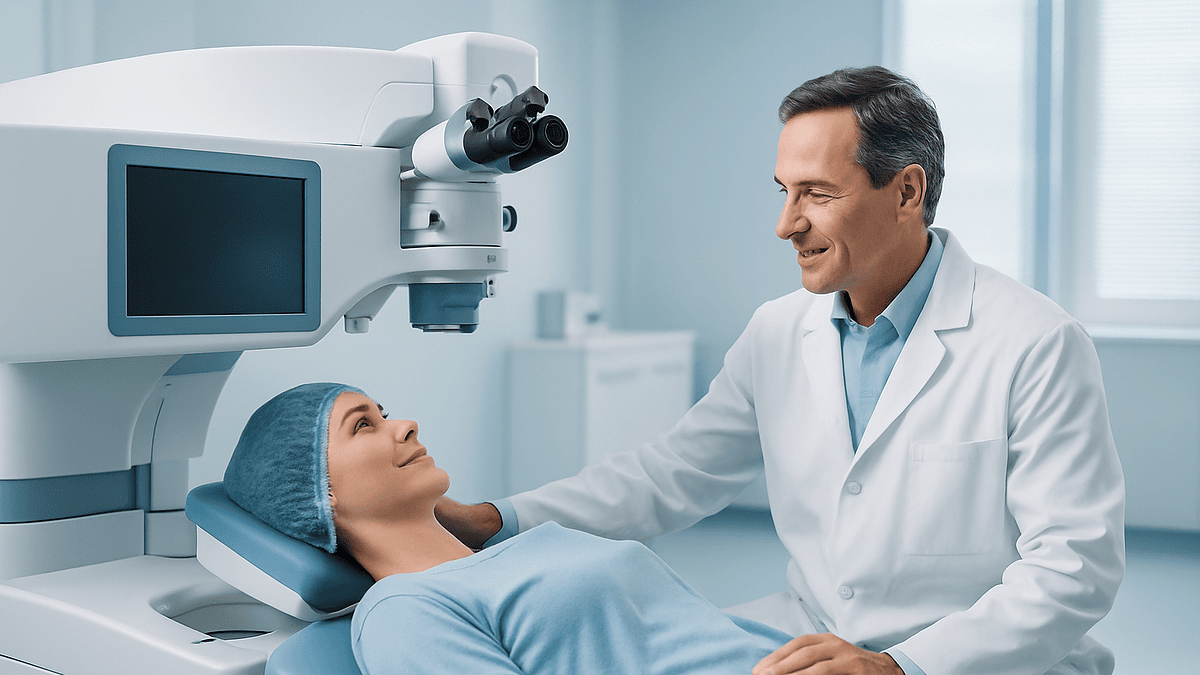
In Femto LASIK, a femtosecond laser replaces the mechanical blade (microkeratome) used to create the thin corneal flap that begins LASIK. The laser fires ultrashort pulses that form microscopic bubbles at a programmed depth, giving a flap of more predictable thickness and shape. The second step, reshaping the cornea with an excimer laser, is identical. Published comparisons show fewer flap-related complications with the laser, but similar final vision for most people.
The consultation is nearly over when the question finally comes out. She has been nodding through corneal maps and pupil measurements, and now she asks the thing she actually wanted to know: “So does the laser cut the flap, or does a blade?” The surgeon smiles, because that question comes up in almost every room.
Femto LASIK laser technology exists to answer it. Standard LASIK has always begun with a hinged flap lifted from the front of the cornea, and for years that flap was made with an oscillating steel blade. A femtosecond laser makes the same flap with light instead of metal. Everything after that step, the reshaping that actually corrects your sight, is the same in both versions.
What follows is an honest look at what the laser changes, what it does not, and how to weigh a decision that will sit on the surface of your eye for decades.
What is a femtosecond laser, in plain terms?
A femtosecond is one quadrillionth of a second. Written out, that is a decimal point followed by fourteen zeros and a one. Light itself travels only about the width of a human hair in that time. A femtosecond laser delivers its energy in pulses that short, which is the whole reason it can work inside living tissue without scorching it.
Here is the mechanism. When a pulse this brief is focused to a tiny point inside the cornea, the energy is so concentrated in time and space that it vaporizes a speck of tissue and produces a microscopic bubble of gas and water vapor. The surrounding tissue barely warms, because the pulse ends before heat has a chance to spread. Ophthalmologists call this photodisruption, meaning the laser separates tissue by creating bubbles rather than by cutting or burning.
Now imagine tens of thousands of those bubbles placed side by side in a flat plane at a chosen depth, then a ring of them rising toward the surface. Together they form a cleavage plane: a layer where the tissue above has been separated from the tissue below, joined only at a hinge the surgeon has left intact. That plane is the flap.
The cornea is the clear dome at the front of the eye, roughly half a millimeter thick at its center, which MedlinePlus describes as the part LASIK reshapes to refocus light. Because it is transparent, the laser can be focused through the surface to a precise depth beneath it, the way a magnifying glass focuses sunlight to a point in mid-air rather than on the lens itself. No blade could do that. A blade must start at the surface and travel inward.
How femto LASIK laser technology works, step by step
The procedure has two distinct laser stages, and people often blur them together. Keeping them separate makes the whole thing easier to understand.
First comes the flap. After numbing drops, a small suction ring rests on the eye to hold it steady, and a flat or gently curved glass interface presses against the cornea to make its surface predictable for the laser. The femtosecond laser then scans across a programmed pattern, laying down its bubble plane at the planned depth and finishing with a side cut up to the surface. This takes tens of seconds. You may feel pressure and see your vision dim while the suction is on, a sensation Mayo Clinic notes is normal during flap creation.
Second comes the correction. The surgeon lifts the flap with a fine instrument, folds it back on its hinge, and a different device, an excimer laser, reshapes the exposed corneal bed. An excimer laser uses ultraviolet light to remove tissue a fraction of a micrometer at a time from the surface, flattening the cornea for shortsightedness or steepening it for farsightedness. This is the step that changes your prescription. It is the same excimer step whether the flap was made by laser or by blade.
Finally the flap is laid back down. It adheres on its own within minutes as the cornea’s natural pumping cells draw fluid out from under it, and no stitches are used. Mayo Clinic gives a typical total time in the room of about 30 minutes or less for both eyes, with most of that spent on preparation rather than laser firing.
Some centers place both lasers in one room; others move you between two machines. Neither arrangement changes how the treatment works.
What the blade actually does differently
The microkeratome deserves a fair description, because it is not a crude tool. It is a precision instrument that has been refined for decades and still produces good outcomes in experienced hands.
A microkeratome is a motorized handpiece holding a very thin steel blade that oscillates rapidly from side to side. The device docks onto a suction ring on the eye, and a mechanism drives the blade across the cornea at a set depth, planing off a thin layer while leaving one edge attached as the hinge. Think of a woodworker’s plane skimming a shaving from a board, except the board is curved, alive and about the size of a fingernail.
Three consequences follow from that design. The flap depth depends on the blade, the suction pressure and the individual cornea’s resistance, so the achieved thickness can differ from the intended thickness more than surgeons would like. The blade travels along a curved surface, so the flap it produces tends to be thinner in the center and thicker toward the edges, a shape sometimes called meniscus. And because the blade physically passes over the cornea, rare mechanical mishaps are possible: an incomplete pass, a hole in the center of the flap called a buttonhole, or a flap cut fully free with no hinge.
None of these are common, and surgeons trained on microkeratomes have well-rehearsed ways of managing them, usually by stopping and rescheduling rather than proceeding. Yet they are the specific problems that femtosecond technology was developed to reduce. When you read that femto LASIK is “bladeless,” this is what the word is really pointing at: the removal of a moving steel edge from the most delicate step of the operation.
Flap thickness, shape and predictability: what the evidence shows
If you remember one technical idea from this article, make it this: the femtosecond laser’s main advantage is predictability, not speed or comfort.
Because the laser focuses at a programmed depth regardless of how firm or soft an individual cornea is, the thickness it achieves stays close to the thickness the surgeon planned. Studies measuring flaps after surgery have consistently found a narrower spread of thicknesses with femtosecond lasers than with mechanical blades. The flap is also planar, meaning uniform in thickness from center to edge, rather than meniscus-shaped.
Why does a few micrometers of variation matter? The excimer laser removes tissue from the bed beneath the flap, and surgeons want to leave a generous cushion of untouched cornea underneath to keep the eye structurally sound. If a blade flap comes out thicker than planned, that cushion shrinks without anyone intending it. A predictable flap lets the surgeon plan the residual thickness with more confidence, which matters most for people with higher prescriptions or corneas on the thinner side of normal.
The laser also allows the surgeon to choose flap diameter, hinge position, hinge width and the angle of the side cut. A steeper side cut lets the flap edge slot back into place like a lid into a rim, which is thought to improve flap stability, though the clinical importance of this is still debated.
What the evidence does not show is a meaningful difference in final vision for most people. Systematic reviews comparing the two methods generally find that uncorrected visual acuity and the accuracy of the final prescription are similar. The laser changes the reliability of one step; it does not change the optics of the correction. That distinction should shape how much weight you give it.
Is Femto LASIK better than LASIK? An honest answer
The question is slightly mis-framed, and the framing matters. Femto LASIK is LASIK. The comparison people mean is femto LASIK vs LASIK done with a microkeratome, and the answer depends on which outcome you care about.
On flap complications, the laser has the stronger record. Buttonholes, free caps and incomplete flaps are reported less often with femtosecond lasers in comparative studies. Because the laser does not depend on tissue resistance, it also copes more consistently with unusually steep or flat corneas, where blades historically struggled.
On the vision you end up with, the picture is closer to a draw. Most head-to-head studies find that both methods achieve similar sharpness and similar accuracy of correction once healing is complete. Some research suggests a small early advantage in quality of vision with laser flaps, possibly because a planar flap induces fewer irregularities, but these differences tend to be modest and to narrow over time.
On side effects, each method has its own signature. Blade flaps have been associated in some studies with slightly more early dry-eye symptoms, plausibly because a thicker peripheral flap cuts more corneal nerves. Laser flaps bring their own list, discussed later: a transient light sensitivity that appears days after surgery, a temporary haze of trapped bubbles, and faint rainbow halos around lights in a small number of people. Neither list is long, and most items resolve.
The balanced view, then: the femtosecond laser makes the first step more predictable and removes a class of mechanical mishaps, while leaving the correction itself unchanged. For a person with an ordinary prescription and a healthy cornea, an experienced surgeon using either method is likely to reach a similar place. The surgeon’s judgment and your suitability matter more than the flap tool.
Blade vs femtosecond laser: a side-by-side comparison
The table below summarizes how the two flap methods differ. It describes typical features reported in the clinical literature, not guarantees about any individual eye. The excimer reshaping step is deliberately omitted because it is the same in both.
| Feature | Microkeratome (blade) | Femtosecond laser |
|---|---|---|
| How the flap is made | Oscillating steel blade planes across the cornea | Ultrashort light pulses form a plane of microscopic bubbles |
| Flap thickness | Varies with cornea firmness and suction; wider spread | Programmed depth; narrower spread around the plan |
| Flap shape | Thinner in center, thicker at edges (meniscus) | Uniform thickness (planar) |
| Customization | Limited choice of diameter and hinge | Surgeon sets diameter, hinge position, side-cut angle |
| Method-specific complications | Buttonhole, free cap, incomplete pass (uncommon) | Opaque bubble layer, transient light sensitivity, rainbow glare (uncommon) |
| Suction time on the eye | Brief, during blade pass | Brief, during laser scan |
| Final visual outcome | Similar in most comparative studies | Similar in most comparative studies |
| Track record | Longer, decades of follow-up | Shorter but now spanning many years |
Two things stand out. The rows that differ are almost all about the flap-making step itself, and the row that patients care about most, the vision they end up with, reads the same in both columns. That is the honest summary of the evidence to date.
A third point hides in the last row. Blade LASIK has been followed for longer simply because it came first. The femtosecond laser has been in routine use for well over a decade now, long enough that its own long-term data are substantial, but a person weighing the two should know the historical reason for the difference rather than read it as a verdict.
Who femto LASIK is usually for, and who is usually asked to wait
Suitability for LASIK of any kind is decided long before anyone chooses a flap method. The screening visit, with its corneal mapping, thickness measurement, pupil sizing and tear-film checks, does most of the work.
People who commonly go forward share a few features. They are adults, since NHS guidance notes that laser eye surgery is generally not offered to those under 18 because the eye is still changing. Their glasses prescription has settled; Mayo Clinic lists a changing prescription as a reason to hold off. Their corneas are thick enough to leave a safe cushion after the flap and the reshaping, and their corneal maps show a regular shape with no signs of thinning disorders. Their eyes are otherwise healthy, with no active infection, significant dry eye or advanced glaucoma.
Within that group, the femtosecond laser is sometimes preferred for specific reasons. A cornea on the thinner side of normal benefits from a thin, predictable flap. A very steep or very flat cornea, where blade flaps were historically less reliable, is another. Some surgeons simply use the laser for every case because they trust its consistency.
Who is usually asked to wait, or to consider something else? People whose prescription is still shifting, including during pregnancy and breastfeeding when hormones can alter the cornea. People with autoimmune conditions or diabetes that is not well controlled, because healing may be less predictable. People with corneal disease, thin or irregular corneas, or very large pupils in dim light, who may be steered toward a surface procedure or an implantable lens instead. And people with unrealistic expectations, who hope to abandon reading glasses in their fifties; LASIK does not stop the age-related stiffening of the eye’s natural lens.
Each of these is a conversation, not a verdict, and it belongs with the treating team.
What the day of femtosecond laser eye surgery feels like
Most people arrive expecting drama and leave surprised by how procedural it was. Knowing the sequence in advance tends to make the sensations easier to tolerate.
You will be awake. Numbing drops take away sensation from the surface of the eye, and a mild sedative may be offered for anxiety. You lie back under the laser, and a small speculum holds the eyelids open, which feels odd rather than painful. The surgeon marks the cornea and centers the machine.
The femtosecond stage begins with the suction ring. Pressure rises inside the eye for the seconds the ring is on, and your vision in that eye goes gray or dark. This dimming alarms people who were not warned; Mayo Clinic describes it as an expected part of flap creation. The laser hums and the scan finishes, and vision returns as the suction releases. Some centers then move you to the excimer laser. Others swivel the bed.
The excimer stage asks one thing of you: look at the blinking fixation light. Modern excimer lasers track small eye movements and pause if you look away, so the instruction is about steadiness, not perfection. You will hear a rapid clicking and may notice a faint odor, which is the sound and smell of tissue being vaporized in microscopic amounts. The flap is then repositioned, smoothed and left to seal.
Afterward, the eye feels gritty and light-sensitive, as though an eyelash is trapped, and vision is smeary. Mayo Clinic advises arranging a ride home and resting with eyes closed for the first hours. Protective shields are worn while sleeping so a stray hand does not disturb the flap before it has fully bonded.
It is ordinary, in the best sense, for a surgery that changes how you see.
Femto LASIK recovery time: the first days and weeks
The flap begins adhering within minutes, but it strengthens over weeks, and that timeline shapes every piece of aftercare advice you will receive.
The first day is the roughest. Burning, watering and sensitivity to light are common for several hours, and Mayo Clinic notes that vision often clears substantially by the next morning, although it can fluctuate. A check within the first day or two is standard so the surgeon can confirm the flap is smooth and in position. Prescription anti-inflammatory and antibiotic drops are used for a period set by the surgeon; how long, and how often, is a decision for the prescribing clinician rather than something to adjust yourself.
The first week brings a list of small prohibitions with one purpose: protecting the flap. Mayo Clinic advises against rubbing the eyes, wearing eye makeup for a time, and swimming or using hot tubs for a period afterward, because pools and tubs carry infection risk and dislodging forces. Screen work is allowed but tends to dry the eye, so many people are told to take breaks and use preservative-free lubricating drops as directed. Driving resumes once vision meets the legal standard and the surgeon agrees.
The following weeks are about stabilization. Vision may sharpen and soften from day to day as the flap and the reshaped surface settle. Dry eye is the most common lingering complaint; NHS guidance describes it as usually temporary but capable of lasting for months in some people. Night glare and halos, when present, generally fade over the same period.
Follow-up visits typically run across the first several months, and the prescription is usually considered final only when measurements have stopped changing. Femto LASIK recovery time, in other words, is short for function and long for fine-tuning.
Risks that are specific to the femtosecond step
Replacing a blade with light removes some problems and introduces others. A truthful account names the new ones, even though most are mild and self-limiting.
The opaque bubble layer is the most visible. Gas produced by the laser sometimes migrates into the corneal tissue instead of staying in the flap plane, creating a temporary whitish haze that can obscure the surgeon’s view or interfere with the excimer laser’s eye tracker. Surgeons usually wait a few minutes for it to clear or adjust their technique; it almost always resolves without lasting effect.
Transient light sensitivity is a peculiar one. A few days to a couple of weeks after an otherwise uneventful surgery, some people develop marked sensitivity to light with normal-looking eyes and good vision. It is thought to be an inflammatory response to the laser energy and typically settles with treatment directed by the surgeon.
Rainbow glare describes faint colored bands seen around point sources of light at night. It is attributed to the microscopic grid pattern the laser leaves on the underside of the flap acting like a diffraction grating, the way a compact disc splits light into colors. It is uncommon, usually subtle, and tends to diminish over months.
Vertical gas breakthrough occurs when bubbles escape upward through a weak spot in the cornea, such as an old scar, and can compromise the flap. Suction loss during the laser scan halts the procedure, and the surgeon decides whether to re-dock or reschedule.
Finally, some people find the docking interface, the glass plate pressed against the eye, more uncomfortable than the suction ring alone. It is transient and reflects the way the laser needs a stable, known surface to focus through.
Risks shared by both methods: dry eye, glare and rarer problems
Most of what can go wrong after LASIK has nothing to do with how the flap was cut. These shared risks deserve the same honest treatment, because a person choosing a flap method sometimes assumes the laser has removed them.
Dry eye leads the list. Both flap methods sever corneal nerves that normally signal the tear glands to keep the surface moist, and NHS guidance lists dry eyes as one of the most common after-effects, usually easing over months. People with borderline tear production before surgery are at higher risk, which is why tear testing at screening matters.
Glare, halos and starbursts at night are the second common group. The reshaped zone of the cornea can be smaller than the pupil in dim light, so edge effects scatter light. Many people notice these early and find they fade; a minority find them persistent. Mayo Clinic notes that these visual disturbances can be more likely with larger pupils and higher corrections.
Under- or over-correction happens when the cornea heals differently than predicted. A small residual prescription may be tolerated or corrected with glasses, and some people are offered an enhancement procedure once measurements stabilize, a decision that rests with the surgeon.
Flap-related issues after surgery, such as wrinkles, epithelial cells growing under the flap, or displacement from a knock, can occur with either method because both leave a flap. Infection and inflammation under the flap are uncommon but serious when they happen.
Corneal ectasia is the rarest and most consequential: progressive thinning and bulging of the cornea after surgery, associated with pre-existing weakness or too little residual thickness. Careful screening is the main protection, and here the predictability of the laser flap is one small contributor among several.
What happens 20 years after LASIK?
People searching this phrase are asking two separate questions. Does the correction wear off? And does the eye pay a hidden price later? Both deserve straight answers grounded in what long-term follow-up has actually found.
The correction itself is permanent in the sense that the tissue removed does not grow back. What changes is the rest of the eye. Some people, particularly those with higher shortsightedness, experience a slow drift back toward their old prescription over years, a phenomenon called regression. It is usually partial. Separately, the natural lens inside the eye stiffens with age, and by the mid-forties most people need reading help regardless of any surgery; Mayo Clinic is explicit that LASIK does not prevent this. Later still, cataract forms in the same lens, and a LASIK-treated cornea can make the calculations for cataract surgery more complex, which is one reason surgeons ask you to keep your pre-operative records for life.
The flap does not “come off” spontaneously decades later. It heals along its edge with a scar-like seal, though the interface itself never fully knits, which is why surgeons can lift an old flap for an enhancement years afterward. Significant blunt trauma can still displace it, and this is worth knowing if you box, play contact sports or work in high-risk settings.
Dry eye that persists beyond the first year is uncommon but real for a small number of people, and it is the long-term complaint most often described in follow-up studies. Night-vision symptoms that have not faded by then tend to be stable rather than progressive.
Is there a difference at 20 years between laser and blade flaps? Comparative data over that span are limited, since the laser is younger. Available follow-up suggests both flap types remain stable; the long-term story is largely about the eye aging, not about the tool that made the flap.
Is femto laser worth it? Weighing what actually matters
“Worth it” is a personal calculation, and this magazine does not publish figures for any treatment. What we can do is separate the parts of the decision that the evidence informs from the parts it does not.
Start with what the laser reliably buys you: a flap of predictable thickness and shape, and a lower chance of the mechanical mishaps that a blade can produce. If your cornea is thinner than average, unusually curved, or your prescription is high enough that residual thickness is a real constraint, those advantages are not abstract. Your surgeon may consider the laser the safer route or may recommend a different procedure altogether.
Then consider what it does not buy you: sharper final vision, freedom from dry eye, freedom from night glare, or protection against the age-related changes described above. If a promotional page implies otherwise, it is running ahead of the evidence.
Consider, too, the alternatives that have nothing to do with flap method. Surface procedures such as PRK reshape the cornea without any flap and are often suggested for thin corneas or people at risk of eye trauma, at the cost of a slower, more uncomfortable early recovery. Lenticule extraction procedures use a femtosecond laser alone to remove a disc of tissue through a small incision, with no flap to displace. Implantable lenses avoid corneal reshaping entirely. Contact lenses and glasses remain reasonable choices, and NHS guidance is clear that laser surgery is elective rather than medically necessary for most people.
The practical answer: ask your surgeon which flap method they use, why, and whether your particular eyes change the calculation. A surgeon who uses the laser routinely and one who uses a blade skillfully can both serve you well. The decision belongs with that conversation, not with a marketing adjective.
What people often get wrong about bladeless LASIK
Some myths cluster around this procedure with unusual persistence. A few corrections, in the order we hear them most.
“Bladeless means no cutting.” A flap is still created and lifted. The laser separates tissue with bubbles rather than steel, but the result is a cut, and the eye heals from it the same way.
“The femtosecond laser corrects my vision.” It does not. The excimer laser reshapes the cornea in the second step. The femtosecond laser only prepares access. Confusing the two lasers leads people to over-value the flap method.
“Laser flaps mean no dry eye.” Both methods cut corneal nerves. Some studies show a modest early advantage for thinner laser flaps, but dry eye remains the most common complaint after LASIK of any kind.
“Femto LASIK is the newest technology.” It is the newer of the two flap methods but has been in routine use for many years. Flapless lenticule procedures and topography-guided treatments are more recent developments, and “newest” is not a medical argument in any case.
“The blade is dangerous.” Microkeratome LASIK has decades of follow-up and excellent safety in experienced hands. The laser reduces a small set of uncommon complications; it does not rescue a procedure that was failing.
“Results are permanent, so my eyes are fixed for life.” The tissue change is permanent, but eyes age. Reading glasses in middle age and eventual cataract are unaffected by LASIK, as Mayo Clinic notes.
“If I can see the next day, I have healed.” Functional vision returns fast; flap strength, dry-eye recovery and prescription stability take weeks to months. The aftercare rules exist for the part you cannot feel.
Questions to ask your care team before femto LASIK
A good consultation should leave you able to explain your own plan in a sentence. These questions help you get there, and none of them should be unwelcome.
- Which method do you use to create the flap, and why do you prefer it for eyes like mine?
- How thick is my cornea, what flap thickness do you plan, and how much untouched tissue will remain underneath afterward?
- Do my corneal maps show anything, such as irregular shape or thinning, that would make a surface procedure or a lens implant a better fit than any form of LASIK?
- How large are my pupils in dim light, and how does that affect my risk of night glare?
- What did my tear-film tests show, and does that change your recommendation?
- What happens during the procedure if suction is lost or the laser cannot complete the flap?
- Which side effects specific to the femtosecond laser have you seen in your own patients, and how were they managed?
- What is your policy if I end up under- or over-corrected, and how long would you wait before considering an enhancement?
- How many follow-up visits are planned, over what period, and who do I contact after hours?
- Which of my daily activities, sports or work exposures should change, and for how long?
- What records should I keep for the rest of my life in case I need cataract surgery later?
- If I were your family member with these measurements, what would you advise, including the option of doing nothing?
Write the answers down. A plan you understand is easier to follow, and easier to question if something later feels wrong.
When to call your doctor after LASIK
Most recovery is uneventful, and most symptoms in the first day, such as grittiness, watering, light sensitivity and blurry vision, are expected. A short list of signs, however, should prompt a same-day call to your surgical team, or emergency care if you cannot reach them.
Call promptly if you have severe or worsening pain rather than the mild discomfort you were warned about. Mayo Clinic advises contacting your doctor immediately for new or worsening symptoms after LASIK, and sudden or increasing pain heads that list. Call if vision that had cleared becomes noticeably worse, or if you develop a new distortion, double image or a sensation that something is moving on the eye’s surface, which can indicate a displaced or wrinkled flap, especially after a rub or a knock.
Call if the eye becomes increasingly red, produces thick discharge, or the eyelid swells, all possible signs of infection under the flap. Call if you develop marked sensitivity to light several days after surgery when your eyes had been comfortable, which may be the transient inflammatory response described earlier and is easier to manage when treated early. Call if you see a sudden shower of new floaters, flashes of light or a curtain across part of your vision; these are not typical LASIK effects and need urgent assessment for retinal problems.
In the months and years afterward, seek care if vision changes rapidly, if one eye’s prescription seems to be shifting, or if dry-eye symptoms interfere with daily life. Progressive change is never something to watch and wait on alone.
Your surgical team knows your eyes, your flap and your plan. Every decision about treatment, including whether a symptom is expected, sits with them, and no article can substitute for that examination.
Frequently asked questions
Is Femto LASIK better than LASIK with a blade?
For most people the final vision is similar; the difference lies in the flap step. A femtosecond laser produces a flap of more predictable thickness and shape and reduces rare mechanical complications such as buttonholes or free caps. It introduces its own uncommon effects, including transient light sensitivity and rainbow glare. Surgeon experience and your corneal measurements influence outcomes more than the flap method, so the choice belongs in a conversation with your treating team.
What does femto LASIK vs LASIK actually change during surgery?
Only the first of two laser stages changes. In femto LASIK, ultrashort laser pulses create the corneal flap through a glass interface under suction; in conventional LASIK an oscillating blade planes the flap. The second stage, in which an excimer laser reshapes the cornea to correct your prescription, is identical. Total time in the room is about 30 minutes or less for both eyes according to Mayo Clinic, whichever flap method is used.
Does bladeless LASIK mean the eye is not cut?
No. A flap is still created and lifted from the cornea; the laser separates tissue with a plane of microscopic bubbles rather than with steel. The eye heals from this in the same way as from a blade flap, with the edge sealing over weeks and the same aftercare rules about not rubbing the eye. “Bladeless” describes the tool, not the absence of a surgical incision.
What is femto LASIK recovery time like?
Functional vision often returns within a day, while fine-tuning takes longer. Mayo Clinic notes that vision usually clears substantially by the next morning and that a check is done within the first day or two. Dry eye, the most common lingering effect, is described by NHS guidance as usually temporary but sometimes lasting months. Night glare tends to fade over the same period, and the prescription is considered final only once measurements stop changing.
What happens 20 years after LASIK?
The tissue removed does not return, so the correction persists, but the eye keeps aging. Some people experience partial regression toward their old prescription, everyone eventually needs reading help because the natural lens stiffens, and later cataract surgery requires special calculations on a treated cornea. Long-term dry eye affects a minority. Follow-up data suggest both laser and blade flaps remain stable; the long-term story is mostly about aging, not the flap tool.
Is femto laser worth it?
It depends on your eyes rather than on the technology’s reputation. The laser reliably offers a predictable, uniform flap and fewer mechanical mishaps, which matters most for thinner or unusually curved corneas and higher prescriptions. It does not deliver sharper vision, prevent dry eye or stop age-related changes. Ask your surgeon which method they use and why for your measurements, and weigh alternatives such as surface procedures, lens implants or continuing with glasses or contacts.
Is femtosecond laser eye surgery painful?
The procedure itself is usually not painful because numbing drops remove sensation from the eye’s surface. People commonly describe pressure and a dimming of vision while the suction ring is applied, and an odd but painless feeling from the eyelid holder. Afterward, a gritty, burning sensation and light sensitivity are common for several hours. Severe or worsening pain is not expected and should be reported to the surgical team the same day.
Who is usually asked to wait before femto LASIK?
People under 18, since NHS guidance notes the eye is still changing, and anyone whose prescription is still shifting, including during pregnancy or breastfeeding. Others commonly asked to wait or consider alternatives include people with thin or irregular corneas, significant dry eye, active eye disease, poorly controlled diabetes or autoimmune conditions, and those expecting to avoid reading glasses in later life. Each is a discussion with the treating team, not an automatic refusal.
What side effects are unique to the femtosecond laser?
Three are described most often. An opaque bubble layer is a temporary haze from gas trapped in the cornea during the scan, which clears within minutes. Transient light sensitivity can appear days to weeks after surgery with otherwise normal eyes and is thought to be inflammatory. Rainbow glare is faint colored banding around lights caused by the microscopic pattern on the flap’s underside. All are uncommon, and most settle over weeks to months.
Can the flap move years after LASIK?
Spontaneous movement is not expected; the flap edge seals with a scar-like ring over weeks, whichever method made it. The interface underneath never fully knits, which is why surgeons can lift an old flap for an enhancement, and significant blunt trauma can still displace it. People in contact sports or high-risk occupations sometimes discuss flapless alternatives with their surgeon for this reason. Any sudden vision change after an eye injury needs prompt assessment.
References
- NHS: Laser eye surgery and lens surgery
- MedlinePlus: LASIK eye surgery
- Cleveland Clinic: LASIK Eye Surgery
This article is for general information only and is not a substitute for professional medical advice. Please consult a qualified doctor about your individual situation.

More from the Blog

What Glaucoma Surgery Can and Cannot Do: Protecting the Vision You Still Have
Glaucoma surgery lowers pressure inside the eye to slow or stop further damage to the optic nerve. It cannot restore vision already lost, because…
Intraocular Lens Recovery: Eye Drops, Lifting Limits and When Vision Settles
Most people recover from intraocular lens (IOL) surgery over about 4 to 8 weeks, according to the NHS and Mayo Clinic, though everyday vision…

Local or General Anesthesia for Vitrectomy: What You Feel and How the Choice Is Made
Most vitrectomies in adults are performed under local anesthesia: numbing injections around the eye, usually combined with light intravenous sedation, so you are relaxed,…
Helping a Child Stick With Eye Patching: Practical Support for Amblyopia Treatment
Helping a child with an eye patch for amblyopia works best when patching becomes a predictable, short, engaging routine: same time daily, paired with…

Preparing for a Contact Lens Fitting: Prescriptions to Bring and What to Tell Your Doctor
Preparing for a contact lens fitting means bringing your current glasses, any previous contact lens prescription or boxes, a list of medicines and eye…
PRK for Athletes, Pilots and Contact-Sport Players: Why No Flap Can Matter
PRK is a laser vision correction method that reshapes the cornea after removing its surface layer, rather than cutting a hinged flap as LASIK…