

ReLEx SMILE Recovery: When Screens, Workouts and Swimming Come Back

Key Takeaways
- SMILE removes a lens-shaped disc of corneal tissue through an incision commonly described as 2 to 4 mm wide, compared with a LASIK flap circumference of roughly 20 mm.
- Most people return to work and everyday activities within one to two days, but day-one sharpness after SMILE was slightly behind LASIK in early comparative studies and catches up over weeks.
- Screens do not harm the healing cornea; they dry it by reducing blinking, so short sessions with deliberate breaks matter more than avoidance.
- Commonly cited waits are about a week for eye makeup and gym workouts, at least two weeks for chlorinated pools, and around a month for hot tubs, open water and contact sports.
- Vision typically keeps settling for two to three months after laser correction, and dry eye symptoms usually ease over a similar window.
- Pain that increases after the first day, vision that worsens after improving, growing redness or thick discharge are red flags that warrant a same-day call to the surgical team.
Most people return to desk work and light screen use within one to two days of SMILE eye surgery, while vision keeps sharpening and dryness settles over weeks to a few months. Commonly cited waits are about a week for eye makeup and gentle exercise, two weeks or more for pools, and around a month for hot tubs, open water and contact sports. Your surgeon's instructions take priority.
The night before her procedure, a software developer sat on the edge of the bed with her phone dimmed to its lowest setting, asking it the question she had already asked her surgeon twice: when could she look at it again? Her partner, a swim coach, had a different worry. The pool season opened in six weeks, and nobody had given him a straight answer about chlorine.
Almost everyone who chooses small incision lenticule extraction arrives with a version of that list: the laptop, the gym, the water, the wedding where the mascara matters. SMILE eye surgery recovery time is short compared with most operations, but ‘short’ hides a lot of texture. Some things come back within a day. Others are wise to hold off for a month.
What follows uses the timelines mainstream medical sources actually publish rather than the ones that circulate on forums. They are ranges, not promises, and your own surgeon’s instructions always override a general article.
How SMILE works: what actually happens inside the cornea
Your cornea is the clear dome at the front of the eye, and it does most of the eye’s focusing. If it is a little too steep for the length of your eyeball, distant objects blur: nearsightedness. Every laser vision procedure reshapes that dome so light lands squarely on the retina. SMILE, short for small incision lenticule extraction, does it from the inside out.
A femtosecond laser is a laser that fires in pulses lasting a quadrillionth of a second, brief enough to separate tissue without heating it. In SMILE it traces two curved planes a fraction of a millimeter apart within the cornea, outlining a lens-shaped disc of tissue called a lenticule. The laser then opens a small side incision, commonly described as 2 to 4 mm wide, and the surgeon eases the lenticule out through it with fine forceps (Reinstein et al., PubMed). Removing that disc flattens the central cornea by a calculated amount. That flattening is the correction.
Compare that with LASIK, where a hinged flap with a circumference of roughly 20 mm is lifted, the surface underneath is reshaped with a second laser, and the flap is laid back down (Reinstein et al., PubMed). SMILE has no flap and uses one laser. The outer layer of the cornea stays largely intact apart from that keyhole opening, which is why people describe it as a ‘flapless’ option.
From your side of the table, the experience is brief. Numbing drops go in, a small lid holder keeps the eye open, and a suction ring steadies the eye while the laser works for well under a minute per eye (Reinstein et al., PubMed). You see lights, then a gray-out of vision for a few seconds, then the surgeon’s hands moving. Most people are in the laser room for minutes rather than an hour (Cleveland Clinic).
How long is SMILE eye surgery recovery time, really?
The honest answer has layers, because ‘recovered’ means different things to a commuter, a weightlifter and a swimmer. It helps to think in four overlapping phases.
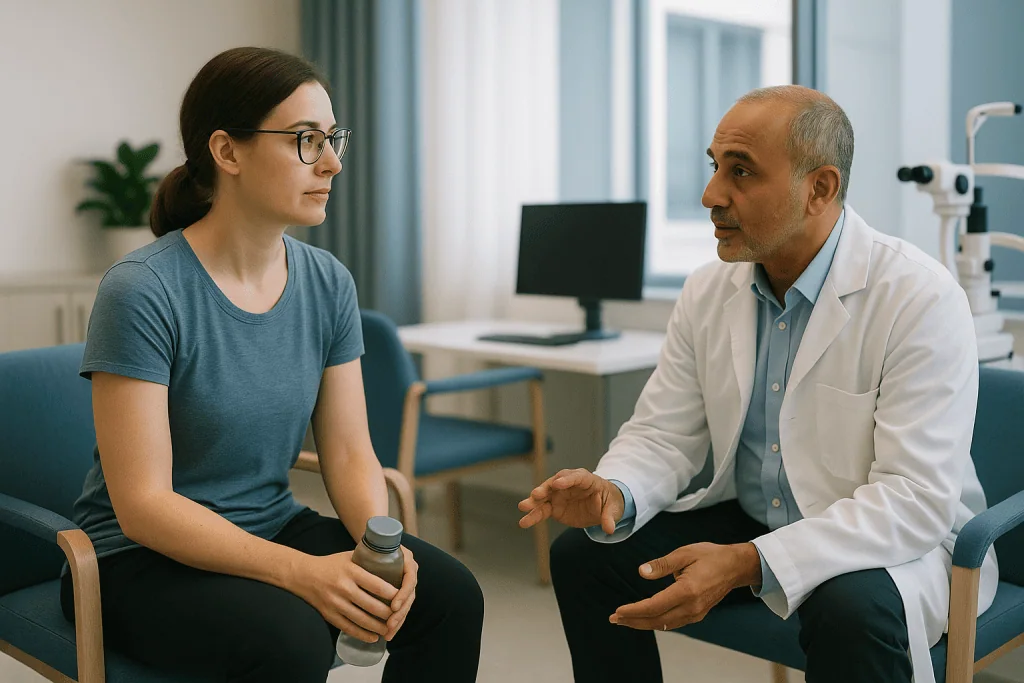
The first few hours are the least comfortable. Vision is hazy, eyes water and feel gritty, and bright light is unpleasant. Most surgeons want you home, eyes closed, ideally napping (Cleveland Clinic).
By the next morning, many people can see well enough to move about the house, read large text and attend the first follow-up visit. Cleveland Clinic notes that most people return to normal daily activities, including work, within a day or two. One nuance the research literature flags: in early comparative studies, day-one sharpness after SMILE tended to lag slightly behind LASIK, with the gap closing over the following weeks (Reinstein et al., PubMed). Slightly soft vision on day one is therefore expected, not a warning sign.
The first two to four weeks are governed by the healing incision and by dryness. This is when water, makeup, rubbing and impact sports are restricted, because the tissue surface is sealing and the tear film is disrupted.
Full stabilization is a longer story. Mayo Clinic describes vision after laser correction continuing to settle for two to three months, and dry eye symptoms commonly easing over a similar window. Many surgeons hold off on judging the final result, or discussing any touch-up, until that point.
So when someone asks how long SMILE recovery takes, a fair summary is: a day or two to function, a few weeks to lift most restrictions, a few months to know where your vision has landed. Every one of those figures shifts with your prescription, your tear film, your job and your surgeon’s protocol.
Who SMILE is usually for, and who is usually asked to wait
SMILE is used to treat nearsightedness, with or without astigmatism, which is an unevenly curved cornea that blurs vision at all distances. Where it is offered, it is generally not used for farsightedness, and it does not address presbyopia, the age-related loss of near focus that sends people to reading glasses (Cleveland Clinic; Reinstein et al., PubMed).
Beyond the prescription itself, surgeons look for the same fundamentals that apply to any corneal laser procedure. Mayo Clinic and the NHS list them consistently: adulthood, a prescription that has been stable for at least a year, a cornea thick and regular enough to reshape safely, and eyes free of active disease. Corneal mapping, called topography, is used to rule out keratoconus, a progressive thinning and bulging of the cornea that laser treatment can worsen.
Some people are asked to pause rather than declined outright. Anyone who is pregnant or breastfeeding is usually asked to wait, because hormonal shifts can change the prescription temporarily (Mayo Clinic). Contact lens wearers are asked to stop lenses beforehand so the cornea returns to its natural shape; soft lenses need a shorter break than rigid lenses, and the surgeon will specify how long (MedlinePlus). A prescription that changed at the last eye exam means another year of watching before the numbers are trusted.
Others are steered toward a different option. Significant dry eye, thin corneas, certain autoimmune conditions, a history of poor wound healing or eye infections such as recurrent herpes keratitis all shift the risk calculation (Mayo Clinic; Johns Hopkins). For some of these people, an implantable lens or simply staying in glasses and contacts is the sounder path. That judgment belongs to the surgeon who has examined your eyes, and a good consultation will spend as much time on why you might not be suited as on why you might.
Is SMILE eye surgery painful? What the first day feels like
People brace for a laser touching their eye and are surprised by how little they feel. Numbing drops take away sensation from the corneal surface. What most describe during the procedure is pressure from the suction ring and a strange few seconds when the view goes dim as the laser passes (Cleveland Clinic). Sharp pain during the laser itself would be unusual and is something to tell the surgeon about immediately.

The hours afterward are a different matter. As the numbing wears off, eyes typically sting, water and feel as though an eyelash is trapped under the lid. Light seems too bright. Cleveland Clinic describes this scratchy, irritated phase as normal and usually settling within the first day. Many surgeons suggest going straight home, closing your eyes and sleeping through the worst of it; you cannot see well enough to do much else anyway.
Your surgeon will typically prescribe an antibiotic drop to lower infection risk and an anti-inflammatory drop to calm swelling, along with preservative-free lubricating drops (Mayo Clinic). The schedule and duration are set by the prescribing clinician and vary between practices, so follow the sheet you were given rather than a friend’s memory of theirs.
A plastic shield or goggles worn for sleep during the first nights prevents you from rubbing the eye in your sleep (Mayo Clinic). Even without a flap to displace, a knuckle in a freshly operated eye is unwelcome.
Discomfort that improves hour by hour is the expected pattern. Pain that builds rather than fades, or that returns after a comfortable first day, is not part of normal SMILE recovery and warrants a call, which the final section covers in detail.
Screen time after SMILE surgery: when can I look at my phone?
Screens do not damage a healing cornea. The light from a laptop is ordinary visible light, and there is no mechanism by which it could disturb the incision or the lenticule pocket. The real issue is blinking. When people concentrate on a screen, they blink noticeably less often, and a freshly operated eye already has a disrupted tear film. Fewer blinks means faster evaporation, more dryness, more blur and more temptation to rub.
That is why the guidance is about pacing rather than prohibition. On the day of surgery, vision is too hazy for reading anyway, and rest is the point. From the next day, when Cleveland Clinic notes most people are back to normal activities, brief use is generally acceptable. The practical trick is to treat screen time like a workout you are easing back into: short blocks, frequent breaks, and stopping when the eyes feel tired.
Several habits make the first week easier:
- Enlarge fonts and lower brightness so you are not squinting through the residual haze.
- Look away from the screen every twenty minutes or so and consciously blink several times; this is a common ergonomic recommendation for dry eye generally.
- Use your prescribed lubricating drops before long tasks rather than waiting for the sting.
- Prefer a larger screen at arm’s length over a phone held close, which demands harder near focus.
Blue-light filters and special glasses are frequently marketed to people recovering from eye surgery. There is no mainstream evidence they speed corneal healing; if they make the screen feel more comfortable, that comfort is the whole benefit.
People in screen-heavy jobs often report that the second and third days feel worse than the first, simply because they have started working again. That fatigue is a cue to shorten sessions, not a sign of a problem.
How many days should I rest after SMILE surgery? Work and driving
The short version: plan for a day of genuine rest, a second day of taking it easy, and expect to be functional by the third. Cleveland Clinic states most people return to work within a day or two after SMILE. People whose jobs demand eight hours of small text often give themselves an extra day, not because healing requires it but because comfort does.
The nature of the work changes the calculation more than the calendar. An office is a benign environment. A construction site, a bakery kitchen, a farm or a dusty workshop is not: airborne particles, sweat and hands near the face all raise the odds of irritation or infection while the incision seals. Surgeons commonly ask people in those settings to wait longer or to wear wraparound protective eyewear for the first couple of weeks (Mayo Clinic advises protecting the eyes from dust and debris during early healing).
Driving has its own rule: you drive when your surgeon confirms your vision meets the legal standard, and not before. That check is usually part of the first follow-up visit, commonly the day after surgery (Mayo Clinic). Someone else drives you home from the procedure without exception. Night driving may feel harder for several weeks because of glare and halos around headlights, which are common early effects and usually diminish (Mayo Clinic).
Follow-up visits shape the early weeks. A typical pattern is a check within a day or two, another around a week, then at a month and again a few months later (Mayo Clinic; MedlinePlus). Those appointments are where restrictions are lifted or extended based on what the surgeon actually sees, which is why booking them before you schedule anything else is the single most useful piece of planning.
Working out after SMILE: from walks to weights to contact sports
Exercise restrictions after SMILE are about three hazards: sweat running into the eye, hands wiping the face, and something striking the eye. None of them involves the flap concern that dominates LASIK advice, because there is no flap. The incision still needs to seal, and the eye still needs to be left alone.
Walking is fine from the day after surgery. Gentle activity that does not make you sweat heavily or lower your head toward the ground is generally allowed within the first few days. Gym cardio, cycling on a stationary bike and lifting are commonly resumed after about a week, once the surface has closed and the first follow-up has gone well (Cleveland Clinic guidance for laser vision correction advises avoiding strenuous exercise for around a week). A headband and a towel kept away from the eyes handle the sweat problem.
Straining during a heavy lift does not carry a specific SMILE risk that mainstream sources identify; the practical concern is the reflex to wipe your face with a chalky hand. Yoga inversions and hot yoga sit in a gray zone because of heat, sweat and shared mats; many surgeons suggest waiting a couple of weeks.
Anything that can put a ball, elbow or fist into your eye is the last to return. Basketball, soccer, racket sports, martial arts and boxing are typically held for about a month (Cleveland Clinic), and many surgeons recommend protective sports eyewear for longer, or permanently, since a direct blow can injure any eye.
Runners often ask about outdoor air. Wind and low humidity dry the tear film, so sunglasses that wrap around the face help during the first weeks, and lubricating drops before heading out are sensible. Dust, pollen and grit are the reason to keep glasses on rather than the light itself.
Swimming after SMILE surgery: pools, hot tubs and open water
Water is the restriction people resent most and the one with the clearest rationale. Every body of water you might swim in carries microorganisms, and some of them, notably certain amoebae and bacteria found in tap water, pools, hot tubs and lakes, can cause serious corneal infections if they reach a healing surface. Chlorine and salt also sting and disrupt the tear film at the moment you least want that.
The commonly cited waits reflect a rough hierarchy of risk. Showering is allowed from the day after surgery, with the eyes closed and the face kept out of the direct spray for about a week, and no water in the eyes deliberately (Cleveland Clinic). Chlorinated pools are typically off limits for at least two weeks (Cleveland Clinic). Hot tubs, lakes, rivers and the ocean are usually held for around a month, because warm stagnant water and untreated natural water carry the highest microbial load (Cleveland Clinic; Mayo Clinic advises avoiding swimming and hot tubs for several weeks after laser vision correction).
When you do return, well-fitting goggles are worth wearing for the first several sessions, and many surgeons recommend them indefinitely for pool swimmers with dry eye. Rinse the face with clean water afterward and use your lubricating drops.
Scuba diving and water polo add pressure and impact to the equation. Mask squeeze and collisions are not SMILE-specific dangers, but they are reasons to have an explicit conversation with the surgeon before committing to a trip.
One myth worth retiring: the idea that the small incision makes water safe sooner than after LASIK. The incision is smaller, but the concern is infection through any not-yet-sealed surface, and mainstream sources give similar water restrictions for both procedures. Your surgeon may adjust the window after examining the eye; that examination is the only thing that should shorten it.
SMILE eye surgery recovery time by activity: what usually comes back when
People remember a table better than a paragraph, so here is the whole timeline in one place. Every window is a typical range drawn from the sources cited in this article, not a rule, and your surgeon’s written instructions replace it.
| Activity | Commonly cited return window | Why the wait |
|---|---|---|
| Sleep and rest with eyes closed | Immediately, and encouraged on day one | Reduces light sensitivity and discomfort while numbing wears off (Cleveland Clinic) |
| Light screen use | Day after surgery, in short blocks | Reduced blinking dries the healing surface; pacing matters more than avoidance |
| Desk work | One to two days | Comfort and clarity rather than healing risk (Cleveland Clinic) |
| Driving | When surgeon confirms legal vision, often at day-one check | Early haze and night glare (Mayo Clinic) |
| Showering | Next day, eyes closed, face out of spray for about a week | Tap water can carry microorganisms (Cleveland Clinic) |
| Eye makeup | About one week | Particles and applicators near the incision (Cleveland Clinic) |
| Gym, running, lifting | About one week | Sweat and hands near the face (Cleveland Clinic) |
| Chlorinated pool | At least two weeks, goggles on return | Infection risk through unsealed surface (Cleveland Clinic) |
| Hot tub, lake, ocean | Around one month | Highest microbial load (Cleveland Clinic; Mayo Clinic) |
| Contact and ball sports | Around one month, protective eyewear after | Direct impact risk (Cleveland Clinic) |
| Air travel | No standard restriction; lubricate in dry cabin air | Cabin humidity worsens dry eye (Mayo Clinic on dry eye after laser correction) |
Notice how the windows cluster. Almost everything indoors and clean returns within days; almost everything involving water or impact waits weeks. Vision itself sits outside this table, because it keeps changing for two to three months (Mayo Clinic), and dry eye symptoms follow a similar curve. If a friend’s surgeon allowed the pool at ten days and yours says three weeks, neither is wrong; they examined different eyes.
SMILE vs LASIK recovery: is SMILE riskier?
Neither procedure is categorically safer. They trade one set of considerations for another, and the right fit depends on the eye in front of the surgeon.
The structural difference is the flap. LASIK creates one; SMILE does not. A flap can, rarely, shift or wrinkle if the eye is rubbed or struck in the early weeks, which is why LASIK advice is so insistent about protective shields and avoiding contact sports (Mayo Clinic). SMILE removes that particular concern, though it does not remove the need to leave the eye alone while the incision seals.
Dry eye is the trade most people ask about. Cutting a flap severs more of the corneal nerves that trigger tear production. Because the SMILE incision is a fraction of the size, several comparative studies have reported fewer dry eye symptoms in the early months after SMILE, with differences narrowing over time (Reinstein et al., PubMed). Fewer is not none; dryness remains the most common complaint after SMILE too.
Speed of visual recovery tilts the other way. Early comparative research found day-one sharpness slightly better after LASIK, with SMILE catching up over subsequent weeks and both reaching broadly comparable outcomes by later follow-up (Reinstein et al., PubMed).
SMILE has its own procedure-specific risks. Loss of suction during the laser pass, difficulty separating or extracting the lenticule, and small tears at the incision edge are described in the literature; they are uncommon and usually manageable, but they are real (Reinstein et al., PubMed). Enhancements, meaning a second treatment to fine-tune the result, are also more complex after SMILE, because there is no flap to lift, so surgeons use a surface laser treatment or a technique that converts the pocket into a flap.
The fair conclusion from the evidence is equivalence with different textures, and the choice belongs to a conversation about your corneas, your tear film and your life.
What are the downsides of SMILE eye surgery?
Marketing tends to present laser vision correction as a single happy morning. The downsides are worth stating plainly, because knowing them is what turns a normal recovery into a calm one.
Dry eye is the most common. Disrupted corneal nerves reduce the signal to produce tears, and most people notice grittiness and fluctuating clarity for weeks to months; Mayo Clinic describes dryness after laser correction as typically temporary but occasionally persistent. Glare, halos and starbursts around lights, especially at night, are frequent early on and usually fade as the cornea settles, though a minority notice them longer (Mayo Clinic; Johns Hopkins).
The correction can land slightly short or slightly long. Under- or overcorrection, and residual astigmatism, may leave you needing thin glasses for certain tasks or considering an enhancement, which after SMILE means a different technique rather than a simple repeat (Reinstein et al., PubMed). The procedure is also not reversible; tissue removed is removed.
SMILE does nothing for presbyopia. If you are in your forties, corrected distance vision may make reading glasses feel more necessary, not less, because you no longer take your nearsighted glasses off to read (Cleveland Clinic).
Rarer complications include infection, inflammation within the lenticule pocket, cells from the surface growing into the incision, and the intraoperative issues described above (Reinstein et al., PubMed; MedlinePlus). Serious loss of vision is uncommon but not zero, and every reputable consent process says so.
Alternatives exist for every candidate: staying in glasses or contact lenses, LASIK, surface ablation (PRK), an implantable lens placed inside the eye, or, for older adults, lens replacement (NHS; Johns Hopkins). A surgeon who lays these out neutrally, including the option of doing nothing, is giving you the information the decision actually requires.
What people often get wrong about SMILE recovery
Recovery forums are full of confident advice, some of it right for one person and wrong for the next. A few misunderstandings come up so often they deserve direct correction.
‘No flap means no restrictions.’ The absence of a flap removes the risk of flap displacement. It does not seal the incision faster, sterilize pool water or make a punch to the eye harmless. Mainstream sources give SMILE similar water, makeup and impact restrictions to LASIK (Cleveland Clinic).
‘Screens will damage my healing eyes.’ There is no mechanism for that. Screens dry the eye through reduced blinking, which is uncomfortable, not harmful. Manage the dryness and the screen is fine.
‘I should see perfectly the next morning.’ Early studies found day-one vision after SMILE slightly softer than after LASIK, improving over weeks (Reinstein et al., PubMed). Haze on day one is expected.
‘Dry eye means the surgery failed.’ Dryness is the most common effect of any corneal laser procedure and usually settles over months (Mayo Clinic). It is a healing phase, not a verdict on the result.
‘The drops are optional once my eyes feel fine.’ The anti-inflammatory and antibiotic drops are prescribed to a schedule set by your surgeon for reasons you cannot feel. Finish the course as directed and raise any concerns with the prescriber rather than stopping.
‘Rubbing is fine after SMILE.’ Rubbing risks introducing bacteria and irritating the incision. Use a lubricating drop instead of a knuckle for the first weeks.
‘My friend swam at ten days, so I can.’ Restrictions are lifted by the surgeon who has examined your eye. A different eye, a different examination, a different answer.
The pattern across all of these is the same: the small incision changes the mechanics of the procedure, but it does not change the biology of a healing surface.
Questions to ask your care team before and after SMILE
The most useful appointment is the one where you leave with your own restrictions written down, not a generic leaflet. These questions tend to produce that outcome. Take them to the consultation, and keep the answers for the week after surgery when memory is hazy.
- Given my corneal thickness and map, is SMILE the option you would choose for my eyes, and what would make you choose something else?
- What does my tear film look like now, and how do you expect it to behave in the first three months?
- What exactly will I be able to see on day one, and when do you expect my vision to stabilize?
- Which drops will I use, in what order, and who do I call if I am unsure whether to continue them?
- When can I drive, and will you tell me at the first follow-up?
- For my specific job, when can I return, and do I need protective eyewear at work?
- What is your timeline for screens, gym, pools, hot tubs and my particular sport?
- What are the signs that should make me call you the same day, and how do I reach someone after hours?
- If the correction lands short, what enhancement technique would you use, and when would you consider it?
- How will my near vision change as I get older, and how should I plan for reading glasses?
- What is your follow-up schedule, and who examines me if you are unavailable?
Ask, too, how the practice defines a good outcome for you personally. Someone who wants to read a phone in bed without glasses at fifty has a different goal from a twenty-five-year-old runner, and the plan should reflect that.
A team that welcomes this list is showing you how they will behave when something is unclear at ten o’clock at night. That responsiveness is worth more than any promise about the result.
When to call your doctor after SMILE
Normal SMILE recovery follows a direction: a rough first day, then steady improvement in comfort and clarity with occasional fluctuations from dryness. Anything that reverses that direction deserves a phone call, and surgeons would far rather hear about a false alarm than see a real problem late.
Contact your surgical team the same day if you notice:
- Pain that increases rather than eases, or pain that returns after a comfortable first day (Mayo Clinic).
- Vision that gets worse after it had been improving, or a sudden drop in clarity in one eye.
- Increasing redness, especially concentrated around the incision, or a red eye that had been settling.
- Discharge that is thick, yellow or green, rather than the watery tearing of the first hours.
- Light sensitivity that intensifies after the first day instead of fading.
- A sensation that something is caught in the eye that does not settle with the prescribed lubricating drops.
- Any blow, poke or splash of contaminated water to the eye during the first weeks, even if it feels fine afterward.
Seek urgent care immediately, through your surgeon’s emergency line or an emergency department, for sudden severe eye pain, a rapid loss of vision, or a shower of new floaters and flashes of light with a curtain or shadow across part of your vision. The last pattern is not typical of corneal surgery, but it describes retinal problems that nearsighted eyes are already more prone to, and it is an emergency regardless of what caused it (Mayo Clinic).
Do not adjust, stop or add eye drops on your own in response to symptoms; describe what you are experiencing and let the prescribing clinician decide. The follow-up schedule exists to catch problems early, so keep every appointment even when the eye feels perfect. Every decision about your care, including whether a concern needs to be seen today or can wait for the next visit, belongs to the team that operated on you.
Frequently asked questions
How many days should I rest after SMILE surgery?
Plan for one day of complete rest, ideally sleeping with your eyes closed, and a second day of taking it easy. Cleveland Clinic notes most people return to work within a day or two of SMILE. People in screen-heavy roles often give themselves a third day for comfort, while those in dusty or physically demanding jobs may be asked to wait longer or wear protective eyewear. Your surgeon sets the timeline at the first follow-up visit.
What are the downsides of SMILE eye surgery?
The most common downside is dry eye lasting weeks to months, followed by glare, halos and starbursts around lights that usually fade as the cornea settles. The correction can land slightly short or long, and enhancements after SMILE require a different technique. The procedure is not reversible, does not treat presbyopia, and carries uncommon risks including infection, inflammation and intraoperative complications such as loss of suction. A neutral consent discussion should cover all of these.
Is SMILE eye surgery painful?
The procedure itself is usually described as pressure rather than pain, because numbing drops remove sensation from the corneal surface and the laser works for well under a minute per eye. The few hours afterward are the uncomfortable part: stinging, watering, grittiness and light sensitivity that typically settle within the first day. Pain that builds rather than eases, or that returns after a comfortable start, is not expected and should be reported to your surgeon.
Is SMILE riskier than LASIK?
Neither procedure is categorically riskier; they trade different considerations. SMILE has no flap, so flap displacement is not a concern, and several studies report fewer early dry eye symptoms. LASIK tends to give slightly sharper vision on day one, and its enhancements are more straightforward. SMILE carries its own uncommon intraoperative risks, such as suction loss or difficulty extracting the lenticule. Comparative research shows broadly similar outcomes over time, so the better choice depends on your individual eyes.
When can I use my phone or laptop after SMILE?
Light screen use is generally acceptable from the day after surgery, in short blocks with frequent breaks. Screens do not damage the healing cornea; they dry it because people blink less while concentrating, and the tear film is already disrupted. Enlarge fonts, lower brightness, use your prescribed lubricating drops before long tasks, and stop when your eyes feel tired. On the day of surgery itself, vision is too hazy for reading and rest is the priority.
When can I go swimming after SMILE surgery?
Chlorinated pools are commonly held for at least two weeks, and hot tubs, lakes, rivers and the ocean for around a month, because water carries microorganisms that can infect a corneal surface that has not fully sealed. Showering is allowed from the next day with eyes closed and the face out of the direct spray. Wear goggles when you return to the pool. Only your surgeon, after examining the eye, should shorten these windows.
How long until my vision is stable after SMILE?
Functional vision usually arrives within a day or two, but final clarity takes longer. Mayo Clinic describes vision after laser correction continuing to settle for two to three months, with dryness-related fluctuations common during that period. Early studies found day-one sharpness after SMILE slightly behind LASIK, with the gap closing over weeks. Most surgeons wait until around the three-month mark before assessing the final result or discussing any fine-tuning treatment.
Can I fly after SMILE eye surgery?
There is no standard restriction on air travel after SMILE, because cabin pressure changes do not affect the cornea in the way they might affect an eye with gas inside it after retinal surgery. The practical issue is dry cabin air, which worsens dryness in a healing eye, so carry your prescribed lubricating drops and use them during the flight. Arrange your follow-up appointments before booking any trip, and confirm timing with your surgeon.
When can I wear eye makeup and shower normally after SMILE?
Eye makeup is commonly held for about a week, because mascara particles and applicators near the incision raise the risk of irritation and infection, and removing it involves rubbing. Showering is fine from the day after surgery, provided you keep your eyes closed and your face out of the direct spray for roughly a week, avoiding tap water in the eyes. Fresh, unopened products are sensible when you restart makeup.
What if I accidentally rub my eye after SMILE?
A brief accidental rub is unlikely to cause harm, because there is no flap to displace, but it is worth avoiding: rubbing can introduce bacteria and irritate the incision while it seals. If you rubbed the eye and it now feels fine, simply use a lubricating drop and carry on. If rubbing is followed by increasing pain, redness, blurred vision or a sensation of something in the eye that does not settle, call your surgical team the same day.
References
This article is for general information only and is not a substitute for professional medical advice. Please consult a qualified doctor about your individual situation.

More from the Blog

What to Expect From an Intraocular Lens: Distance, Near and the Glasses You May Still Need
An intraocular lens replaces the eye's natural lens, usually after cataract removal, and is set to focus at a chosen distance. Most people see…

Straight Lines Suddenly Look Wavy: Why Macular Degeneration Patients Get Same-Week Reviews
Sudden distortion in macular degeneration, where straight lines bend or ripple over hours to days, can signal that the dry form has converted to…
What Happens During a Retinal Injection Appointment: Numbing, the Injection and Aftercare
During a retinal injection appointment, your vision and eye pressure are checked, the eye is numbed with anesthetic drops or gel, the surface is…

How ReLEx SMILE Reshapes the Cornea Through a Keyhole Incision
SMILE eye surgery works by using a femtosecond laser to cut a thin, lens-shaped disc of tissue, called a lenticule, inside the cornea, then…

What Ultrasound and OCT Show Before Retina Surgery and How the Images Shape the Plan
Before retina surgery, two imaging tests do most of the work. Optical coherence tomography (OCT) gives a cross-section of the retina, showing whether the…
How a Custom Prosthetic Eye Is Made and Fitted: Impressions, Color Matching and Final Checks
A custom prosthetic eye is usually made by an ocularist over several visits, typically starting around six to eight weeks after eye removal surgery…