

What Happens During Glaucoma Laser Treatment: Numbing Drops, the Lens and the Pressure Check
Key Takeaways
- The anesthetic for laser trabeculoplasty is a topical eye drop that numbs only the surface, which is why the lens is painless but individual pulses can still register as warmth or pressure.
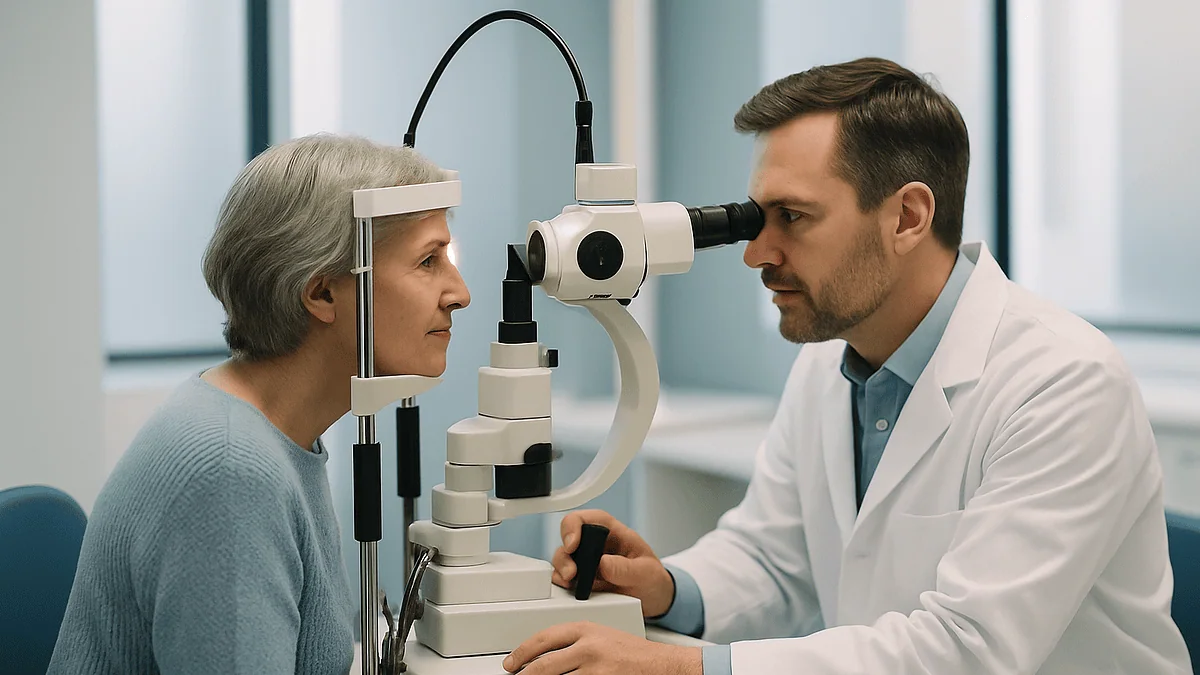
- The gonioscopy lens placed on the eye contains mirrors that let the specialist see into the hidden drainage angle while steadying the eye and focusing the beam.
- The pressure check before you leave screens for an early pressure spike; it does not measure success, because the effect of trabeculoplasty builds over a few weeks.
- In the LiGHT trial of 718 newly diagnosed patients, the majority of eyes treated with SLT first reached target pressure without drops at three years, prompting NICE to support laser as a first option.
- Selective laser trabeculoplasty requires an open drainage angle, so eyes with closed angles are offered laser iridotomy or other approaches instead.
- Trabeculoplasty's pressure-lowering effect tends to fade over years and can often be repeated, so lifelong pressure monitoring continues regardless of the result.
During a glaucoma laser treatment procedure, an eye specialist places numbing drops in the eye, rests a small contact lens on the surface to steady it and focus the beam, and delivers brief pulses of light to a target inside the eye to help lower pressure. Most people feel pressure or clicks rather than pain. Eye pressure is measured before and after, and the effect builds over the following weeks.
The appointment letter says one word that makes most people sit up straighter: laser. You read it twice. You picture something from a film, a red beam and a countdown. Then you notice the fine print says you can go home the same day, and that you should bring sunglasses.
That mismatch, between what the word suggests and what actually happens in the room, is the reason this explainer exists. A glaucoma laser treatment procedure is one of the quieter events in modern eye care. You sit at a machine that looks like the one used for an ordinary eye exam. Someone puts in drops. A lens touches the eye. There are clicks. Fifteen minutes later you are asking where the coffee cart is.
What follows walks through each step in the order you will meet it, explains why each one exists, and is honest about the parts that are uncertain, uncomfortable or simply not for everyone.
What is the glaucoma laser treatment procedure, in plain language?
Glaucoma is a group of conditions in which the optic nerve, the cable carrying images from the eye to the brain, is slowly damaged, most often because the pressure inside the eye is higher than that nerve can tolerate. That pressure is called intraocular pressure, and it depends on a fluid called aqueous humor, a clear liquid the eye makes continuously and drains continuously. When drainage lags behind production, pressure climbs.
Every glaucoma laser treatment procedure works on one side of that equation. Either it helps fluid leave the eye more easily, or it reduces how much fluid the eye makes. The laser itself is a very precise source of light energy. It does not cut in the way a scalpel does. Depending on the type, it either nudges tissue to behave differently, opens a tiny channel, or gently reduces the activity of the fluid-producing tissue.
The most common outpatient version targets the trabecular meshwork, the spongy drainage tissue that sits in the angle where the colored iris meets the clear cornea. Short pulses of light are aimed at that meshwork through a lens held on the eye. The tissue is not burned away. Instead, the light energy triggers a biological response over the following weeks that improves outflow, which is why the pressure drop is gradual rather than instant, a point the Mayo Clinic makes when it notes that the full effect can take a few weeks to appear.
Hold on to that idea, because it explains almost everything else about the day: why you are measured before and after, why nobody promises a number on the spot, and why you will probably still be using drops when you leave.
SLT laser for glaucoma, ALT, iridotomy or cyclophotocoagulation: which is which?
Patients often arrive having read about “the glaucoma laser” as if there were one. There are several, and the NHS lists three broad kinds in its guidance on glaucoma treatment: laser trabeculoplasty, laser iridotomy and cyclodiode (cyclophotocoagulation) laser. The right one depends on the type of glaucoma, and that is a decision your specialist makes after examining the drainage angle.
Selective laser trabeculoplasty (SLT) uses low-energy pulses that are absorbed mainly by pigment-containing cells in the drainage meshwork, sparing surrounding tissue. Argon laser trabeculoplasty (ALT) is the older approach; it uses a continuous beam to make tiny thermal spots along the same meshwork. Both aim to improve outflow in open-angle glaucoma, where the angle is open but drains poorly.
Laser iridotomy is different. It creates a small opening in the peripheral iris so fluid can bypass a narrow or closed angle. It is used for angle-closure glaucoma or for eyes judged at risk of angle closure. Cyclophotocoagulation treats the ciliary body, the ring of tissue that manufactures aqueous humor, reducing fluid production. It is usually reserved for glaucoma that has not responded to other measures.
| Laser type | Where it acts | What it aims to do | Usually considered for |
|---|---|---|---|
| SLT | Trabecular meshwork | Improve fluid outflow | Open-angle glaucoma, ocular hypertension |
| ALT | Trabecular meshwork | Improve fluid outflow | Open-angle glaucoma (older method) |
| Laser iridotomy | Peripheral iris | Open a bypass for fluid | Angle-closure or narrow angles |
| Cyclophotocoagulation | Ciliary body | Reduce fluid production | Advanced or hard-to-control glaucoma |
The rest of this article describes the trabeculoplasty experience in most detail, because it is the version most people are offered first, and notes where iridotomy differs.
What happens before the laser starts: the first pressure check
The day begins the way many eye visits do. A technician checks your vision, then measures your intraocular pressure. This is tonometry, a test that estimates pressure by measuring how the cornea responds to a small puff of air or the gentle touch of a tiny probe after a numbing drop. That baseline number matters, because it is the reference point for everything that follows.
You will usually be asked about your current eye drops and whether you have used them that morning. Answer precisely. A missed dose can raise the baseline and make later readings hard to interpret. You will also be asked about allergies, past eye surgery, blood thinners and any history of inflammation inside the eye, because those details can change the plan.
Many specialists then instill a pressure-lowering drop before the laser. The reason is a known quirk of the procedure: in a minority of eyes, pressure rises briefly in the first hour or so afterward, a pressure spike. A pre-treatment drop, commonly from the alpha-agonist class, is meant to blunt that spike. Which drop, and whether one is used at all, is the clinician’s call based on your eye, and this article does not suggest any particular choice.
For laser iridotomy the preparation adds a step. A drop that constricts the pupil, such as pilocarpine, is used to stretch the iris thin and pull it away from the cornea so the laser has a clear, taut target. That drop can cause a dull brow ache and dim vision for a while, which is normal and expected, and your team will tell you how long that typically lasts.
Then the numbing drops go in, and the part people are actually nervous about begins.
Numbing drops: what they do and what you will actually feel
The anesthetic used for a glaucoma laser treatment procedure is a topical eye drop, not an injection and not sedation. A topical anesthetic works by temporarily blocking the nerve signals from the surface of the eye, the cornea and the conjunctiva, so that touch no longer registers as sensation. Onset is quick, within a minute or so in most eyes, and the effect wears off within a short time after the visit.
Here is what people rarely get told in advance: the drop stings for a few seconds when it first lands. That brief sting is often the single most uncomfortable moment of the whole appointment. After it passes, the surface of the eye feels oddly heavy or absent, a bit like a lip after dental work.
What the drop does not do is numb the inside of the eye. The trabecular meshwork and the iris are not touched by the drop, and they do not have the same kind of pain fibers as the surface. That is why surface anesthesia is enough for trabeculoplasty: the lens touching the eye is what would otherwise hurt, and the drop handles that. It is also why some people feel something during the pulses themselves, a sensation described below, which the drop cannot fully prevent.
A practical consequence of a numb eye: your blink reflex is dulled, so you may not notice if you rub it. Do not rub. The cornea is easy to scratch while it cannot feel, and a scratch would add a day or two of gritty discomfort you did not need. Your team will usually tell you when the drop has worn off, and until then, hands away.
The NHS notes that even with anesthetic drops, a brief twinge or a feeling of heat during laser treatment is possible. That is an honest expectation, and it is the right one to carry into the room.
Why does the doctor put a lens on your eye?
Once the eye is numb, the specialist places a small contact lens directly onto its surface. This is a gonioscopy lens, a specialized lens containing tiny mirrors that lets the doctor look around the corner into the drainage angle, which is hidden from a straight-on view. The lens also steadies the eye, holds the lids apart and focuses the laser beam onto the exact spot being treated.
A gel is placed on the lens first so it glides on smoothly and so there is no air between lens and cornea. The gel is the reason your vision will be blurry afterward for a while; it lingers and smears the view until it washes out with your tears.
You will feel the lens as light pressure, sometimes a sense that something is resting on the eye, but not as pain, because the surface is numb. Your job during this part is simple and surprisingly important: keep your other eye open and look at the target you are given. When the untreated eye stays open, both eyes stay still. When you squeeze one shut, the other tends to wander.
For laser iridotomy the lens is a different design, one that magnifies and concentrates the beam on the iris rather than on the angle, but the sensation of having it placed is the same.
The specialist then rotates the lens gradually around the circumference of the angle, delivering pulses as they go. Some treat half the angle, some the whole 360 degrees, depending on their protocol and your eye. Each pulse is announced by a click from the machine and often a small flash of light. Most trabeculoplasty sessions take a matter of minutes. When the lens comes off, the treatment is over. It feels, for many, anticlimactic.
Is glaucoma laser surgery painful? An honest answer
Ask a room of people who have had SLT and you will hear a range, but the center of that range is “uncomfortable, not painful.” The most common descriptions are a sense of pressure from the lens, a dull ache building over the session, and occasional sharp pinpricks or a feeling of warmth as individual pulses land. Some notice nothing at all beyond the clicks.
Why the variation? Pigment. SLT energy is absorbed by pigment-containing cells, and eyes with more pigment in the angle can register more sensation per pulse. Individual pain thresholds and anxiety also play a part; a tense, braced body reads every sensation louder.
Laser iridotomy is more often reported as briefly uncomfortable, because the iris has more sensory supply than the drainage meshwork and because the energy needed to create an opening is higher. People describe a single sharp jab, sometimes a headache-like ache, lasting seconds. Cyclophotocoagulation is the exception in this group; because it targets tissue deeper in the eye, it is typically performed with a local anesthetic injection around the eye rather than drops alone, and your team will explain that separately if it applies to you.
Two things genuinely help. Tell the specialist during the procedure if a pulse is sharp; energy settings can often be adjusted, and knowing you can speak up reduces the dread. And breathe slowly through the clicks rather than holding your breath, which is the reflex most people fall into.
Afterward, a mild ache or light sensitivity for the rest of the day is common. Persistent or worsening pain is not, and the section on when to call your doctor explains what that might mean.
The pressure check after the laser: why you are asked to wait
When the lens comes off, you are not finished. In most clinics you will be asked to sit in the waiting area and then have your intraocular pressure measured again before you leave. This second tonometry reading is not looking for success. It is looking for a problem.
The problem is the pressure spike mentioned earlier. In a small proportion of eyes, the treated tissue reacts with mild swelling or releases pigment and debris into the drainage angle, temporarily clogging it. Pressure can rise sharply for a short time. Most spikes are modest and settle on their own, but an eye with advanced nerve damage has little reserve, so specialists want to catch a significant rise while you are still in the building and can be treated with drops on the spot.
This is also why the reading taken before you leave will not tell you whether the laser “worked.” The therapeutic effect of trabeculoplasty is biological and gradual; the Mayo Clinic describes the full effect as taking a few weeks to become apparent. A post-laser number that is the same as, or slightly above, your baseline is completely ordinary. The number that matters is the one at your follow-up visit, usually scheduled several weeks out, and your team will set that interval.
Before you go, expect a short conversation covering three things: whether to continue your existing drops exactly as before (usually yes, until told otherwise), whether any anti-inflammatory drop has been prescribed and how to use it, and when to come back. Write the follow-up date down. The most common way a good laser result goes to waste is a missed appointment where nobody measured the pressure.
Who is the glaucoma laser treatment procedure usually for, and who is asked to wait?
Laser trabeculoplasty is generally considered for people with primary open-angle glaucoma or with ocular hypertension, raised eye pressure without yet-detectable nerve damage. It is offered in three broad situations: as an initial treatment instead of drops, as an addition when drops alone are not reaching the target pressure, and as a substitute when drops cause side effects or are hard to use consistently. UK guidance from NICE now supports offering SLT as a first option for newly diagnosed open-angle glaucoma or ocular hypertension, a shift driven largely by the LiGHT trial described later.
Laser iridotomy is for a different group: people whose drainage angle is anatomically narrow or closed. Sometimes that means an acute angle-closure attack has already happened. More often it means an eye examination found the angle narrow enough that the specialist judged the risk of closure worth preventing, even without symptoms.
Who is usually asked to wait, or offered something else? Trabeculoplasty depends on a visible, open angle, so it is not suited to eyes where the angle is closed or scarred shut. Eyes with active inflammation inside them, a condition called uveitis, are often deferred until the inflammation is controlled, because laser energy can aggravate it. Certain secondary glaucomas, where pressure is high because of another disease, may respond poorly. Very advanced glaucoma with pressure far above target is sometimes steered toward incisional surgery instead, because a modest laser effect would not be enough.
People taking blood thinners, pregnant patients and those unable to sit at a slit-lamp machine each need individual assessment. None of these is an automatic exclusion. Each is a conversation, and the decision rests with the specialist who has examined your angle, your nerve and your history.
What do the following days and weeks usually look like?
The first evening is mostly about the leftovers of the appointment. Vision is blurred from the gel and the drops. The eye may feel achy, gritty or light-sensitive, which is why the letter told you to bring sunglasses. Reading and screens are fine if comfortable, but most people find they would rather not. Someone else should drive you home.
By the next morning the blur has usually cleared and the eye feels close to normal. A mild redness or a sense of something in the eye can linger for a day or two. If your specialist prescribed an anti-inflammatory drop, use it exactly as directed; its role is to calm the treated tissue’s reaction, and the schedule is the prescriber’s decision, not a matter of preference.
Continue your regular glaucoma drops unless told otherwise. This surprises people. The laser is not an immediate replacement, and your specialist will only consider reducing drops once follow-up measurements show a stable, adequate pressure. The Mayo Clinic notes the effect can take a few weeks to fully develop, so the meaningful decision point is the follow-up visit, not the day of treatment.
Some people notice halos or faint glare after laser iridotomy, especially if the opening sits where the upper eyelid margin crosses it and light scatters through. This tends to be more noticeable early and often fades, though not in everyone. After trabeculoplasty, visual side effects are uncommon.
Over the longer term, the pressure-lowering effect of trabeculoplasty is not permanent. It can wane over a period of years, and in many eyes the treatment can be repeated. That is another reason regular pressure checks continue for life: glaucoma is managed, monitored and controlled, not finished.
Eye drops or laser: which is better for glaucoma?
This is the question behind most searches, and the honest answer is that “better” depends on what you are measuring. Both lower eye pressure. The differences lie in convenience, side effects, dependence on daily behavior and durability.
The most influential evidence comes from the LiGHT trial, a randomized study of 718 people with newly diagnosed open-angle glaucoma or ocular hypertension in the UK, published in The Lancet and indexed in PubMed. Participants were assigned either to SLT first or to eye drops first and followed for three years. The majority of eyes in the laser-first group reached their target pressure without needing any drops at three years, and the laser-first strategy was judged cost-effective within the UK health system. The trial did not show laser to be more effective at lowering pressure than drops; it showed that starting with laser was a reasonable, effective strategy that spared many people daily medication. NICE guidance subsequently endorsed offering SLT as a first option.
Drops have real strengths. They are adjustable, reversible and can be layered. They also have real weaknesses: the eye must receive them every day, often more than once, indefinitely. Missed doses are common, and preservatives in some formulations irritate the ocular surface over years. Some classes have body-wide effects, which is why your prescriber asks about heart and lung history.
Laser’s strength is that it does not depend on remembering anything. Its weakness is that the effect is variable from eye to eye, cannot be predicted in advance, and fades over time. Many people end up with both: a laser that does part of the work and a drop that does the rest.
Which is right for you is a judgment about your pressure target, your angle, your ability to use drops and your preferences, made with your specialist.
What are the downsides of eye laser treatment? Glaucoma laser side effects and alternatives
Neutral language matters here, because the risks are real but mostly minor, and both exaggeration and reassurance can mislead.
The common, short-lived effects after trabeculoplasty are inflammation inside the front of the eye, causing ache and light sensitivity for a few days, and the transient pressure spike already described. Blurred vision from the gel and drops clears within hours. Redness and a gritty feeling settle over a day or two.
Less common effects include a more pronounced or prolonged inflammation, particularly in eyes with heavy pigment or a history of uveitis, and, rarely, a lasting pressure increase that needs additional treatment. Trabeculoplasty can also simply fail to lower pressure enough, which is not a complication so much as a limitation, but it is a downside people should hear before choosing it.
Laser iridotomy carries its own list: glare, halos or a line of light in the visual field from the new opening; bleeding from the iris at the time of treatment, usually brief; inflammation; and occasionally a small area of clouding of the lens or cornea near the treatment site. The opening can also close over and need re-treatment.
Cyclophotocoagulation has a higher rate of inflammation and a small risk of pressure falling too low, which is why it is generally reserved for eyes with fewer options.
- Alternatives to laser include continuing or adjusting drops, incisional glaucoma surgery that creates a new drainage pathway, and a range of smaller implant-based procedures often combined with cataract surgery.
- For narrow angles, removing a cataract can itself deepen the angle and is sometimes preferred to iridotomy in older eyes.
Each alternative trades a different set of risks against a different expected pressure drop. Your specialist’s job is to lay those trade-offs out for your particular eye; this article’s job is only to make sure you know they exist.
What people often get wrong about glaucoma laser treatment
“The laser restores lost vision.” It does not. Glaucoma damages the optic nerve, and nerve fibers that have died do not regrow. Every glaucoma treatment, laser included, aims to lower pressure so that further damage is slowed or prevented. The vision you have on the day of treatment is the vision the treatment is trying to protect.
“If the laser works, I can stop my drops.” Sometimes, eventually, and only on your specialist’s instruction after follow-up measurements. Stopping drops on your own because the eye “feels fine” is a well-worn route to nerve damage, because rising pressure produces no symptoms at all in most people.
“The pressure reading right after the laser tells me if it worked.” It tells the team whether there is an early spike. The therapeutic effect builds over weeks, as the Mayo Clinic notes, and the follow-up reading is the one that counts.
“Laser is a one-time fix.” The effect of trabeculoplasty tends to diminish over years. Repeat treatment is often possible, and lifelong monitoring continues regardless.
“Laser and surgery are the same thing.” Laser is performed at a slit-lamp machine with drops, in minutes, with no incision. Incisional surgery is performed in an operating room and creates a physical drainage pathway. They sit at very different points on the intervention scale.
“Laser is only for advanced glaucoma.” The evidence, and UK guidance, now position SLT as a reasonable first step for newly diagnosed open-angle glaucoma, not a last resort.
“It will hurt like a burn.” For most people it feels like pressure and clicks, with a sting from the drops and perhaps a few sharp pulses. Iridotomy is briefly sharper. Neither resembles a burn.
Questions to ask your care team before the laser
A good consultation leaves you knowing not just what will happen but why this particular option was chosen for your eye. These questions tend to surface the information that matters.
- Which type of laser are you recommending, and what in my examination points to that one rather than another?
- What is my target eye pressure, and how far from it am I now?
- Are you offering laser instead of drops, in addition to drops, or as a step before considering surgery?
- Will you give a pressure-lowering drop before treatment, and will I be checked for a pressure spike before I leave?
- Should I take my usual glaucoma drops on the morning of the laser?
- Will I need an anti-inflammatory drop afterward, and for how long?
- How much of the angle will you treat in one session, and might a second session be planned?
- When is my follow-up pressure check, and what result would lead you to change my drops?
- If the laser does not lower my pressure enough, what would the next step be?
- How long does the effect typically last in eyes like mine, and can it be repeated?
- For iridotomy: where will the opening be placed, and what visual effects should I expect?
- What symptoms after treatment should make me call the same day?
Bring a written list of your current eye drops with their names and how often you use them, plus any other medicines, particularly blood thinners. If English is not your first language or you find medical conversations hard to retain, ask whether a companion can sit in. The answers to these questions are specific to your eye, and no article can supply them.
When to call your doctor after glaucoma laser treatment
Most people have an uneventful evening and a normal next day. A mild ache, light sensitivity, redness and blurred vision that clears within hours are expected. The signs below are not expected, and each warrants a same-day call to your eye clinic or, out of hours, urgent eye care.
- Severe or steadily worsening eye pain, especially with nausea or vomiting, which can signal a significant pressure rise.
- Vision that becomes markedly worse rather than gradually clearer, or a sudden loss of part of your visual field.
- A sudden shower of new floaters, flashes of light, or a curtain or shadow across the vision.
- Deep redness that increases over a day or two rather than fading, or a visibly cloudy cornea.
- Intense light sensitivity that persists beyond the first day or two.
- Any discharge from the eye, or a feeling that something is in the eye that does not settle, which could indicate a corneal scratch.
- After iridotomy: a sudden return of the symptoms that prompted treatment, such as haloes around lights with a painful, hard-feeling eye.
You should also call if you are unsure whether to keep using a drop, have run out of a prescribed drop, or have missed your follow-up appointment. Glaucoma gives no warning when pressure rises; the appointment is the warning system. Keeping it is the single most useful thing you can do after the laser itself.
Every judgment about your eye, from whether to treat to what to do if pressure rises, belongs to the team that has examined it. This explainer is meant to help you understand their reasoning and ask better questions, never to replace it.
Frequently asked questions
How painful is laser surgery for glaucoma?
Most people describe laser trabeculoplasty as uncomfortable rather than painful: pressure from the lens, clicks, and sometimes a few sharp or warm pulses. The numbing drops sting briefly when they go in, and that is often the worst moment. Laser iridotomy is more often felt as a single sharp jab lasting seconds. A dull ache and light sensitivity for the rest of the day are common, and worsening pain is a reason to call.
What are the downsides of eye laser treatment for glaucoma?
The main downsides are short-lived inflammation, a temporary pressure spike in a minority of eyes, blurred vision for a few hours, and the possibility that pressure does not fall enough. The effect of trabeculoplasty also fades over years. Laser iridotomy can cause glare or halos and occasionally needs repeating. Serious complications are uncommon, but any option carries trade-offs your specialist should walk through.
Which is better for glaucoma, eye drops or laser treatment?
Neither is universally better; both lower pressure by different routes. The LiGHT trial found that starting with SLT allowed most newly diagnosed patients to reach target pressure without drops at three years, and UK guidance now supports laser as a first option. Drops remain adjustable and reversible but depend on daily use. Many people end up using both. The choice rests on your pressure target, anatomy and preferences, decided with your specialist.
Is laser surgery for glaucoma a good idea?
For many people with open-angle glaucoma or ocular hypertension it is a reasonable, evidence-supported option, either first or alongside drops. Whether it is a good idea for you depends on whether your drainage angle is open, how far you are from your pressure target, how well you manage drops, and whether you have conditions such as uveitis that make laser less suitable. Only the specialist who has examined your eye can weigh those factors.
What is the laser iridotomy procedure like compared with SLT?
Laser iridotomy creates a small opening in the peripheral iris to let fluid bypass a narrow angle, whereas SLT treats the drainage meshwork of an open angle. Preparation for iridotomy usually includes a pupil-constricting drop that can cause a brow ache and dim vision. The pulses are briefly sharper than SLT. Afterward, some people notice glare or halos. The lens, numbing drops and pressure checks are otherwise similar.
How long does the glaucoma laser treatment procedure take?
The laser delivery itself is usually a matter of minutes, but the appointment is longer because of the pressure check before, the wait for drops to take effect, and the pressure check afterward. Plan on being at the clinic for a good part of the morning or afternoon, and arrange for someone else to drive you home because vision is blurred by the gel and drops.
Can I stop my eye drops after glaucoma laser treatment?
Not on your own. Continue your usual drops exactly as prescribed unless your specialist tells you otherwise. The laser’s effect takes a few weeks to develop, so any decision to reduce drops is made after follow-up pressure measurements show a stable, adequate result. Stopping early risks a silent rise in pressure, since glaucoma produces no symptoms until damage is advanced.
Does glaucoma laser treatment improve vision?
No. Laser treatment lowers eye pressure to protect the optic nerve from further damage; it does not restore vision already lost, because damaged nerve fibers do not regrow. Vision may actually be blurry for a few hours afterward because of the gel and drops. The goal of every glaucoma treatment, laser included, is to preserve the sight you have.
How long does SLT laser for glaucoma last?
The pressure-lowering effect of selective laser trabeculoplasty is not permanent. It typically diminishes over a period of years, and the duration varies widely between eyes and cannot be predicted in advance. In many eyes the treatment can be repeated when the effect wanes. Regular pressure checks continue for life regardless, so that a gradual rise is caught before it causes harm.
What should I do the evening after glaucoma laser treatment?
Rest the eye, wear sunglasses if light bothers you, and avoid rubbing while the surface is still numb. Use any prescribed anti-inflammatory drop exactly as directed and keep taking your regular glaucoma drops unless told otherwise. Do not drive. Mild ache, redness and blur are expected; severe or worsening pain, nausea, marked vision loss or new flashes and floaters warrant a same-day call.
References
This article is for general information only and is not a substitute for professional medical advice. Please consult a qualified doctor about your individual situation.

More from the Blog

LASEK vs PRK: How the Two Surface Laser Techniques Differ and Why Surgeons Pick One
LASEK and PRK are both surface laser procedures that reshape the cornea without cutting a flap; the difference is what happens to the thin…

Is ILASIK Right for You? Corneal Thickness, Eye Pressure and Contact Lens Breaks
ILASIK candidate requirements generally include being at least 18 with a prescription that has been stable for a year or more, corneas thick and…

What Glaucoma Surgery Can and Cannot Do: Protecting the Vision You Still Have
Glaucoma surgery lowers pressure inside the eye to slow or stop further damage to the optic nerve. It cannot restore vision already lost, because…
Intraocular Lens Recovery: Eye Drops, Lifting Limits and When Vision Settles
Most people recover from intraocular lens (IOL) surgery over about 4 to 8 weeks, according to the NHS and Mayo Clinic, though everyday vision…

Local or General Anesthesia for Vitrectomy: What You Feel and How the Choice Is Made
Most vitrectomies in adults are performed under local anesthesia: numbing injections around the eye, usually combined with light intravenous sedation, so you are relaxed,…

Helping a Child Stick With Eye Patching: Practical Support for Amblyopia Treatment
Helping a child with an eye patch for amblyopia works best when patching becomes a predictable, short, engaging routine: same time daily, paired with…