

Robotic Colorectal Surgery Recovery: Daily Walks, Small Meals and the Lifting Limit

Key Takeaways
- MedlinePlus describes a typical hospital stay of about three to seven days after large bowel resection, with longer stays more likely after emergency operations.
- Fascia, the connective tissue holding the abdominal wall together, heals far more slowly than skin, which is why lifting limits of roughly four to six weeks apply even when small robotic wounds look healed.
- Walking several times a day from the first day lowers the risk of pneumonia, deep vein thrombosis, and a sluggish bowel, and is built into enhanced recovery pathways as treatment rather than optional activity.
- Small, frequent, low-residue meals in the first week reduce bloating and cramping while the bowel join regains function, with fiber reintroduced gradually over the following weeks.
- The robotic system cannot act independently; the surgeon controls every movement, and MedlinePlus notes the operation may be converted to open surgery if that is safer.
- Evidence comparing robotic and laparoscopic colorectal surgery shows broadly similar complication and cancer outcomes, so recovery should be planned around the internal operation, not the size of the scars.
Robotic colorectal surgery recovery usually means a hospital stay of a few days, then several weeks of gradual healing at home. Most care teams ask patients to walk daily from the first day, eat small and frequent meals as appetite returns, and avoid heavy lifting for roughly four to six weeks. Exact timelines depend on the operation, your health, and your surgical team's instructions.
The kettle is on, the surgical stockings are still folded on the chair, and somewhere in the house a bag of soil that never made it to the garden has become the most tempting object in the world. Two weeks after a robotic bowel operation, the body feels almost ordinary again. That is precisely the moment people start asking whether the rules still apply.
They do, and understanding why makes them far easier to follow. Robotic colorectal surgery recovery has a rhythm: a short, intense stretch in hospital, then a longer, quieter phase at home where three habits do most of the work. Walking every day keeps the lungs clear and the bowel moving. Small meals let a freshly joined intestine relearn its job without being overwhelmed. And the lifting limit protects tissue that looks healed on the outside long before it is strong on the inside.
This explainer walks through what actually happens, what the evidence supports, and where the honest answer is “ask your surgeon.”
What does robotic colorectal surgery recovery actually involve?
Colorectal surgery is any operation on the colon (the large bowel) or the rectum (its final section). The most common version is a colectomy, in which a surgeon removes a diseased segment and, where possible, reconnects the healthy ends. That reconnection is called an anastomosis, a stitched or stapled join that must hold while the bowel wall heals around it.
The robotic part describes how the surgeon reaches the bowel, not what happens to it. Instead of one long incision, the operation is performed through several small ports using instruments controlled from a console. The surgical work inside is the same: tissue is cut, blood vessels are sealed, and the join is made.
Recovery therefore has two overlapping layers. The first is the healing of the small skin wounds, which usually settle within a couple of weeks. The second, and more important, is internal healing of the anastomosis and the muscle layer of the abdominal wall, which takes considerably longer. MedlinePlus describes a typical hospital stay of about three to seven days after large bowel resection, with the longer end more common after emergency operations or complications.
Home recovery is where most of the effort happens. Mayo Clinic notes that full recovery from a colectomy generally takes several weeks, and that patients are usually asked to build activity slowly rather than resume everything at once. The three pillars in this article’s title are not arbitrary hospital habits. Each one targets a specific risk: pneumonia and clots for walking, a sluggish or overloaded bowel for meals, and hernia or strain for the lifting limit.
One early expectation is worth setting: feeling well is not the same as being healed. Robotic techniques often shorten the first, visible layer of recovery. They do not change the biology of how quickly a bowel join or an abdominal wall regains strength.
How does robotic colorectal surgery work?
Picture the operation from the surgeon’s side. After general anesthesia, the abdomen is gently inflated with carbon dioxide gas to create working space. Through four or five small incisions, each usually shorter than a thumbnail, thin robotic instruments and a high-definition camera are inserted. The surgeon sits at a console a few feet away, viewing a magnified three-dimensional image and moving hand controls that translate into precise movements of the instruments inside.
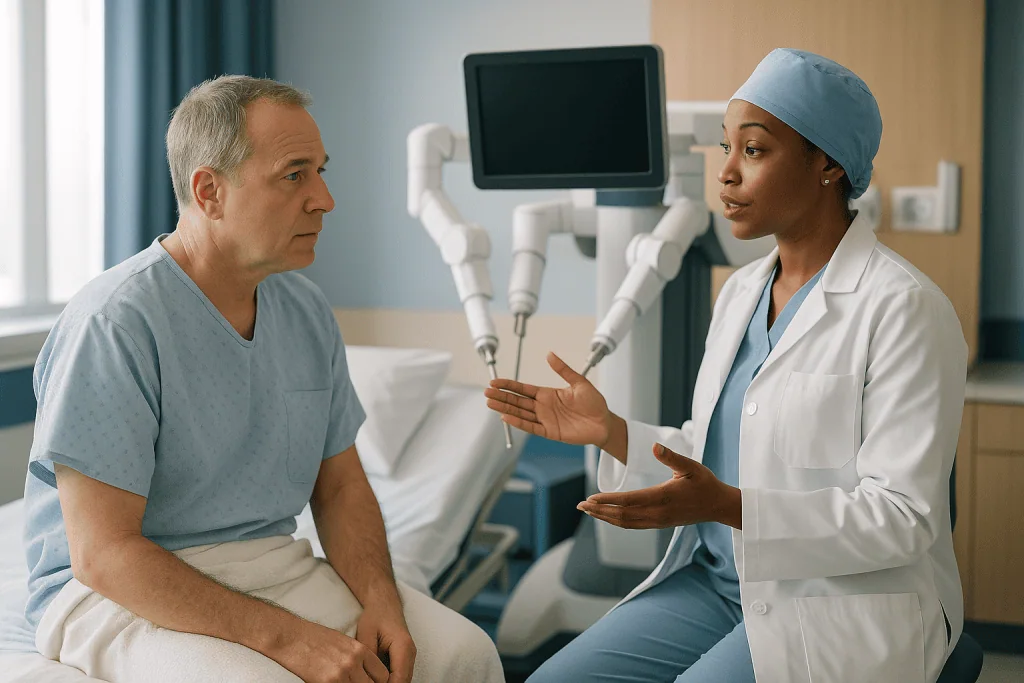
The robot does nothing on its own. MedlinePlus is explicit that the system cannot make decisions or move without the surgeon, and that a trained surgical team stands at the patient’s side throughout. The instruments have wrists that rotate further than a human hand, which is particularly useful in the narrow pelvis where the rectum sits, surrounded by nerves and blood vessels.
The diseased segment is freed from its attachments, its blood supply is sealed, and the specimen is removed through one of the small incisions, which may be slightly enlarged for this step. The healthy ends are then joined with staples or sutures. In some rectal operations the join sits very low, and the surgeon may create a temporary stoma, an opening on the abdomen through which stool leaves into a pouch, to rest the join while it heals.
Two practical points follow from this mechanism. First, the carbon dioxide gas is largely absorbed within a day or two, but a share of the shoulder or upper-abdominal ache people describe in the first days comes from irritation of the diaphragm by that gas, not from the bowel itself. Second, MedlinePlus notes the surgeon may need to convert to a conventional open operation if bleeding, scarring, or anatomy make the robotic approach unsafe. That is a judgment call made for the patient’s benefit, not a failure, and it changes the recovery plan toward the longer open-surgery timeline.
Who is usually offered a robotic approach, and who is asked to wait?
Robotic access is used for many of the same conditions as other bowel operations: colorectal cancer, diverticular disease that keeps flaring or has perforated, inflammatory bowel disease that no longer responds to medical treatment, large polyps that cannot be removed through a colonoscope, and some cases of rectal prolapse. Mayo Clinic lists these as the usual reasons a colectomy is recommended in the first place; the decision about how to reach the bowel comes afterward.
Surgeons tend to favor a minimally invasive approach, robotic or laparoscopic, when the operation is planned rather than emergency, the patient’s heart and lungs can tolerate the gas inflation and positioning, and there is no expectation of dense scarring from previous abdominal operations. Rectal cancer, where the working space is tight and the margins matter, is an area where the instrument dexterity is often considered helpful, though evidence comparing outcomes between robotic and laparoscopic approaches remains mixed rather than decisive.
Some people are asked to wait, or are steered to a different approach. Emergency presentations such as a blocked or perforated bowel often need open surgery because speed and wide access come first. Severe obesity, extensive previous surgery, or advanced heart or lung disease may make prolonged gas inflation and the head-down positioning riskier. Active infection, uncontrolled diabetes, smoking, and poor nutrition are frequently addressed before a planned operation, because each is linked with slower wound healing and higher complication rates. Cleveland Clinic notes that not every patient or procedure is suitable for robotic surgery and that the surgeon weighs these factors case by case.
The honest summary is that the approach is chosen for the person and the problem, not the other way round. Being offered an open operation does not mean worse care; it usually means the team judged it the safer route for that particular abdomen.
What happens in the first 48 hours after robotic bowel surgery?
The first two days are structured, and it helps to know the structure in advance. Most units follow an enhanced recovery pathway, a set of evidence-based steps designed to get the body functioning normally as soon as safely possible. In practice that means less time attached to tubes and more time upright.

Within hours of waking, nurses will usually ask you to sit on the edge of the bed, then stand, then take a short walk with support. This is not impatience. Early mobilization helps the lungs fully inflate, which lowers pneumonia risk, and gets calf muscles pumping blood back toward the heart, which reduces the risk of deep vein thrombosis, a clot in a leg vein. You will likely also be wearing compression stockings and receiving a blood-thinning injection prescribed by the team for the same reason.
Fluids by mouth are commonly allowed the same day, and light food soon after, once the anesthesia has worn off and there is no significant nausea. The bowel is often slow to wake after being handled, a temporary state called ileus. Sipping fluids, chewing gum in some pathways, and walking are all used to encourage it along. Passing gas is the milestone everyone waits for; it signals the bowel is moving again.
A urinary catheter, if placed, is typically removed within a day or two. Small wounds are covered with dressings that may stay on for several days. Pain is usually managed with a combination of regular non-opioid painkillers and, where needed, short-term opioid medication, all at the discretion of the prescribing team.
By the end of day two, many people are walking the corridor several times, eating small meals, and beginning to feel more like themselves. MedlinePlus frames the typical hospital stay at three to seven days, and discharge is generally tied to specific goals: eating, walking, pain controlled by tablets, and bowel function returning.
Colectomy recovery timeline: what the first six weeks usually look like
Timelines are ranges, not promises, and your own may run shorter or longer for reasons your surgeon can explain. The table below reflects the typical pattern described by MedlinePlus and Mayo Clinic for people recovering from a planned large bowel resection using a minimally invasive approach.
| Phase | What is usually happening | What most teams ask of you |
|---|---|---|
| Days 1 to 3 | Bowel waking up, gas and early stool, wounds dressed, hospital stay of about 3 to 7 days per MedlinePlus | Walk several times daily, sip fluids, start small meals |
| Week 1 at home | Fatigue high, appetite variable, stools loose or frequent | Short walks, frequent small meals, no lifting beyond light household objects |
| Weeks 2 to 3 | Skin wounds largely closed, energy improving, bowel pattern settling | Longer walks, gradual return to desk-type work if cleared, driving only when comfortable and off strong painkillers |
| Weeks 4 to 6 | Internal healing continues though you feel well | Lifting limit still in place, typically until about 4 to 6 weeks per MedlinePlus guidance |
| Beyond 6 weeks | Most people back to usual activity; Mayo Clinic notes full recovery takes several weeks | Resume exercise and lifting as your surgeon advises |
Two caveats matter. If your operation was open rather than robotic, or if it was an emergency, every row shifts later, and your team will give you a revised plan. And if you have a stoma, the physical timeline is similar but the practical learning curve adds its own weeks.
The pattern most people do not anticipate is the mismatch between energy and healing. Fatigue tends to lift noticeably around the third week, which is exactly when the abdominal wall is still weakest. That gap is the reason the lifting limit gets its own section below.
Why daily walks matter more than bed rest
The instinct after an operation is to lie still and let the body knit itself back together. The evidence points the other way. Prolonged bed rest after abdominal surgery is associated with more lung complications, more clots, more muscle loss, and slower return of bowel function. Walking addresses all four at once, and it costs nothing.
Consider what happens when you stand and take a few steps. Breathing deepens, opening the lower parts of the lungs that stay partly collapsed when you lie flat; those collapsed segments are where post-operative pneumonia tends to begin. Calf muscles squeeze the deep veins, which is the body’s own clot-prevention system. Gentle movement of the trunk and abdominal contents encourages peristalsis, the wave-like contractions that move gas and stool along, easing the bloating that troubles many people in the first week. MedlinePlus lists walking among its core discharge instructions after large bowel resection, and enhanced recovery programs across guideline bodies build early and frequent mobilization into the pathway.
How much is enough? In hospital, several short walks a day, often to the end of the corridor and back, are the usual target. At home, a sensible approach is to walk a little several times a day rather than attempt one long outing, then extend the distance as stamina returns. Most people find that by the second or third week they can manage a comfortable walk around the neighborhood. Stairs are generally fine when you feel ready; take them slowly at first.
What walking is not is a substitute for rest. Naps in the afternoon are normal and useful in the first weeks. The goal is a rhythm of activity and recovery, not exhaustion. If a walk leaves you breathless, dizzy, or with sharply increased abdominal pain, stop and mention it to your team.
What to eat after colon surgery: small meals and a returning appetite
A bowel that has just been cut and rejoined behaves a little like a new employee: capable, but best not handed the whole workload on day one. Small, frequent meals give it manageable portions. Five or six modest plates spread through the day are usually easier to tolerate than three large ones, and they reduce the bloating and cramping that come when a sluggish bowel meets a heavy meal.
In the first week, most teams suggest soft, low-residue foods: white bread or toast, rice, pasta, well-cooked vegetables without skins, eggs, tender meat or fish, yogurt, and bananas. Low-residue simply means foods that leave less undigested bulk behind, easing the load on the join. MedlinePlus advises returning gradually to a normal diet as tolerated and paying attention to which foods cause discomfort. Fluids matter as much as food, particularly if stools are loose, because the colon’s job of absorbing water is temporarily reduced when part of it has been removed.
Foods that commonly cause trouble early include raw vegetables and salads, nuts, seeds, popcorn, high-fat or fried dishes, very spicy meals, and large quantities of fruit at once. Carbonated drinks add gas to an abdomen that already has plenty. Alcohol is generally best avoided while taking strong painkillers and while sleep and hydration are still recovering.
Protein deserves a mention. Wound healing and rebuilding lost muscle both draw on protein, and appetite is often lowest exactly when the need is highest. Including a source at each small meal, even a modest one such as an egg or a spoonful of cottage cheese, is a practical way to close that gap.
By the third or fourth week most people are back to a broadly normal diet, reintroducing fiber gradually. If a specific food reliably causes pain, vomiting, or a sudden change in stool, hold off and tell your team; a dietitian’s input can be arranged where needed.
The lifting limit explained: lifting after bowel surgery
Of the three pillars, the lifting limit is the one most often broken, usually by someone who feels fine. The logic behind it is worth understanding, because it applies even when the small robotic wounds look completely healed.
Every incision through the abdominal wall passes through fascia, the tough connective-tissue sheet that holds the muscles together and keeps the intestines in. Fascia heals slowly. While skin regains most of its strength in a couple of weeks, fascia takes well over a month to approach its previous tensile strength. Lifting a heavy object sharply raises pressure inside the abdomen, and that pressure pushes outward against every point where the fascia was cut. Push hard enough, often enough, and a gap can open, allowing bowel or fat to bulge through. That is an incisional hernia, and repairing one means another operation.
Robotic surgery reduces the size of the incisions but does not eliminate the risk. The port used to remove the specimen is often enlarged, and small fascial openings can still herniate. MedlinePlus discharge guidance for large bowel resection describes avoiding heavy lifting and strenuous activity for roughly four to six weeks, with many teams setting a limit around ten pounds, about the weight of a full grocery bag or a small watering can.
Practical translation for daily life: no carrying laundry baskets, no vacuuming with a heavy upright machine, no lifting toddlers or pets onto your lap, no bags of soil or compost, no dragging a full trash bin to the curb, and no gym work involving the trunk. Pushing and pulling heavy doors or shopping carts also raises abdominal pressure. Coughing and straining on the toilet do the same, which is one more reason to keep stools soft.
When the limit lifts, build back gradually. Your surgeon will tell you when it is safe to progress, and that decision belongs with them, not the calendar.
Bowel habits, gas and a temporary stoma: finding the new normal
Few things unsettle people after bowel surgery as much as the bowel itself. Stools may be loose, frequent, urgent, or unpredictable for weeks. This is expected. Part of the colon’s job is to absorb water and store stool; remove a section and both functions are reduced until the remaining bowel adapts. The lower the join, the more noticeable the change tends to be, and after rectal surgery some people experience clustering, several small bowel movements in quick succession, that improves slowly over months.
Gas is the other constant companion. Some is left over from the operation, some comes from a bowel that is still sluggish, and some from foods that ferment in the gut. Walking helps, small meals help, and time helps most of all. Constipation can also occur, especially while taking opioid painkillers, which slow the gut as a side effect. Fluids, gentle activity, and any stool softener your team recommends are the usual tools; straining is best avoided for the same reasons as lifting.
If you have a temporary stoma, the early weeks add a practical learning curve. NHS guidance on bowel cancer treatment explains that a stoma is sometimes created to divert stool away from a healing join, and that it can often be reversed in a later operation once the surgeon is satisfied the join has healed. A stoma nurse will teach you to change the pouch, check the skin, and recognize a healthy stoma, which is normally moist and pink or red. Output tends to be looser from an ileostomy, which is made from the small bowel, than from a colostomy, so hydration and salt intake need more attention.
Emotionally, the first weeks with a stoma can be hard. That reaction is common, not a weakness, and stoma nurses and patient support groups exist precisely for it. Reversal, where planned, is a separate decision made by the team on the basis of healing and overall health, not a fixed date.
Pain, sleep and fatigue: what medicines do and how long the tiredness lasts
Robotic surgery often means less wound pain than an open incision, but “less” is not “none.” In the first days the discomfort has several sources: the small port sites, the deeper work inside, referred pain in the shoulders from residual carbon dioxide, and the ache of a bowel that is cramping back to life. Knowing which is which makes it less alarming.
Pain control is usually layered. Regular non-opioid painkillers, such as acetaminophen and, where the kidneys and stomach allow, anti-inflammatory drugs, form the base because they reduce pain without slowing the bowel. Opioids are added for breakthrough pain in the short term; their drawbacks are constipation, drowsiness, and nausea, which is why teams aim to step them down within the first week or two. Some units use local anesthetic blocks or infusions at the wound sites. Every one of these choices, including when to stop, sits with the prescribing clinician, and it is worth asking before discharge what the planned step-down looks like.
Fatigue is the symptom people least expect and most underestimate. Major surgery triggers an inflammatory and hormonal response that draws on energy stores for weeks, and disrupted sleep in hospital compounds it. Mayo Clinic describes recovery from colectomy as taking several weeks, and many people find that stamina, rather than pain, is the last thing to return. Afternoon rest, a regular bedtime, protein at each meal, and a daily walk in daylight all help reset the pattern.
Sleep positions can be awkward at first. Lying on your back with a pillow under the knees, or on your side with a pillow against the abdomen, reduces pull on the wounds. Hugging a pillow when you cough or laugh does the same job in the daytime.
If pain is climbing rather than easing after the first few days, or if you need more medicine rather than less, that trend itself is a reason to call the team.
Robotic colon surgery recovery time compared with laparoscopic and open surgery
People naturally want to know whether the robotic approach recovers faster. The honest answer is that minimally invasive surgery of either kind, robotic or laparoscopic, tends to shorten the visible part of recovery compared with open surgery, and that the difference between robotic and laparoscopic is smaller and less consistent than marketing sometimes implies.
Laparoscopic surgery uses the same small ports and camera but with straight, hand-held instruments rather than console-controlled wristed ones. Both approaches avoid the long midline incision of open surgery, and MedlinePlus lists the shared advantages: smaller wounds, less blood loss, less post-operative pain, shorter hospital stays, and quicker return to normal activity. These benefits are well established for minimally invasive approaches as a group.
Where robotic and laparoscopic surgery are compared head to head, systematic reviews have generally found broadly similar rates of major complications and similar oncological results, with robotic operations often taking longer in the operating room and, in some series, converting to open surgery less often, particularly in rectal cases. Differences in hospital stay and return to activity between the two are typically modest. This is an area of active research, and the balance of evidence may shift; your surgeon can tell you what applies to your operation.
What does not differ is the biology described earlier. Fascia heals at the same rate regardless of how it was cut. A bowel join takes the same weeks to strengthen. Bowel habits take the same months to settle after rectal surgery. So while the robotic patient may go home a day sooner than an open-surgery patient and feel comfortable earlier, the lifting limit and the meal advice are essentially the same.
The practical takeaway is to plan your recovery around the operation you had inside, not the size of the scars outside.
What people often get wrong about robotic colorectal surgery recovery
Myths cluster around this operation, and most of them are optimistic ones. Correcting them early prevents setbacks.
“Small scars mean I’m basically healed once they close.” Skin closes in about two weeks; fascia and the bowel join take considerably longer. The lifting limit exists because of what you cannot see.
“The robot did the surgery, so it was less of an operation.” The surgeon performed every step; the robot is an instrument, as MedlinePlus makes clear. The same length of bowel was removed and the same join was made as in any other approach.
“Rest is the fastest route to recovery.” Bed rest raises the risk of clots, pneumonia, and a sluggish bowel. Walking several times a day is treatment, not optional extra.
“I should eat a big meal to get my strength back.” A freshly joined bowel copes better with small, frequent meals. Strength comes back through protein spread across the day, not volume.
“Loose stools mean something has gone wrong.” Changed bowel habits are expected for weeks and, after rectal surgery, sometimes months. Sudden severe pain, fever, or bleeding are the signals that matter, not looseness alone.
“If I feel fine, the lifting rule no longer applies.” Energy often returns around week three, which is before the abdominal wall has regained its strength. This is the highest-risk window for hernia from overexertion.
“A stoma is permanent.” Many stomas created to protect a low join are temporary, and NHS guidance describes reversal as a later planned operation once healing is confirmed. Whether and when that happens is a decision for the surgical team.
“Robotic is always better.” Evidence comparing robotic and laparoscopic bowel surgery shows broadly similar outcomes. The right approach is the one your surgeon judges safest for your anatomy and condition.
Questions to ask your care team before you go home
Discharge conversations tend to happen quickly, often while someone is packing a bag. Writing questions down beforehand turns a rushed handover into a plan you can actually follow. These are the ones that most often matter later.
- Exactly what was removed, and was the bowel rejoined or was a stoma created? If a stoma, is reversal planned, and what will the team need to see before deciding?
- What is my personal lifting limit, in plain terms, and until which follow-up appointment does it apply?
- Which painkillers am I going home with, how is the step-down planned, and who do I call if pain increases rather than eases?
- Am I going home on blood-thinning injections or compression stockings, and for how long?
- Which foods should I avoid for now, and when can I reintroduce fiber, raw vegetables, and alcohol?
- What bowel pattern should I expect, and which changes are a reason to call?
- How should I care for the wounds, when can I shower or bathe, and are the stitches dissolvable?
- When can I drive, return to work, and resume exercise, and does that differ for desk work versus physical work?
- If my operation was for cancer, when will the pathology results be discussed, and what happens next?
- Who is my point of contact out of hours, and what number do I call?
Bring a family member or friend to the conversation where possible; two sets of ears catch more. Ask for the answers in writing if they are not already in your discharge summary. And if something is unclear once you are home, calling to ask is always preferable to guessing. Care teams expect these calls and would rather hear from you early.
When to call your doctor
Most of robotic colorectal surgery recovery is uneventful, but a small number of complications need prompt attention, and the earlier they are caught the simpler they are to treat. The two that matter most are infection and a leak at the bowel join. Neither announces itself with a single symptom, so the pattern matters.
Call your surgical team or seek urgent care the same day if you notice any of the following: a fever or chills; abdominal pain that is getting worse rather than better, especially if the abdomen becomes hard, swollen, or tender to touch; persistent vomiting or an inability to keep fluids down; no bowel movement or gas for several days accompanied by bloating and nausea; redness, warmth, increasing pain, or pus-like drainage from a wound, which CDC lists as the common signs of a surgical site infection; heavy or continuing bleeding from the rectum or a stoma; a stoma that turns dark, dusky, or black, or one that produces no output while you feel bloated; a swollen, painful, or warm calf; or a wound that opens up.
Call emergency services immediately for chest pain, sudden breathlessness, coughing up blood, fainting, confusion, or a rapid heartbeat with dizziness. These can signal a clot in the lungs or severe infection and are not symptoms to wait on.
Less urgent but still worth a phone call: pain that requires increasing rather than decreasing medication, ongoing diarrhea causing dizziness or dark urine, difficulty passing urine, or low mood that is not lifting. None of these is something to manage alone.
Your team will have given you a contact number at discharge; keep it where you can find it. Every decision about investigation and treatment sits with the clinicians who know your operation, and calling early gives them the best chance to keep a small problem small.
Frequently asked questions
What is the typical robotic colon surgery recovery time?
Most people spend about three to seven days in hospital after a large bowel resection, according to MedlinePlus, then several weeks recovering at home, as Mayo Clinic describes. Skin wounds close within roughly two weeks, energy often returns around week three, and lifting restrictions typically last about four to six weeks. Full recovery varies with the operation performed, your general health, and whether complications occurred, so your surgical team’s timeline takes priority.
How long is the lifting limit after bowel surgery?
Discharge guidance such as MedlinePlus’s describes avoiding heavy lifting and strenuous activity for roughly four to six weeks after large bowel resection, with many teams setting a limit around ten pounds, about a full grocery bag. The restriction protects the fascia, the connective-tissue layer of the abdominal wall, which heals slowly and can develop a hernia if strained. Your surgeon decides when the limit lifts based on your healing.
What should I eat after colon surgery in the first week?
Small, frequent, soft meals are usually easiest: toast, rice, pasta, eggs, yogurt, tender fish or meat, bananas, and well-cooked vegetables without skins. These low-residue foods leave less bulk for the healing bowel to handle. Fluids matter as much as food, since a shortened colon absorbs less water. Raw vegetables, nuts, seeds, fried or spicy dishes, and carbonated drinks commonly cause bloating early on and are best reintroduced gradually as tolerated.
Why do I need to walk so soon after robotic bowel surgery?
Walking opens the lower lungs, which reduces pneumonia risk, squeezes the calf veins to help prevent blood clots, and stimulates the bowel to start moving again after the temporary slowdown called ileus. Enhanced recovery pathways build several short walks a day into the first 24 hours for these reasons. Bed rest, by contrast, is associated with more lung and clot complications and slower bowel recovery.
Is a colectomy recovery timeline different for robotic versus open surgery?
The visible part differs more than the internal part. Minimally invasive approaches, robotic or laparoscopic, are associated with smaller wounds, less pain, shorter hospital stays, and quicker return to activity than open surgery, as MedlinePlus notes. But the bowel join and abdominal fascia heal at the same biological pace regardless of approach, so lifting limits and dietary advice are essentially similar. Robotic and laparoscopic recovery times are generally comparable.
When can I drive after robotic colorectal surgery?
Most teams advise waiting until you are no longer taking strong opioid painkillers, can sit comfortably for the length of a journey, and can perform an emergency stop without abdominal pain. For many people that is around two to three weeks, but there is no universal rule, and some insurers or licensing bodies have their own requirements. Ask your surgeon for a specific answer before you drive.
Are loose stools normal after bowel surgery?
Yes, changed bowel habits are expected for weeks and, after rectal surgery, sometimes months. Removing part of the colon reduces its capacity to absorb water and store stool until the remaining bowel adapts, so looser, more frequent, or urgent movements are common. Staying hydrated helps. Loose stools alone are not alarming, but diarrhea with fever, worsening pain, dizziness, or bleeding should prompt a call to your team.
Will my temporary stoma definitely be reversed?
Not automatically. NHS guidance explains that a stoma created to protect a low bowel join can often be reversed in a later operation once the surgeon confirms the join has healed, usually after imaging or examination. Whether and when reversal happens depends on healing, overall health, and any further treatment such as chemotherapy. That decision sits with your surgical team, who will discuss the plan and timing with you.
How long does fatigue last after robotic colectomy?
Fatigue is often the last symptom to resolve. Major surgery triggers an inflammatory and hormonal response that draws on energy reserves for weeks, and hospital sleep disruption adds to it. Mayo Clinic describes recovery from colectomy as taking several weeks, and many people notice stamina improving markedly around the third week while still needing afternoon rest. Regular protein, daylight walks, and a consistent bedtime help the pattern reset.
What are the warning signs of infection or a leak after bowel surgery?
Call your surgical team the same day for fever or chills, abdominal pain that worsens rather than eases, a hard or swollen abdomen, persistent vomiting, no gas or stool for several days with bloating, or wound redness, warmth, and pus-like drainage, which CDC lists as signs of surgical site infection. Chest pain, sudden breathlessness, or fainting need emergency care. Early contact gives the team the best chance to treat problems while they are small.
References
- MedlinePlus: Large bowel resection
- MedlinePlus: Robotic surgery
- NHS: Bowel cancer – Treatment
- CDC: Surgical Site Infection Basics
This article is for general information only and is not a substitute for professional medical advice. Please consult a qualified doctor about your individual situation.

More from the Blog

Do Seeds Cause Appendicitis? Common Myths About the Appendix, Examined by Surgeons
No. Mainstream evidence does not support the idea that seeds cause appendicitis. Appendicitis usually begins when the appendix is blocked by hardened stool, swollen…

How Is Pain Managed After an Appendectomy? Anesthesia Wear-Off, Gas Discomfort and Day One
Pain after appendectomy is usually managed with a layered plan: local anesthetic in the wounds, scheduled non-opioid pain relievers such as acetaminophen or an…

When Achalasia Symptoms Return After Treatment: Repeat Dilation, Redo Myotomy and Next Steps
Achalasia symptoms can return months or years after pneumatic dilation, Heller myotomy or POEM because the treated muscle can tighten again, scar tissue can…

What Is Normal After Robotic Hernia Repair and What Signals Infection or Recurrence?
After robotic hernia repair, mild swelling, bruising, a firm ridge under the incisions, shoulder-tip gas pain and tiredness are common for one to two…

Helping a Family Member After Gallbladder Surgery: Meals, Movement and the First Night Home
Helping someone after gallbladder surgery mostly means covering three things for the first few days: small, low-fat meals that are easy to digest, short…
Hepatopancreatobiliary Surgery Explained: Liver Resection, Whipple and Bile Duct Operations
Hepatopancreatobiliary surgery procedures are operations on the liver, pancreas, gallbladder and bile ducts, most often for tumors, blockages or injuries. The main types are…