

Rosacea That Affects the Eyes: Gritty, Red or Watery Eyes That Need Medical Attention
Key Takeaways
- The hallmark of ocular rosacea is a persistent gritty, foreign-body sensation with red lid margins, and it can appear before any facial redness.
- Eyes feel dry and water excessively for the same reason: inflamed meibomian glands produce thick oil, the tear film evaporates quickly, and reflex tearing follows.
- Rosacea is a chronic inflammatory condition, not autoimmune and not contagious, so treatment targets the lid glands and local inflammation rather than the whole immune system.
- The severity of eye involvement does not track the severity of facial rosacea, so mild cheeks are no reassurance about the lids.
- Daily warm compresses of around 5 to 10 minutes followed by gentle lid cleaning are the foundation of care in NHS guidance, and they need to continue after symptoms settle.
- Eye pain, blurred vision, marked light sensitivity or a white spot on the cornea are red flags for corneal involvement and warrant a same-day call.
Ocular rosacea is rosacea affecting the eyes and eyelids. Typical eye symptoms include a gritty or burning sensation, redness of the eyes and lid margins, watering, light sensitivity, crusting at the lash line and recurrent styes, often alongside facial flushing. It is a chronic inflammatory condition, not an infection or allergy. Persistent symptoms, eye pain, blurred vision or marked light sensitivity warrant a medical review, because untreated inflammation can involve the cornea.
She had tried three brands of artificial tears, an allergy drop, a warm flannel and, on a bad week, simply closing one eye at her desk. The feeling never left: a grain of sand that no amount of blinking could shift, eyes that watered in the wind and looked pink by lunchtime. Her cheeks had flushed easily for years. Nobody had connected the two.
That gap is common. Ocular rosacea eye symptoms are frequently treated as dry eye, an allergy or a run of bad luck with styes, sometimes for months before the pattern is recognized. The eyes and the skin are often managed by different specialists, and the eye findings can appear before the face gives anything away.
This explainer sets out what is actually happening at the eyelid margin, why the eyes can feel dry and watery at the same time, how clinicians tell ocular rosacea apart from its look-alikes, what treatment usually involves and, above all, which signs mean the wait is over and an examination is due.
What ocular rosacea eye symptoms feel like day to day
Most people describe it the same way: a feeling that something is in the eye when nothing is there. Sand, an eyelash, a speck of dust. Rubbing does not help and often leaves the lids redder. That gritty, foreign-body sensation is the most characteristic of the ocular rosacea eye symptoms, and it tends to be worse first thing in the morning or after long stretches at a screen.
The rest of the picture varies. Eyes may water excessively, which sounds like the opposite of dryness but is usually the body overcompensating for a poor-quality tear film. The whites of the eyes look pink or bloodshot. Lid margins become red, thickened or crusted, with flaky debris at the base of the lashes. Small, dilated blood vessels may be visible along the lid edge. Some people get recurrent styes (a painful, infected lump at the lash line) or chalazia (a firmer, usually painless lump from a blocked oil gland). Light sensitivity, burning and blurred vision that clears with a blink are also reported, according to Mayo Clinic.
What makes the condition easy to miss is that the eye and skin findings do not travel together in any predictable way. Someone with pronounced facial flushing may have almost no eye trouble; someone with barely noticeable cheek redness may have persistently irritated lids. Mayo Clinic notes that eye symptoms can appear before the skin ever changes, and that their severity does not mirror the severity of the facial rosacea.
The pattern to notice is chronicity. Viral conjunctivitis runs its course in a week or two. Ocular rosacea grumbles on, with better and worse stretches, for months. That persistence is the clue that this is inflammation rather than infection, and it is the reason a proper assessment matters more than another bottle of redness-relief drops.
How ocular rosacea affects the eye: what actually happens
Run a fingertip along the edge of your lower eyelid and you are passing over a row of meibomian glands: tiny oil-producing glands that open just behind the lashes. Their job is unglamorous and essential. Each blink spreads a thin layer of oil across the watery tear film, slowing evaporation so the surface of the eye stays wet between blinks.
Rosacea is a chronic inflammatory disorder of the skin’s small blood vessels and oil glands, and the eyelid is skin. When that inflammation reaches the lid, the meibomian glands misbehave. Their oil thickens, from something like olive oil toward something closer to toothpaste. Openings clog. Less oil reaches the tear film, tears evaporate faster, and the eye surface dries and stings even while the tear glands pour out watery tears in protest. This is why dry eye and watery eye can be the same problem seen from two angles.
Inflammation also dilates blood vessels along the lid margin and in the conjunctiva (the thin membrane covering the white of the eye), producing the redness. Blocked glands become styes or chalazia. Mayo Clinic lists several contributors thought to sit behind this cascade: an overactive inflammatory response, eyelash mites called Demodex that live in hair follicles, bacteria on the lid margin, and environmental factors that widen blood vessels.
In a smaller number of people the cornea, the clear window at the front of the eye, becomes involved. Keratitis (inflammation of the cornea) can cause pain, light sensitivity and blurred vision, and Mayo Clinic notes that in severe cases it can lead to scarring or corneal ulcers that threaten sight. That possibility is why ocular rosacea is never treated as a cosmetic nuisance.
Who tends to get ocular rosacea, and who is usually asked to watch and wait
Rosacea is most often diagnosed in adults between 30 and 60, according to the National Institute of Arthritis and Musculoskeletal and Skin Diseases, and Mayo Clinic places the usual onset of ocular rosacea between 30 and 50. The NHS describes rosacea as more common in women and in people with lighter skin, while noting that symptoms can be more severe in men and that the redness is harder to see on brown or black skin. In darker skin, the eye and lid findings may be the most visible sign of all.
People who blush or flush easily, who have a family history of rosacea, or who already have facial rosacea are the group most likely to develop eye involvement. Even so, a proportion of patients have never been told they have rosacea and arrive at an eye appointment convinced they have stubborn dry eye or a seasonal allergy that never quite ends.
Who is usually asked to watch and wait? Someone with mild, intermittent grittiness, no light sensitivity, normal vision and no history of corneal trouble is typically started on eyelid hygiene and lubricating drops, then reviewed after a few weeks to see whether the surface settles. That is not neglect. It is the standard first rung of care, and for many people it is enough to keep things manageable.
Who is usually seen promptly by an eye specialist? Anyone with eye pain, blurred or reduced vision that does not clear with blinking, marked light sensitivity, a previous episode of corneal inflammation, or symptoms that persist despite consistent lid care. Mayo Clinic specifically advises referral to an ophthalmologist when ocular rosacea is severe or keratitis is suspected. Your clinician, not a checklist, makes that call.
What are the common ocular rosacea triggers?
A trigger is anything that makes small blood vessels widen, and for rosacea the list is long and personal. Mayo Clinic names hot or spicy foods, alcohol, sunlight, wind, extreme temperatures, strong emotions such as stress or embarrassment, strenuous exercise, and hot baths or saunas. The NHS adds caffeine, hot drinks and certain medicines that dilate blood vessels. None of these causes rosacea; they light up inflammation that is already there.
For the eyes there is a second, more local list. Smoke, dry air from heating or air conditioning, and long periods of concentrated screen work, during which people blink less and the tear film evaporates unopposed, all make lids and eye surfaces feel worse. Eye makeup applied along the inner lid margin can block gland openings. Contact lenses sit on an already fragile tear film and can amplify grittiness. Rubbing the eyes, an almost reflex response to the sand sensation, releases more inflammatory chemicals into the lid and can loosen crusts that were sealing minor infections in.
The practical difficulty is that triggers vary enormously from one person to the next. Red wine may be irrelevant to you and decisive for the person next to you. Clinicians generally suggest keeping a simple record for a few weeks: what you ate, drank and did on days the eyes flared. Patterns emerge more reliably from notes than from memory.
One caution about the trigger conversation: it can drift into blame. Nobody caused their rosacea by enjoying a curry. Identifying triggers is a tool for reducing the frequency of flares, not a moral audit, and trigger avoidance on its own rarely replaces the eyelid care and, where prescribed, the medicines described later in this article.
Is ocular rosacea autoimmune, or something else?
Rosacea, including its ocular form, is not classified as an autoimmune disease. In autoimmune conditions the immune system produces antibodies or immune cells directed at the body’s own specific tissues, as in type 1 diabetes or rheumatoid arthritis. Rosacea does not fit that definition. Mayo Clinic and the NHS describe its exact cause as unknown, with several threads that appear to intertwine.
The first thread is an overactive innate immune response, the fast, non-specific branch of immunity that responds to microbes and injury. In rosacea-prone skin this response seems primed to overreact, releasing inflammatory signals and dilating blood vessels at modest provocation. The second thread is neurovascular: nerves in the skin respond to heat, spice or emotion by widening vessels more readily than usual. The third involves microbes. Demodex mites, which live harmlessly in most adults’ hair follicles, are found in higher numbers on rosacea-affected lids, and bacteria that colonize the lid margin may add fuel. Whether the mites drive the inflammation or simply thrive in it remains debated in the research literature.
The distinction matters for two reasons. First, treatment does not involve suppressing the whole immune system; it targets the lid glands, the local inflammation and the tear film. Second, one genuinely autoimmune condition, Sjögren’s syndrome, causes severe dry eye and dry mouth and can be confused with ocular rosacea. If dry eye is accompanied by a persistently dry mouth, joint pains or unusual fatigue, a clinician may test for it.
Ocular rosacea is also not contagious. You cannot pass it on through towels, pillows or close contact, and a partner who develops red eyes has something else going on.
Ocular rosacea vs blepharitis vs dry eye: how they overlap
These three labels are not rivals. Blepharitis simply means inflammation of the eyelid margins, and dry eye disease means the tear film fails to keep the eye surface comfortable. Ocular rosacea causes both: it is one of the recognized reasons for posterior blepharitis (inflammation of the inner lid where the oil glands open) and for evaporative dry eye. What distinguishes it is the context around the eye.
| Feature | Ocular rosacea | Blepharitis (other causes) | Dry eye disease | Allergic conjunctivitis |
|---|---|---|---|---|
| Dominant sensation | Grit, burning, watering | Grit, crusting, sticky lashes | Dryness, tired eyes, blurring | Itch, above all |
| Lid margin | Red, visible tiny vessels, thick oil, styes or chalazia | Scales or dandruff-like flakes at lash base | Often normal-looking | Puffy, may be swollen |
| Facial skin | Flushing, redness, bumps on cheeks or nose common | May have scalp or eyebrow dandruff | Usually unaffected | Usually unaffected |
| Course | Chronic, flares with triggers | Chronic, per NHS usually long-term | Chronic, worse with screens and dry air | Seasonal or exposure-linked |
| First-line care | Lid hygiene, lubricants, treat inflammation | Lid hygiene, lubricants | Lubricants, blink habits, environment | Avoid allergen, antihistamine drops |
Two observations from the table are worth holding onto. Itch is the signature of allergy; grit and burning point elsewhere. And the state of the facial skin, plus the appearance of the lid margin under magnification, is what tips a clinician from a generic blepharitis diagnosis toward rosacea. Both Mayo Clinic and the NHS describe blepharitis as a long-term condition managed rather than eliminated, and the same expectation applies here.
What can be mistaken for ocular rosacea?
The mimic list runs in both directions. Ocular rosacea is often mislabeled as something else, and other conditions are occasionally called rosacea because the person happens to have a red face.
The most frequent confusion is with ordinary dry eye disease, particularly in people who spend their days on screens. The symptoms overlap almost completely; the difference lies at the lid margin and in the skin history. Seborrheic blepharitis, linked to the same oily-skin process that causes dandruff, produces greasy scales on the lashes and often coexists with rosacea, which muddies the picture further. Staphylococcal blepharitis, where bacteria irritate the lash follicles, causes crusts and lash loss. Allergic conjunctivitis brings itch and puffy lids and usually follows a season or an exposure. Viral or bacterial conjunctivitis is self-limiting and does not come back month after month.
Less common but important: Sjögren’s syndrome, discussed above; side effects of medicines that dry the eye surface, including some antihistamines and acne treatments; and contact lens intolerance, where the lens itself is the irritant. A chalazion that keeps recurring in exactly the same spot on the same lid is usually examined more closely, because rare eyelid growths can imitate a blocked gland.
Clinicians also watch for the reverse error. Facial redness has many causes, from sun damage to seborrheic dermatitis to lupus, and red eyes with a red face do not automatically add up to rosacea. Careful history taking, examination of the lid glands and, where needed, a dermatology opinion sort this out. If you have been given a diagnosis that never quite explained your symptoms, it is reasonable to ask whether rosacea was considered.
How doctors diagnose ocular rosacea
There is no blood test, swab or scan that confirms ocular rosacea. Mayo Clinic describes the diagnosis as clinical, resting on your symptoms, your history and an examination of the eyes and face. That may sound imprecise, but the examination is more detailed than most people expect.
The conversation comes first. You will likely be asked about flushing, whether your cheeks or nose sting with certain foods or in heat, whether anyone in the family has rosacea, how long the eyes have been troublesome, and what makes them better or worse. Bringing a list of drops you have tried, and how long you used each, saves time.
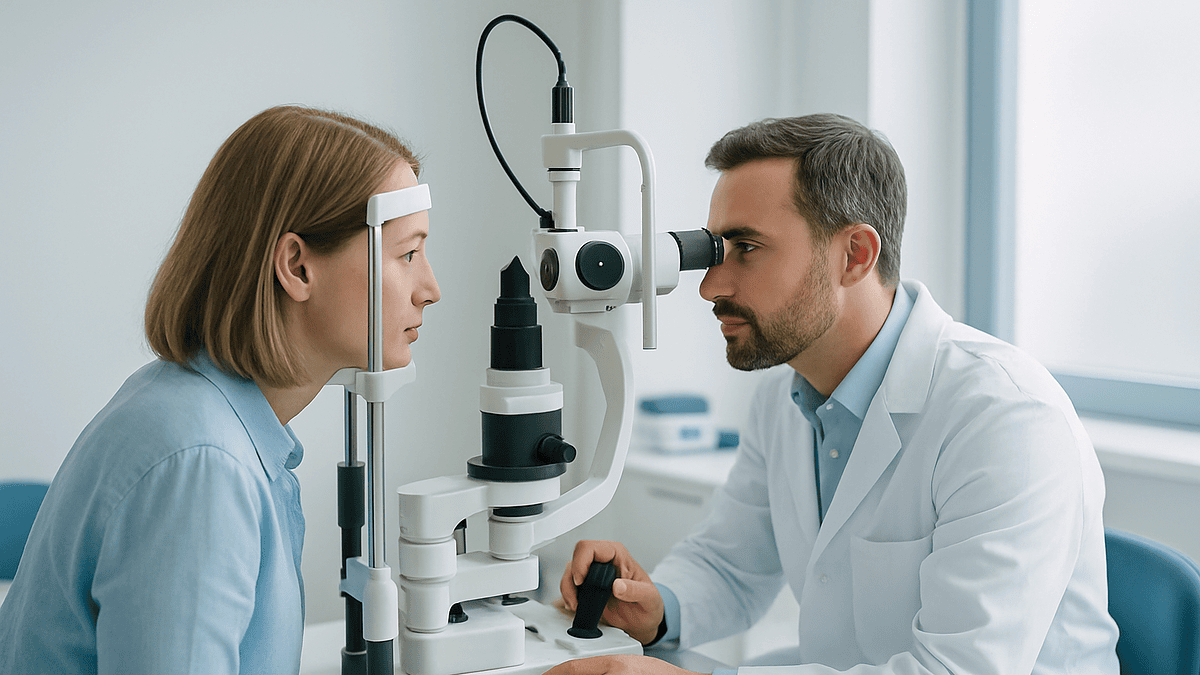
Then the slit lamp: a microscope with a bright, narrow beam that lets the clinician see the lid margin at high magnification. They look for dilated vessels along the lid edge, capped or plugged gland openings, and the quality of the oil when the lid is pressed gently. Clear, free-flowing oil is healthy; cloudy or paste-like oil suggests meibomian gland dysfunction. A drop of orange fluorescein dye reveals how quickly the tear film breaks up between blinks and highlights any dry or damaged patches on the cornea. Lashes may be inspected for the tiny cylindrical collars associated with Demodex mites.
In some services the assessment is shared. A dermatologist confirms and manages the skin component; an optometrist or ophthalmologist manages the eyes. Neither can fully see the other’s territory, so it helps if you tell each one what the other has found and prescribed. Keep a note of the terms used at each visit, because the same problem may be called meibomian gland dysfunction in one room and ocular rosacea in another.
Ocular rosacea treatment options: what the evidence supports
Treatment aims to control inflammation, restore the oil layer of the tear film and protect the cornea. No single therapy does all three, so care is layered, and the layers are added or removed by the treating team as the eyes respond.
The foundation, endorsed by Mayo Clinic and the NHS alike, is physical: warm compresses to soften thickened gland oil, gentle lid cleaning to clear debris and reduce the microbial load, and lubricating drops to supplement the tear film. This is the part patients most often underestimate and the part with the most consistent support across guidance.
Medicines are chosen according to severity. For inflamed lid margins, a clinician may prescribe a topical antibiotic or anti-inflammatory ointment applied to the lid edge. For more persistent disease, oral antibiotics of the tetracycline class are commonly used, not primarily to kill bacteria but because, at the levels used for rosacea, they dampen inflammatory enzymes and appear to improve the quality of gland oil. The NHS notes that courses for rosacea often run for several weeks to months. Topical cyclosporine drops, which calm inflammation on the eye surface, are used for some people with significant dry eye. Short courses of steroid drops are reserved for specialist supervision because of their effects on eye pressure and the lens.
Where facial rosacea is also active, treating the skin and the eyes in parallel makes sense. The evidence base for ocular rosacea specifically is modest: many recommendations draw on small studies and on the larger literature for blepharitis and dry eye. Omega-3 supplements and in-office device treatments such as thermal gland expression or intense pulsed light have produced mixed results, and mainstream guidance does not yet treat them as established therapy. Which options suit you, and in what order, is a decision for your prescribing clinician.
Eyelid care at home: the part most people skip
Ask an eye specialist what single habit changes ocular rosacea most and the answer is rarely a prescription. It is the ten unglamorous minutes spent on the eyelids, done every day rather than only during flares.
The routine has three steps, and the NHS blepharitis guidance describes them in plain terms. Warmth first: a clean flannel soaked in warm water, or a reusable heat mask, rested over closed eyes for around 5 to 10 minutes. Heat softens the thickened oil inside the glands so it can flow again. Massage second: with clean fingertips, gentle pressure along the lids toward the lash line, sweeping downward on the upper lid and upward on the lower, to push softened oil out of the gland openings. Clean third: wipe along the lash base with a lid wipe or a cotton pad and the cleanser your clinician recommends, removing crusts and debris. The NHS suggests cleaning once or twice a day when symptoms are active, then continuing daily to keep them settled.
Around that routine sit smaller habits. Preservative-free lubricating drops are gentler if you use them more than a few times a day. Eye makeup is best applied outside the lash line, removed thoroughly each night and replaced regularly. Mayo Clinic suggests avoiding eye makeup altogether during flares and pausing contact lens wear when the eyes are inflamed. A humidifier in a dry office, a conscious blink every few minutes during screen work, and hands kept away from the eyes all help the tear film stay intact.
None of this is dramatic. Its value lies in repetition. Lid glands that are warmed, emptied and kept clean day after day stay open; glands that are attended to only when the eye is already sore have farther to recover.
What the first weeks of treatment usually look like
People starting treatment often expect a switch to flip. The realistic picture is a dimmer being turned down slowly, with occasional flickers.
In the first week or two, warm compresses and lid cleaning tend to feel soothing while doing little that is visible. Crusting may lessen. The gritty sensation usually persists, because the tear film cannot rebuild its oil layer until the glands have been coaxed open repeatedly. Lubricating drops offer short-lived relief, which is their job; they are a bridge, not the destination. If an oral antibiotic has been prescribed, the anti-inflammatory effect builds gradually, and the NHS describes rosacea courses lasting several weeks to months rather than days. It is common not to notice much change before the first review.
Over the following weeks, the pattern most people report is fewer bad mornings, less watering outdoors and a reduction in styes. Redness of the lid margin softens more slowly than the symptoms do. Flares still happen, typically after a recognizable trigger, but they are shorter and less intense. A follow-up appointment, often scheduled a few weeks in, lets the clinician re-examine the glands and the cornea and decide whether to continue, adjust or step down.
Two things derail this stage. The first is stopping the lid routine as soon as the eyes feel better; because the underlying tendency remains, symptoms usually return within weeks. The second is stopping or altering a prescribed medicine without discussing it, whether because of side effects or because things feel fine. Both concerns are legitimate and both belong in a conversation with the prescriber, who can weigh them against the risk of relapse. Ocular rosacea is managed over years, and the goal of the first weeks is to find a routine you can sustain.
What people often get wrong about ocular rosacea eye symptoms
It is just dry eye. Dryness is one consequence, not the diagnosis. Treating the tear film alone, without addressing the inflamed lid glands, is why so many people cycle through drops without lasting benefit.
Redness-relief drops will fix the color. Over-the-counter drops that whiten the eye work by constricting blood vessels. Used regularly they can produce rebound redness when they wear off, and they do nothing for the inflammation underneath. Eye specialists generally advise against relying on them.
Antibiotics mean there is an infection. Oral tetracycline-class medicines are prescribed for rosacea chiefly for their anti-inflammatory action on glands and blood vessels. The word antibiotic misleads here, and it is not a reason to think the condition is contagious. It is not.
Cutting out one food will stop it. Triggers modify flares; they do not cause the condition. Eliminating coffee or wine may help some people and make no difference to others. Rigid diets built on internet lists tend to add stress, itself a common trigger.
Mild skin means mild eyes. Mayo Clinic is explicit that the severity of eye involvement does not track the severity of facial rosacea. Some of the most inflamed eyes belong to people whose cheeks barely flush.
Once it settles, the routine can stop. Both the NHS and Mayo Clinic frame this as a long-term condition. Lid care is maintenance, like brushing teeth, and stopping it invites the grit back.
Hypoallergenic makeup is safe on the waterline. The issue is not allergy; it is physical blockage of gland openings. Product applied along the inner lid margin clogs glands regardless of its label.
Children never get it. Rosacea is far more common in adults, but ocular rosacea is recognized in children, where it is frequently misdiagnosed as recurrent conjunctivitis or styes. A child with repeated lid inflammation deserves an eye examination, not another antibiotic drop by default.
Questions to ask your care team
Appointments are short and the lid margin is a small place, so it helps to arrive with questions that get to the decisions that matter. These are the ones clinicians say they wish patients asked more often.
- Is my cornea involved, and if not, what would make you concerned that it was becoming involved?
- Which of my symptoms come from the lid glands and which from the tear film, and does that change what we do first?
- What exactly should my daily eyelid routine be, how warm and how long, and how will I know it is working?
- If you are prescribing a medicine, what is it meant to do, roughly how long before I should expect a change, and what side effects should prompt a call?
- Should I keep wearing contact lenses, and if I pause them, what would tell us it is reasonable to restart?
- Do I need a dermatology assessment for my skin as well, and how should the two plans fit together?
- Are any of my other medicines drying my eyes or worsening flushing?
- When is my next review, and what should I do if things worsen before then?
Bring a short written record: the drops and cleansers you have used, how long you used each, what helped, and a note of the days your eyes flared alongside what you ate, drank and did. A phone photograph of your lids on a bad morning is often more informative than a description, because clinic appointments have a habit of falling on good days.
Finally, ask who to contact between visits. Ocular rosacea is a long game, and knowing whether the practice prefers a phone message, an online form or a nurse line removes a barrier at exactly the moment you should not hesitate.
When to call your doctor
Most ocular rosacea is uncomfortable rather than dangerous, and it is managed in routine appointments. A small number of situations are different, because they may signal that the cornea is inflamed or that an infection is spreading beyond the lid. Mayo Clinic advises prompt attention when the eyes are painful or vision changes, and the following signs should prompt a same-day call to your doctor or eye service, or urgent care if that is not available.
- Eye pain, as opposed to grittiness or soreness of the lids.
- A sudden or progressive drop in vision, or blurring that does not clear when you blink.
- Marked sensitivity to light, especially if new or accompanied by pain.
- A white or grey spot visible on the clear front of the eye.
- A sty or lid swelling that spreads, closes the eye, feels hot, or comes with fever or a headache.
- Any of the above in someone who wears contact lenses, where corneal infection is a particular concern.
- A lump on the lid that keeps returning in the same place or slowly enlarges.
Less urgent but still worth a routine appointment: symptoms that have not eased after several weeks of consistent lid care and prescribed treatment, new side effects from a medicine, styes recurring more than a couple of times a year, or facial redness that is worsening alongside the eyes. Do not stop or change a prescribed treatment before that conversation; tell the prescriber what is happening and let them adjust the plan.
If you are unsure whether a symptom counts, err toward calling. Corneal problems caught early are usually straightforward to treat; caught late, they can leave scarring. Nobody on an eye team minds a phone call that turns out to be nothing.
Frequently asked questions
How do you get rid of ocular rosacea?
Ocular rosacea is controlled rather than eliminated. Mainstream guidance from Mayo Clinic and the NHS centers on daily eyelid care with warm compresses and gentle cleaning, lubricating drops, trigger awareness and, when inflammation is more marked, prescribed topical or oral anti-inflammatory treatment chosen by your clinician. Most people reach a stage where symptoms are mild and flares are infrequent, provided the routine continues long term.
What can be mistaken for ocular rosacea?
Ordinary dry eye disease is the most common mix-up, followed by seborrheic or staphylococcal blepharitis, allergic conjunctivitis, recurrent infectious conjunctivitis and contact lens intolerance. Sjögren’s syndrome, an autoimmune cause of severe dry eye, and medicine side effects can also imitate it. A lid lump that keeps returning in one spot should be examined to exclude rarer causes. Examination of the lid glands and the skin history usually separates them.
Is ocular rosacea considered an autoimmune disease?
No. Rosacea is classified as a chronic inflammatory condition, not an autoimmune one, because it does not involve the immune system attacking a specific body tissue. Mayo Clinic and the NHS describe its cause as unknown, with an overactive innate immune response, blood vessel reactivity and microbes such as Demodex mites all thought to contribute. It is also not contagious and cannot be passed to others.
What can trigger ocular rosacea?
Mayo Clinic lists hot or spicy food, alcohol, sunlight, wind, temperature extremes, strong emotion, strenuous exercise and hot baths or saunas as flushing triggers; the NHS adds caffeine and hot drinks. Eye-specific aggravators include smoke, dry indoor air, long screen sessions with reduced blinking, makeup on the inner lid margin, contact lenses and eye rubbing. Triggers vary widely between people, so a short diary is more useful than a generic list.
Can ocular rosacea affect your vision permanently?
It can, though this is uncommon. Mayo Clinic notes that when inflammation involves the cornea, keratitis, scarring or corneal ulcers may develop and can threaten sight. For most people symptoms stay on the lids and eye surface and vision is unaffected. Eye pain, blurred vision that does not clear with blinking, or strong light sensitivity are the signs that call for prompt examination rather than waiting for a routine review.
Can I wear contact lenses with ocular rosacea?
Many people do, but lenses rest on a tear film that is already unstable and can worsen grittiness. Mayo Clinic suggests pausing contact lens wear during flares and while the eyes are inflamed. Whether and when to restart, and which lens type or wearing schedule suits your eyes, is a decision for your eye care clinician, who can check the cornea first. Any pain in a lens wearer needs same-day assessment.
Do eye symptoms come before skin rosacea?
Sometimes. Mayo Clinic notes that ocular rosacea can be the first sign, appearing before facial redness or bumps develop, and that eye severity does not mirror skin severity. This is one reason the diagnosis is often delayed: irritated eyes without an obviously red face are easily labelled as dry eye or allergy. If you have persistent lid inflammation and a tendency to flush, mention both to your clinician.
Are artificial tears enough to treat ocular rosacea?
Usually not on their own. Lubricating drops relieve the surface symptoms for a short time but do not address the inflamed, clogged meibomian glands that cause the tear film to evaporate. Guidance from Mayo Clinic and the NHS places daily lid warming and cleaning at the foundation, with drops as a supplement and prescribed anti-inflammatory treatment added where needed. Preservative-free drops are generally gentler when used frequently.
Do omega-3 supplements help ocular rosacea?
The evidence is mixed. Some studies of dry eye and meibomian gland dysfunction have suggested modest benefit from omega-3 fatty acids, while others, including large trials, found no clear advantage over placebo. Mainstream guidance does not currently treat supplements as an established therapy for ocular rosacea. If you are considering one, discuss it with your clinician, particularly if you take blood-thinning medicines or have other health conditions.
Is ocular rosacea contagious?
No. Ocular rosacea is an inflammatory condition, not an infection, and it cannot spread through touch, shared towels or close contact. The confusion often arises because some treatments are antibiotics; in rosacea these are used chiefly for their anti-inflammatory effect on glands and blood vessels. A partner or child who develops red eyes has a separate cause that should be assessed on its own merits.
References
This article is for general information only and is not a substitute for professional medical advice. Please consult a qualified doctor about your individual situation.

More from the Blog
Before Your First Acne Appointment: Products to Pause and What Your Dermatologist Will Ask
Before a first acne appointment, most dermatologists prefer to see your skin as it usually looks, so avoid starting new products, skip harsh scrubs…

How to Stop and Prevent Dandruff for Good: Causes, Treatments and Daily Habits
Dandruff is usually controlled, not cured, by washing regularly with a medicated anti-dandruff shampoo, leaving it on the scalp for a few minutes before…
When Does Seborrheic Dermatitis Need a Dermatologist? Persistent Scaling and Facial Flares
Most seborrheic dermatitis can be managed with over-the-counter antifungal or anti-dandruff products, but it is reasonable to see a dermatologist when scaling persists after…

Cryotherapy, Topical Treatment or Lesion Removal for Molluscum: How the Options Compare
Cryotherapy, topical treatments and lesion removal all aim to clear molluscum bumps faster than the body would on its own, but no single option…

When Impetigo Needs Urgent Review: Fever, Spreading Redness and Sores That Are Not Healing
Impetigo that is not healing after about a week of treatment, is spreading quickly, or comes with fever, swelling, warmth or pain beyond the…
Skin Tags: Why They Form, and Safe Removal
Skin tags form where skin rubs against skin or clothing, most often on the neck, armpits, eyelids, and groin. Friction, genetics, hormonal shifts such…