

What Happens After a Surgical Oncology Operation? Walking, Wound Care and Pathology Results

Key Takeaways
- Enhanced recovery pathways ask most people to sit up and walk within hours of cancer surgery because movement lowers the risk of chest infection and blood clots and helps the bowel restart.
- Surgical site infection affects roughly 1 to 3 of every 100 people having surgery and usually shows itself between days three and ten as spreading redness, worsening pain, cloudy discharge or fever.
- Staples and non-dissolving stitches are typically removed between one and two weeks after surgery, sooner on the face and later over joints or areas under tension.
- A pathology report is often ready within about 10 days, but immunohistochemistry and molecular tests can extend the wait without implying bad news.
- Pathologic stage, assigned after the specimen is examined, can differ from the stage estimated from scans and is the one most treatment decisions are built on.
- Lymphedema can appear months or years after lymph node surgery, and early signs such as a tight ring or a heavy limb respond best when reported promptly.
After cancer surgery, the first hours focus on waking safely, controlling pain and getting you upright to walk, usually the same day or the next. Over the following one to two weeks the incision heals, drains and stitches come out, and the removed tissue is examined by a pathologist. That pathology report guides staging and any further treatment, which your surgical team discusses with you.
The recovery bay is quieter than most people expect. A blood pressure cuff hums, a nurse asks you to wiggle your toes, and somewhere a monitor beeps in a rhythm you slowly realize is your own heartbeat. The operation you have been thinking about for weeks is over. The strange part is that the questions have only just begun.
After cancer surgery, what happens next is rarely explained in one sitting, partly because it unfolds in stages: the first walk to the bathroom, the first look at the dressing, the phone call about the pathology report. Each stage has its own logic, and knowing that logic in advance takes some of the fear out of it.
This explainer walks through those stages in order, drawing on published guidance rather than hospital folklore. It will not tell you what your own result will say. It will help you understand the words when your team does.
After cancer surgery, what happens in the first 24 hours?
The first job of the recovery team is not the cancer. It is your airway, your blood pressure and your temperature. Anesthetic drugs wear off at different speeds, so nurses check breathing and alertness every few minutes at first, then less often as you stabilize. Many people remember this period as a blur of questions: what is your name, where does it hurt, can you take a deep breath.
Pain control starts before you fully wake. Modern surgical pathways favor a combination approach, often pairing a local anesthetic placed into the wound or near a nerve with regular non-opioid medicines, so that stronger drugs are needed less. The idea, described in the enhanced recovery framework used across many surgical services, is that a person who is comfortable can breathe deeply, cough, and move, all of which shorten recovery (NHS, Enhanced recovery).
Then comes the part that surprises people: someone will ask you to sit up, dangle your legs, and stand. For many operations that happens within hours, not days. Early mobilization reduces chest complications and helps the gut restart after abdominal surgery. Eating and drinking also resume sooner than older approaches allowed; for some procedures a light drink is offered once you are alert (NHS).
Depending on the operation you may have a urinary catheter, a wound drain, an intravenous line, or all three. Each is temporary and each has a planned removal point, which your nurse can explain. The dressing over the incision is usually left alone for the first day or two unless there is a reason to look.
By the end of the first night, most of the immediate risks of anesthesia have passed. What remains is the steady work of healing, and the wait for the laboratory.
Who goes home quickly, and who is usually asked to stay longer?
Length of stay is one of the most common questions before an operation, and the honest answer is that it depends on three things: the operation itself, your health before it, and how the first day or two go.
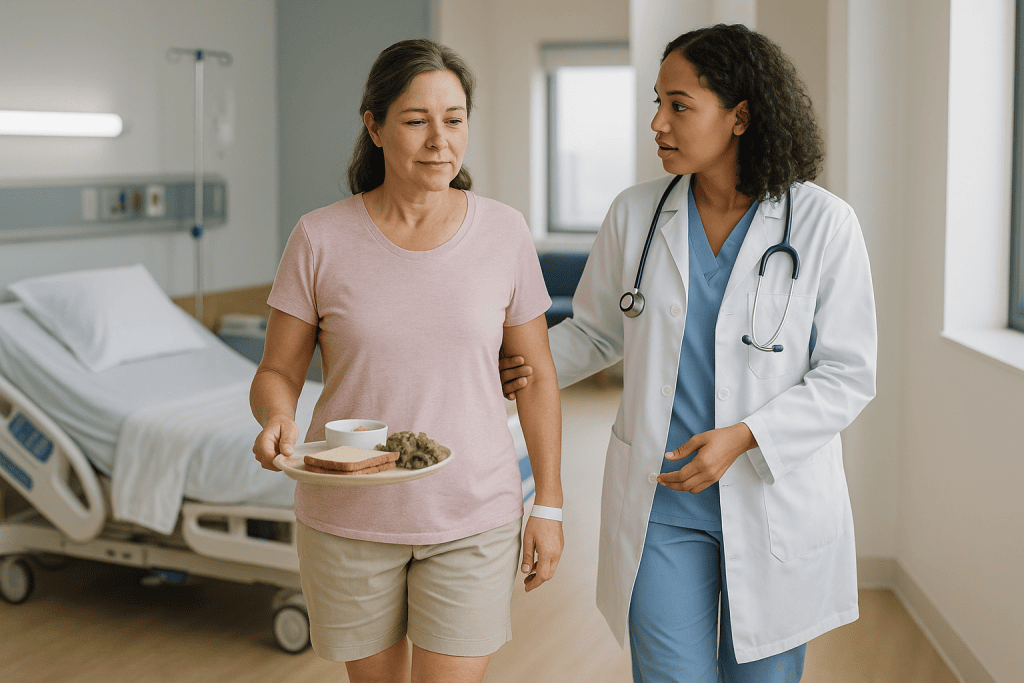
People having smaller procedures, such as removal of a skin cancer, a lymph node biopsy, or a breast lump with no reconstruction, frequently go home the same day or the next morning. Enhanced recovery pathways have shortened stays for larger operations too, including bowel and gynecologic surgery, because early feeding and walking bring bodily functions back sooner (NHS, Enhanced recovery).
Others are usually asked to stay longer, and that is a safety decision rather than a sign that something went wrong. Reasons include:
- Operations on the esophagus, stomach, pancreas or lung, where breathing, swallowing or nutrition need monitoring.
- Heart, lung or kidney conditions that make anesthesia recovery slower.
- Living alone, or living far from emergency care, so that early problems would be hard to manage at home.
- Nausea, low blood pressure, a fever or a drain that is still producing a lot of fluid.
- Needing a stoma, a feeding tube or new medicines that take time to learn.
Discharge is generally tied to milestones rather than a fixed day: eating and drinking, passing urine, walking safely, pain manageable with tablets, and a clear plan for wound care and follow-up. Some teams use a checklist; others rely on the surgeon’s morning round.
If you are asked to stay an extra night, it is reasonable to ask which milestone is not yet met. If you are being sent home sooner than you expected, ask who to call around the clock. Both questions are normal, and both belong to you.
Why walking after surgery matters more than rest, and how it prevents blood clots
The instinct after an operation is to lie still and protect the wound. The evidence points the other way. Walking after surgery is now treated as a therapy in its own right, with a start time written into many recovery pathways (NHS, Enhanced recovery).
Movement does several things at once. Contracting calf muscles squeeze blood back toward the heart, which counters the sluggish flow that lets clots form in the deep veins of the leg. Standing upright expands the lower lungs and clears mucus that pools during anesthesia, lowering the chance of pneumonia. After abdominal surgery, gentle walking helps the bowel resume its normal rhythm. And there is a psychological effect that surgeons see daily: the person who reaches the corridor on day one tends to believe they are recovering.
Blood clots deserve a specific word. Surgery, cancer and immobility are each independent risk factors for deep vein thrombosis, a clot in a deep leg vein, and the three together raise the risk further. That risk does not end at discharge; it persists for weeks (NHS, Deep vein thrombosis). Hospitals reduce it with compression stockings, calf pumps during and after the operation, and for many cancer operations a course of an anticoagulant, a medicine that thins the blood, sometimes continued at home. Whether you receive one, and for how long, is a decision for your surgical team based on the operation and your history.
At home the practical steps are unglamorous: walk several times a day, even if only around the house at first; avoid sitting with legs crossed for long stretches; drink fluids unless told otherwise; and do the ankle circles and foot pumps shown on the ward. A calf that becomes painful, swollen, warm or red, or sudden breathlessness or chest pain, needs urgent assessment, not a wait-and-see approach.
Cancer surgery wound care: what a healing incision should look like
An incision goes through a predictable sequence, and knowing it helps you tell normal from worrying. In the first days the edges look pink or slightly red, the skin around them may be a little swollen and warm, and a small amount of clear or faintly blood-tinged fluid on the dressing is common. Bruising can appear a day or two later and can look dramatic, especially on the abdomen or breast, without meaning anything is wrong (MedlinePlus, Surgical wound care).
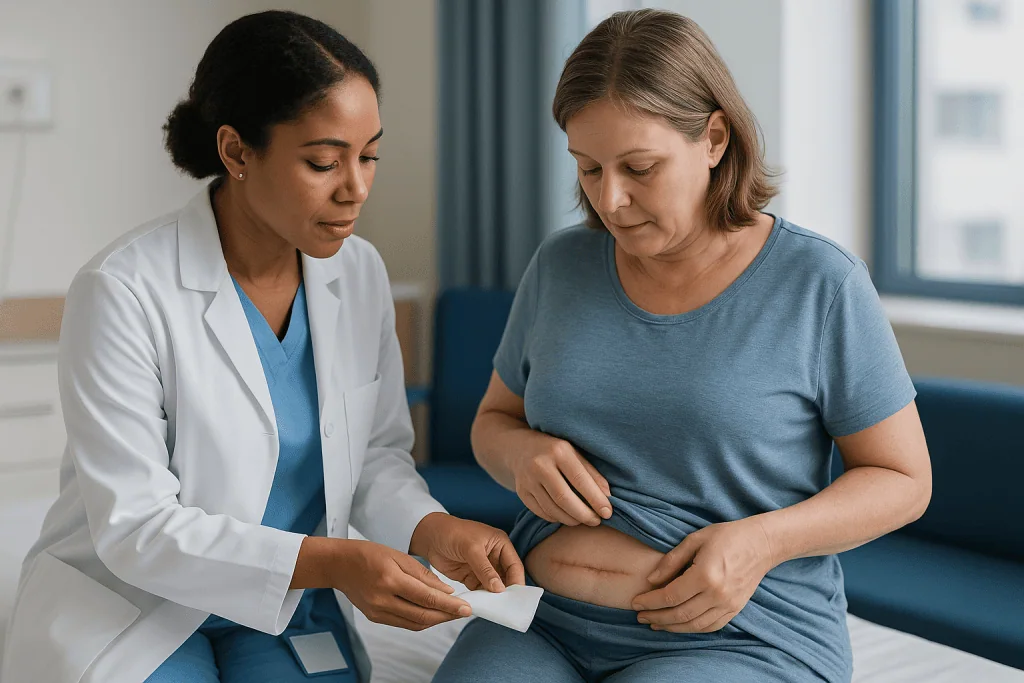
Most closed incisions are protected by a dressing for the first 24 to 48 hours, after which many teams allow the wound to be left uncovered or covered with a light dressing. Showering is often permitted from around that point, letting soapy water run over the wound and patting it dry, though soaking in a bath or pool usually waits until the wound has sealed. Your written discharge instructions take precedence over any general rule (MedlinePlus).
Surgical site infection is the complication people worry about most. It occurs in roughly 1 to 3 of every 100 people who have surgery, more often after longer or contaminated operations, and less often after clean, short ones (CDC, Surgical site infections). Signs usually appear between days three and ten, not on day one: spreading redness, increasing rather than easing pain, thick or cloudy discharge, a bad smell, or a fever.
Simple habits lower the risk. Wash hands before touching the area. Do not apply creams, powders or antiseptics unless told to. Avoid picking at scabs or the thin strips of tape sometimes used to close skin; they fall off on their own. If you smoke, the weeks around surgery are the moment when stopping most directly helps the wound, because nicotine narrows the small blood vessels that carry oxygen to healing tissue.
Drains, stitches and staples: what gets removed and when
Few things puzzle people more than the tubing and hardware they wake up with, so here is what each item does and roughly how long it stays.
A surgical drain is a soft tube placed near the operation site that carries away blood and tissue fluid that would otherwise collect under the skin. It ends in a small bulb or bottle that you or a nurse empties and measures. Drains are removed when the daily output falls below a threshold your surgeon sets, which may be a couple of days after a bowel operation or a week or more after breast or armpit surgery. Removal is quick and usually causes only a brief pulling sensation.
Skin closure comes in several forms. Dissolving sutures disappear on their own over weeks. Non-dissolving sutures and metal staples are taken out in clinic or by a community nurse, typically between one and two weeks after surgery, sooner on the face where skin heals quickly and later on areas under tension such as the back or joints (MedlinePlus, Surgical wound care – closed). Skin glue flakes off by itself.
| Item | Purpose | Typical removal | Source |
|---|---|---|---|
| Wound drain | Removes fluid collecting under skin | When output falls below surgeon’s threshold; days to about 1–2 weeks | MedlinePlus |
| Staples or non-dissolving sutures | Hold skin edges together | Around 1–2 weeks; earlier on face | MedlinePlus |
| Dissolving sutures | Hold skin or deeper layers | Absorb over weeks; nothing to remove | MedlinePlus |
| Skin glue or adhesive strips | Seal surface | Peel away naturally | MedlinePlus |
After removal the scar line looks raised and red for months before fading. Keeping it out of direct sun for the first year helps it settle to a paler color.
Pain, fatigue and appetite: what the first two weeks of recovery after cancer surgery usually feel like
Recovery after cancer surgery follows a rough curve that people rarely hear described honestly. Days one to three are usually the sorest, but the soreness is expected and medicines are timed for it. Days four to seven often bring a dip in mood and energy that catches people off guard: the adrenaline of getting through the operation has faded, visitors have gone home, and the body is spending enormous energy on repair. Weeks two and three are when most people notice they can do a little more each day.
Fatigue is the symptom that outlasts the others. It is not simply tiredness; it is a heaviness that sleep does not fully fix, driven by the inflammatory response to tissue injury, blood loss, disrupted sleep and, for many, the emotional weight of a cancer diagnosis. Short walks paradoxically help more than bed rest, and pacing, meaning breaking tasks into pieces with rests between, is the strategy most consistently recommended (Mayo Clinic, Cancer surgery).
Appetite often lags. Anesthesia and pain medicines slow the gut; abdominal surgery slows it more. Small, frequent meals with protein help the body rebuild, and constipation is common enough that many teams prescribe a stool softener alongside pain medicine. Ask rather than assume.
Pain medicine deserves a plain explanation. Non-opioid medicines work on inflammation at the wound and on pain signaling in the nervous system; opioids act on receptors in the brain and spinal cord and are intended as a short bridge, not a long-term plan. Any change to what you were sent home with, including stopping earlier because you feel well, is worth a quick call to the prescribing team so they can advise on timing and on watching for withdrawal or rebound pain.
After cancer surgery, what happens to the tissue that was removed?
While you are on the ward learning to sit up, the removed tissue, known as the specimen, has begun a journey of its own. It goes to a pathology laboratory, where a pathologist, a doctor who diagnoses disease by examining tissue, takes over. Understanding this process explains why pathology results after surgery take longer than a blood test.
First the specimen is inked and measured. Ink of different colors marks its surfaces so that later, under the microscope, the pathologist can tell which edge is which. Then it is fixed in a preservative for hours to a day, cut into thin slices, embedded in wax, shaved into slivers thinner than a hair, mounted on glass and stained. Only then does the microscope work begin (NIH National Cancer Institute, Pathology reports).
For some operations a preliminary check called a frozen section is done during surgery, giving the surgeon a quick answer about a margin or a lymph node within about 20 minutes. Frozen sections are useful but less detailed, so the final report always waits for the fully processed slides.
Additional tests may follow. Immunohistochemistry uses antibodies to identify proteins on the cancer cells, which helps confirm the type of cancer and can guide treatment choices. Molecular or genetic tests look for specific mutations. Each adds days to the timeline.
The National Cancer Institute notes that a pathology report is typically ready within about 10 days, and that specialized tests can extend that (NIH). In practice the wait varies with the lab and the complexity of the case. Ask before you leave hospital how and when you will receive the result: in person at follow-up, by phone, or through a patient portal, and whether someone will be available to explain it.
Reading pathology results after surgery: margins, nodes, grade and stage
The report itself is written for doctors, but four terms carry most of the meaning, and each can be defined in a sentence.
A margin is the rim of normal-looking tissue around the tumor. A negative or clear margin means no cancer cells were seen at the inked edge; a positive margin means cancer reached the edge, which may prompt discussion of further surgery or radiation. Margin width is often given in millimeters, and what counts as adequate differs by cancer type (NIH, Pathology reports).
Lymph nodes are small filters in the immune system that cancer cells can reach first if they spread. The report states how many nodes were removed and how many contained cancer, for example 2 of 14. Grade describes how abnormal the cells look under the microscope, usually on a scale from 1 (closer to normal) to 3 or 4 (very abnormal), and reflects how quickly the cancer is likely to grow. Stage, covered in the next section, summarizes how far the cancer has extended (NIH, Staging).
| Report term | Plain meaning | Why it matters |
|---|---|---|
| Tumor size | Largest dimension of the cancer | Contributes to stage |
| Margins | Whether cancer reaches the cut edge | May influence further surgery or radiation |
| Lymph nodes | Number examined and number involved | Key part of staging |
| Grade | How abnormal cells appear | Reflects likely growth behavior |
| Lymphovascular invasion | Cancer cells seen in small vessels | One of several risk features |
| Receptor or marker status | Proteins or mutations detected | Guides treatment options |
Two cautions. A report describes the tissue removed, not your whole body, so it is read alongside scans and your history. And single words like positive or invasive sound alarming in isolation; their weight depends entirely on context that your team will supply.
What does stage 2 cancer mean, and why staging can change after surgery
People often arrive at surgery with a stage already in mind from scans and biopsies. That is the clinical stage. The pathologic stage is assigned after the pathologist examines the actual specimen, and it can be lower or higher than expected. That is not an error; it reflects better information (NIH National Cancer Institute, Cancer staging).
Most solid cancers are staged using the TNM system. T describes the size or depth of the primary tumor, N whether nearby lymph nodes are involved, and M whether the cancer has spread to distant organs. Those three elements are combined into an overall stage from 0 to 4, written in Roman numerals in most reports (NIH, Staging).
So what does stage 2 cancer mean? In general terms it describes a cancer that is larger than stage 1, or has begun to involve nearby tissue or a limited number of nearby lymph nodes, but has not spread to distant parts of the body. The precise definition differs for every cancer type; stage 2 breast cancer and stage 2 colon cancer are defined by different measurements and mean different things for treatment. Letters such as 2A or 2B subdivide further.
Staging can shift after surgery in either direction. A tumor that looked large on a scan may prove smaller once inflammation is excluded. A node that appeared normal may contain a cluster of cancer cells visible only under the microscope. Either way, the pathologic stage is the one most treatment decisions are built on.
Stage is a description of extent, not a verdict. It helps your team choose among options and lets them speak about likely outcomes in ranges drawn from large groups of people. What it cannot do is predict a single person’s course, and any clinician who quotes numbers to you should be willing to explain where they come from and how wide the uncertainty is.
Will there be more treatment after surgery? Adjuvant therapy explained
For some people, surgery is the only treatment needed. For others, the pathology report opens a second chapter. Treatment given after an operation to lower the chance of cancer returning is called adjuvant therapy, and understanding its logic helps the conversation with your oncologist make sense (Mayo Clinic, Cancer surgery).
The reasoning is this. Surgery removes cancer that can be seen and felt. Microscopic cells may remain in the operative area or may have traveled elsewhere before the operation, too small to show on any scan. Adjuvant treatment is aimed at those unseen cells. Whether it is recommended depends on the features in the pathology report, chiefly stage, grade, margin status, node involvement and marker results, weighed against your general health and preferences.
The main categories are:
- Chemotherapy: drugs that damage rapidly dividing cells throughout the body, given in cycles over months.
- Radiation therapy: focused high-energy beams to the operative area, typically daily sessions over several weeks.
- Hormone (endocrine) therapy: for cancers driven by hormones, medicines that block hormone signals, often taken for years.
- Targeted therapy and immunotherapy: medicines directed at specific molecular features or that help the immune system recognize cancer cells.
Timing matters. Most adjuvant treatment begins once the wound has healed and strength has returned, commonly several weeks after surgery, though the window varies by cancer type and protocol. Some people instead receive treatment before surgery, called neoadjuvant therapy, in which case the pathology report also shows how well the cancer responded.
Recommendations usually come from a multidisciplinary tumor board, a meeting where surgeons, oncologists, radiologists and pathologists review your case together. You are entitled to ask what was discussed, what the alternatives were, including no further treatment, and what the expected benefit is in plain numbers.
Lymphedema, numbness and other effects that show up weeks or months later
Some consequences of cancer surgery are immediate. Others arrive after the wound has healed, when you thought recovery was finished. Knowing about them in advance turns a frightening surprise into a recognized event.
Lymphedema is swelling that develops when lymph fluid cannot drain properly because lymph nodes or vessels were removed or damaged. It most often affects the arm after armpit surgery for breast cancer or the leg after groin or pelvic node removal, and it can appear months or even years later (Cleveland Clinic, Lymphedema). Early signs are subtle: a ring or watch feeling tight, a heaviness in the limb, or one side of a garment fitting differently. Lymphedema can be managed with compression, specialized massage and exercise, and early referral to a therapist trained in the condition makes a difference to how well it is controlled.
Numbness and odd sensations along or near the scar are almost universal, because small skin nerves are cut in any incision. Sensation often returns partially over 6 to 12 months but may remain altered permanently. Tingling, burning or a shooting pain that persists beyond the expected healing period may be nerve-related pain, which responds to different medicines than wound pain and is worth reporting rather than enduring.
Scar tissue can tighten, limiting movement of a shoulder, hip or jaw. Gentle stretching, started when your team approves, prevents much of this; physical therapy corrects the rest.
Organ-specific effects depend on what was removed: altered bowel habit after colon surgery, changes to eating after stomach or esophageal surgery, urinary or sexual changes after pelvic surgery, breathlessness on exertion after lung surgery. None of these are signs of failure. All of them have management strategies, and asking about them is part of good follow-up rather than a complaint.
How can cancer surgery change your life? The practical and emotional adjustments
People asking how cancer can change your life are often braced for a list of losses. The truthful answer is more mixed, and it varies enormously from person to person.
Physically, most people return to their usual activities over weeks to a few months, with the timeline set by the operation and by any further treatment. Driving usually waits until you can perform an emergency stop without pain and are no longer taking sedating medicines; lifting restrictions after abdominal surgery are common for several weeks to protect the healing muscle layer; return to work depends on the job. Your surgical team will give specific timeframes rather than general ones (Mayo Clinic, Cancer surgery).
Body image can shift. A scar, a stoma, a reconstructed or absent breast, a changed voice or a new way of eating all take adjusting to, and the adjustment is emotional as much as practical. Many people find it useful to see the wound early with a nurse present rather than alone at home for the first time.
Emotionally, the period after surgery has its own pattern. Relief that the operation is done is often followed by anxiety while waiting for results, then by a strange flatness once decisions are made and the intensity of appointments eases. Fear of recurrence is common and tends to peak around follow-up scans. These reactions are normal responses to an abnormal situation; persistent low mood, sleeplessness or loss of interest that lasts more than a couple of weeks deserves the same attention as a physical symptom.
Relationships change too, sometimes for the better. Many people describe a sharper sense of what matters and a lower tolerance for what does not. Survivorship programs, offered by many cancer services, exist precisely to support this phase, covering exercise, nutrition, work, finances and follow-up schedules in one place.
What people often get wrong about recovery after cancer surgery
Recovery advice travels by word of mouth, and some of what travels is out of date. Here are the misconceptions surgical nurses correct most often.
Rest is the best medicine. Bed rest after surgery was standard decades ago. Evidence since has linked it to more chest infections, more clots and slower return of bowel function. Structured early movement is now the standard of care in enhanced recovery pathways (NHS, Enhanced recovery).
Clear margins mean the cancer is gone for good. A clear margin means no cancer cells were seen at the cut edge of the specimen. It is reassuring and important, but it does not rule out microscopic cells elsewhere, which is exactly why adjuvant treatment is sometimes discussed even after a clean report (NIH, Pathology reports).
Any redness means infection. Mild pinkness and warmth along a fresh incision are part of normal inflammation. Infection is suggested by spreading redness, worsening pain, cloudy discharge or fever, usually from day three onward (CDC).
Air makes wounds heal faster. Modern dressings keep a wound slightly moist, which supports cell migration across the gap. Follow your team’s instructions on when to uncover rather than removing dressings early.
Pathology takes long because something is wrong. Tissue processing alone takes days, and extra stains or molecular tests add more. Delay reflects thoroughness, not bad news (NIH).
Stopping pain medicine early shows toughness. Uncontrolled pain limits breathing and walking, the two things that most protect you. Take what is prescribed as directed and discuss any change with the prescriber.
Stage from the scan is final. Pathologic staging after surgery can move up or down, and the surgical stage is the one that guides treatment (NIH, Staging).
Everyone needs chemotherapy afterward. Many people do not. The decision rests on the report, the cancer type and your circumstances.
Questions to ask your care team before and after the operation
Good questions turn a passive wait into an informed one. Write them down; anesthesia and stress make it hard to remember what you meant to ask. These are the ones surgical teams find most useful to answer.
- Before discharge: What milestones do I need to meet to go home, and who do I call day or night if something worries me?
- Walking: How often and how far should I walk in the first week, and are there movements or lifts I should avoid?
- Clot prevention: Will I be sent home with stockings or an anticoagulant, and for how long?
- Wound: When can I shower, when does the dressing come off, and what would you want me to photograph and send you?
- Drains and stitches: Who removes them, where, and roughly when?
- Pain: What is the plan for tapering pain medicine, and what should I do if pain increases rather than decreases?
- Pathology: When will the report be ready, how will I receive it, and will someone go through it with me line by line?
- Results: What do the margins, node count, grade and stage in my report mean for me specifically?
- Next steps: Will my case go to a multidisciplinary meeting, what options might be discussed, and what would happen if I chose no further treatment?
- Later effects: Am I at risk of lymphedema or nerve pain, and what early signs should I watch for?
- Daily life: When can I drive, lift, return to work, exercise and have sex?
- Follow-up: How often will I be seen, which scans or blood tests are planned, and who coordinates them?
You do not need to ask everything at once. Asking who your named contact is, and how to reach them, covers most of the rest, because it means the questions that arise at 2 a.m. have somewhere to go.
When to call your doctor: red-flag signs after cancer surgery
Most recovery worries turn out to be nothing, and calling about them is never a nuisance; it is the system working as intended. Some signs, though, should never wait for the next routine appointment.
Call your surgical team the same day, or the out-of-hours number you were given, for:
- A temperature of 38 C (100.4 F) or higher, or shaking chills.
- Redness spreading outward from the incision, increasing pain at the wound, thick or foul-smelling discharge, or the wound edges coming apart (CDC, Surgical site infections; MedlinePlus).
- Bleeding that soaks through a dressing or does not stop with gentle pressure.
- Pain, swelling, warmth or redness in one calf or thigh (NHS, Deep vein thrombosis).
- Being unable to pass urine, or persistent vomiting that prevents you keeping fluids down.
- No bowel movement plus a swollen, tense abdomen after bowel surgery.
- A drain that suddenly stops, falls out, or produces fluid that changes color or becomes cloudy.
- New or worsening confusion, especially in older adults.
Call emergency services immediately, rather than your surgeon, for sudden breathlessness, chest pain, coughing up blood, fainting, a severe headache with weakness or facial drooping, or heavy bleeding. Sudden breathlessness with chest pain after surgery can signal a pulmonary embolism, a clot that has traveled to the lungs, and it is treated as an emergency (NHS).
Emotional distress counts too. If you find yourself unable to sleep, eat or function, or have thoughts of harming yourself, tell your team or a crisis line the same day. Cancer services have psychological support pathways for exactly this.
Every decision about what your symptoms mean, and what to do about them, belongs to the clinicians who know your operation and your history. This article can prepare you for that conversation; it cannot replace it.
Frequently asked questions
How soon should I start walking after surgery?
Usually within hours, once you are fully awake and a nurse has checked your blood pressure. Enhanced recovery pathways build early walking into the plan because it lowers the risk of chest infections and blood clots and helps the gut recover. Start with a few steps to a chair, then along the corridor, increasing each day. Your team will tell you if your particular operation needs any restriction.
How long do pathology results after surgery take?
Often around 10 days, according to the National Cancer Institute, though timing varies between laboratories and cases. Tissue must be preserved, sliced, stained and examined before a report is written, and extra tests such as immunohistochemistry or genetic analysis add days. A longer wait usually reflects thoroughness rather than a problem. Ask before discharge how the result will be delivered and who will explain it.
What does stage 2 cancer mean on my report?
Broadly, a cancer that is larger than stage 1 or has begun to involve nearby tissue or a limited number of nearby lymph nodes, without spread to distant organs. The exact definition differs for every cancer type, so stage 2 in one cancer is not equivalent to stage 2 in another. Stage describes extent and guides treatment choices; your oncologist can explain what it implies in your specific situation.
What does a positive margin mean after cancer surgery?
It means cancer cells were found at the inked edge of the removed tissue, suggesting some may remain at the operation site. Depending on the cancer type and location, your team may discuss further surgery, radiation to the area, or in some cases close monitoring. A positive margin is a finding to act on, not a verdict, and the plan is made by the multidisciplinary team with you.
What should cancer surgery wound care look like at home?
Keep the dressing on for as long as instructed, wash hands before touching the area, shower rather than bathe once permitted, and avoid creams or antiseptics unless prescribed. Expect mild pinkness, slight swelling and some bruising in the first days. Report spreading redness, worsening pain, cloudy or smelly discharge, or fever. Your written discharge sheet overrides any general advice, including this.
Will I definitely need chemotherapy after cancer surgery?
No. Whether further treatment is recommended depends on the pathology report, particularly stage, grade, margins and lymph node involvement, along with the cancer type and your overall health. Many people need no further treatment; others are offered chemotherapy, radiation, hormone therapy or targeted drugs to address cells too small to see. The recommendation usually comes from a multidisciplinary meeting, and the decision is yours with your team.
What happens if you don't treat cancer?
Untreated cancers generally continue to grow and, for most types, can spread to lymph nodes and distant organs over time, though the speed varies enormously between cancers and individuals. Some very slow-growing cancers are monitored rather than treated, a strategy called active surveillance. Declining treatment is a legitimate choice, and your team can explain what is likely to happen in your specific case and what supportive care is available.
What is the average life expectancy after stopping cancer treatment?
There is no single figure; it depends on the cancer type, its extent, how it responded before, and a person’s overall health. Some people stop treatment because it has done its job and are followed for years; others stop when it no longer helps and move to care focused on comfort. Population statistics describe groups, not individuals. Your oncology team is the right source for a personal, honest discussion.
How can cancer surgery change your life in the long term?
Effects range from a scar and altered skin sensation to changes in bowel, bladder, sexual or eating function depending on what was removed, and some people develop lymphedema. Emotionally, many describe anxiety around follow-up scans and a shifted sense of priorities. Most people return to usual activities over weeks to months. Survivorship programs help with the practical, physical and emotional adjustments that follow.
When are staples or stitches removed after cancer surgery?
Non-dissolving stitches and staples are typically removed between one and two weeks after surgery, earlier on the face and later on the back or over joints where skin is under tension. Dissolving sutures and skin glue need no removal. Drains come out when daily fluid output falls below a level your surgeon sets. Your discharge plan should state who removes each item and where.
References
- NHS: Enhanced recovery
- NHS: Deep vein thrombosis (DVT)
- CDC: About surgical site infections
- MedlinePlus: Surgical wound care – closed
This article is for general information only and is not a substitute for professional medical advice. Please consult a qualified doctor about your individual situation.

More from the Blog
Does Chemotherapy Come Before or After Surgery? What Neoadjuvant and Adjuvant Mean
Chemotherapy can come either before or after cancer surgery, and the timing is a deliberate choice by the treating team. Neoadjuvant chemotherapy is given…
Recovering From Endometrial Cancer Surgery: Activity, Wound Care and Follow-Up Timing
Endometrial cancer surgery recovery time is usually measured in weeks, not days. Most people leave the hospital within one to five days, feel steadier…
Parotidectomy Surgery Step by Step: How Surgeons Protect the Facial Nerve
During a parotidectomy, surgeons protect the facial nerve by locating its main trunk with fixed anatomical landmarks near the ear, then tracing each branch…

How Lymphoma Treatment Is Planned: Hodgkin Versus Non-Hodgkin and What Subtype Changes
Hodgkin and non-Hodgkin lymphoma are treated differently because they are different diseases under a microscope. Hodgkin lymphoma is usually planned around a small number…
What Robotic Surgery Changes for Kidney Cancer Patients: Incisions, Precision, Recovery
Robotic kidney cancer surgery is keyhole surgery in which the surgeon removes part or all of a kidney using instruments controlled from a console…

When Is Mohs Surgery Chosen Over Standard Excision for Basal Cell Carcinoma?
Mohs surgery is usually chosen over standard excision for basal cell carcinoma when the tumor sits where skin is scarce or cosmetically and functionally…