

What Happens During PRP for Hair Loss: From the Blood Draw to the Scalp Injections
Key Takeaways
- PRP for hair loss uses only your own blood, spun in a centrifuge to concentrate platelets, then injected in shallow rows across thinning scalp in a single outpatient visit.
- Platelets release growth factors that may prolong the hair growth phase in miniaturizing follicles, which is why PRP is aimed at thinning areas rather than long-bald skin.
- The randomized trial protocol most clinics copy used three sessions about a month apart, with hair density compared against placebo-treated areas several months later.
- Small controlled trials show increased hair density in some people with pattern loss, but they are short, small and use different methods, so durability and size of effect remain unproven.
- Expect a tender, tight scalp with small bumps and possible headache for a day or two; visible change, if it comes, is judged in months, not weeks.
- Infection signs such as spreading redness, pus or fever after injections, and any breathing difficulty or facial swelling, warrant an immediate call to your treating team or emergency services.
During PRP for hair loss, a clinician draws a small tube of your own blood, spins it in a centrifuge to separate a platelet-rich layer, then injects that plasma in a grid of shallow injections across thinning areas of the scalp after numbing. The visit is outpatient and usually completed in one sitting; most study protocols repeat it roughly monthly for three sessions.
The mirror in the elevator is the culprit for a lot of people. Overhead light, a downward glance at a phone screen, and there it is: more scalp at the crown than you remember, or a part line that has quietly widened. A search later, the letters PRP keep appearing, usually next to phrases like “your own blood” and “scalp injections.” That combination tends to raise more questions than it answers.
So let’s walk through exactly what happens during PRP for hair loss, in the order it happens, from the tourniquet on your arm to the last injection at the hairline. Along the way we’ll look at what the platelet layer is actually meant to do, how much the studies really support, and what the days afterward tend to feel like.
No hype, no promises, and no shortcuts around the honest answer: this is a procedure with plausible biology and a modest, still-maturing evidence base. Your treating team decides whether it fits your situation.
What happens during PRP for hair loss, step by step
Strip away the marketing and the appointment has four movements. First, a phlebotomist or nurse draws blood from a vein in your arm, exactly as they would for a routine blood test. Second, the tube goes into a centrifuge, a machine that spins samples at high speed so heavier and lighter components settle into layers. Third, the clinician pulls off the platelet-rich layer and prepares it for injection. Fourth, after cleaning and usually numbing the scalp, they inject that plasma into the skin over the thinning areas in a series of closely spaced injections.
Cleveland Clinic describes PRP as an outpatient procedure that uses a patient’s own blood components and is typically completed in a single visit. There is no incision, no anesthesia that puts you to sleep, and no dressing to remove afterward. You walk in, you walk out.
What makes hair PRP different from the joint or tendon injections you may have heard about is the target. Instead of one deep injection into a knee, the clinician places many small, shallow injections into the dermis, the layer of skin where hair follicles sit. Think of watering a lawn with a can rather than a hose: the goal is even coverage of the area that is thinning, not a single spot.
The procedure is repeated. In the randomized trial by Gentile and colleagues indexed on PubMed, participants received three treatments spaced about thirty days apart, and that rhythm is the one most clinics borrow. Each of those visits follows the same four movements, which is why the first session tells you nearly everything about the ones that follow.
What is platelet-rich plasma, and why would platelets matter for hair?
Platelets are the small cell fragments in your blood best known for forming clots. Plasma is the pale yellow fluid that carries them. Platelet-rich plasma, then, is simply your plasma with the platelets concentrated well above their usual level, which Cleveland Clinic notes is achieved by the spinning process rather than by adding anything from outside the body.
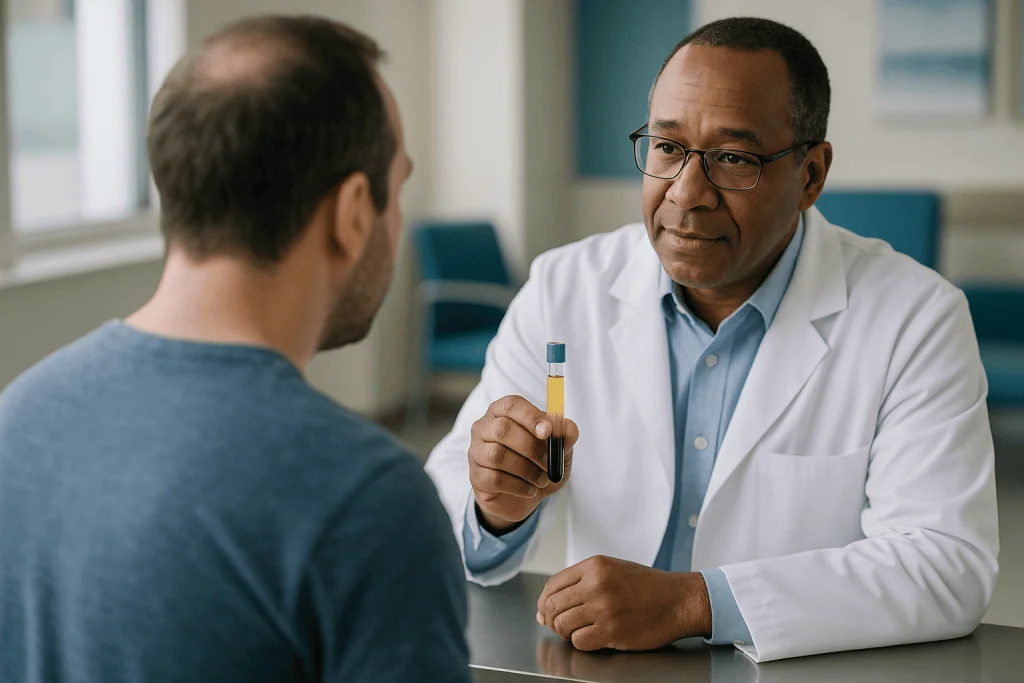
The interest for hair comes from what platelets carry inside them. When activated, they release growth factors, signaling proteins that tell nearby cells to divide, build blood vessels and repair tissue. These same signals are part of normal wound healing. The hypothesis behind PRP for hair loss is that bathing the follicle, the tiny pocket of skin that grows each hair, in those signals may nudge follicles that are shrinking back toward a longer growth phase.
Hair grows in a cycle. The active growing phase is called anagen; a resting and shedding phase follows before the follicle restarts. In androgenetic alopecia, the common inherited pattern of thinning that Mayo Clinic describes as the most frequent cause of hair loss, follicles progressively miniaturize and spend less time in anagen. The strands they produce become finer and shorter until they are barely visible.
PRP does not create new follicles. Where a follicle has fully scarred over or disappeared, there is nothing for a growth signal to act upon. This is the single most useful fact for setting expectations, and it explains why clinicians tend to reserve PRP for areas that are thinning rather than fully bald. The mechanism is biologically reasonable; whether it produces a change you can see in the mirror is a separate question we will get to.
Before the appointment: the consultation and what gets checked
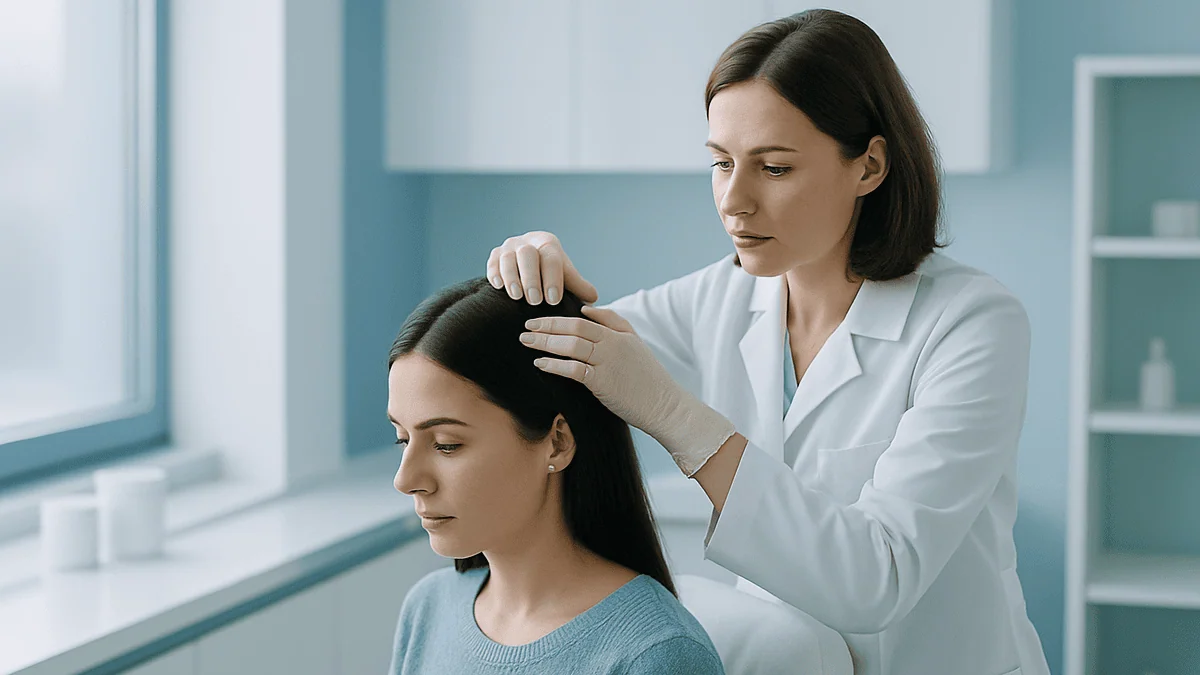
A responsible PRP appointment begins days or weeks earlier, in a chair rather than on a table. The clinician needs to know why your hair is thinning before anyone spins a tube of blood, because not every kind of hair loss behaves the same way. The NHS lists a wide range of causes, from the inherited pattern type to thyroid problems, iron deficiency, stress-related shedding, certain medicines and autoimmune conditions such as alopecia areata.
Expect questions about family history, the timeline of the change, recent illness or weight loss, and what you take, including supplements. Mayo Clinic notes that evaluation for hair loss may include blood tests, a close look at the scalp, sometimes a pull test where the clinician gently tugs a small bunch of hairs to see how many release, and occasionally a scalp biopsy. Many teams also photograph the scalp under standardized lighting so that later comparisons rest on images rather than memory.
The pre-visit conversation also covers what could make PRP a poor fit for you right now. Clinicians typically ask about bleeding disorders, blood thinners, active scalp infection or inflammation, recent illness, pregnancy, and conditions affecting platelets. If you take anti-inflammatory medicines or supplements that affect platelet function, your team may discuss timing; do not change anything on your own, since that decision belongs to whoever prescribed them.
Finally, this is the moment for expectation-setting. A good consultation should tell you plainly that results, where they occur, appear gradually over months, that the evidence is still developing, and that maintenance visits are usually part of the plan. If that conversation feels rushed or overly upbeat, it is fair to ask for more time.
Step one: the blood draw
For many people this is the part they dread most and the part that turns out to be the least eventful. A tourniquet goes around your upper arm, the skin over a vein at the elbow or forearm is cleaned, and a needle collects blood into one or more collection tubes. It is the same technique used for a cholesterol test.
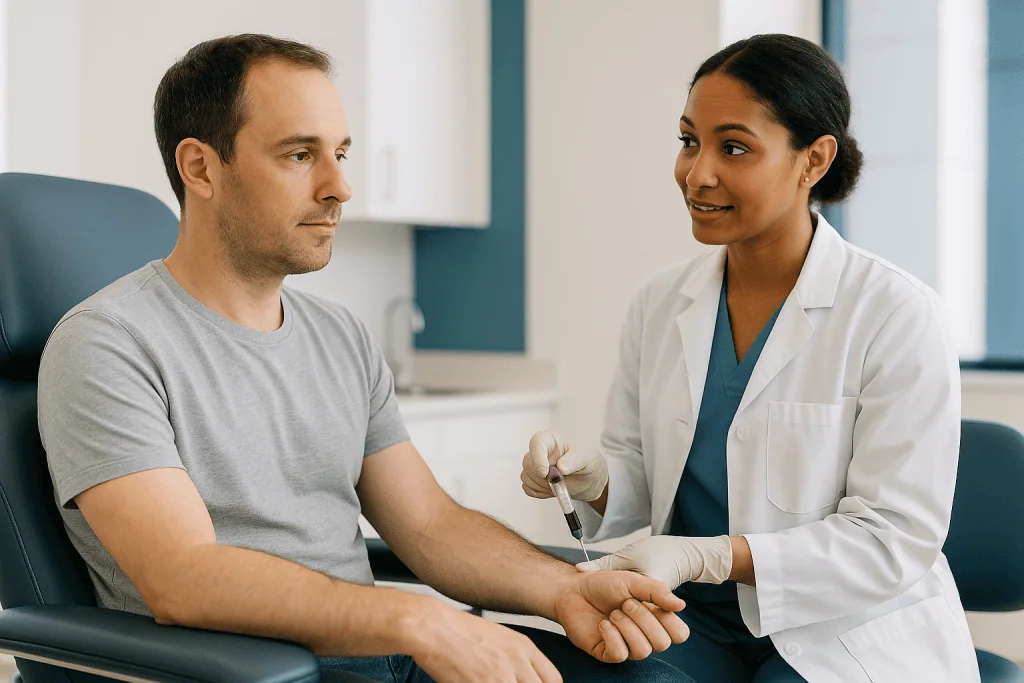
The tubes used for PRP usually contain an anticoagulant, a substance that stops the blood clotting in the tube so the platelets stay suspended and can be separated cleanly. Some systems use specialized kits designed for the centrifuge in the room; others use standard laboratory tubes. Either way, the sample stays with you and is processed within minutes rather than sent away.
Small practical things make the draw easier. Being well hydrated the day before and that morning helps veins fill, and eating a normal breakfast lowers the chance of feeling faint. If you have a history of fainting with needles, a reaction called a vasovagal response in which heart rate and blood pressure briefly drop, mention it beforehand so staff can have you lie down. A brief sting and a small bruise at the site are the usual after-effects.
The amount drawn depends on the area being treated and the system in use, and the clinician will tell you what to expect. It is a modest volume compared with blood donation; you should not feel weak afterward. Once the tubes are filled, the needle comes out, pressure goes on for a minute, and the sample heads straight to the centrifuge sitting a few feet away.
Step two: the centrifuge, and what "concentration" really means
A centrifuge is a machine that spins samples at high speed so that denser components move outward and settle. Spin whole blood and it separates into recognizable bands: red blood cells at the bottom because they are heaviest, a thin pale layer of white cells and platelets above them, and clear plasma on top. The platelet-rich fraction is drawn from the region where plasma meets that pale layer.
Systems differ in how they do this. Some spin once; others use a two-step spin, the first to separate red cells and the second to pack the platelets into a smaller volume. Harvard Health, in its overview of female pattern hair loss treatments, notes that PRP preparation methods vary considerably between practices, which is one reason study results are hard to compare with one another.
Concentration is the word you will hear, and it simply means how many platelets end up in each unit of the final plasma relative to your baseline. A higher number is not automatically better; the biology of growth-factor signaling appears to have a range in which it works, and the optimal concentration for scalp use has not been settled by high-quality trials. White cells are another variable, since some preparations include them and some deliberately exclude them.
You will typically wait in the treatment room during the spin, which takes minutes rather than hours. Once complete, the clinician draws the platelet-rich layer into small syringes. Some add a substance to activate the platelets so they begin releasing growth factors; others rely on the platelets activating on contact with tissue. Neither approach has been proven superior for hair, and your team should be able to explain which they use and why.
How painful is PRP for hair loss? Numbing and preparing the scalp
The honest answer is that the scalp is a sensitive place and most people feel the injections, but the experience is usually described as tolerable rather than severe, and clinicians have several ways to soften it.
Before anything touches your head, the treatment area is mapped, often with the pre-visit photographs as a guide, and cleaned with an antiseptic. Hair is not shaved; the clinician parts it in rows to reach the skin. Then comes numbing. Many practices apply a topical anesthetic cream to the scalp and leave it in place for a period before injecting. Others inject a local anesthetic, the same class of numbing medicine a dentist uses, along the border of the area or as a ring block, a technique that numbs the nerves supplying a region by injecting around its edge. Some use cold air, vibration devices or ice, which distract the nerves that carry sharp pain.
Which approach you receive is a clinical decision, and it is worth asking about in advance if you are anxious. People who have had the procedure often describe the sensation as a series of quick pinches or pressure, with the front hairline and temples tending to be more sensitive than the crown. A tight, sore feeling can follow for the rest of the day.
What numbing does not do is remove the sensation of pressure entirely, and the very first injections, before an injected anesthetic has taken hold, are typically the ones people remember. Telling the clinician early if the discomfort feels sharper than expected allows them to pause, add anesthetic or slow the pace. You are not expected to tough it out.
Step three: the scalp injections themselves
With the scalp numb and the syringes prepared, the clinician begins injecting the platelet-rich plasma into the skin. The needle is fine and short, and each injection deposits a small amount of plasma into the dermis, the layer where follicles live, before the clinician moves a short distance and repeats. Some practitioners work in a grid, others in overlapping rows following the pattern of thinning; the intent is even distribution over the treatment area rather than a few deep deposits.
Depth matters and is judged by feel and experience. Too superficial and the plasma sits in the very top layer of skin and leaks back out; too deep and it lands in fat below the follicles. Many clinicians use a technique that raises a tiny bleb, a small temporary bump of fluid under the skin, as a sign the plasma is in the intended plane. Those blebs settle within hours.
Some practices combine the injections with microneedling, a technique in which a device with very fine needles creates thousands of shallow channels in the skin. The idea is to spread plasma across the surface and stimulate a mild healing response. This is a variation, not a requirement, and the evidence base for adding it is thinner than for injections alone.
The injection phase takes minutes. The area is then gently cleaned of any surface blood or plasma. Many clinicians ask you not to wash your hair for a period so the plasma stays where it was placed, and they will give specific instructions. You may see small pinpoint marks where the needle entered; these fade quickly. Then you stand up, and the appointment is over.
Who PRP is usually for, and who is usually asked to wait
The clearest candidates are adults with early to moderate androgenetic alopecia, the inherited pattern thinning that Mayo Clinic identifies as the most common cause of hair loss in both men and women. These are people whose follicles are miniaturizing but still present, because PRP can only signal to follicles that exist. Widening part lines, thinning crowns and receding temples with visible fine hairs fall into this group. Harvard Health lists PRP among options being explored for female pattern hair loss, alongside more established treatments.
Fully bald, smooth areas that have been that way for years generally respond poorly, because the follicles are gone. Clinicians also tend to wait, or steer toward other approaches, in several situations:
- Active scalp infection, open skin or a flare of an inflammatory scalp condition, where injections could spread infection or worsen irritation.
- Bleeding disorders, very low platelet counts or anticoagulant therapy, where bruising and bleeding risk rise and platelet quality may be affected.
- Pregnancy and breastfeeding, largely because safety data are lacking rather than because harm has been shown.
- Recent serious illness, fever or certain cancers, where a treatment that stimulates cell growth warrants caution and specialist input.
- Hair loss caused by something treatable elsewhere, such as thyroid disease or iron deficiency, which the NHS notes can drive shedding and which deserve their own management first.
Scarring types of alopecia, in which inflammation destroys follicles permanently, are a different disease and are usually managed by a dermatologist with anti-inflammatory approaches rather than PRP. Alopecia areata, an autoimmune patchy loss, has a small evidence base for PRP but is not the main target. In every case, the decision belongs with the treating team, who can weigh your history against what the plasma can realistically do.
Does PRP actually regrow hair? What the evidence shows
Here is where a good explainer has to slow down. The evidence for PRP in pattern hair loss is genuinely encouraging in places and genuinely limited in others, and both halves matter.
On the encouraging side, several small randomized trials have compared PRP with placebo injections, often on the same head, treating one side and leaving the other as a control. In the trial by Gentile and colleagues published in Stem Cells Translational Medicine and indexed on PubMed, participants treated with three monthly sessions showed a statistically significant increase in hair count and hair density on treated areas compared with placebo areas, with scalp biopsies showing more follicles and thicker skin layers. Other half-head studies have reported similar directions of effect.
On the limited side, these trials are small, often a few dozen participants. They use different centrifuges, concentrations, injection techniques and outcome measures, which makes pooling them difficult. Follow-up is usually months, not years, so we do not know how durable any gain is or how quickly it fades when maintenance stops. Harvard Health characterizes PRP as promising but still being studied, and Mayo Clinic’s treatment overview places established medicines and surgery ahead of newer approaches.
So the accurate statement is this: PRP appears to increase hair density in some people with pattern thinning over a period of months, based on small controlled trials, while larger and longer studies have not yet confirmed how big, how consistent or how lasting that effect is. Anyone who tells you it definitely works, or definitely does not, is ahead of the data. Your team should frame it as a reasonable option with uncertain individual response, not a guaranteed outcome.
How many PRP sessions for hair loss? Is three enough?
Three is the number people arrive with, and it comes from the trial protocols rather than from a biological law. The Gentile trial on PubMed used three sessions spaced about a month apart, and most clinics have adopted that as the initial course. Cleveland Clinic’s general PRP overview notes that the number of injections varies with the condition being treated and that effects, where they appear, develop over weeks to months rather than immediately.
Why space them by roughly a month? Growth factors released from platelets act over days, and repeating the signal before follicles drift back toward miniaturization is the rationale. Whether monthly is truly optimal has not been tested against other intervals in large studies.
| Phase | What typically happens | Where the pattern comes from |
|---|---|---|
| Initial course | Three sessions, roughly one month apart | Randomized trial protocols (Gentile et al., PubMed) |
| Assessment | Standardized photographs compared with baseline several months after the first session | Timelines described in Cleveland Clinic PRP overview |
| Maintenance | Periodic single sessions if the team judges a response has occurred | Common practice; not established by high-quality trials |
Is three enough? Enough to judge whether you are a responder, probably. Enough to hold a result indefinitely, probably not, because the underlying process that shrinks follicles continues. Most clinicians who use PRP describe maintenance sessions, and the interval for those is decided case by case with far less evidence behind it than the initial course. What you should not accept is an open-ended commitment without a checkpoint. Ask when the photographs will be compared and what would prompt the team to stop.
The days and weeks after PRP: what recovery usually looks like
The first evening is the least glamorous part. The scalp typically feels tight, tender and warm, a little like a mild sunburn, and the injection sites may look pink with small raised bumps where plasma was placed. Cleveland Clinic lists soreness and bruising at injection sites as the expected short-term effects of PRP. A mild headache is common, particularly after front hairline treatment. Most people are back at work or their usual routine the same or the next day.
Aftercare instructions vary, and the ones from your own team override anything general, but they usually include waiting before washing your hair so the plasma settles, avoiding vigorous exercise, saunas and swimming for a short period to limit sweating and infection risk, skipping styling products on the treated area briefly, and not applying heat. Many clinicians advise against anti-inflammatory pain relievers immediately afterward on the theory that the inflammatory response is part of how PRP works; they can suggest an alternative if you are uncomfortable, and any medication decision should go through them.
Over the following days the tenderness fades and the pink marks disappear. Then comes the hard part: nothing visible for a while. Hair follicles cycle slowly, and even a follicle that responds needs time to move into its growing phase and push out a strand thick enough to notice. Some people report a temporary increase in shedding a few weeks after treatment; this is described anecdotally and is thought to reflect resting hairs being pushed out as follicles restart, though it has not been well characterized in studies.
Realistically, comparisons with baseline photographs are made months into the course, not weeks. Keeping your own photos under the same light and angle helps you see change without relying on memory.
PRP hair treatment side effects, risks and the alternatives
Because PRP uses your own blood, the risk of allergic reaction or disease transmission is very low, which Cleveland Clinic highlights as a key safety advantage. The risks that remain are mostly those of any injection into the scalp.
Common and short-lived effects include pain during and after injection, tenderness, swelling, pinpoint bleeding, bruising and headache. Less common effects include temporary numbness or tingling, small scabs at injection points, and a brief increase in shedding. Rare but serious effects include infection at the injection sites, which is why skin preparation and hygiene afterward matter, and injury to small blood vessels or nerves. Fainting during the blood draw is a possibility for anyone prone to it.
The more subtle risk is the one nobody puts on a consent form: spending time and money on a treatment that produces no visible change for you while pattern loss continues. That is why a defined assessment point matters.
Alternatives exist, and a fair consultation should name them. Mayo Clinic describes medicines as the mainstay for pattern hair loss: a topical vasodilator class that appears to prolong the growth phase, and an oral hormone-pathway class for men that reduces conversion of testosterone to the form that miniaturizes follicles. Both act gradually over months and require ongoing use, and whether either is appropriate is a decision for the prescribing clinician. Low-level laser devices have some supporting evidence. Hair transplant surgery relocates your own follicles from the back of the scalp to thinning areas and is the only approach that places follicles where none remain. Some teams use PRP alongside these options; that combination is common in practice but not clearly proven to add benefit.
What people often get wrong about PRP for hair loss
The myths cluster around a few themes, and each one has a factual correction.
“It is stem cell therapy.” It is not. PRP contains platelets and plasma proteins, not stem cells. Some clinics blur the two; the distinction matters because stem-cell products for hair are experimental and regulated very differently.
“One session and you are done.” The trial evidence that exists, including the Gentile study on PubMed, used a series of monthly sessions, and clinicians generally describe maintenance afterward. A single session is a poor test of whether you respond.
“It regrows hair on bald scalp.” Growth factors need a living follicle to act on. Smooth, long-bald areas have lost their follicles, and no injection of plasma brings them back. Transplantation is the approach that addresses that situation.
“Results show up in a few weeks.” Hair cycles are slow. Cleveland Clinic notes PRP effects develop over weeks to months; for hair, meaningful comparison usually waits several months.
“It hurts as much as a tattoo” or “it does not hurt at all.” Both are exaggerations. Most people report a series of tolerable pinches with a sore scalp afterward, softened by numbing.
“Higher platelet concentration means better results.” The optimal concentration for scalp use has not been established, and more is not demonstrated to be better.
“It replaces the medicines.” Guideline-level sources such as Mayo Clinic still place established medicines and surgery as the primary treatments, with PRP as an adjunct or option under study. Whether to continue, start or stop any medicine is a question for your prescribing clinician, never something to decide because a PRP course has begun.
“It fixes every kind of hair loss.” Shedding from thyroid disease, iron deficiency or stress, which the NHS lists among common causes, needs its own evaluation first.
Questions to ask your care team before your first session
A well-run consultation welcomes questions, and the quality of the answers tells you a great deal. Bring this list, or your own version of it.
- What type of hair loss do you believe I have, and what led you to that conclusion? Were blood tests or a scalp examination part of the workup?
- Are there other causes we should rule out first, such as thyroid or iron problems?
- Which areas would you treat, and which would you consider too far gone for PRP?
- What preparation system do you use, how many spins, and is the plasma activated? Why that approach?
- How will you manage pain during the injections, and what should I do if it feels worse than expected?
- How many sessions are in the initial course, how far apart, and at what point will we compare photographs against baseline?
- What result would make you recommend maintenance, and what would make you recommend stopping?
- What side effects should I expect in the first days, and which ones should prompt a call?
- Do you want me to change anything about my usual medicines or supplements before the visit? If so, will you coordinate with whoever prescribed them?
- How does PRP fit alongside the other options for my type of hair loss, including medicines, devices and surgery?
- Who performs the injections, and who do I contact after hours if something feels wrong?
- Can I have the full plan, including all sessions and any add-on procedures, in writing before I commit?
Notice that none of these questions asks the team to guarantee a result. A clinician who answers them with specifics, acknowledges uncertainty and describes a clear checkpoint is giving you what the evidence allows. A clinician who answers with before-and-after collages and a discount if you sign today is telling you something too.
When to call your doctor after PRP scalp injections
Most of what follows a PRP session is mild and resolves within a few days: soreness, small bumps, pinpoint bleeding, a headache and some pinkness. A short list of signs falls outside that expected range and warrants a call to the team that treated you, or urgent care if they cannot be reached.
Infection is the most important one. Call if the scalp becomes increasingly red, hot and swollen rather than gradually settling, if you notice pus or cloudy drainage from injection points, if tenderness worsens after the second day instead of easing, or if you develop a fever or chills. Injection-site infections are uncommon but need prompt treatment.
Bleeding that does not stop with gentle pressure, or a rapidly enlarging lump under the scalp, should also prompt a call, particularly if you take blood thinners or have a bleeding tendency. So should severe or worsening headache, a headache with vision changes, confusion or a stiff neck, or numbness in the scalp that spreads or persists beyond the numbing period your team described.
Allergic reactions to PRP itself are very unlikely because the plasma is your own, but the anesthetic, antiseptic or any added product can occasionally cause one. Hives, swelling of the lips or face, wheezing or difficulty breathing are emergency signs: call your local emergency number rather than the clinic.
Finally, call if something simply does not feel right. Fainting after you left, dizziness that does not pass, or a reaction you were not warned about are all reasonable reasons to pick up the phone. Your treating team knows exactly what was injected, where and how, and they are the right people to interpret what you are feeling.
Frequently asked questions
How painful is PRP for hair loss?
Most people describe the injections as a series of quick pinches or pressure that is tolerable, followed by a sore, tight scalp for the rest of the day. Clinicians commonly use numbing cream, injected local anesthetic, cold or vibration to reduce discomfort. The front hairline and temples tend to be more sensitive than the crown. Tell the clinician early if it feels sharper than expected so they can adjust.
Does PRP regrow hair, or does it only slow shedding?
Small randomized trials, including a placebo-controlled study indexed on PubMed, found increased hair count and density in treated areas over several months, so it appears to do more than slow shedding in some people. The studies are small and short, however, and cannot yet say how large or lasting the effect is. PRP does not create follicles where none remain.
Is three sessions of PRP enough?
Three monthly sessions is the initial course used in trial protocols and is generally enough to judge whether you respond when photographs are compared with baseline. It is usually not enough to hold a result indefinitely, because the process that miniaturizes follicles continues, and most clinicians describe periodic maintenance. Ask your team for a defined checkpoint and stopping criteria.
What happens to the blood after it is drawn?
The tubes go straight into a centrifuge in the treatment room, which spins them so red cells settle at the bottom and plasma rises to the top. The clinician draws off the platelet-rich layer near the boundary, sometimes after a second spin to concentrate it further, loads it into small syringes and injects it within minutes. Nothing is sent away or stored.
How long does a PRP hair appointment take?
It is an outpatient visit completed in one sitting, with the blood draw, spinning, numbing and injections done consecutively. Cleveland Clinic describes PRP as a same-day procedure with no downtime requiring recovery in a facility. Your clinic will give you a time estimate that reflects its own numbing method and the size of the area being treated.
What are the side effects of PRP hair treatment?
Common effects are soreness, tenderness, swelling, pinpoint bleeding, bruising and headache for a day or two. Less common are temporary numbness, small scabs and a brief increase in shedding. Rare but serious effects include infection at injection sites and reaction to the anesthetic. Because the plasma is your own, allergic reaction to PRP itself is very unlikely.
Can I wash my hair after PRP injections?
Most clinicians ask you to wait before washing so the plasma stays in the skin where it was placed, and to avoid heat, heavy sweating, swimming and styling products on the area for a short period. The exact timing varies by practice, so follow the written aftercare from your own team rather than a general rule.
Who should not have PRP for hair loss?
Clinicians typically defer or avoid PRP in people with active scalp infection, bleeding disorders, very low platelets or anticoagulant therapy, pregnancy or breastfeeding, recent serious illness, and hair loss driven by an untreated cause such as thyroid disease or iron deficiency. Long-bald scarred areas rarely respond. The treating team weighs these factors individually.
Does PRP work with hair loss medicines or hair transplant surgery?
Many practices combine PRP with topical or oral medicines for pattern hair loss, or use it around transplant surgery, but whether the combination adds benefit has not been clearly shown in high-quality trials. Never start, stop or change a prescribed medicine because a PRP course has begun; that decision belongs to the clinician who prescribed it.
When should I worry after a PRP session?
Call your treating team if redness, heat or swelling increases rather than settles, if you see pus or drainage, or if you develop fever, worsening pain after the second day, bleeding that will not stop, severe headache or spreading numbness. Hives, facial swelling or difficulty breathing are emergency signs that need your local emergency number immediately.
References
This article is for general information only and is not a substitute for professional medical advice. Please consult a qualified doctor about your individual situation.

More from the Blog
How Surgeons Assess Keloid Risk and Scar Tendency Before an Afro Hair Transplant
Before an afro hair transplant, surgeons assess keloid risk by asking about personal and family scar history, examining existing scars anywhere on the body,…
How a Hair Transplant Without Shaving Is Done: Hidden Donor Windows and Graft Placement
A no shave hair transplant procedure harvests follicles from narrow, concealed strips of the back and sides of the scalp, trimmed short beneath longer…

Beard Transplant Recovery: Healing Without Ruining the Grafts
Most people are socially presentable within 7 to 10 days of a beard transplant, but biological recovery takes months. Grafts anchor securely by about…
How Technique Choice Changes Shaving and Placement: FUE or DHI for a Female Hair Transplant?
For a female hair transplant, FUE and DHI use the same method of harvesting follicles one by one from the back of the scalp;…
Hair Transplant Without Shaving Results: Does Working Around Existing Hair Limit Density?
A hair transplant can be done without shaving the whole head, usually as an unshaven or partially shaved follicular unit extraction. Working around existing…

Who Suits Scalp Micropigmentation for Scars and Thinning, and Who Needs Another Approach?
Scalp micropigmentation for scars usually suits adults whose scar is fully healed and flat, whose skin does not tend to form raised keloids, and…