

When Does a Drooping Eyelid Need Oculoplastic Surgery? Vision, Comfort and Timing
Key Takeaways
- In most adults, a drooping eyelid results from a stretched levator aponeurosis, the tendon-like sheet that transmits the lifting muscle's pull, rather than from a weak muscle.
- Surgery is generally considered functional, and potentially covered, when the margin reflex distance and taped visual field tests show the lid encroaching on the pupil.
- A droop that develops over hours or days, or arrives with double vision, an unequal pupil or weakness, is a medical emergency before it is ever a surgical question.
- Blepharoplasty removes excess skin but does not raise a low lid margin; true ptosis needs the levator or Müller's muscle addressed, and many adults need both procedures.
- Mayo Clinic notes that bruising and swelling after upper eyelid surgery typically subside within about 10 to 14 days, while final lid height settles over weeks.
- In congenital ptosis, MedlinePlus notes that severe cases threatening visual development are repaired early, while milder droops are commonly corrected in the preschool years.
A drooping eyelid usually needs surgery when the lid margin sits low enough to block the upper or central field of vision, when it causes eye strain, headaches or neck tilting, or when a child's lid threatens visual development. Sudden drooping, drooping with double vision, an unequal pupil or weakness elsewhere is not a surgical question first but a medical emergency. The decision rests with an eye specialist after measurement and examination.
Every family photo from the last few years shows the same thing: one eyebrow hitched up higher than the other, as if she were permanently skeptical. She was not. She was compensating. Her right upper lid had been creeping down for a decade, so slowly that she only noticed when the reading lamp started to feel too dim and her forehead ached by dinner.
Her question, the one she finally typed into a search bar late one night, was simple: when does a droopy eyelid need surgery, and when is it just a face doing what faces do with time? The honest answer has three parts. It depends on what the lid is doing to your sight, what it is doing to your comfort, and, most urgently, what caused it in the first place.
This explainer walks through how specialists measure a drooping lid, why the cause matters more than the appearance, what ptosis repair actually involves, and how the recovery weeks tend to unfold. Every decision described here belongs to you and your treating team; the aim is to help you arrive at that conversation well informed.
When does a droopy eyelid need surgery? The short version
Eye specialists tend to sort drooping eyelids into three broad buckets, and the bucket determines the urgency far more than the amount of droop does.
The first bucket is the eyelid that is quietly stealing vision. The upper lid normally rests a little below the top edge of the cornea, the clear front window of the eye. When it sags further, it begins to shade the top of the visual field, then the center. People describe reading lamps that feel dim, missing the top line on a road sign, or tilting the chin up to see under the lid. Once vision is measurably obstructed, or the effort of holding the brow up produces daily fatigue and headaches, surgery moves from optional to reasonable, according to MedlinePlus and Cleveland Clinic guidance on ptosis.
The second bucket is the eyelid that is a symptom of something else. Drooping that appears over hours or days, or arrives alongside double vision, a pupil that no longer matches the other, or weakness in the face or limbs, points to a nerve or muscle problem. That lid does not need a surgeon first; it needs a medical diagnosis, sometimes urgently. Correcting the lid before understanding the cause would be treating the smoke rather than the fire.
The third bucket is the eyelid that bothers you but does not obstruct sight. Here the decision is elective. There is nothing wrong with choosing surgery for comfort or appearance, but the balance of risk and benefit is different, and a good surgeon will say so plainly.
So when does a droopy eyelid need surgery? When it blocks vision, when it exhausts you, or when it threatens a child’s visual development, and only after the cause has been established. The rest of this article unpacks each of those conditions.
What is ptosis, and how does an eyelid actually lift?
Ptosis (pronounced TOE-sis) is the medical term for an upper eyelid that sits lower than it should. It is worth separating from a look-alike: dermatochalasis, which is excess, loose skin folding over a lid that is otherwise in the right position. The two often coexist in older adults, but they are treated differently, and mistaking one for the other is a common reason people feel a surgery did not deliver what they expected.

To understand why a lid droops, it helps to picture how it lifts. The main engine is the levator palpebrae superioris, a thin muscle that runs from the back of the eye socket forward to the lid. It attaches to the lid through a broad tendon-like sheet called the levator aponeurosis. Think of it as a curtain cord: the muscle pulls, the aponeurosis transmits the pull, and the lid rises. A smaller helper, Müller’s muscle, adds a millimeter or two of lift and is driven by the sympathetic nervous system, the same wiring that dilates your pupil when you are startled.
Each part of that system can fail in its own way. In most adults the culprit is the aponeurosis, which stretches or partially detaches from the lid with age, long-term contact lens wear or previous eye surgery; the muscle itself still works, but the cord has gone slack. In children born with ptosis, the levator muscle usually never developed properly. In nerve disorders, the signal to the muscle is interrupted. In myasthenia gravis, the junction between nerve and muscle fatigues through the day.
This anatomy matters because the surgical plan follows the failure point. A stretched aponeurosis is tightened or reattached. A muscle that barely works is bypassed by linking the lid to the forehead. Knowing which is which is the surgeon’s first job.
Why is my eyelid drooping, and when to worry about a droopy eyelid?
The slow, symmetrical sag of later life is the most common story and rarely dangerous. The aponeurosis thins, the lid creeps down over years, and the brow does overtime to compensate. People often notice it first in photographs or when one eye appears smaller than the other after a long day.
Several other causes deserve to be ruled out before anyone talks about surgery. MedlinePlus lists among them a stroke or transient ischemic attack, an aneurysm pressing on the third cranial nerve, Horner syndrome, myasthenia gravis, a tumor behind or around the eye, and long-standing diabetes affecting nerves. Some medicines and injections can also produce a temporary droop. Eye injuries and previous eye surgery can stretch the aponeurosis mechanically.
The features that should prompt a same-day conversation with a clinician rather than an online search are speed and company. Speed: a lid that drops over hours or days rather than years. Company: anything traveling alongside the droop. Double vision suggests the eye muscles are also affected. A pupil that is larger or smaller than its partner points to a nerve pathway problem; Horner syndrome, for instance, pairs a small droop with a small pupil and sometimes reduced sweating on that side of the face, according to MedlinePlus. A severe new headache with a droop and a dilated pupil is one of the classic warning patterns for an aneurysm and belongs in an emergency department.
Myasthenia gravis has its own signature. Cleveland Clinic describes drooping and double vision that are mild in the morning and worsen with fatigue later in the day, sometimes with difficulty swallowing or speaking. That pattern calls for a neurologist, not a scalpel, because the lid position will change with medical treatment.
None of these causes is common. All of them are worth excluding, which is why a thorough eye examination precedes any surgical plan.
Is my droopy eyelid affecting vision? How specialists measure it
Feeling that a lid is in the way is a starting point, but surgeons and insurers both want measurements, and the measurements are more revealing than most people expect.

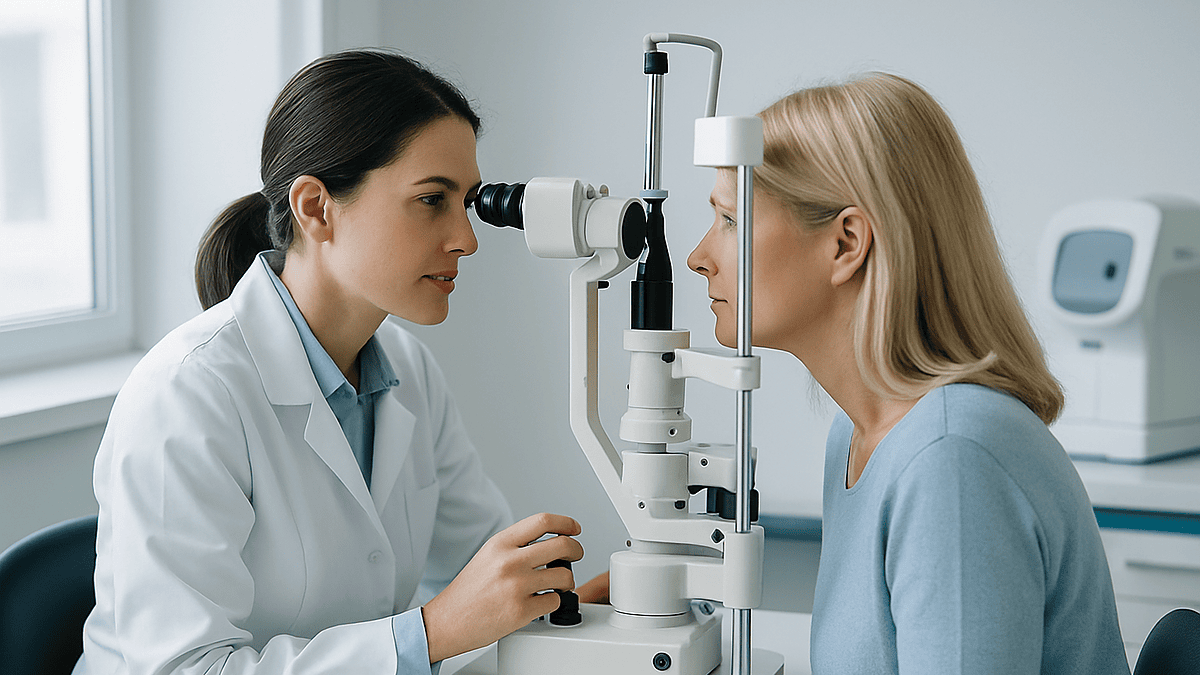
The first is the margin reflex distance, usually abbreviated MRD1. The examiner shines a small light at your eye and measures, in millimeters, how far the edge of the upper lid sits above the light reflection on the center of your cornea. A generous distance means the lid is clear of the pupil; a small or negative distance means the lid is covering it. This single number often decides whether a case is classed as functional or cosmetic.
The second is levator function: how many millimeters the lid travels from looking fully down to looking fully up while the examiner holds the brow still. This is the muscle’s strength test. Good excursion suggests the muscle works and only the aponeurosis needs attention. Poor excursion suggests the muscle itself is weak, which changes the operation.
The third is visual field testing. You sit at a machine and click when you see flashes of light at the edge of your vision, first with the lid in its natural position and then with the lid taped up. The difference between the two maps shows exactly how much of the upper field the lid is stealing. It is also the test that turns a subjective complaint into objective evidence.
Photographs complete the picture, often including one showing your habitual chin-up or brow-raised posture. Cleveland Clinic and Mayo Clinic both note that a complete eye examination, checking pressure, tear production and the health of the eye surface, is part of the workup, because dry eyes or poor closure would affect how safely a lid can be lifted.
If your droopy eyelid is affecting vision, these measurements will show it, and they give you and your team a shared, honest baseline.
Who is usually offered ptosis surgery, and who is usually asked to wait
The clearest candidates share a few features. Their measurements show the lid crossing into or over the pupil. Their visual field test improves when the lid is taped. Their cause is mechanical, usually a stretched aponeurosis, rather than neurological. They report a daily toll: brow ache, tension headaches, difficulty reading or driving, fatigue by evening. They have a stable lid, meaning it has not been changing over recent months. And their eye surface is healthy enough to tolerate a higher lid, since a lid that opens wider also closes less easily.
Children fall into a special category discussed in a later section, because a lid that covers the pupil during early childhood can interfere with visual development, and that risk can outweigh the general preference to wait.
Others are usually asked to hold off, at least for now. Anyone whose droop is new, rapidly progressive or accompanied by double vision, pupil changes or weakness should complete a medical workup first. Someone whose ptosis is caused by myasthenia gravis or a recent nerve palsy may see the lid recover with medical treatment or time; MedlinePlus notes that some nerve-related droops improve on their own over months. Operating too early risks an overcorrection when the underlying condition settles.
People with significant dry eye or incomplete blink are often asked to treat the surface first, because the surgical lift can worsen exposure. Those on blood-thinning medicines are not excluded, but the plan must be coordinated with whoever prescribes them; no one should stop or adjust such medicines on their own before surgery.
Finally, some are asked to wait simply because the lid is not yet in the way. A mild droop that bothers you in photographs is a legitimate concern, but it is an elective one, and a fair surgeon will separate what is medically indicated from what is personally desired, then let you decide.
What actually happens during ptosis repair
Most adult ptosis repair is a day procedure performed under local anesthetic, usually with light sedation, according to MedlinePlus and Mayo Clinic descriptions of eyelid surgery. Being awake sounds alarming to many people, but it is often deliberate: the surgeon may ask you to open your eyes and look up partway through so the lid height and contour can be checked and adjusted on the spot. Symmetry is judged in real time rather than guessed.
There are two main approaches for an adult with a working levator muscle. In the external approach, the surgeon makes an incision in the natural crease of the upper lid, finds the stretched aponeurosis, and shortens or reattaches it to the firm plate of tissue inside the lid. The scar sits in the crease, where it is largely hidden when the eye is open. In the internal approach, the surgeon works from the inside surface of the lid, tightening Müller’s muscle and the tissue beneath it, leaving no external incision at all. This suits milder droops that lift well when a test eye drop temporarily stimulates Müller’s muscle.
When the levator muscle itself is too weak to do the work, as in many children with congenital ptosis, the surgeon performs a frontalis sling. A thin strip of tissue or a fine synthetic material is threaded between the lid and the forehead muscle so that raising the eyebrows lifts the lid. Children adapt to this remarkably quickly.
If loose skin is also present, the surgeon may remove a strip of it at the same time, which is blepharoplasty performed alongside ptosis repair rather than instead of it. The whole procedure for one or both lids typically takes under an hour or two, and most people go home the same day with an ice pack and instructions rather than a hospital bed.
Ptosis vs blepharoplasty vs non-surgical options: a plain comparison
People often arrive at consultations asking for “an eyelid lift” without realizing that the phrase covers different operations addressing different problems. The table below separates the main options by what they fix and who they tend to suit.
| Option | What it addresses | How it works | Typically considered for |
|---|---|---|---|
| Ptosis repair (external or internal) | The lid margin sitting too low | Tightens or reattaches the levator aponeurosis or Müller’s muscle | Adults with a working levator and a lid that shades the pupil |
| Frontalis sling | Severe droop with a very weak levator | Links the lid to the forehead muscle so brow movement lifts the lid | Congenital ptosis, some nerve or muscle disorders |
| Upper blepharoplasty | Excess skin and fat folding over a normally positioned lid | Removes a strip of skin, sometimes fat, through the lid crease | Dermatochalasis without true ptosis |
| Eye drops that stimulate Müller’s muscle | Mild acquired ptosis | A prescription drop from the alpha-adrenergic class temporarily contracts Müller’s muscle | Adults who want a non-surgical trial or are not surgical candidates |
| Ptosis crutch on glasses | Any droop when surgery is unsuitable | A small bar fitted to the spectacle frame props the lid | Neurological ptosis awaiting recovery, medically fragile patients |
| Observation and treating the cause | Droop from myasthenia, nerve palsy, medication or injection | Lid often improves as the underlying condition is managed | New or fluctuating ptosis |
Two clarifications matter. Blepharoplasty alone will not lift a lid margin that is truly low; it tidies the skin above it. Conversely, ptosis repair alone may leave heavy skin in place. Many adults need both, and Mayo Clinic notes that the procedures are frequently combined. On the drops: they provide a lift only while used, they are a prescription decision for your clinician, and they are not a substitute for diagnosing the cause of a new droop.
What's the best age for eyelid surgery? Children and adults
There is no single best age, because the question means something different for a child than for an adult.
For children born with ptosis, timing is driven by vision rather than appearance. A developing visual system needs a clear image reaching the retina. If the lid covers the pupil, or if it presses on the eye and distorts its shape enough to cause astigmatism, the brain may begin to favor the other eye, a condition called amblyopia, sometimes known as lazy eye. MedlinePlus explains that severe congenital ptosis with amblyopia risk is corrected early, whereas milder cases are often repaired in the preschool years, once the child is large enough for accurate measurements and before the lid becomes a social issue at school. In the meantime, the child’s ophthalmologist monitors vision closely and may treat amblyopia with patching or glasses regardless of the lid.
For adults, age is almost irrelevant compared with three other factors: whether the lid obstructs vision, whether the cause is stable, and whether the eye surface is healthy. A healthy person in their eighties with a lid over the pupil and good tear function is a reasonable candidate. A person in their forties with a fluctuating droop from an undiagnosed condition is not, yet.
People sometimes ask whether they should wait until the droop is “bad enough” to justify it. The honest reply is that the measurements answer that better than intuition does, and that waiting carries its own cost when the brow is doing daily overtime. Others ask whether operating early means repeating surgery later. Ptosis can recur as tissues continue to age, and a second operation is possible, but that is a reason to have realistic expectations, not a reason to delay a procedure that would restore vision now.
The best age for eyelid surgery, in short, is when the lid is causing a measurable problem and the cause is understood.
How painful is droopy eyelid surgery, and what is ptosis surgery recovery time?
Most people are surprised by how little pain follows eyelid surgery. The lid has excellent blood supply and few deep pain fibers; the dominant sensations are tightness, heaviness and the odd feeling of a lid that opens further than it used to. Mayo Clinic describes the days after blepharoplasty in terms of soreness, bruising and swelling rather than severe pain, typically managed with cold compresses and simple pain relief chosen with your surgical team, not with strong medicines.
A typical timeline, drawing on Mayo Clinic and MedlinePlus descriptions, runs roughly like this. On the day itself, expect blurred vision from lubricating ointment, a tight sensation and the start of swelling; someone should drive you home. Over the first two or three days, bruising peaks and the lids may look asymmetric, which is normal at this stage and not a verdict on the final result. Cold packs, sleeping with the head raised and avoiding bending and heavy lifting help. Stitches, if external, are usually removed or dissolve within about a week.
Mayo Clinic notes that bruising and swelling generally subside over about 10 to 14 days, at which point most people feel comfortable in public and return to desk work, though final lid height and contour keep settling for weeks as swelling fully resolves. Scars in the lid crease fade over several months and are typically well concealed. Contact lenses, eye makeup and strenuous exercise each have a return date set by your surgeon.
Ptosis surgery recovery time is therefore measured in days for discomfort, two weeks for looking presentable, and a few months for the true final result. Children follow a similar arc, and Cleveland Clinic notes that they usually tolerate it well. Dry or gritty eyes are common early on because the lid closes less completely while swollen; lubricating drops or ointment recommended by the team ease this until the blink recovers.
What are the risks of ptosis repair, and how are they handled?
Eyelid surgery is common and generally safe, but no honest explainer skips the ways it can disappoint or cause harm. Mayo Clinic and MedlinePlus list the recognized risks, and they fall into a few families.
The first is imperfect height or symmetry. Because tissues swell during surgery and heal unpredictably, a lid can end up slightly too low (undercorrection) or too high (overcorrection). Small differences often settle as swelling resolves. Larger ones may need an adjustment, sometimes a minor procedure in the office and occasionally a return to the operating room. This is the most frequent reason for a second operation and is worth discussing before the first.
The second is exposure. A lid that opens further also closes less completely, especially at night. Dry, gritty, watering eyes are common early and usually improve, but people with pre-existing dry eye can be left with lasting discomfort. This is precisely why the tear film is assessed beforehand and why some patients are asked to treat their eye surface first.
The third family is the general surgical set: bleeding, infection, noticeable scarring, and reaction to anesthesia. Bleeding behind the eye that threatens vision is rare but serious, which is why sudden severe pain, bulging or loss of vision after surgery is treated as an emergency.
Less common outcomes include a change in the lid crease or contour, temporary or lasting numbness of the lid skin, double vision if a muscle that moves the eye is irritated, and, in sling procedures for children, the material stretching or becoming infected over time. Recurrence of the droop years later is possible as tissues keep aging.
Neutral framing matters here. These risks do not argue against surgery for someone whose vision is blocked. They argue for a thorough preoperative assessment, realistic expectations and a team that explains what happens if a result needs refining.
Will insurance pay to fix droopy eyelids? Functional versus cosmetic
This is one of the most searched questions about eyelid surgery, and the answer follows the same logic as the surgical decision itself. Insurers generally distinguish between functional surgery, meaning surgery to restore an impaired visual field or relieve documented symptoms, and cosmetic surgery, meaning surgery to change appearance in someone whose vision is not obstructed. Functional procedures may be covered; cosmetic ones usually are not.
What turns a case into a functional one is documentation rather than persuasion. Plans commonly ask for the margin reflex distance showing the lid encroaching on the pupil, visual field tests performed with the lid in its natural position and again with it taped up to demonstrate improvement, photographs of the lids and of any compensatory head or brow posture, and a record of symptoms such as difficulty reading, driving or brow fatigue. The specific thresholds vary by plan and country, and this article deliberately gives no figures; your surgeon’s office and your insurer are the only reliable sources for your policy.
A few practical points help. Ask at the first consultation whether your measurements are likely to meet functional criteria, and request that the visual field test be done in the way your plan requires. If skin removal is planned alongside ptosis repair, understand that the two components may be assessed separately, and the skin portion may be classed as cosmetic even when the ptosis repair is not. Prior authorization, where required, should be completed before a surgery date is fixed.
Public healthcare systems apply similar logic. The NHS, for example, describes eyelid surgery as generally available when the lid affects vision, with purely cosmetic procedures falling outside routine provision. None of this changes what is medically sensible for you; it simply determines who pays, and it is one more reason to have the measurements done properly.
What people often get wrong about droopy eyelids and surgery
Some misunderstandings surface at nearly every consultation, and clearing them up early saves disappointment.
“A droopy eyelid is always just aging.” Usually, yes. Sometimes it is the first visible sign of a nerve, muscle or vascular problem. Speed of onset and accompanying symptoms, not age, decide whether a droop is benign. A new droop in a seventy-year-old still deserves examination.
“Eye exercises or creams will lift the lid.” There is no evidence that facial exercises, tapes worn overnight or topical products tighten a stretched aponeurosis or strengthen a weak levator. Lid tape may help someone see temporarily, but it does not treat the cause, and prolonged use can irritate the skin. Prescription drops that stimulate Müller’s muscle are the only non-surgical option with a physiological mechanism, and they work only while used.
“Blepharoplasty and ptosis repair are the same operation.” They are not. Removing skin does not raise the lid margin. Someone who has had a blepharoplasty and still feels the lid is heavy may well have unaddressed ptosis.
“Surgery is permanent.” Tissues continue to age. Many results last for years, but recurrence is possible, and surgeons plan for the possibility of adjustment.
“I should wait until it is really bad.” Waiting is reasonable when the cause is unclear or the lid is not obstructing sight. It is not a virtue when the brow is straining daily and the field test shows loss. Nor does waiting make the operation simpler.
“Both eyes will match perfectly.” Faces are not symmetrical before surgery and are rarely perfectly symmetrical after. A small difference in height or crease is normal and is discussed frankly in good preoperative conversations.
“It is only cosmetic.” A lid over the pupil is a vision problem in the same way that a cataract is. The appearance benefit is real but secondary.
Questions to ask your care team before eyelid surgery
A consultation goes better when you arrive with questions that reveal how your surgeon thinks. Here are ones that tend to yield useful answers.
- What is causing my ptosis, and how confident are you? Has anything neurological or muscular been ruled out, and did my examination suggest any further tests?
- What are my measurements? Ask specifically about the margin reflex distance, levator function and the visual field results with and without tape. Ask what they mean for whether this is functional or elective.
- Which operation are you recommending and why: external levator repair, internal Müller’s muscle surgery or a sling? Will skin also be removed, and is that part classed differently?
- Will I be awake, and will you check the lid height during surgery?
- How do you handle a result that is too high or too low? How often do you adjust, and what does that involve?
- How is my eye surface? Am I at particular risk of dryness afterwards, and should anything be treated first?
- What should I do about the medicines and supplements I take, including anything that affects bleeding? Who coordinates that with my prescribing doctor?
- What does the first two weeks look like in practical terms: time off work, driving, screens, contact lenses, exercise?
- Which symptoms after surgery should make me call you the same day?
- If we do nothing for now, how will we monitor the lid, and what would prompt a rethink?
Write the answers down or bring someone who will. Ask for a copy of your measurements; they are yours, and they form the baseline against which any future change is judged. If an answer is a promise rather than an explanation, that is worth noticing. Reputable clinicians describe likelihoods and contingencies, not guarantees, and every decision about whether and when to operate remains yours to make with them.
When to call your doctor: red flags before and after surgery
Most drooping eyelids are slow, painless and safe to assess at a routine appointment. A short list of features changes that, and they are worth knowing whether or not you have had surgery.
Before any surgery, seek care the same day, or go to an emergency department, if a lid droops suddenly over hours or days; if drooping is accompanied by double vision, a pupil that is a different size from the other, a severe or unusual headache, facial weakness or numbness, slurred speech, difficulty swallowing, or weakness in an arm or leg. MedlinePlus lists stroke, aneurysm and third nerve palsy among causes that can present this way, and the combination of a new droop, a dilated pupil and a severe headache is treated as an emergency. Drooping that worsens through the day alongside double vision or fatigue with chewing or speaking warrants prompt review for myasthenia gravis. In a child, a lid that covers the pupil, a new head tilt, or an eye that seems to wander should be reported to the pediatrician or eye specialist without waiting for the next routine check.
After ptosis repair, contact your surgical team without delay for sudden or worsening pain, a rapidly swelling or tense lid, bruising that spreads quickly, any loss or dimming of vision, new double vision, a lid that will not close at all, discharge or increasing redness suggesting infection, or fever. Bleeding behind the eye is rare but can threaten sight, and it is far better to be checked and reassured than to wait until morning.
Routine matters such as mild dryness, tightness, asymmetric swelling in the first days or a lid that looks slightly higher or lower than its partner can wait for the scheduled review. If you are unsure which category a symptom belongs to, call. Your care team would rather hear from you.
Frequently asked questions
When does a droopy eyelid need surgery?
Surgery is usually considered when the upper lid sits low enough to block part of the visual field, causes brow strain or headaches from constant compensation, or threatens a child’s visual development. The cause must be established first; a droop from a nerve or muscle disorder is treated medically. Measurements of lid position, muscle strength and visual field, not appearance alone, guide the decision, which rests with your eye specialist.
When should I worry about a droopy eyelid?
Worry when the droop is fast or has company. A lid that falls over hours or days, or that appears with double vision, a pupil of a different size, severe headache, facial or limb weakness, or difficulty speaking or swallowing, needs same-day medical assessment. MedlinePlus lists stroke, aneurysm, Horner syndrome and myasthenia gravis among causes. A slow, symmetrical sag over years is far more common and rarely dangerous.
How painful is droopy eyelid surgery?
Most people report tightness, heaviness and soreness rather than severe pain. Eyelid tissue has few deep pain fibers, and Mayo Clinic describes the recovery in terms of swelling and bruising managed with cold compresses and simple pain relief agreed with your surgical team. Discomfort is usually most noticeable in the first two or three days and eases steadily as swelling settles.
What is the best age for eyelid surgery?
There is no ideal number. For children with congenital ptosis, timing depends on whether the lid threatens visual development, with severe cases repaired early and milder ones often in the preschool years, according to MedlinePlus. For adults, the relevant factors are whether the lid obstructs vision, whether the cause is stable and whether the eye surface is healthy enough to tolerate a higher lid; chronological age matters far less.
Will insurance pay to fix droopy eyelids?
It depends on whether the surgery is classed as functional or cosmetic. Insurers commonly require documentation such as the margin reflex distance, visual field tests with and without the lid taped, photographs and a symptom history showing that vision is impaired. Skin removal performed at the same time may be assessed separately. Thresholds vary by plan, so confirm criteria with your insurer and surgeon’s office before a date is set.
Is my droopy eyelid affecting vision, and how would I know?
Common signs are needing to raise the brows or tilt the chin up to see, a top-heavy shadow in the field of view, difficulty reading or seeing overhead signs, and brow fatigue by evening. The objective answer comes from a visual field test done with the lid natural and then taped up; the difference shows exactly how much sight the lid is blocking. An eye specialist can arrange this.
What is the difference between ptosis vs blepharoplasty?
Ptosis repair raises a lid margin that sits too low by tightening the levator aponeurosis or Müller’s muscle. Blepharoplasty removes excess skin and fat folding over a lid that is otherwise correctly positioned. The problems look similar from outside but require different operations, and many adults have both at once. Removing skin alone will not lift a truly drooping lid margin.
What is the typical ptosis surgery recovery time?
Discomfort lasts days, visible bruising and swelling generally settle over about 10 to 14 days according to Mayo Clinic, and final lid height and contour keep refining for several weeks as residual swelling resolves. Scars in the lid crease fade over months. Return to desk work is often within one to two weeks, while contact lenses, makeup and strenuous exercise each have a date set by your surgeon.
Can a droopy eyelid go away on its own?
Sometimes. A droop caused by a nerve palsy, a medication or an injected product may improve as the underlying cause resolves or wears off, and MedlinePlus notes that some nerve-related ptosis recovers over months. Age-related ptosis from a stretched aponeurosis does not reverse by itself, and no exercises or creams have been shown to lift it. An examination distinguishes the two situations.
Do I need an oculoplastic surgeon for a droopy eyelid?
An oculoplastic surgeon is an ophthalmologist with additional training in eyelid, tear duct and orbit surgery, so the specialty combines eye protection with lid repair. Other appropriately trained surgeons also perform eyelid procedures. What matters most is that whoever assesses you measures lid position, levator function, visual field and tear film, considers non-mechanical causes, and explains how imperfect results would be adjusted.
References
This article is for general information only and is not a substitute for professional medical advice. Please consult a qualified doctor about your individual situation.

More from the Blog
Who Is Steered Toward LASEK PRK? Thin Corneas, Contact Sports and Dry Eye Explained
LASEK and PRK are surface laser treatments that reshape the cornea without cutting a flap, so eye surgeons often suggest them for people whose…

Preparing for Vitrectomy: Fasting, Medication Review and Arranging Help for the First Days
Preparing for vitrectomy usually means attending a pre-operative assessment, following the fasting instructions your surgical team gives you, reviewing every medicine and supplement with…
Booking an Eye Examination Abroad: Which Records to Carry and How Results Travel Home
For an eye exam for international patients, carry your current glasses or contact lens prescription, recent visual acuity and eye pressure readings, any retinal…

Conjunctivitis in Contact Lens Wearers: Why Your Doctor Treats It More Cautiously
Doctors treat conjunctivitis in contact lens wearers more cautiously because a lens can trap germs against the eye and can mask an early corneal…

How PRK Surgery Is Done: Removing the Surface Layer, Reshaping and the Bandage Lens
PRK surgery is done in three steps. After numbing drops, the surgeon removes the cornea's thin outer skin, the epithelium, using a soft brush,…

Questions to Ask Before Strabismus Surgery: Glasses First, Injections and What Surgery Adds
Before agreeing to strabismus surgery, ask why non-surgical steps such as glasses, patching, prisms or botulinum toxin injections are or are not enough for…