

When Radiation Therapy Is Used Before Surgery, After Surgery or on Its Own

Key Takeaways
- Radiation therapy is given before surgery mainly to shrink tumors near structures that cannot be cut, as in locally advanced rectal cancer and limb sarcomas.
- After surgery, radiation targets microscopic cancer cells left in the area, which is why the pathology report on margins and lymph nodes drives the recommendation.
- Radiation on its own is a standard option for cancers such as localized prostate, early larynx and cervical cancer, often combined with chemotherapy rather than surgery.
- Cancer cells keep dying for weeks to months after the final session, so scans are scheduled well after treatment ends rather than immediately.
- External beam radiation does not make you radioactive; only permanent implants and swallowed or injected radioactive substances require time-limited precautions around others.
- Side effects follow geography: whatever healthy organ neighbors the tumor is what may be affected, which is why teams name specific organs at risk during consent.
Radiation therapy is used before surgery to shrink a tumor so it can be removed more safely, after surgery to destroy microscopic cancer cells that may remain, and on its own when it can control a cancer without an operation or when surgery is not advisable. It is also used to relieve pain and other symptoms in advanced cancer. The timing depends on cancer type, stage, location and overall health, and the treating team decides.
The folder on the kitchen table is thicker than it was last week. Somewhere inside it is a sentence a radiation oncologist said out loud, and a spouse wrote down in shaky capitals: radiation first, then the operation. Across town, a neighbor with a different cancer heard the reverse order. A third person, a retired teacher with an early prostate cancer, was told he might not need surgery at all.
Three people, three sequences, one treatment. It is no wonder that when is radiation therapy used ranks among the questions people bring to the clinic and to their search bars. The answer is less mysterious than it feels, and it rests on a small number of principles that oncologists apply case by case.
This explainer walks through those principles: what radiation does to a cell, why it sometimes goes before a scalpel and sometimes after, when it stands alone, what the weeks of treatment usually feel like, and which warning signs should prompt a phone call. It is written to inform the conversation with your own team, not to replace it.
When is radiation therapy used? The three jobs it does
Radiation therapy, sometimes called radiotherapy, uses high-energy beams or radioactive sources to damage cancer cells so they stop dividing and die. Estimates from major cancer centers suggest that roughly half of all people treated for cancer receive it at some point, making it one of the most common cancer treatments alongside surgery and drug therapy (Cleveland Clinic).
Oncologists describe its role with a handful of words worth learning. Neoadjuvant means given before the main treatment, usually surgery. Adjuvant means given after the main treatment to lower the chance of the cancer returning. Definitive (or radical) means radiation is itself the main treatment, with or without chemotherapy. A fourth job, palliative radiation, does not aim to eliminate the cancer; it aims to shrink a tumor that is causing pain, bleeding, pressure on a nerve or a blocked airway.
Which job applies depends on where the cancer sits, how far it has spread, how the particular cell type responds to radiation, and what the rest of the body can tolerate. A tumor pressed against the rectal wall, a lump removed from a breast, a cancer in the voice box, and a painful spot on the spine each call for a different sequence.
The decision is rarely made by one doctor alone. Most centers review cases at a multidisciplinary meeting, often called a tumor board, where surgeons, medical oncologists, radiation oncologists, radiologists and pathologists look at the same scans and biopsy results before a plan is offered (NCI). If your plan seems to have arrived quickly, it usually came out of that room, and you are entitled to ask what alternatives were discussed.
How radiation therapy actually works, in plain language
Every cell carries instructions in its DNA, and every time a cell divides, it must copy those instructions. Radiation breaks the strands of DNA. Healthy cells are reasonably good at repairing that damage between sessions; cancer cells, which divide rapidly and often have faulty repair machinery, are much worse at it. Give small amounts of radiation day after day and the gap between the two widens: normal tissue keeps up with repairs while the tumor accumulates damage it cannot fix (NCI).
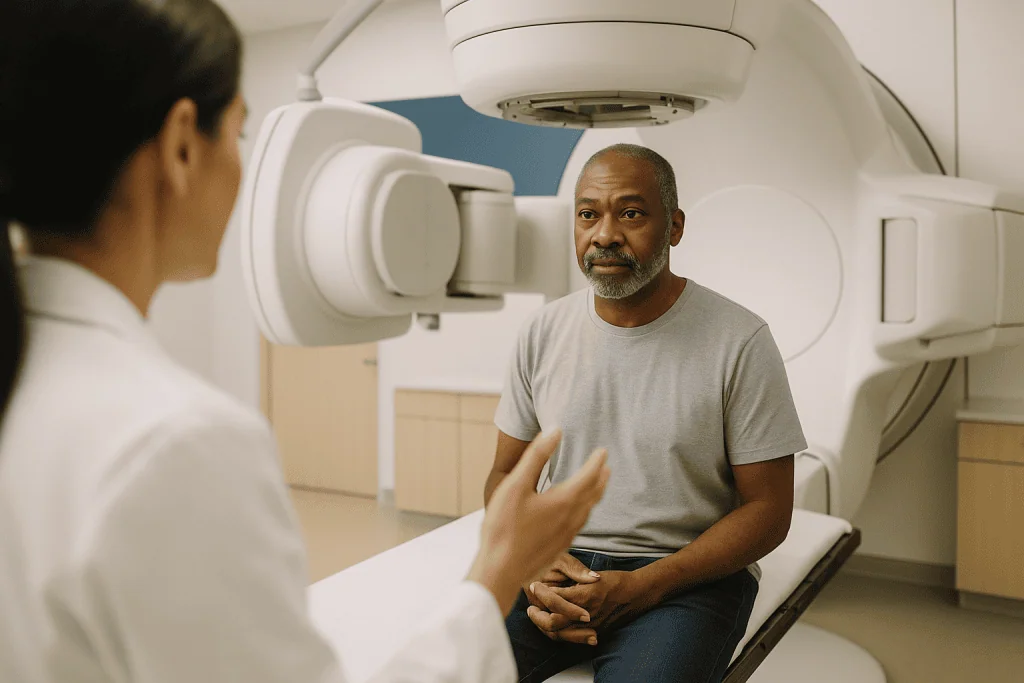
That is why a course is usually split into daily sessions rather than delivered all at once, a strategy called fractionation. Each session typically lasts only minutes, and most of that time is spent positioning you precisely; the beam itself is on for a short portion (Mayo Clinic).
Three broad delivery methods exist. External beam radiation aims beams from a machine called a linear accelerator into the body from outside; it is by far the most common form. Brachytherapy, sometimes called internal radiation, places sealed radioactive sources inside or next to the tumor, either temporarily or permanently. Systemic radiation uses a radioactive substance swallowed or injected that travels through the bloodstream to target cells, such as radioactive iodine for certain thyroid cancers (MedlinePlus).
Modern external beam techniques shape the dose to the tumor’s outline and spare surrounding organs. You may hear terms such as intensity-modulated radiation therapy (IMRT), which varies the beam’s strength across the field, or stereotactic radiation, which delivers highly focused treatment in a small number of sessions to a well-defined target. These are tools, not tiers of quality; the right one depends on the tumor’s size, shape and neighbors.
Why radiation before surgery? Shrinking first, operating second
Picture a surgeon planning to remove a tumor that sits close to something that cannot be cut: a major blood vessel, the spinal cord, the muscles that control continence. If the tumor were smaller and its edges clearer, the operation would be safer and more likely to remove everything. That is the core logic of neoadjuvant radiation (NCI).
Several cancers commonly follow this order. Locally advanced rectal cancer is a frequent example, where radiation, often paired with chemotherapy, is given before surgery to shrink the tumor and reduce the chance of cancer cells being left behind in the pelvis. Cancers of the esophagus and some soft-tissue sarcomas of the limbs are also often treated this way, the aim being a less extensive operation and, in sarcoma, preservation of the arm or leg.
Giving radiation first has two other practical advantages. Blood supply to the tumor is intact before surgery, and oxygen-rich tissue responds better to radiation than scarred tissue does. And the area to be treated is easier to define when the tumor is still there to see on scans, rather than an empty bed where it used to be.
The trade-off is timing. Surgery usually waits several weeks after radiation ends so that acute inflammation settles and the tumor has time to shrink, and that pause can feel agonizing when you want the cancer out. Wound healing may also be slower in irradiated tissue, which surgeons factor into their planning. Whether the wait is worth it is exactly the kind of judgment a tumor board weighs against your individual scans, and it is fair to ask them to walk you through their reasoning.
Radiation after surgery: clearing the cells a scalpel cannot see
A pathologist examining a removed tumor is looking for two things that change what happens next: whether the margins (the rim of normal tissue around the tumor) are free of cancer, and whether cancer has reached nearby lymph nodes. Even with clear margins, cancer cells too small to detect on any scan can remain in the surrounding tissue. Adjuvant radiation exists to deal with that invisible residue and lower the risk of the cancer coming back in the same area (NCI).
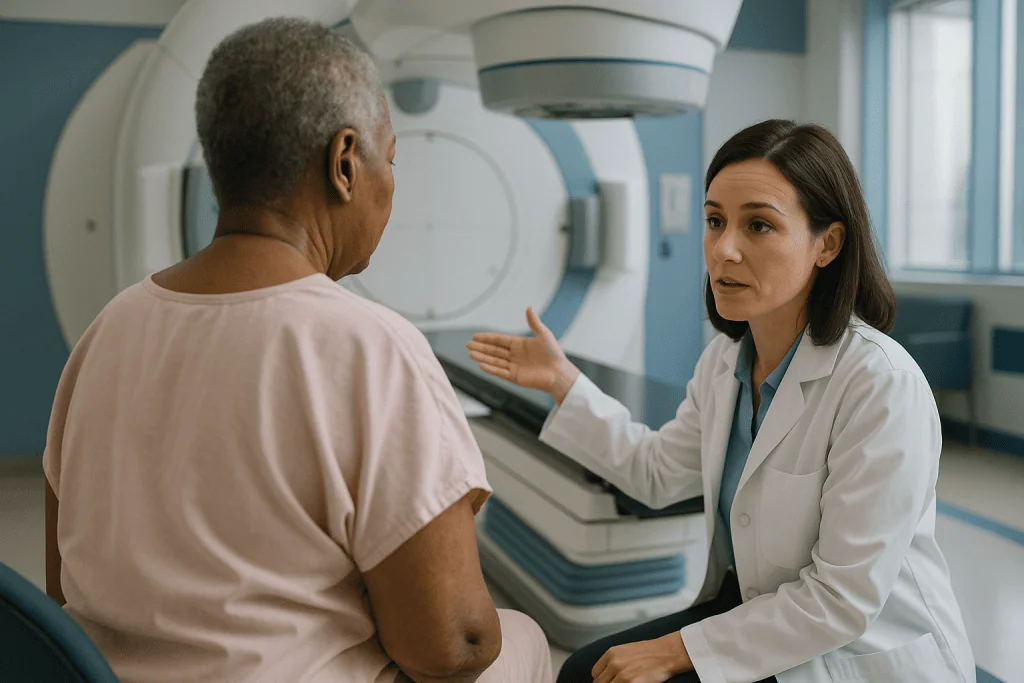
The clearest everyday example is breast cancer treated with lumpectomy, where radiation to the remaining breast tissue is a standard part of breast-conserving treatment. Radiation is also commonly recommended after surgery for many head and neck cancers, some brain tumors, high-grade or large sarcomas, and certain lung, endometrial, and prostate cancers when the pathology report shows features that raise recurrence risk.
Timing matters here too. Radiation cannot begin until the wound has healed enough to tolerate it, and when chemotherapy is also planned, the team decides which comes first. That is why some people are told their radiation will start weeks after their operation and others are told to expect a longer gap while chemotherapy runs its course.
Not everyone who has surgery needs radiation afterwards. Small tumors, wide clear margins and no lymph node involvement can mean the added benefit is too small to justify the side effects. Conversely, a report showing cancer at the margin or in several nodes tips the balance toward treating. If your pathology report has been discussed with you, ask which specific findings drove the recommendation; the answer is usually concrete.
When is radiation therapy used on its own?
For some cancers, radiation can do the whole job. Definitive radiation is chosen when it can control the tumor as effectively as surgery in a particular situation, when it can spare an organ or a function that surgery would remove, or when an operation is too risky because of age, heart or lung disease, or the tumor’s position (NHS).
Prostate cancer is a familiar example: many men with localized disease are offered a choice between surgery and radiation, with the discussion centering on side-effect profiles rather than on one being plainly superior. Early cancers of the larynx are often treated with radiation to preserve the voice. Cervical cancer beyond its earliest stages is usually treated with radiation combined with chemotherapy rather than with a hysterectomy. Some lymphomas, certain skin cancers in cosmetically sensitive areas, and early-stage lung cancers in people who cannot safely undergo lung surgery are also frequently treated with radiation alone.
The phrase “on its own” needs a caveat. Definitive radiation is often paired with chemotherapy given at the same time, a combination called chemoradiation, because some drugs make cancer cells more sensitive to radiation. In that setting the radiation remains the main local treatment, but the drug is not optional decoration.
Palliative radiation is the other way radiation stands alone. Here the intent is relief: a short course to a painful bone metastasis, to a tumor pressing on the spinal cord, or to a growth blocking a bronchus. Courses are often much shorter than curative-intent schedules, and the benefit is measured in comfort and function rather than scans (NCI). Being offered palliative radiation does not mean other treatment has stopped; it often runs alongside ongoing drug therapy.
At what stage is radiotherapy used, and for which cancers?
People often assume radiation is reserved for advanced disease. In practice it is used across every stage, but for different purposes. In early-stage cancer it may be the definitive treatment or follow surgery to reduce recurrence. In locally advanced cancer, meaning the tumor is large or has reached nearby nodes but not distant organs, it is frequently combined with chemotherapy before or instead of surgery. In metastatic cancer, where disease has spread to distant sites, its role shifts mostly toward relieving symptoms, with some focused exceptions when only a few metastases are present (Cleveland Clinic).
The table below summarizes common patterns. It is a map of typical practice, not a rulebook; your own plan may differ for good reasons.
| Cancer type | Radiation before surgery | Radiation after surgery | Radiation as main treatment |
|---|---|---|---|
| Breast | Uncommon | Standard after lumpectomy; sometimes after mastectomy | Rare |
| Rectal | Common for locally advanced tumors, often with chemo | Sometimes, if not given first | Selected cases |
| Prostate | Rare | Sometimes, based on pathology | Common alternative to surgery |
| Head and neck | Uncommon | Common for higher-risk findings | Common, often with chemo |
| Lung (non-small cell) | Selected cases | Selected cases | Common when surgery is not possible |
| Cervical | Rare | Sometimes | Standard beyond early stage, with chemo |
| Soft-tissue sarcoma | Common | Common if not given first | Rare |
| Bone or brain metastases | Not applicable | Sometimes after surgery | Common, for symptom relief or focal control |
Some cancers rarely involve radiation at all. Most leukemias are treated with drugs because the disease is in the blood and marrow rather than one location, and many early colon cancers are managed with surgery alone. The question “what kind of cancer requires radiation” therefore has no single list; it is answered by the intersection of cell type, location and stage (MedlinePlus).
Who is usually offered radiation, and who is usually asked to wait
A radiation oncologist weighs three things before recommending treatment: whether the cancer is likely to respond, whether the benefit outweighs the harm to nearby tissue, and whether the person can lie still in the required position for each session. Most adults with a solid tumor in a defined location, and reasonable overall health, meet those tests (Mayo Clinic).
Several situations lead to a pause rather than a refusal. A wound that has not healed after surgery usually needs more time before radiation begins, because irradiated skin repairs itself more slowly. Someone in the middle of chemotherapy may be asked to finish it, or the team may schedule the two so they do not overlap in a way that magnifies side effects. Active infection in the treatment area is another common reason to wait.
Other factors change the plan rather than the timing. Radiation is generally avoided during pregnancy, particularly to the abdomen or pelvis, and teams plan carefully around it. Tissue that has previously received a full course of radiation has limited capacity to receive more in the same spot, so a recurrence in a treated area calls for different thinking. Certain connective tissue conditions, such as scleroderma or active lupus, can make skin and tissue more sensitive, and the team may adjust the approach accordingly. A pacemaker or implanted defibrillator is not a barrier but does require coordination with cardiology (Cleveland Clinic).
Frailty deserves an honest mention. Very short palliative courses are often well tolerated even by people who are quite unwell, whereas a long definitive course with daily travel and cumulative fatigue may not be. Being asked to wait, or being offered a shorter schedule, is usually a sign the team is matching the treatment to the person rather than the other way round.
How long does radiation take to work?
Radiation does not kill cancer cells on the spot. The DNA damage from one session is rarely enough; it takes days or weeks of accumulated damage before cancer cells lose the ability to divide and die, and cells continue to die for weeks or even months after the last session (NCI). That lag is why a scan done immediately after treatment can look unchanged, and why follow-up imaging is usually scheduled a couple of months out rather than a couple of days.
The length of a course reflects the same biology. Standard external beam schedules are typically delivered once a day, Monday to Friday, with weekends off to let normal tissue recover, and courses commonly run from a single session for some palliative treatments to several weeks for curative-intent plans (NHS; Mayo Clinic). Stereotactic techniques compress treatment into a few sessions by delivering a larger amount per visit to a very small, precisely mapped target.
Symptom relief from palliative radiation often arrives faster than tumor shrinkage. Pain from a bone metastasis may begin to ease within a week or two, although it can briefly worsen first, a phenomenon called a pain flare that teams anticipate and manage. Relief of pressure on a nerve or airway depends on how quickly the tumor recedes and how much damage was already done.
Two practical implications follow. First, missing sessions does matter, because the schedule is built on giving cancer cells no time to recover; if you must miss a day, the team will usually add it to the end. Second, feeling no different halfway through the course is normal and does not mean the treatment is failing. Your team judges response by scans and examination weeks later, not by how the third week feels.
What the following days and weeks usually look like
Treatment starts before the first dose, with a planning appointment often called simulation. You lie on a CT scanner in the position you will hold for every session, sometimes with a custom mold or mask to keep you still. Tiny permanent skin marks, no bigger than a freckle, may be placed so the same spot can be aligned each day (Mayo Clinic). The team then spends days designing the plan on those images before treatment begins.
Sessions themselves are quiet affairs. Radiation therapists position you, leave the room, and operate the machine while watching on camera and speaking to you through an intercom. You feel nothing from the beam. Most of the visit is setup; you are usually out within half an hour.
Side effects build gradually and depend entirely on the area treated. Fatigue is the most widespread, tending to deepen over the course and peak near the end. Skin in the treatment field may redden, darken, itch or peel, much like sunburn, typically appearing after the first couple of weeks. Radiation to the head and neck can cause a sore mouth and taste changes; to the abdomen or pelvis, nausea, diarrhea or bladder irritation; to the chest, a cough or difficulty swallowing (NCI).
Most acute effects settle within weeks to a few months after treatment ends, though fatigue can linger longer (NCI). Late effects, meaning changes that appear months or years later such as tissue stiffening or, rarely, a second cancer, are uncommon but real, and your team will explain which ones are relevant to your treatment area.
Follow-up usually involves a visit a few weeks after completion, then imaging at an interval the team sets. Keep a simple diary of symptoms during treatment; it helps the weekly review with your radiation oncologist, which is where doses of supportive medicines are adjusted and concerns are caught early.
How long do you have to stay away from someone after radiation?
This question carries a great deal of quiet worry, especially for grandparents and new parents, so it deserves a precise answer: it depends entirely on the type of radiation you receive, and for most people the answer is that no separation is needed at all.
External beam radiation does not make you radioactive. The beam passes through you and is gone the instant the machine switches off; you can hug a child, share a bed and sit beside a pregnant colleague the same afternoon (NCI; MedlinePlus).
Temporary brachytherapy, where sealed sources are placed and then removed during the same hospital stay, also leaves no radiation behind once the sources are out. While the sources are in place, you are typically in a shielded room with limited visiting, and staff explain the rules.
Permanent brachytherapy, most familiar in prostate cancer where small seeds remain in the gland, does emit a low level of radiation that fades over weeks to months as the seeds decay. Teams commonly advise limiting close, prolonged contact with young children and pregnant people for a period they specify, and may give guidance about physical intimacy; the exact instructions depend on the isotope used (NCI).
Systemic radiation, such as radioactive iodine for thyroid cancer, is the situation where precautions matter most. The substance leaves the body over days through urine, saliva and sweat, so people are usually asked to sleep alone, use a separate bathroom where possible, flush twice, avoid preparing food for others and keep distance from children and pregnant people for a number of days that the nuclear medicine team sets based on the amount given (NCI).
If you are unsure which category you fall into, ask before you leave the department. Written instructions specific to your treatment are standard, and they override anything general you read online, including this article.
Risks, side effects and alternatives, described neutrally
Every effective cancer treatment carries risk, and radiation is no exception. The most useful way to think about its harms is by geography: whatever healthy tissue shares the neighborhood with the tumor is what may be affected. Radiation to the pelvis can irritate the bowel and bladder and, in some cases, affect sexual function or fertility. Radiation to the chest can inflame the lung or, over years, contribute to heart disease if the heart receives dose. Radiation to the head and neck can permanently reduce saliva. Radiation to the breast can alter its texture and shape (Mayo Clinic; NCI).
Modern planning has reduced many of these effects by shaping the beam and, in some cases, using breath-holding or positioning to move organs out of the field. Reduced is not eliminated, and a careful consultation will name the specific organs at risk in your plan and the approximate likelihood of each problem, ideally drawn from the team’s experience with the same technique.
Alternatives depend on the situation. For many early cancers, surgery is the main alternative to definitive radiation, with a different side-effect profile rather than a clearly better or worse one. For some slow-growing prostate cancers, active surveillance, meaning close monitoring with treatment deferred unless the cancer shows signs of progressing, is a recognized option. For adjuvant radiation, the alternative is often no radiation with closer follow-up, accepting a higher recurrence risk in exchange for fewer side effects. For palliative radiation, alternatives include pain medicines, nerve blocks or surgery to stabilize a bone (NHS).
None of these choices is made in the abstract. The reasonable question to put to your team is not “is radiation safe” but “in my case, what is the added benefit, what are the specific risks, and what happens if I choose the alternative.”
What people often get wrong about radiation therapy
Misconceptions about radiation are old and stubborn, and correcting them removes a lot of unnecessary fear.
“Radiation is a last resort.” It is not. It is frequently a first-line treatment for early cancers, and for some, such as early larynx cancer, it is preferred precisely because it preserves function. Being offered radiation says nothing about how advanced your cancer is (Cleveland Clinic).
“The treatment will hurt.” The beam is painless; you feel nothing during a session. Side effects that develop over the weeks can certainly be uncomfortable, but the treatment itself is not.
“I’ll lose my hair.” Only if the scalp is in the treatment field. Radiation to the breast, prostate or pelvis does not cause hair loss on the head. Where hair is in the field, loss is usually confined to that area and often, though not always, regrows (NCI).
“I’ll be radioactive and dangerous to my family.” External beam radiation leaves nothing behind. Only permanent implants and systemic radiation require any precautions, and the team spells those out.
“Radiation causes cancer, so it must do more harm than good.” A small increased risk of a second cancer years later is real and is weighed against a much larger and more immediate benefit. In most situations where radiation is recommended, the mathematics favors treatment; when they do not, oncologists do not recommend it (NCI).
“If the tumor is still there on the scan after treatment, it failed.” Cancer cells keep dying for weeks to months after the course ends, and scar tissue can look like tumor on imaging. Response is judged over time, not on the last day.
“Newer or bigger machines mean better results.” Technique should match the tumor. A simple plan delivered accurately is often exactly right, and no single technology is universally superior.
Questions to ask your care team
A good consultation leaves you knowing not just what will happen, but why this sequence was chosen over the others. Bring a notebook or a companion, and consider asking the following, in whatever order feels natural.
- What is the goal of my radiation: to shrink the tumor before surgery, to reduce the chance of recurrence after it, to treat the cancer on its own, or to relieve symptoms?
- Why is this order recommended for me rather than the alternative? Was surgery first, or radiation alone, discussed at the tumor board?
- Which type of radiation will I have, and roughly how many weeks will the course run?
- Will chemotherapy or hormone therapy be given at the same time, and how does that change side effects?
- Which organs near the tumor are at risk, and what specific side effects should I expect in the short term and over the years?
- Do I need any precautions around children or pregnant people, and for how long?
- What happens if I have to miss a session for illness or travel?
- What is the plan if scans after treatment show the tumor has not shrunk as hoped?
- Who do I call, at any hour, if something worries me during the course?
- Are there clinical trials I might be eligible for, and would joining one change the timing?
You may also ask what the team would want to know if they were in your position. Most radiation oncologists welcome that question; it tends to surface the trade-offs that matter most. If the answers feel rushed, it is reasonable to request a second appointment before signing consent. A well-planned course starts with a well-understood plan.
When to call your doctor
Most side effects of radiation are expected, are reviewed at your weekly visit, and settle after treatment ends. Some symptoms, however, need a same-day call to your radiation oncology team or, outside hours, urgent medical care. Do not wait for your next scheduled visit if you notice any of the following (NCI; Mayo Clinic).
- A fever, chills or shaking, especially if you are also receiving chemotherapy, because infection can progress quickly when blood counts are low.
- Skin in the treated area that breaks open, weeps, bleeds or shows spreading redness, warmth or pus.
- Difficulty breathing, chest pain, a new persistent cough or coughing up blood after chest or head and neck treatment.
- Inability to swallow liquids, or not being able to keep fluids down for more than a day, which risks dehydration.
- Severe or worsening pain that your prescribed medicines no longer control, or new pain in a bone.
- New weakness or numbness in the arms or legs, trouble walking, or loss of bladder or bowel control, which can signal pressure on the spinal cord and is an emergency.
- Confusion, a severe headache, repeated vomiting or a seizure after brain radiation.
- Heavy bleeding from the bowel, bladder or vagina, or black or bloody stools.
- Swelling, redness or pain in one leg, which may indicate a blood clot.
Even when a symptom is not on this list, a rule of thumb serves well: if something is new, worsening or frightening, call. Radiation departments expect these calls and would far rather hear from you about a false alarm than miss an early complication. Keep the department’s contact numbers, including the after-hours line, somewhere you and your household can find them.
Frequently asked questions
At what stage is radiotherapy used?
Radiotherapy is used at every stage of cancer, but for different reasons. In early-stage disease it may be the main treatment or follow surgery to lower recurrence risk. In locally advanced disease it is often combined with chemotherapy before or instead of surgery. In metastatic disease it mostly relieves symptoms such as pain or pressure. Being offered radiation does not by itself indicate how advanced a cancer is.
Is radiation better before or after surgery?
Neither order is universally better; each suits different cancers. Radiation before surgery shrinks tumors that sit near vital structures and treats well-oxygenated tissue, which responds more readily. Radiation after surgery targets microscopic cells the pathology report suggests may remain. Rectal cancer and sarcoma often follow the first pattern, breast and head and neck cancers the second. Your tumor board chooses based on your scans and biopsy.
What cancers need radiation therapy?
Radiation is commonly part of treatment for breast, prostate, lung, head and neck, cervical, rectal, brain and some skin cancers, lymphomas and sarcomas, and for bone or brain metastases causing symptoms. It plays little role in most leukemias, which are blood-wide diseases, and in many early colon cancers managed by surgery alone. Whether your cancer needs it depends on cell type, location and stage.
How long does radiation take to work?
Radiation does not destroy cancer cells instantly. Damage accumulates over days or weeks of treatment before cells lose the ability to divide, and cell death continues for weeks to months after the course ends, according to the National Cancer Institute. Symptom relief from palliative radiation, such as easing of bone pain, can begin within one to two weeks, sometimes after a brief flare.
How long do you have to stay away from someone after radiation?
After external beam radiation, no time at all, because the treatment leaves no radiation in the body. After permanent seed implants, teams usually advise limiting prolonged close contact with young children and pregnant people for a period they specify as the seeds decay. After systemic radiation such as radioactive iodine, precautions typically last a number of days set by the nuclear medicine team.
Does radiation therapy hurt during the session?
No. The beam itself is painless and you feel nothing while the machine is on, much like having an X-ray. Sessions are short, and most of the time is spent positioning you accurately. Discomfort, when it occurs, comes from side effects that build over the course, such as skin soreness or fatigue, not from the treatment being delivered.
Why does the course last several weeks instead of one big session?
Splitting treatment into daily sessions, called fractionation, exploits a difference between healthy and cancerous cells. Normal cells repair DNA damage reasonably well between sessions; cancer cells repair it poorly. Daily small amounts let healthy tissue recover while damage accumulates in the tumor. Some focused stereotactic treatments compress the schedule to a few sessions when the target is small and precisely mapped.
Will I lose my hair from radiation?
Only if the scalp lies within the treatment field. Radiation affects hair where the beam passes, so treatment to the breast, prostate, pelvis or limbs does not cause hair loss on the head, unlike some chemotherapy drugs. When the scalp is treated, hair loss is usually limited to that area and often regrows, though it may return thinner or with a different texture.
Can radiation be given again to the same area if cancer returns?
Sometimes, but healthy tissue has a limited lifetime tolerance for radiation, so re-treating the same region is approached cautiously. Teams review the earlier plan, the time elapsed and the organs nearby before deciding. Highly focused techniques can occasionally allow retreatment of a small area. In other cases surgery, drug therapy or other approaches are preferred. This is a specialist decision made case by case.
What should I do if I have to miss a radiation session?
Tell the department as soon as you know. Because the schedule is designed to give cancer cells little time to recover, missed days are usually added to the end of the course rather than skipped, and the team may adjust the plan slightly. A single missed session is common and manageable; repeated interruptions matter more, so discuss travel or illness with your team early.
References
This article is for general information only and is not a substitute for professional medical advice. Please consult a qualified doctor about your individual situation.

More from the Blog
Why Head Cancer Follow-Up Keeps Examinations and Scans on a Schedule After Treatment
Head and neck cancer follow up scans and examinations stay on a schedule because most recurrences appear within the first few years after treatment,…
Ablation or Surgery for Liver Cancer? What Makes Each Option Suitable
Ablation and surgery are both used to treat liver cancer that has not spread beyond the liver. Ablation destroys a small tumor in place…
How Doctors Choose Between HDR and LDR Brachytherapy: Temporary Source or Permanent Seeds
Doctors choose between HDR and LDR brachytherapy based on the cancer type and size, how the tumor sits next to healthy organs, the patient's…

Immunotherapy Cycles Explained: Why Infusions Repeat Every Few Weeks and for How Long
Immunotherapy is usually given in cycles because the drugs are cleared from the body over days to weeks and the immune response they trigger…
How to Support Someone Through Radiation Therapy: Rides, Meals and Watching for Fatigue
To support someone going through radiation, take on the repeatable jobs: a shared ride rota for daily weekday appointments, small frequent meals matched to…

Recovery After Melanoma Surgery: Stitches, Skin Grafts and Getting Back to Activity
Recovery after melanoma surgery usually takes about one to three weeks for a wound closed with stitches, and several weeks longer when a skin…