

Who Can Wear Contact Lenses? Dry Eye, Astigmatism and Allergies at the Fitting Exam
Key Takeaways
- Around 45 million Americans wear contact lenses, and astigmatism, mild dry eye and seasonal allergies are fitting considerations rather than reasons for refusal, according to the CDC.
- Toric soft lenses carry different powers in different meridians and are shaped to resist rotation, which is how they correct regular astigmatism that a spherical lens cannot.
- A contact lens splits the tear film into two thinner layers, which is why borderline dry eye often shows up as late-afternoon scratchiness in lenses but not in glasses.
- Daily disposable lenses are the design most often suggested for allergy-prone wearers because they discard the allergen and protein deposits that accumulate on reusable lenses.
- Sleeping in contact lenses raises the risk of eye infection roughly six to eight times, per the CDC, regardless of how comfortable the lens feels.
- There is no fixed minimum or maximum age for contact lenses; hand dexterity, motivation and eye surface health predict success far better than being 12 or 70.
Most people who need vision correction can wear contact lenses, including many with dry eye, astigmatism and seasonal allergies, provided a fitting exam confirms the eye surface is healthy and a suitable lens design exists. Wear is usually delayed or advised against when there is active eye infection, severe dry eye, uncontrolled allergic inflammation, or when someone cannot reliably clean and replace lenses. The final decision rests with the eye care team.
She had rehearsed the sentence in the waiting room. “I’ve always been told I can’t wear contacts.” A decade of glasses, a diagnosis of astigmatism at fifteen, hay fever every spring, and lately a gritty, tired feeling by mid-afternoon at the screen. Surely three strikes. The optometrist listened, then reached for a slit lamp and asked a question nobody had asked before: “Told by whom, and when?”
That exchange captures why the question who can wear contact lenses deserves a better answer than folklore. Lens materials, designs and replacement schedules have changed enormously, and so has our understanding of the tear film, the thin, three-layered liquid coat that sits between a lens and the cornea. Some of what disqualified a teenager in the past is now a routine fitting note.
What has not changed is the part that matters most: the eye surface has to be healthy enough to tolerate a foreign object for hours, and the wearer has to be honest about habits. This explainer walks through what the fitting exam actually checks, how dry eye, astigmatism and allergies each change the conversation, and the moments when a clinician will say “not yet.”
Who can wear contact lenses? The short, honest answer
The candid answer is: far more people than assume they can, and slightly fewer than a product advertisement implies. Contact lenses sit directly on the cornea, the clear dome at the front of the eye, or, in some designs, on the white of the eye around it. Anything that lives on that surface needs oxygen, moisture and a clean environment. If those three conditions can be met, a lens can usually be fitted; if any of them cannot, the eye will eventually protest.
The United States Centers for Disease Control and Prevention estimates that around 45 million Americans wear contact lenses, a figure that already includes large numbers of people with astigmatism, mild dry eye and seasonal allergies. Those conditions are not the usual reasons someone is turned away. The usual reasons are an active infection, a badly compromised tear film, inflammation that has not been controlled, a corneal disease that needs specialty care first, or a frank inability to handle and clean lenses safely.
Notice what is not on that list: age by itself, a high prescription, or having been told “no” years ago. Notice also what the list quietly emphasizes. Two of the five reasons are about the eye; the other three are about behavior and timing. In practice, most eye care professionals will tell you that the person who fails with contact lenses is rarely the one with the trickiest cornea. It is the one who sleeps in lenses, tops up old solution, or wears a two-week lens for two months.
So the real question at a fitting is not “Am I allowed?” but “Which design, which schedule, and what has to be true about my eyes and my routine for this to work?” The rest of this article unpacks how that assessment happens and where dry eye, astigmatism and allergies fit into it.
What actually happens at a contact lens fitting exam
A fitting is not the same as a glasses prescription. Spectacle lenses sit about 12 millimeters in front of the eye; a contact lens sits on it, so the exam has to measure the surface, not just the focusing error.
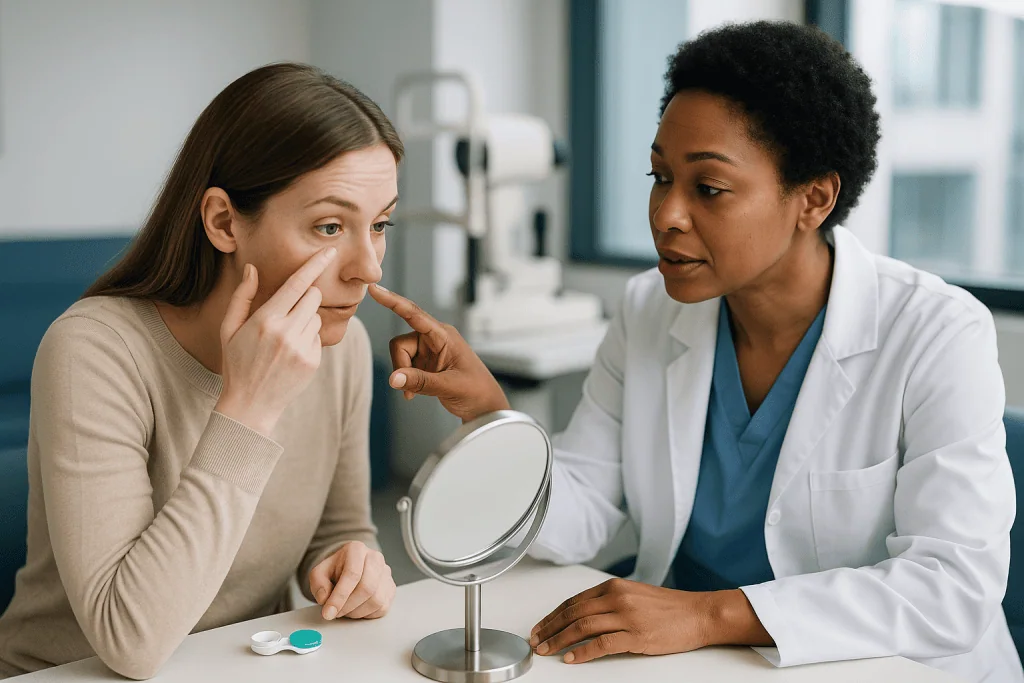
It normally begins with a conversation. The clinician asks about screen hours, sleep, medications, allergies, previous lens experience, and what you want the lenses for: all-day wear, sport, weekends only. Then comes the refraction, the familiar “better one or two” test that measures how strongly the eye needs correcting and whether astigmatism is present.
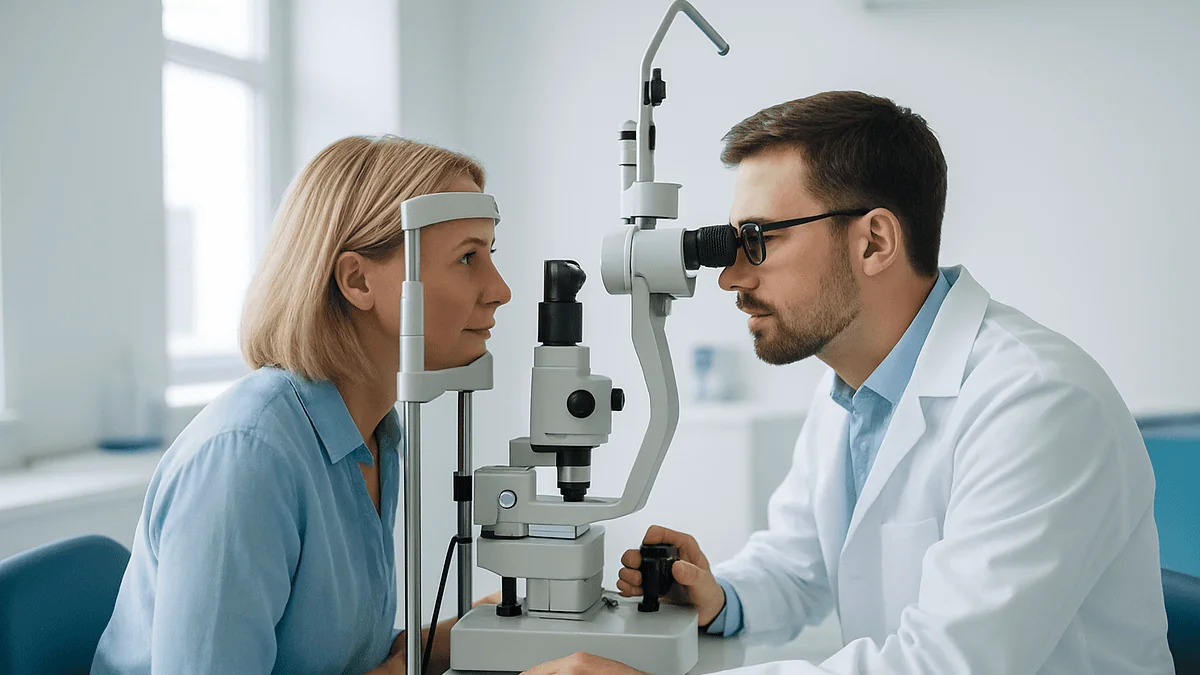
Next, the surface itself. A keratometer or corneal topographer maps the curvature of the cornea, a bit like a contour map of a hill, so the lens curve can be matched to it. A slit lamp, a bright microscope with a narrow beam, lets the clinician inspect the cornea, the conjunctiva (the thin membrane over the white of the eye) and the eyelid margins. Dye drops, usually fluorescein, glow under blue light and reveal dry patches or tiny surface scratches.
Tear film testing may follow if dryness is suspected: how quickly the tear layer breaks up between blinks, how much tear volume there is, whether the oil glands along the lid edge are blocked. Turning the upper lid inside out shows whether the underside is smooth or bumpy from allergic irritation.
Only then does a trial lens go in. The clinician watches how it centers, how it moves with each blink (a lens that does not move at all starves the cornea; one that moves too much blurs vision), and checks vision again through it. Most people are then sent home with trial lenses to wear for several days before a follow-up decides the final specification. That follow-up matters. A lens that felt fine for twenty minutes in a chair can behave very differently after six hours in an air-conditioned office.
Who contact lenses are usually for, and who is usually asked to wait
Contact lenses are, first, for anyone whose vision correction would be improved by having it on the eye rather than in front of it. That includes people with short-sightedness (myopia), long-sightedness (hyperopia), astigmatism, and the age-related loss of near focus called presbyopia. It also includes people with specific practical needs: athletes, people whose glasses fog under masks or safety visors, those with very different prescriptions in each eye, and people whose corneas are irregular enough that glasses simply cannot sharpen the image.
The “please wait” group is smaller and mostly temporary. An active eye infection, such as conjunctivitis or a corneal ulcer, has to resolve completely first; a lens over an infected surface traps organisms against the cornea. A recent eye injury, recent eye surgery, or a flare of severe allergic inflammation typically means a pause until the surface has settled, with the timeline set by the treating clinician rather than a calendar.
A few situations call for a longer conversation rather than a flat refusal. Severe dry eye disease, certain autoimmune conditions that dry the eye, uncontrolled diabetes that slows corneal healing, and a corneal condition called keratoconus (a progressive thinning that pushes the cornea into a cone shape) may all be compatible with lenses, but often specialty designs fitted by someone who does this regularly, not a standard soft lens picked from a drawer.
Then there is the question of hands and habits. Very young children, people with tremor or reduced hand function, and anyone who knows they will not keep to a cleaning routine are asked to be realistic. The CDC’s surveys have found that around 99 percent of lens wearers report at least one behavior known to raise infection risk, which tells you how easy it is to slip. A clinician who says “daily disposables only” to such a person is not being strict; they are fitting the lens to the life.
Can you wear contact lenses with dry eyes?
Often, yes, though “dry eye” covers a wide spectrum and the answer depends on where you sit on it.
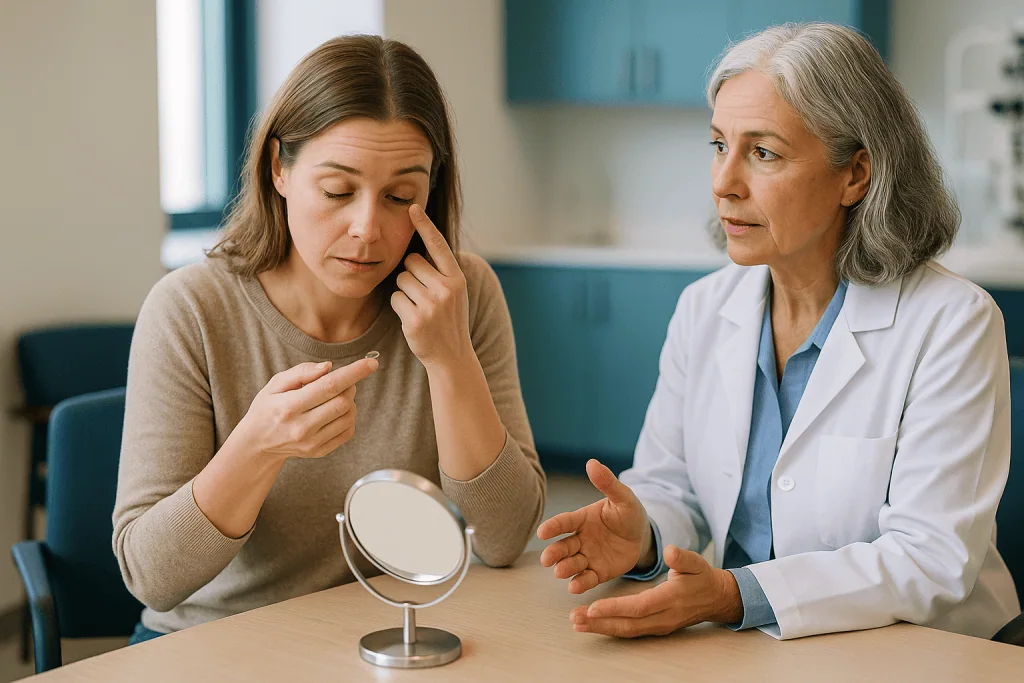
Dry eye disease means either the eye does not make enough tears or the tears evaporate too quickly, most often because the meibomian glands along the eyelid edge are not releasing enough oil to seal the tear surface. The Mayo Clinic notes that it becomes more common after 50 and affects women more often than men, partly through hormonal change. Screen work makes it worse for a mechanical reason: people blink less when concentrating, and each missed blink lets the tear layer thin.
A contact lens divides that already thin tear film into two even thinner layers, one in front of the lens and one behind it. That is why a person with borderline dryness who is comfortable in glasses may feel scratchy by late afternoon in lenses. It does not mean lenses are impossible; it means the fitting has to account for it.
Several levers exist. Daily disposable lenses avoid the protein and lipid build-up that older lenses accumulate. Certain silicone hydrogel materials let more oxygen through, which reduces one source of irritation, although higher oxygen transmission does not by itself fix dryness. Shorter wearing days, preservative-free lubricating drops approved for use with lenses, and treating the underlying lid gland problem with warm compresses and lid hygiene often make the difference between “gave up” and “wears them most days.” For more severe surface disease, scleral lenses, large rigid lenses that vault over the cornea and rest on the white of the eye, hold a reservoir of fluid against the cornea and are sometimes used therapeutically.
Where the honest evidence stops: no lens material has been shown to eliminate lens-related dryness, and a clinician who finds significant surface staining with dye is likely to treat the dry eye first and revisit lenses afterwards. That sequence is protective, not obstructive.
Contact lenses for astigmatism: what a toric lens actually does
Astigmatism is one of the most persistent “you can’t” myths, and one of the least deserved.
The Mayo Clinic describes it plainly: instead of the cornea (or sometimes the lens inside the eye) curving evenly like a ball, it curves more steeply in one direction than the other, more like the back of a spoon. Light entering along the steep axis focuses at a different point from light along the flatter axis, so the image is smeared rather than blurred uniformly. Most people with astigmatism also have myopia or hyperopia alongside it.
A standard spherical soft lens corrects the same amount in every direction, so it cannot fix that mismatch. A toric lens can. It carries different powers in different meridians and is weighted or shaped so that it settles in the same orientation on the eye after every blink. Common stabilization methods include a slightly thicker lower zone that gravity and the lids hold in place, or thin zones at the top and bottom that the lids squeeze into alignment.
Toric fittings take a little longer because the clinician watches for rotation. A lens that turns a few degrees off axis will give sharp vision one moment and a ghosted image the next, particularly when looking sideways or lying down. The follow-up visit is where this gets refined.
People with high or irregular astigmatism, including many with keratoconus, are sometimes fitted with rigid gas permeable lenses instead. These hold their shape on the eye, and the tear layer trapped beneath fills in the irregular surface, effectively creating a new, smooth optical front. Hybrid lenses, rigid in the center with a soft skirt, and scleral lenses serve the same purpose for eyes that struggle with a small rigid lens.
The practical upshot: astigmatism changes which lens you are fitted with, not whether you can be fitted at all.
Allergies and contact lenses: itchy eyes at the fitting
Seasonal allergies are the third pillar of “I probably can’t,” and they sit somewhere between dry eye and astigmatism in how much they matter.
Allergic conjunctivitis is the eye’s version of hay fever. When pollen, dust mite debris or animal dander lands on the conjunctiva, immune cells release histamine, producing itch, redness, watering and swelling. MedlinePlus notes that it is common, is not contagious, and typically flares in patterns that track the allergen: spring and early summer for tree and grass pollens, year-round for indoor triggers.
Lenses interact with this in two ways. First, a soft lens is a sponge for airborne allergens and for the proteins in tears that allergy provokes. A lens worn for two weeks during pollen season carries a growing load of exactly what the eye is reacting to. Second, constant mechanical rubbing of the upper lid across a coated lens can produce giant papillary conjunctivitis, a condition in which the underside of the eyelid develops small bumps and the lens becomes intolerable. It is one reason clinicians flip the upper lid at the fitting.
None of this rules lenses out. Daily disposables sidestep the build-up problem completely and are the design most often suggested for allergy-prone wearers. Wearing glasses on the highest-count days, using preservative-free lubricating drops to rinse allergen off the surface, and never rubbing the eyes with a lens in place all help. Antihistamine or mast-cell-stabilizing eye drops, medicines that block or prevent the histamine release, are often part of the plan; how they are timed around lens insertion is something the prescribing clinician will specify, because some drops are not meant to be applied with a lens in.
The point where a clinician pauses is an active flare: a red, swollen, itching eye at the fitting itself. The sensible course is to settle the inflammation, then fit into a calm eye.
Lens types compared: which design suits which eye
People often arrive believing there is one kind of contact lens. There are several, and the fitting exam is largely about matching design to eye and lifestyle. The table below is a plain-language guide, not a substitute for the clinician’s choice.
| Lens type | How it works | Often considered for | Common trade-offs |
|---|---|---|---|
| Daily disposable soft | Thin hydrogel or silicone hydrogel worn once and discarded | Allergies, mild dry eye, part-time or sport wear, anyone unsure about cleaning routines | Higher ongoing use of materials; not all prescriptions available |
| Reusable soft (two-week or monthly) | Same materials, cleaned nightly and replaced on schedule | Full-time wearers with reliable habits | Deposit build-up; infection risk rises sharply if schedule slips |
| Toric soft | Different powers in different meridians, stabilized against rotation | Regular astigmatism | Vision can fluctuate if the lens rotates; longer fitting |
| Multifocal soft | Concentric or blended zones for distance and near | Presbyopia, typically from the early to mid 40s onward | Some compromise in sharpness at one distance; adaptation period |
| Rigid gas permeable | Firm oxygen-permeable plastic; tears beneath smooth the cornea | High or irregular astigmatism, keratoconus, very sharp vision needs | Initial lid awareness; longer adaptation; small and easy to dislodge |
| Scleral | Large rigid lens vaulting the cornea, resting on the white of the eye | Severe dry eye, irregular corneas, post-surgical eyes | Specialist fitting; more handling; larger to insert |
Two patterns are worth noticing. The daily disposable row appears against almost every one of the conditions in this article’s title, because removing the deposit problem solves a lot at once. And the rigid designs appear wherever the cornea’s shape, rather than its focusing power, is the challenge. A lens that holds its own shape can correct what a soft lens simply drapes over.
What disqualifies you from contacts? Who cannot wear contact lenses
Because the internet is full of vague warnings, it helps to separate the firm reasons from the soft ones.
The firm, though usually temporary, reasons are active disease on the eye surface. Bacterial or viral conjunctivitis, a corneal ulcer, a herpes simplex infection of the cornea, or an eye that is recovering from injury or surgery all need to heal fully before a lens goes anywhere near them. The CDC identifies contact lens wear as the leading risk factor for microbial keratitis, an infection of the cornea that can permanently scar it; placing a lens on an already inflamed cornea stacks that risk.
Also firm: a demonstrated inability to handle lenses safely. This is not a judgment of character. Someone with significant tremor, severe arthritis in the hands, or a cognitive condition that makes routines unreliable may be advised against lenses unless a carer can assist, because a lens left in for days is a genuine hazard.
Then come the situations that require a specialist rather than a refusal. Severe dry eye disease, including that linked to autoimmune conditions such as Sjögren’s, may still be fitted with scleral lenses in some cases. Keratoconus is often a reason to fit lenses rather than avoid them. Very high prescriptions are almost always available in some design.
Finally, the soft reasons, which are more about likelihood of success than eligibility: a workplace full of dust or chemical fumes, a job with long unbroken screen hours, a habit of swimming or showering in lenses, or a history of giving up on lenses because of discomfort. These lead to a frank conversation about lens type and wearing pattern, not a closed door.
Pregnancy deserves a note. Hormonal shifts can temporarily change corneal curvature and tear production, so some people find their lenses fit differently. That is a reason to be re-checked, not a disqualification.
Can a 70 year old wear contact lenses? Age, presbyopia and children
Yes, a 70 year old can wear contact lenses, and plenty do. Age is a factor in the fitting, not a barrier to it.
What changes with age is mostly the tear film and the lens inside the eye. Presbyopia, the stiffening of the eye’s natural lens that makes near focus harder, generally begins in the early to mid 40s and progresses over the following two decades, according to the Mayo Clinic. Multifocal contact lenses, or a “monovision” arrangement in which one eye is corrected for distance and the other for near, address this. Some people adapt to monovision within a couple of weeks; others never find it comfortable and prefer multifocals or reading glasses over distance lenses. That is an individual outcome the trial period reveals.
Dry eye becomes more prevalent with age and after menopause, so an older first-time wearer is more likely to be steered toward daily disposables and a shorter wearing day, and to have lid gland health addressed first. Cataract, clouding of the eye’s lens, is not itself a reason to avoid contact lenses, but a cataract operation will usually change the prescription entirely, so lenses fitted shortly before surgery may be short-lived. Dexterity and eyesight for handling a lens matter more than the number on a birth certificate.
At the other end of life, the question “is it okay for a twelve-year-old to wear contacts?” comes up constantly. There is no fixed minimum age. Clinicians look at maturity, motivation, and whether the child can insert, remove and clean a lens without a parent doing it for them. Many children manage well from around 10 to 12 years old; some younger children are fitted for specific medical reasons under close supervision. Daily disposables are the usual starting point because they remove the cleaning step, and parents are typically asked to supervise for the first weeks.
Is it healthier to wear contacts or glasses?
Framed as a health question rather than a convenience one, glasses win on one measure and the contest is otherwise closer than people expect.
The measure glasses win is infection. A pair of spectacles cannot give you keratitis. A contact lens can, if it is worn overnight, handled with unwashed hands, exposed to tap water or a swimming pool, or kept past its replacement date. The CDC reports that sleeping in lenses raises the risk of eye infection roughly six to eight times, and that about one in three wearers has experienced a red or painful eye requiring a clinician’s visit. Those figures are not an argument against lenses; they are an argument for the habits that avoid the risk.
Where contacts have the edge is optical. Because the lens moves with the eye, peripheral vision is uninterrupted and the image size is closer to natural, which matters most for people with high prescriptions or a large difference between the two eyes. For sport, lenses remove the risk of a frame breaking against the face. For people whose glasses fog under protective equipment, lenses may be safer at work.
Neither option affects the underlying eye condition. Wearing glasses does not “weaken” the eyes, and contact lenses do not “train” them; the prescription changes because the eye changes, not because of what corrects it. The exception is a specialized area of childhood myopia management in which certain lens designs are used under supervision to slow the progression of short-sightedness; that is a clinical decision, not a general health advantage.
The most useful way to hold this: glasses are the safer default and the right fallback whenever an eye is red or sore; lenses are a well-understood, low-risk option for a healthy eye when the wearer respects the rules. Most people are best served by having both.
The first days and weeks: what adapting to lenses usually looks like
The trial period is the most underrated part of the fitting, and it has a fairly predictable shape.
Day one is often a surprise in both directions. A soft lens usually feels like almost nothing within a few minutes, which delights people who expected discomfort. Rigid lenses are different: most wearers are aware of the lens edge against the upper lid for the first several days, and adaptation over one to two weeks is typical, with the sensation fading as the lid learns the shape.
Vision may fluctuate at first. With toric lenses, a brief blur after a big blink or when looking far to one side is common in the opening days and often settles as the lens beds in; if it persists, the clinician adjusts the axis or design. With multifocals, near vision can feel soft for a week or two while the brain learns to select the sharper of the overlapping images.
Wearing time is usually built up gradually. A common pattern is a few hours on the first day, extended by an hour or so daily, so that by the follow-up visit the eye has had a realistic test. The follow-up itself, typically within a week or two of the first trial, is where the clinician looks again at how the lens moves, whether the cornea shows any staining, and whether dryness by evening or itch in the mornings has appeared.
Some things are normal in this window: mild awareness of the lens, slightly drier eyes at the end of the day, and needing two attempts to insert. Others are not: pain, a red eye, light sensitivity, or vision that is worse with the lens in than without. Those are reasons to remove the lens and call, not to push through.
By the end of the first month most people know which category they fall into: comfortable full-time wearer, part-time wearer who keeps glasses for long screen days, or someone for whom a different design should be tried.
What people often get wrong about who can wear contact lenses
A handful of myths do more to keep people out of lenses, or in unsafe ones, than any actual eye condition.
“Astigmatism means no contacts.” False for the great majority. Toric soft lenses correct regular astigmatism; rigid and scleral designs handle the irregular kind. The myth survives from an era when toric soft lenses were scarce.
“If it feels fine, it’s fine to sleep in.” The cornea gets much of its oxygen from the air, and a closed lid plus a lens cuts supply. The CDC’s six-to-eight-fold infection figure for overnight wear applies whether or not the lens feels comfortable, and applies to lenses marketed for extended wear too unless a clinician has specifically approved it.
“Water is clean, so rinsing lenses in it is harmless.” Tap water, showers, lakes and pools can carry Acanthamoeba, a free-living organism that causes a rare but sight-threatening keratitis. Lenses should never touch water; the CDC is unambiguous on this point.
“Older people can’t handle lenses.” Dexterity and motivation predict success far better than age.
“Costume or colored lenses aren’t real contacts.” They sit on the cornea like any other lens and carry the same risks; in the United States they require a prescription for that reason.
“Once I’m fitted, I’m fitted for life.” Corneas change with age, hormones, medication and surgery. Annual checks exist because a lens that fitted well five years ago may now be tight or loose.
“Dry eye means give up.” It usually means treat the lid glands, switch to daily disposables, and shorten the day. Only a minority need to stop entirely.
The thread running through all of these is the same: the eye is rarely the obstacle people think it is, and habits are more often the obstacle they overlook.
Questions to ask your care team at the fitting
A fitting goes better when the person in the chair is an active participant. These questions are worth having ready, and the answers will differ from one pair of eyes to the next.
- What did you see on the surface of my eyes today, and is there anything you would want to treat before I start lenses?
- Given my dry eye, astigmatism or allergies, which lens design are you recommending, and what is the reasoning?
- Would daily disposables suit me better than reusable lenses, and why?
- How many hours a day is realistic for me to start with, and how should I build up?
- Which lubricating drops are safe to use with a lens in place, and which of my other eye medications need to be timed around insertion or removal?
- What should I do on high-pollen days or during a cold?
- If I use a screen for most of the working day, what changes would you suggest?
- What exactly should my cleaning routine look like, and how often should the case be replaced?
- What signs mean I should take the lens out and phone you the same day?
- When is my follow-up, and what will you be checking?
- How often should I come back once the fitting is settled?
- If this design does not work for me, what would we try next?
Two of those deserve emphasis. The question about other eye medications matters because some drops are not designed to be applied over a soft lens and the sequencing is a prescribing decision. And the question about “what would we try next” reframes a difficult first trial as a step rather than a verdict, which is exactly how experienced fitters think about it.
Write the answers down, or ask for them in writing. The cleaning routine in particular is easy to hear in the room and misremember at the bathroom sink.
When to call your doctor: red-flag signs for contact lens wearers
Most problems with contact lenses announce themselves early and settle quickly once the lens is out. A few do not, and the difference between an uncomfortable evening and a corneal scar can be how fast someone acts.
Remove the lens and contact your eye care professional the same day, or seek urgent care if you cannot reach them, if you notice any of the following:
- Eye pain, rather than mild irritation, especially if it continues after the lens is out
- A red eye that does not clear within a few hours of removing the lens
- New sensitivity to light
- Blurred vision that does not improve when the lens is removed and glasses are worn
- A white or gray spot visible on the cornea
- Thick discharge, or eyelids stuck together on waking
- A feeling that something is in the eye that persists after removal and rinsing with sterile saline
- Any of the above after the lens has been exposed to water, worn overnight, or worn past its replacement date
The CDC lists pain, redness, light sensitivity and blurred vision as the core warning signs of a lens-related infection and advises that lenses be removed immediately and the eye assessed by a professional. Keratitis can progress within a day or two, and early treatment is associated with better outcomes than delayed treatment, which is why “wait and see until Monday” is the wrong instinct.
Less urgent but still worth a call: persistent end-of-day dryness that lubricating drops do not relieve, morning itch that suggests allergic build-up, lenses that repeatedly rotate or blur, or a lens that suddenly feels tight or loose when nothing else has changed. Each of these signals a fitting that may need adjusting.
Keep the lens and case if you can; a clinician may want to culture them. Switch to glasses until you have been seen, and do not restart lenses until the treating team says the surface has recovered. That decision, like the original one about whether lenses are right for you, belongs with them.
Frequently asked questions
Who can not wear contact lenses?
People with an active eye infection, a corneal ulcer, a recent eye injury or recent eye surgery are usually told to wait until the surface has fully healed. Severe dry eye disease or uncontrolled allergic inflammation may also delay fitting. Those who cannot reliably insert, remove and clean lenses, because of tremor, hand problems or unreliable routines, may be advised against them. Most other situations change the lens design rather than rule lenses out.
What disqualifies you from getting contact lenses?
Very little disqualifies someone permanently. Temporary disqualifiers are infection, inflammation or healing after injury or surgery. Longer-term concerns include severe surface disease, certain corneal conditions needing specialty fitting, and an inability to handle lenses safely. High prescriptions, astigmatism, mild dry eye, allergies and age are not disqualifiers; they steer the clinician toward a specific lens type. The treating team makes the final call based on what the fitting exam shows.
Is it healthier to wear contacts or glasses?
Glasses are safer on one specific measure: they cannot cause a corneal infection, whereas contact lenses can if worn overnight, exposed to water or kept past their replacement date. Contact lenses offer better peripheral vision and a more natural image, particularly for high prescriptions. Neither changes the underlying eye condition. Most eye care professionals suggest having both, using glasses whenever an eye is red or sore.
Can a 70 year old wear contact lenses?
Yes. Age alone is not a barrier. Older wearers more often have presbyopia, addressed with multifocal lenses or a monovision arrangement, and are more prone to dry eye, which may mean daily disposables and a shorter wearing day. Dexterity and eyesight for handling the lens matter more than age. A planned cataract operation will change the prescription, so timing should be discussed with the eye care team.
Is it okay for a twelve-year-old to wear contact lenses?
Often, yes. There is no fixed minimum age; clinicians assess maturity and whether the child can insert, remove and clean a lens independently. Many children manage well from around 10 to 12 years old. Daily disposables are the usual starting point because they remove the cleaning step, and parents are typically asked to supervise closely for the first weeks and to keep glasses available as a fallback.
Can you wear contact lenses with dry eyes?
Many people with mild to moderate dry eye can, with adjustments. A lens thins the tear film, so clinicians often suggest daily disposables, shorter wearing days, preservative-free lubricating drops approved for lens use, and treatment of blocked eyelid oil glands. Severe dry eye may require specialty scleral lenses or a pause while the surface is treated. The fitting exam, including dye testing, guides the decision.
Are contact lenses for astigmatism different from regular ones?
Yes. Regular astigmatism is corrected with toric soft lenses, which have different powers in different meridians and are weighted or shaped to stay in one orientation on the eye. Irregular astigmatism, including keratoconus, is often fitted with rigid gas permeable, hybrid or scleral lenses, where the tear layer beneath the lens smooths the corneal surface. Fitting takes a little longer because rotation has to be checked.
Can I wear contacts if I have seasonal allergies?
Usually, yes, though it takes planning. Soft lenses collect pollen and tear proteins, which worsens itch and can inflame the underside of the eyelid. Daily disposables avoid that build-up, glasses on peak pollen days help, and antihistamine or mast-cell-stabilizing eye drops may be prescribed. Timing of drops around lens wear is set by the prescribing clinician. An active flare at the fitting is a reason to settle the eye first.
How long does it take to get used to contact lenses?
Soft lenses often feel comfortable within minutes, though wearing time is usually built up over several days. Rigid gas permeable lenses typically take one to two weeks of adaptation while the eyelid adjusts to the lens edge. Toric and multifocal lenses may need a week or two for vision to stabilize. A follow-up visit, commonly within the first couple of weeks, checks fit and surface health.
What are the best contact lenses for seniors?
There is no single best lens. Seniors most often need presbyopia correction, so multifocal soft lenses or monovision are common choices, and because dry eye is more prevalent with age, daily disposables and silicone hydrogel materials are frequently suggested. Ease of handling, existing eye conditions and any planned cataract surgery all shape the recommendation, which the eye care professional makes after examining the tear film and cornea.
References
- CDC: About Healthy Contact Lens Wear
- MedlinePlus: Allergic conjunctivitis
- NHS: Dry eyes
- National Eye Institute (NIH): Dry Eye
This article is for general information only and is not a substitute for professional medical advice. Please consult a qualified doctor about your individual situation.

More from the Blog

Preparing for LASEK: Contact Lens Breaks, Corneal Thickness Checks and Planning Days Off
LASEK preparation usually involves three things: pausing contact lenses for a period your surgeon sets (often a few weeks, longer for rigid lenses) so…
How Eye Alignment Is Measured: The Tests Behind a Strabismus Disorder Diagnosis
Eye alignment is measured with a short set of clinic tests. The cover test, in which one eye is covered while the examiner watches…

What PRK Results Usually Look Like Once Healing Finishes and How Long They Hold
PRK reshapes the cornea after its surface layer is removed, so vision is blurry for the first several days and sharpens gradually rather than…
What Injections for Macular Degeneration Can Realistically Do: Slowing Loss, Not Undoing It
Injections for wet macular degeneration block a growth signal that makes fragile new blood vessels leak under the retina. In large trials, most treated…

What Cornea and External Disease Specialists Treat: Infections, Pterygium and Dystrophies
A cornea and external disease specialist is an ophthalmologist with extra fellowship training in the clear front window of the eye and the surface…
What Chalazion Removal Involves: Numbing, the Incision Inside the Eyelid and the Patch
A chalazion removal procedure is a short outpatient operation for a blocked oil gland in the eyelid. The lid is numbed with a local…