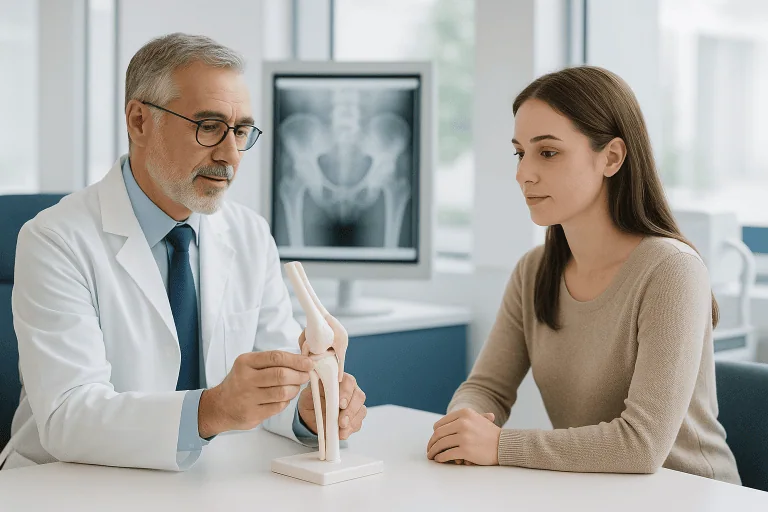
Patellofemoral Pain Syndrome

Quick answer
Patellofemoral pain syndrome is pain around or behind the kneecap caused by irritation where the patella moves over the thigh bone, often related to overuse, alignment problems, or muscle imbalance. At Acibadem, evaluation focuses on the knee’s structure and movement, and treatment typically starts with rest, activity changes, physical therapy, pain control, and, when needed, further orthopedic care.
What is patellofemoral pain syndrome?
Patellofemoral pain syndrome is a common condition that causes pain at the front of the knee, in and around the kneecap. The kneecap is medically called the patella, and the thigh bone is called the femur. Where these two bones meet, they form the patellofemoral joint. When you bend and straighten your knee, the kneecap glides up and down in a groove at the end of the thigh bone. In patellofemoral pain syndrome, this area becomes irritated and painful, most often without any single obvious injury and without clear structural damage on scans.
Many people ask what is patellofemoral pain syndrome in everyday terms. A simple way to think of it is as an overload problem: the tissues around the front of the knee are being asked to handle more stress than they can currently tolerate, often because of activity levels, muscle imbalances, or the way the kneecap moves in its groove. You may also hear it called “runner’s knee” or anterior knee pain, because it is frequent in runners and other active people.
Patellofemoral pain syndrome can affect anyone, but it is especially common in adolescents, young adults, runners, cyclists, and people whose work or sport involves a lot of squatting, kneeling, jumping, or stair climbing. It tends to be reported more often in women and girls than in men and boys, possibly because of differences in hip and leg alignment. In the international classification of diseases, it is coded as M22.2X9. Although the pain can be frustrating and long-lasting, the condition is generally not dangerous, and in many cases it improves with conservative (non-surgical) care.
Symptoms of patellofemoral pain syndrome
The hallmark of patellofemoral pain syndrome symptoms is a dull, aching pain at the front of the knee, around or behind the kneecap. The pain usually builds gradually rather than starting suddenly, and it is typically made worse by activities that load the bent knee.
Common patellofemoral pain syndrome symptoms include:
- Pain at the front of the kneeoften described as an ache around or behind the kneecap, sometimes hard to pinpoint with one finger.
- Pain with stairsgoing up and especially going down stairs or hills often triggers the pain.
- Pain with squatting, kneeling, or lungingdeep knee bends increase pressure between the kneecap and thigh bone.
- Pain after prolonged sittingsometimes called the “movie theater sign,” where the knee aches after sitting with it bent for a long time, such as during a film, a long drive, or a flight.
- Pain during or after running, jumping, or sportoften worse with increased training volume or intensity.
- Grinding, clicking, or popping sensationsa crackling feeling under the kneecap (called crepitus) is common, although these sounds alone, without pain, are usually not a concern.
- A sense of the knee “giving way”some people feel brief weakness or buckling, usually caused by pain rather than true joint instability.
Symptoms often vary by how long the condition has been present and how irritated the knee is. In the early stage, pain may appear only during or after intense activity and settle quickly with rest. As irritation increases, pain may start earlier in an activity, last longer afterward, and eventually appear during everyday tasks such as climbing stairs or standing up from a chair. In more persistent cases, the knee may ache even at rest or at night, although constant severe pain is less typical and should prompt a medical review to rule out other causes.
Unlike some other knee conditions, patellofemoral pain syndrome does not usually cause large amounts of swelling, true locking of the joint (where the knee gets stuck and cannot move), or the knee giving out completely. If you have those features, a different diagnosis may be more likely, and a doctor should assess you.
Causes and risk factors
There is rarely a single cause. Patellofemoral pain syndrome causes are usually a combination of factors that increase stress on the patellofemoral joint or reduce the tissues’ ability to tolerate that stress.
- Overuse and training errorsa sudden increase in running distance, jumping, stair work, or squatting; returning to sport too quickly; or training on hard or sloped surfaces. This is one of the most common triggers.
- Muscle weakness or imbalanceweakness in the quadriceps (the muscles at the front of the thigh) or in the hip muscles that control leg alignment can allow the kneecap to track abnormally in its groove.
- Tight muscles and soft tissuestightness in the hamstrings, calf muscles, quadriceps, or the band of tissue on the outer thigh (the iliotibial band) can change how forces pass through the knee.
- Alignment and movement patternsthe way the hip, knee, and foot line up during walking, running, squatting, and landing can concentrate stress on the front of the knee. Flat feet (fallen arches) or knees that roll inward during movement may contribute in some people.
- Kneecap tracking problemsin some people, the kneecap sits slightly off-center or shifts in its groove during movement (sometimes called maltracking), which may irritate surrounding tissue.
- Previous injury or surgerya prior kneecap dislocation, knee injury, or operation can change the mechanics of the joint.
- Occupational or lifestyle loadjobs involving frequent kneeling, squatting, or stair climbing, or long periods of sitting with bent knees.
Risk factors include being an adolescent or young adult (partly because bones, muscles, and activity levels are changing rapidly), being female, participating in running or jumping sports, and rapid changes in body weight or activity. It is important to understand that patellofemoral pain syndrome is generally considered a problem of load and function rather than a disease of worn-out cartilage. It is not the same as arthritis of the knee, although the two can sometimes coexist, especially in older adults.
Diagnosis
Patellofemoral pain syndrome diagnosis is primarily clinical, meaning it is based on your history and a physical examination rather than on a specific laboratory test or scan. There is no single test that “proves” the condition; instead, doctors look for the typical pattern of symptoms while ruling out other causes of knee pain.
During the consultation, your doctor will usually:
- Ask about your symptomswhere the pain is, when it started, what makes it worse (stairs, squatting, sitting, sport), and how it affects your daily life.
- Review your activity historyrecent changes in training, new sports, footwear, work demands, or previous knee injuries.
- Examine the kneechecking for tenderness around the kneecap, how the kneecap moves and tracks, swelling, range of motion, and stability of the ligaments.
- Assess movement and strengthwatching you squat, step down, or balance on one leg to see how the hip, knee, and foot work together, and testing the strength of the thigh and hip muscles.
Reproducing your familiar pain with a squat, a step-down, or gentle pressure on the kneecap during knee movement supports the diagnosis. Just as importantly, the examination helps exclude other problems such as meniscus (cartilage pad) tears, ligament injuries, tendon problems such as patellar tendinopathy (irritation of the tendon below the kneecap), or arthritis.
Imaging is not required in most typical cases. However, your doctor may order tests in certain situations:
- X-raysmay be used if there was a significant injury, if symptoms do not improve as expected, if you are an adolescent (to check the growth plates), or if arthritis is suspected in older adults.
- MRI (magnetic resonance imaging)a scan that shows soft tissues in detail; it may be considered when the diagnosis is unclear, when a cartilage or ligament injury is suspected, or when symptoms persist despite appropriate treatment.
It is worth knowing that scans in people with patellofemoral pain syndrome are often normal, and that minor changes seen on imaging do not always explain the pain. Your doctor interprets any imaging together with your examination findings.
Treatment options
The good news is that patellofemoral pain syndrome treatment is usually non-surgical, and most people improve with a structured, patient approach. Treatment aims to reduce pain in the short term and, more importantly, to correct the underlying contributors so the problem is less likely to return. Conditions like this are typically managed by orthopedic and sports medicine teams; at Acibadem, for example, this falls under the Orthopedics & Joint Center, often working together with physical therapists.
Activity modification and relative rest
Complete rest is rarely recommended, because inactivity weakens the very muscles the knee depends on. Instead, doctors usually advise temporarily reducing or adjusting the activities that provoke pain, for example, cutting back running distance, avoiding deep squats for a while, or switching to lower-impact exercise such as swimming or cycling with a properly adjusted seat. As symptoms settle, activity is gradually built back up.
Physical therapy and exercise
Exercise-based rehabilitation is the cornerstone of treatment and has the strongest support in clinical practice. A physical therapist typically designs a program that may include:
- Strengthening exercises for the quadriceps and, very importantly, the hip and buttock muscles that control leg alignment.
- Stretching of tight muscle groups such as the hamstrings, calves, and quadriceps.
- Movement retraininglearning squatting, landing, and running patterns that put less stress on the front of the knee.
- A gradual return-to-activity plan so that load increases at a pace the knee can tolerate.
Improvement with exercise usually takes weeks to months of consistent effort, and it is common for pain to fluctuate along the way. Sticking with the program, even when progress feels slow, is often the key factor in recovery.
Medication
Over-the-counter pain relievers, such as acetaminophen (paracetamol) or nonsteroidal anti-inflammatory drugs (NSAIDs, such as ibuprofen), may help with short-term pain relief. They do not fix the underlying problem, and they are generally used for limited periods. Always follow dosing instructions and ask a doctor or pharmacist if you have other health conditions, take other medications, or are unsure whether these medicines are safe for you. Ice applied to the front of the knee after aggravating activity can also help ease discomfort in some people.
Supportive measures
Depending on your individual assessment, your doctor or therapist may suggest:
- Taping or bracingkneecap taping or a soft patellar brace may reduce pain in some people, especially in the early phase of rehabilitation, although responses vary.
- Footwear changes or shoe inserts (orthoses)may help selected people whose foot mechanics contribute to knee stress.
- Weight managementfor people carrying extra body weight, gradual weight reduction can lower the load on the patellofemoral joint.
Procedures and surgery
Injections and surgery play a very limited role in typical patellofemoral pain syndrome. Corticosteroid (anti-inflammatory) injections are not a standard treatment for this condition. Surgery is rarely needed and is generally considered only when a clear structural problem is identified, for example, significant kneecap instability with repeated dislocations, or cartilage damage, and only after a thorough, well-conducted course of conservative treatment has not helped. If surgery is ever discussed, your doctor should explain exactly what structural issue is being addressed and what realistic outcomes to expect. For most people with this diagnosis, an operation is neither necessary nor helpful.
Living with patellofemoral pain syndrome and outlook
The overall outlook for patellofemoral pain syndrome is generally favorable, but honesty is important: recovery is often gradual, and symptoms can persist for months in some people, or return when activity increases again. The condition does not usually cause permanent joint damage, and having it does not mean you are destined to develop arthritis.
Living well with the condition usually involves:
- Staying active within tolerable limitsmovement is part of the treatment, not the enemy. Mild discomfort during exercise is often acceptable; sharp or worsening pain is a signal to scale back.
- Continuing strength workkeeping the hip and thigh muscles strong after recovery reduces the chance of the pain coming back.
- Increasing training graduallyavoiding sudden jumps in running distance, intensity, or jumping volume.
- Paying attention to early warning signsaddressing a mild flare-up early, by temporarily reducing load, is easier than treating a full recurrence.
Some people recover fully within a few months; others have symptoms that come and go over a longer period, particularly if they return to high training loads quickly or stop their exercises once the pain eases. No treatment can guarantee a complete or permanent cure, but with a consistent rehabilitation program and sensible activity habits, many people return to sport and daily activities comfortably.
Frequently asked questions
What is patellofemoral pain syndrome in simple terms?
It is pain at the front of the knee, around or behind the kneecap, caused by irritation of the joint between the kneecap and thigh bone. It usually develops gradually from overuse, muscle imbalances, or the way the kneecap moves, rather than from a single injury. It is often called “runner’s knee,” and it is one of the most common causes of knee pain in active people, especially adolescents and young adults.
Can patellofemoral pain syndrome heal on its own?
In some people, mild symptoms settle with simple measures such as temporarily reducing aggravating activities. However, in many cases the pain lingers or returns unless the underlying contributors, such as hip and thigh weakness or training errors, are addressed. A structured exercise program guided by a physical therapist gives the best chance of lasting improvement, so “waiting it out” without any changes is often less effective than active rehabilitation.
How serious is patellofemoral pain syndrome?
It is generally not a serious or dangerous condition. It does not usually damage the joint permanently, and it is not the same as arthritis. That said, it can significantly interfere with sport, work, and daily activities, and in some people it becomes a long-standing problem. Persistent, worsening, or unusual symptoms should always be reviewed by a doctor to make sure another condition is not being missed.
How long does recovery from patellofemoral pain syndrome take?
Recovery time varies widely from person to person. Some people improve within several weeks of adjusting their activity and starting exercises, while others need several months of consistent rehabilitation. Factors that influence recovery include how long the symptoms have been present, how well the exercise program is followed, and how gradually activity is rebuilt. Setbacks and flare-ups along the way are common and do not necessarily mean the treatment is failing.
What is the best treatment for patellofemoral pain syndrome?
The most consistently supported patellofemoral pain syndrome treatment is exercise-based physical therapy, focused on strengthening the hip and thigh muscles, improving flexibility, and retraining movement patterns, combined with a temporary reduction of aggravating activities. Pain relievers, ice, taping, bracing, or shoe inserts may help some people in the short term. Surgery is rarely appropriate and is reserved for specific structural problems. Your doctor can tailor the approach to your individual findings.
Should I stop running or exercising completely?
Usually not. Complete rest tends to weaken the muscles the knee needs for support. Most doctors and therapists recommend “relative rest”: reduce or modify the activities that clearly provoke pain, keep moving with lower-impact options, and then rebuild your running or sport gradually as symptoms improve. If a particular level of activity causes sharp pain or a flare-up that lasts more than a day or so, that is a sign to ease back temporarily.
Do I need an MRI to diagnose patellofemoral pain syndrome?
In most typical cases, no. Patellofemoral pain syndrome diagnosis is made from your symptom history and a physical examination. Imaging such as X-rays or MRI is generally reserved for cases with an unclear diagnosis, a significant injury, suspicion of another problem such as a cartilage or ligament tear, or pain that does not improve with appropriate treatment. Scans in this condition are often normal, which can itself be reassuring.
When to see a doctor
Front-of-knee pain that is mild and clearly linked to activity can often be managed initially with sensible activity adjustments. However, you should arrange a medical review if your knee pain persists for more than a few weeks despite rest and activity changes, if it is getting steadily worse, or if it interferes with daily activities such as walking, working, or sleeping. A proper assessment can confirm the diagnosis and rule out other knee problems that need different treatment.
Seek prompt medical attention if you notice any of the following red-flag warning signs:
- Significant swelling of the knee, especially if it appears rapidly after an injury.
- Inability to bear weight on the leg or to fully straighten or bend the knee.
- True locking of the knee, where the joint gets stuck and cannot be moved.
- Obvious deformity of the kneecap or knee, or a kneecap that has visibly shifted out of place.
- Signs of infectiona knee that is hot, red, and very painful, especially with fever or chills.
- Severe pain at rest or at night that does not ease with position changes or simple pain relief.
- Numbness, tingling, or coldness in the lower leg or foot, or a calf that becomes swollen, warm, and tender.
- Unexplained weight loss or feeling generally unwell alongside the knee pain.
These features are not typical of patellofemoral pain syndrome and may point to another condition that needs urgent evaluation. If you are ever unsure whether your symptoms fit this diagnosis, it is safest to have a doctor examine your knee rather than assume the cause on your own.
Medically reviewed by the Acıbadem International Medical Board September 2, 2026
See our medical review board →
Update history
- PublishedJune 14, 2026
- Medical review approvedSeptember 2, 2026
- Last content updateSeptember 2, 2026