Quick answer
Prostate cancer is a malignant tumor that develops in the prostate gland and is managed according to its stage, growth pattern, and whether it has spread. At Acibadem in Turkey, evaluation typically includes PSA testing, imaging, and biopsy, followed by personalized treatment such as active surveillance, surgery, radiotherapy, hormone therapy, chemotherapy, or targeted approaches when appropriate.
What is prostate cancer?
Prostate cancer is a disease in which cells in the prostate gland begin to grow in an uncontrolled way. The prostate is a small gland, roughly the size of a walnut, that sits below the bladder in men and surrounds the urethra, the tube that carries urine out of the body. Its normal job is to produce part of the fluid that makes up semen. When cells in this gland develop changes in their DNA (the genetic material that tells cells how to behave), they may multiply faster than they should and form a tumor, which is an abnormal mass of tissue.
Understanding what is prostate cancer starts with knowing that it behaves very differently from person to person. Many prostate cancers grow slowly over years and may never cause serious harm during a man’s lifetime. Others are more aggressive, meaning they grow and spread more quickly, and these forms need prompt treatment. In medical coding systems, prostate cancer is classified under ICD-10 code C61.
Prostate cancer affects only people who have a prostate gland. It is one of the most common cancers in men worldwide, and the risk rises noticeably with age. It is uncommon before age 50 and becomes much more frequent in older men. Because it is often slow growing and frequently detected early, many men diagnosed with prostate cancer live for many years, and in many cases the disease can be managed or treated successfully.
Symptoms of prostate cancer
One of the most important facts about prostate cancer symptoms is that early prostate cancer often causes no symptoms at all. The cancer usually begins in the outer part of the gland, away from the urethra, so it may grow for some time without affecting urination. This is why many cases are first found through screening tests rather than because a man felt unwell.
When symptoms do appear, they may include:
- Difficulty urinatinga weak or interrupted urine stream, or trouble starting urination
- Frequent urination, especially at night (doctors call this nocturia)
- A feeling that the bladder does not empty completely
- Blood in the urine (hematuria) or, less commonly, blood in the semen
- Pain or burning during urination
- Discomfort or pain when sitting, caused by an enlarged prostate
- Erectile dysfunction, meaning new difficulty getting or keeping an erection
Symptoms can differ depending on the stage of the disease. Stage refers to how far the cancer has grown or spread. In early, localized disease, cancer that is still contained within the prostate, urinary changes, if present at all, are usually mild. When prostate cancer becomes advanced or metastatic, meaning it has spread beyond the prostate to other parts of the body, additional symptoms may develop. These can include:
- Bone pain, often in the back, hips, or pelvis, because prostate cancer frequently spreads to bone
- Unexplained weight loss or loss of appetite
- Fatigue that does not improve with rest
- Weakness or numbness in the legs or feet, which can occur if cancer presses on the spinal cord
- Loss of bladder or bowel control in rare, advanced cases
It is important to know that most of the urinary symptoms listed above are far more commonly caused by non-cancerous conditions, such as benign prostatic hyperplasia (a harmless enlargement of the prostate that is very common with age) or prostatitis (inflammation of the prostate, often due to infection). Having these symptoms does not mean you have cancer, but they should always be evaluated by a doctor so the cause can be identified.
Causes and risk factors
Doctors do not yet fully understand the exact prostate cancer causes in each individual. What is known is that the disease begins when cells in the prostate acquire changes, called mutations, in their DNA. These changes tell the cells to grow and divide more rapidly than normal cells and to keep living when healthy cells would die. Over time, the abnormal cells can accumulate into a tumor and, in some cases, break away and spread.
Although the trigger for these DNA changes is not always clear, several factors are known to increase the risk of developing prostate cancer:
- Age: Risk rises sharply after age 50, and most cases are diagnosed in men over 65.
- Family history: Having a father, brother, or son with prostate cancer increases your risk, especially if the relative was diagnosed at a young age. A family history of breast or ovarian cancer may also matter, because some inherited gene changes (such as BRCA1 and BRCA2 mutations) raise the risk of both breast and prostate cancers.
- Ethnicity: Men of African descent have a higher risk of developing prostate cancer and of developing more aggressive forms of the disease.
- Inherited gene changes: Certain genetic conditions, including Lynch syndrome, are associated with higher risk.
- Obesity: In many studies, obesity has been linked with a higher likelihood of aggressive or advanced prostate cancer.
- Diet and lifestyle: Diets high in animal fat and low in fruits and vegetables may play a role, though the evidence is less certain than for the factors above.
Having one or more risk factors does not mean you will develop prostate cancer, and some men with no known risk factors still develop the disease. Risk factors simply help doctors decide who may benefit from earlier or more frequent screening conversations.
Diagnosis
Prostate cancer diagnosis usually happens in steps, moving from simple screening tests to more detailed examinations that confirm whether cancer is present and how advanced it is.
Initial tests
Two tests are commonly used first:
- PSA blood test: PSA stands for prostate-specific antigen, a protein made by the prostate. Higher-than-expected PSA levels can suggest prostate cancer, but they can also be caused by benign enlargement, infection, recent ejaculation, or even vigorous exercise. An elevated PSA is a reason for further evaluation, not a diagnosis by itself.
- Digital rectal examination (DRE): The doctor gently inserts a gloved, lubricated finger into the rectum to feel the surface of the prostate for lumps, hardness, or irregular areas.
Imaging
If initial tests raise concern, your doctor may recommend imaging. Multiparametric MRI (magnetic resonance imaging, a scan that uses magnets rather than radiation to create detailed pictures) is increasingly used to identify suspicious areas within the prostate and to guide biopsies. Transrectal ultrasound, which uses sound waves, may also be used to visualize the gland.
Biopsy
The only way to confirm prostate cancer with certainty is a biopsy, a procedure in which small samples of prostate tissue are removed with a thin needle and examined under a microscope by a pathologist (a doctor who specializes in analyzing tissue). If cancer is found, the pathologist assigns a Gleason score or grade group, which describes how abnormal the cells look and helps predict how quickly the cancer is likely to grow.
Staging
If cancer is confirmed, further tests may be used to determine its stage, whether it is confined to the prostate or has spread. These may include bone scans, CT scans (computed tomography, a detailed X-ray-based scan), MRI, or PET scans (positron emission tomography, which highlights areas of active disease). Staging is essential because it guides the choice of treatment.
Treatment options for prostate cancer
Prostate cancer treatment is highly individualized. The best approach depends on the stage and grade of the cancer, your PSA level, your age and overall health, and your personal preferences, including how you weigh potential side effects. In many cases, more than one reasonable option exists, and it is appropriate to take time to discuss them with your care team. Detailed information about care pathways for this condition is available on the prostate cancer treatment page.
Active surveillance and watchful waiting
For low-risk, slow-growing cancers, immediate treatment is not always necessary. Active surveillance means monitoring the cancer closely with regular PSA tests, examinations, imaging, and sometimes repeat biopsies, and starting treatment only if the cancer shows signs of progressing. Watchful waiting is a less intensive form of monitoring, often chosen for older men or those with other serious health conditions, with treatment focused on relieving symptoms if they arise. These approaches allow many men to avoid or delay the side effects of treatment without compromising their outcome.
Surgery
Radical prostatectomy is an operation to remove the entire prostate gland and some surrounding tissue. It can be performed through open surgery or with minimally invasive techniques, including robot-assisted laparoscopic surgery, which uses small incisions and precision instruments. Surgery is often considered for cancer that is confined to the prostate. Possible side effects include urinary incontinence (leakage of urine) and erectile dysfunction, which may improve over time and can often be managed.
Radiation therapy
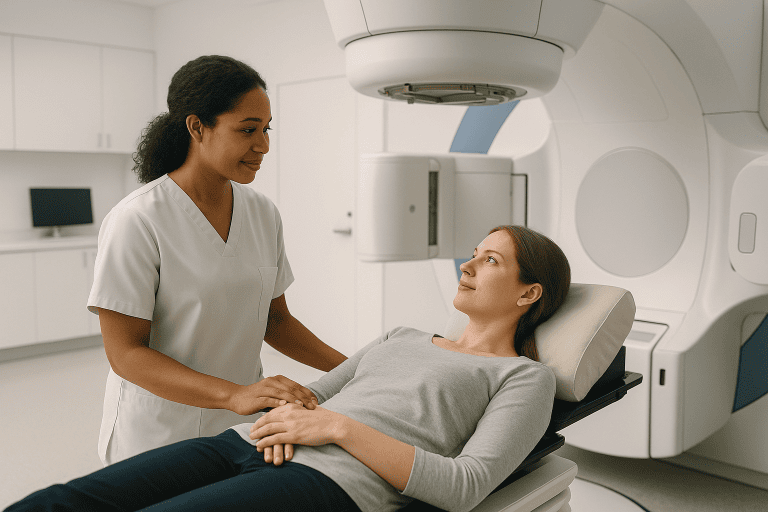
Radiation therapy uses high-energy beams to destroy cancer cells. It may be delivered from outside the body (external beam radiation) or by placing small radioactive seeds directly into the prostate (brachytherapy). Radiation can be used as a primary treatment for localized disease, after surgery in some situations, or to relieve symptoms in advanced disease.
Hormone therapy
Prostate cancer cells usually depend on male hormones, called androgens (mainly testosterone), to grow. Hormone therapy, also known as androgen deprivation therapy, lowers testosterone levels or blocks its effects. It is often used for advanced disease or alongside radiation for higher-risk cancers. Side effects can include hot flashes, reduced sex drive, fatigue, and bone thinning, and your doctor may recommend measures to manage these.
Chemotherapy and other systemic treatments
Chemotherapy uses medications that kill rapidly dividing cells and is generally reserved for prostate cancer that has spread or no longer responds to hormone therapy. Newer options, including targeted therapies (drugs designed to act on specific genetic features of the cancer) and immunotherapy (treatments that help the immune system recognize cancer cells), may be appropriate for certain patients. Systemic treatments of this kind are typically planned and supervised by specialists such as those in a medical oncology department, working together with urologists and radiation oncologists as a multidisciplinary team.
Focal and other localized therapies
In selected cases, doctors may discuss focal treatments, such as high-intensity focused ultrasound (HIFU) or cryotherapy (freezing), which aim to destroy only the cancerous part of the prostate. These approaches are not suitable for everyone, and their long-term results are still being studied.
Living with prostate cancer and outlook
A prostate cancer diagnosis is life-changing, but for many men the outlook is encouraging, particularly when the disease is found while it is still confined to the prostate. Localized prostate cancer is often treatable, and many men diagnosed at an early stage live for many years, frequently with a normal or near-normal life expectancy. Even when the cancer has spread, modern treatments can often control the disease for extended periods, though advanced prostate cancer is generally managed as a long-term condition rather than cured.
Prognosis depends on several factors, including the stage at diagnosis, the Gleason grade, PSA levels, how the cancer responds to treatment, and your general health. No doctor can promise a specific outcome, and it is reasonable to ask your care team what the findings mean in your particular situation.
Living well with prostate cancer often involves more than medical treatment. Regular follow-up visits and PSA monitoring are important for detecting any recurrence early. Side effects such as urinary problems or changes in sexual function are common after treatment and can often be improved with pelvic floor exercises, medications, devices, or specialist referral, do not hesitate to raise these issues, as they are a normal part of care. Maintaining a healthy weight, staying physically active, eating a balanced diet, and not smoking may support overall health during and after treatment. Emotional support also matters: anxiety and low mood are common, and counseling or patient support groups can help both patients and their partners.
Frequently asked questions
What is prostate cancer in simple terms?
Prostate cancer is an abnormal growth of cells in the prostate, a small gland below the bladder that helps produce semen. The abnormal cells can form a tumor, and in some cases they can spread to other parts of the body. Many prostate cancers grow slowly, while others are more aggressive, which is why testing and grading are so important in deciding what to do next.
Can prostate cancer be cured?
In many cases, yes, particularly when the cancer is found early and is still confined to the prostate. Treatments such as surgery or radiation can often remove or destroy localized disease. When the cancer has spread beyond the prostate, a complete cure is less likely, but treatments can frequently control the disease for years. Your doctor can explain what is realistic in your specific situation based on the stage and grade of your cancer.
How serious is prostate cancer?
Seriousness varies widely. Some prostate cancers are so slow growing that they may never cause harm and can simply be monitored. Others are aggressive and require prompt, intensive treatment. Doctors use the stage, the Gleason grade, and PSA levels to estimate how serious an individual cancer is likely to be, so the same diagnosis can mean very different things for different men.
What are the first warning signs of prostate cancer?
Early prostate cancer often causes no warning signs at all, which is why many cases are found through PSA blood tests. When symptoms do occur, the earliest ones are usually urinary: a weaker stream, urinating more often (especially at night), or difficulty starting urination. Blood in the urine or semen and new erectile problems can also occur. Because these symptoms are more often caused by benign conditions, medical evaluation is the only way to know the cause.
How is prostate cancer diagnosed?
Diagnosis usually begins with a PSA blood test and a digital rectal examination. If results are concerning, your doctor may recommend an MRI scan and then a biopsy, in which small tissue samples are taken from the prostate and examined under a microscope. The biopsy is the only test that can confirm cancer. If cancer is found, further scans may be used to check whether it has spread.
What is recovery like after prostate cancer treatment?
Recovery depends on the treatment. After surgery, most men spend a short time in the hospital and gradually return to normal activities over several weeks; urinary control and erectile function often improve over months. Radiation therapy is usually given as an outpatient and may cause temporary urinary, bowel, or fatigue-related side effects. Hormone therapy side effects last as long as the treatment continues. Regular follow-up with PSA testing continues for years after any treatment.
Can you live a normal life with prostate cancer?
Many men do. Those on active surveillance often continue their lives with little change apart from regular checkups. After successful treatment for localized disease, most men return to work, exercise, and everyday activities, though some manage ongoing side effects. Even men with advanced disease can often maintain a good quality of life for extended periods with modern treatments, supportive care, and attention to overall health.
When to see a doctor
Make an appointment with a doctor if you notice persistent urinary changes, such as a weak stream, frequent nighttime urination, difficulty starting urination, or a feeling of incomplete emptying, even though these are often caused by benign conditions, they deserve evaluation. Men over 50, or over 45 with a family history of prostate cancer or African ancestry, may also wish to discuss whether PSA screening is appropriate for them.
Seek medical attention promptly if you experience any of the following red-flag symptoms:
- Blood in your urine or semen
- Inability to urinate or sudden, severe difficulty passing urine
- Persistent, unexplained pain in the back, hips, or pelvis, especially pain that is worse at night
- New weakness, numbness, or tingling in the legs or feet, or loss of bladder or bowel control: these can signal pressure on the spinal cord and need urgent assessment
- Unexplained weight loss or ongoing fatigue with no clear cause
- Fever with urinary symptoms, which may indicate an infection requiring treatment
These symptoms do not necessarily mean you have prostate cancer, but they should never be ignored. Early evaluation gives doctors the best chance to identify the cause and, if cancer is present, to treat it at the most manageable stage.
Patient Guides for This Condition
Medically reviewed by the Acıbadem International Medical Board September 2, 2026
See our medical review board →
Update history
- PublishedJune 14, 2026
- Medical review approvedSeptember 2, 2026
- Last content updateSeptember 2, 2026