Clinical Neurophysiology Tests for Muscle Weakness: When EMG, EEG, or Evoked Potentials Are Used

EMG and nerve conduction studies are the main neurophysiology tests used to investigate muscle weakness. EEG is not a routine test for ordinary muscle weakness, but it may be used when episodes could be related to seizures or altered brain activity.
Key Takeaways
- EMG and nerve conduction studies are the main neurophysiology tests used to investigate muscle weakness.
- EEG is not a routine test for ordinary muscle weakness, but it may be used when episodes could be related to seizures or altered brain activity.
- Evoked potentials can assess how well signals travel through sensory and motor pathways in selected cases.
- These tests help localize the cause of weakness and guide further treatment or imaging.
- Most neurophysiology tests are outpatient procedures and are generally well tolerated.
Clinical neurophysiology tests for muscle weakness help doctors understand whether weakness is related to muscles, nerves, the nerve-muscle junction, spinal pathways, or the brain. The most suitable test depends on the person’s symptoms, examination findings, and the suspected underlying condition.
Overview: Why Neurophysiology Tests Are Used for Muscle Weakness
Muscle weakness is a symptom rather than a diagnosis. It can develop because of problems in the muscles themselves, the peripheral nerves, the connection between nerve and muscle, the spinal cord, or the brain. Clinical neurophysiology tests are used to measure the electrical activity of these systems and help doctors understand where the problem may be starting.
These tests are especially useful when weakness is unexplained, persistent, progressive, or associated with other symptoms such as numbness, cramps, muscle wasting, twitching, imbalance, or fatigue. They can help distinguish true weakness from pain-limited movement, poor endurance, or general tiredness.
The three test groups most often discussed are electromyography (EMG), electroencephalography (EEG), and evoked potentials. In practice, EMG is the most common test for muscle weakness because it directly evaluates nerves and muscles. EEG and evoked potentials are more selective and are used when the symptoms suggest involvement of the brain or specific sensory and motor pathways.
Symptoms and Situations That May Prompt Testing
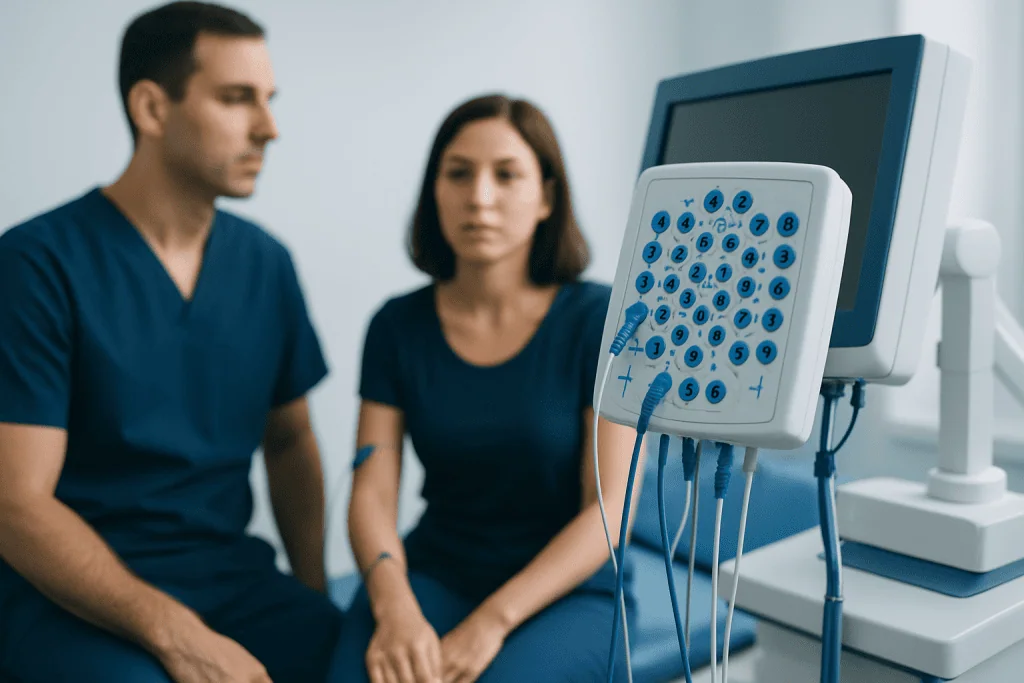
A doctor may recommend neurophysiology testing when weakness affects one limb, both legs, the hands, facial muscles, swallowing, speech, or breathing muscles. Testing may also be considered when weakness changes over time, worsens with activity, or appears together with tingling, burning pain, balance problems, drooping eyelids, or muscle cramps.
Patterns in the weakness can offer important clues. For example, weakness that is worse at the end of the day may raise suspicion for a nerve-muscle junction disorder, while weakness with numbness may point more toward peripheral nerve disease. Weakness with spasticity, brisk reflexes, or visual or sensory symptoms may suggest a central nervous system problem that needs a different testing approach.
Common situations that may lead to evaluation include:
- Persistent unexplained weakness in the arms or legs
- Weakness after an infection, injury, or surgery
- Suspected pinched nerve or nerve root problem
- Possible peripheral neuropathy
- Muscle twitching, wasting, or cramps
- Symptoms suggesting disorders such as myasthenia gravis, motor neuron disease, or demyelinating disease
Neurophysiology tests do not replace a neurological examination. Instead, they are chosen to answer specific clinical questions after a detailed history and physical exam.
EMG and Nerve Conduction Studies: The Main Tests for Muscle Weakness
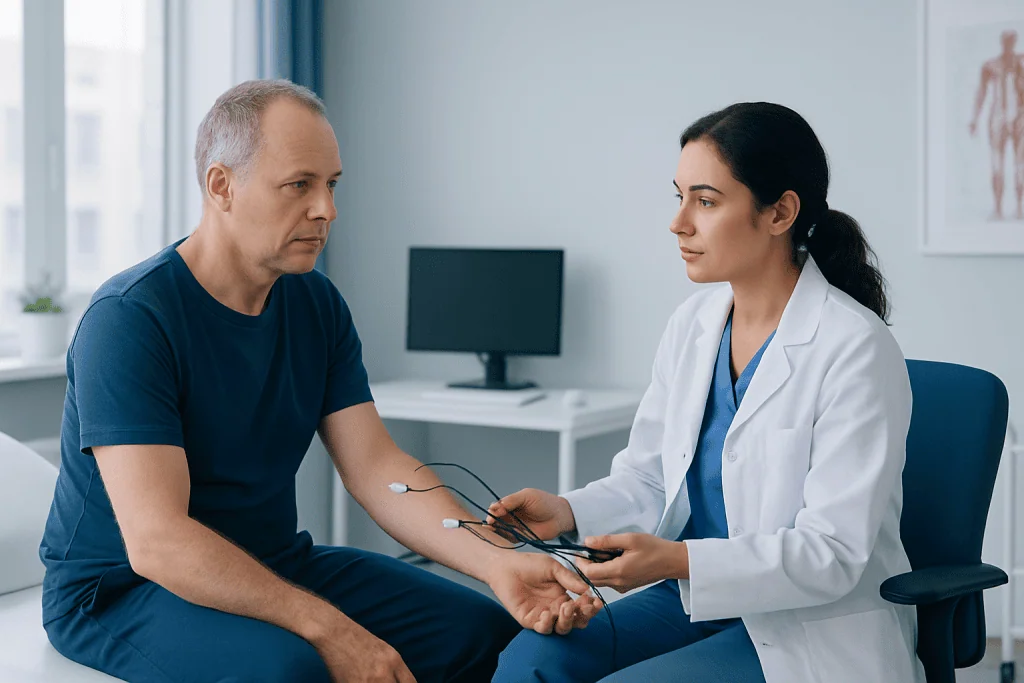
When people ask about testing for muscle weakness, EMG is usually the most relevant examination. EMG is often performed together with nerve conduction studies (NCS). NCS evaluate how quickly and effectively electrical signals travel along peripheral nerves, while EMG measures electrical activity within muscles at rest and during contraction. Together, these tests can help show whether weakness is caused by nerve injury, nerve compression, muscle disease, or a problem at the nerve-muscle junction.
Doctors often use EMG and NCS when they suspect conditions affecting the peripheral nervous system or muscles, such as peripheral neuropathy, nerve entrapment, radiculopathy, inflammatory muscle disease, or disorders of neuromuscular transmission. In some cases, specialized repetitive stimulation or single-fiber techniques may be added if a condition such as myasthenia gravis is suspected.
During nerve conduction studies, small electrodes are placed on the skin and gentle electrical pulses are delivered to a nerve. During needle EMG, a very fine electrode is inserted into selected muscles to record their activity. The test may feel uncomfortable, but it is usually brief and manageable. Results can help determine whether additional evaluation such as blood tests, imaging, genetic testing, or targeted treatment is needed.
If structural pressure on a nerve root or spinal pathway is suspected, the doctor may combine neurophysiology findings with imaging such as MRI scanning. In people whose symptoms suggest a surgical nerve compression problem, the test results may also help guide referral for a procedure such as neurosurgical evaluation when appropriate.
When EEG Is Used in a Person With Weakness
EEG records the brain’s electrical activity through electrodes placed on the scalp. Unlike EMG, EEG is not primarily a muscle test. For that reason, it is not routinely ordered for common causes of limb weakness such as neuropathy, muscle disease, or a pinched nerve.
However, EEG can be very helpful when episodes of weakness may actually reflect abnormal brain activity. This may happen if a person has brief, recurrent events with loss of awareness, unusual movements, confusion, or post-event weakness. In such cases, the doctor may want to rule out seizures or other cortical causes.
EEG may also be considered when weakness is part of a broader neurological picture involving spells, altered consciousness, or suspected functional neurological episodes. The aim is not simply to label the symptom, but to understand whether the brain is contributing to the events and whether treatment should focus on seizure management, further imaging, or another neurological pathway.
In short, EEG is used for muscle weakness only in selected clinical situations. Its value depends on the person’s full symptom pattern, not on weakness alone.
When Evoked Potentials Are Helpful
Evoked potentials measure how electrical signals travel through specific sensory or motor pathways after a controlled stimulus. Depending on the type of test, the stimulus may be visual, auditory, or electrical. The recordings help doctors assess whether the pathway from the eye, ear, skin, spinal cord, or brain is conducting signals normally.
For muscle weakness, evoked potentials are not usually the first test. They are more often used when the doctor suspects a central nervous system disorder that affects conduction in the spinal cord or brain, especially if weakness is accompanied by sensory changes, visual symptoms, gait difficulty, or signs of demyelination. In such settings, evoked potentials can add useful functional information alongside neurological examination and MRI scanning.
Examples include visual evoked potentials for suspected optic pathway involvement and somatosensory evoked potentials when sensory pathways in the spinal cord or brain may be affected. Motor evoked potentials, available in some specialized centers, can help assess descending motor pathways. These tests do not diagnose every cause of weakness, but they can support localization and help clarify whether a problem lies beyond the peripheral nerves and muscles.
How Doctors Choose the Right Test
The choice between EMG, EEG, evoked potentials, or a combination depends on the clinical question. Doctors begin by asking where the weakness is, how quickly it developed, whether it fluctuates, and what other symptoms are present. Reflexes, sensation, muscle tone, coordination, and cranial nerve findings all help determine whether the likely source is muscle, peripheral nerve, spinal cord, or brain.
As a general guide, EMG and nerve conduction studies are most useful for suspected peripheral nerve, nerve root, muscle, or neuromuscular junction disorders. EEG is reserved for situations where weakness may be part of seizure-like or cortical events. Evoked potentials are considered when central pathway conduction needs to be assessed, particularly in possible demyelinating or spinal cord disease.
Additional tests are often needed to complete the picture. These may include blood tests for inflammation, vitamin deficiency, thyroid disease, or autoimmune disorders; imaging such as MRI or CT; and in selected cases, ultrasound, lumbar puncture, or genetic testing. Because muscle weakness has many possible causes, diagnosis usually relies on combining test findings rather than depending on one single result.
What to Expect During Testing and Afterward
Most clinical neurophysiology tests are outpatient procedures. EEG involves placing sensors on the scalp to record brain activity; it is painless, though the setup can take some time. Nerve conduction studies involve brief electrical pulses on the skin, while needle EMG uses a thin electrode inserted into muscles to record activity. Evoked potential tests use surface electrodes and controlled stimuli such as a flashing pattern or small electrical pulse.
Preparation is usually simple. Patients may be asked to avoid heavy lotions or oils on the skin and scalp, wear comfortable clothing, and bring a list of medications. In some cases, certain medicines that affect neuromuscular transmission may need review beforehand, but this should only be done under medical advice.
After testing, most people can return to usual daily activities right away. Mild temporary soreness can happen after needle EMG, but serious complications are uncommon. The results are interpreted in the context of the person’s symptoms and examination, so the meaning of the test is best discussed with a neurologist or clinical neurophysiologist rather than judged from raw numbers alone.
Near the end of the diagnostic journey, some people benefit from care in a center with coordinated neurology, radiology, rehabilitation, and laboratory services. Acibadem International’s multidisciplinary specialists and JCI-accredited hospitals evaluate and treat international patients with complex causes of muscle weakness when advanced neurophysiology assessment is needed.
When to See a Doctor for Muscle Weakness
Medical attention is advisable when weakness is new, persistent, progressive, or clearly different from ordinary fatigue after exercise. A doctor should also assess weakness that affects walking, hand function, swallowing, speech, vision, or breathing, or that is associated with numbness, severe pain, muscle wasting, falls, or bladder and bowel symptoms.
Urgent care is important if weakness appears suddenly, affects one side of the body, or comes with facial drooping, confusion, severe headache, or trouble speaking, because these can be warning signs of a stroke or another acute neurological emergency. Emergency evaluation is also needed for rapidly worsening weakness, especially if it begins to affect breathing or swallowing.
Even when the problem is not urgent, earlier evaluation often makes diagnosis more straightforward. Careful history-taking, a neurological examination, and the right neurophysiology test can help identify the cause and guide treatment more efficiently.
Frequently asked questions
Which test is most commonly used for muscle weakness?
EMG, usually combined with nerve conduction studies, is the most commonly used neurophysiology test for unexplained muscle weakness. It helps doctors determine whether the weakness is coming from the muscle, the peripheral nerves, the nerve roots, or the nerve-muscle junction.
Is EEG useful for ordinary muscle weakness?
Usually not. EEG is mainly used when episodes of weakness may be linked to abnormal brain activity, such as seizures or brief events with altered awareness. For most neuromuscular causes of weakness, EMG is more informative.
Are evoked potentials the same as EMG?
No. EMG evaluates muscle electrical activity and is often paired with nerve conduction studies, while evoked potentials measure how signals travel through specific sensory or motor pathways. They answer different clinical questions and are used in different situations.
Are these tests painful?
Most people tolerate them well, although some parts can be uncomfortable. Nerve conduction studies cause brief electrical sensations, and needle EMG can produce temporary discomfort or mild soreness afterward. EEG and many evoked potential tests are generally painless.
Can one test diagnose the exact cause of weakness?
Not always. Neurophysiology tests often show where the problem is most likely located, but doctors may still need blood tests, imaging, or other evaluations to confirm the diagnosis. Results are most useful when combined with the medical history and neurological examination.
How should a patient prepare for neurophysiology testing?
Preparation is usually simple. Patients are often advised to keep the skin and scalp clean, avoid heavy creams or oils, wear comfortable clothing, and bring a medication list. Any medicine changes should only be made if the doctor specifically recommends them.
References
- World Health Organization
- National Institute of Neurological Disorders and Stroke
- American Association of Neuromuscular & Electrodiagnostic Medicine
- International Federation of Clinical Neurophysiology
- National Institute for Health and Care Excellence
This article is for general information only and is not a substitute for professional medical advice. Please consult a qualified doctor about your individual situation.
Clinical Neurophysiology in Turkey — costs, top hospitals & a free quote
JCI-accredited · board-certified surgeons · reply within 24h
Add us as a Preferred Source to see more of our trusted health content across Google Search, AI Overviews and Discover.

Neurology
Diagnosis and treatment of disorders of the brain, spinal cord, nerves and muscles.
51 specialists in this unitMore from the Health Library



Related Specialists

Prof. Dr. Meriç Şengöz
Radiation Oncology
Assoc. Prof. Dr. Onur Dülgeroğlu
General Surgery
Prof. Dr. Andaç Salman
Dermatology
Prof. Dr. Faruk Suat Dede
Gynecology & Obstetrics