Deuteranopia: A Complete Medical Overview

Deuteranopia affects how a person distinguishes certain greens, reds, browns, and related shades. It is most often inherited and usually does not damage overall eyesight or eye structures.
Key Takeaways
- Deuteranopia affects how a person distinguishes certain greens, reds, browns, and related shades.
- It is most often inherited and usually does not damage overall eyesight or eye structures.
- Diagnosis is made with color vision tests and a routine eye examination.
- There is no cure for inherited deuteranopia, but practical adaptations can improve daily life.
- A new change in color vision later in life should be medically evaluated because it can signal another eye or health problem.
Deuteranopia is a type of red-green color vision deficiency in which green-sensitive cone cells do not work normally, making some colors look similar or muted. It is usually inherited, often recognized in childhood, and diagnosed with color vision testing by an eye care professional.
Overview: what deuteranopia means
Deuteranopia is a form of red-green color vision deficiency. In simple terms, it changes how the eye and brain detect and interpret color, especially shades that depend on green-sensitive cone cells. A person with deuteranopia may confuse greens with browns, reds with certain dark tones, or have trouble telling apart colors that others see as clearly different.
This condition is usually present from birth and is linked to inherited changes in the genes involved in color vision. Many people first notice it in school, during sports, while reading color-coded information, or when choosing clothing. Because the change is lifelong, people often adapt well and may not realize their color perception differs until formal testing is done.
Deuteranopia is different from complete blindness and does not usually reduce sharpness of vision. Most people still see shapes, movement, depth, and light normally. The main difference is in color discrimination, especially along the red-green spectrum.
How normal color vision works
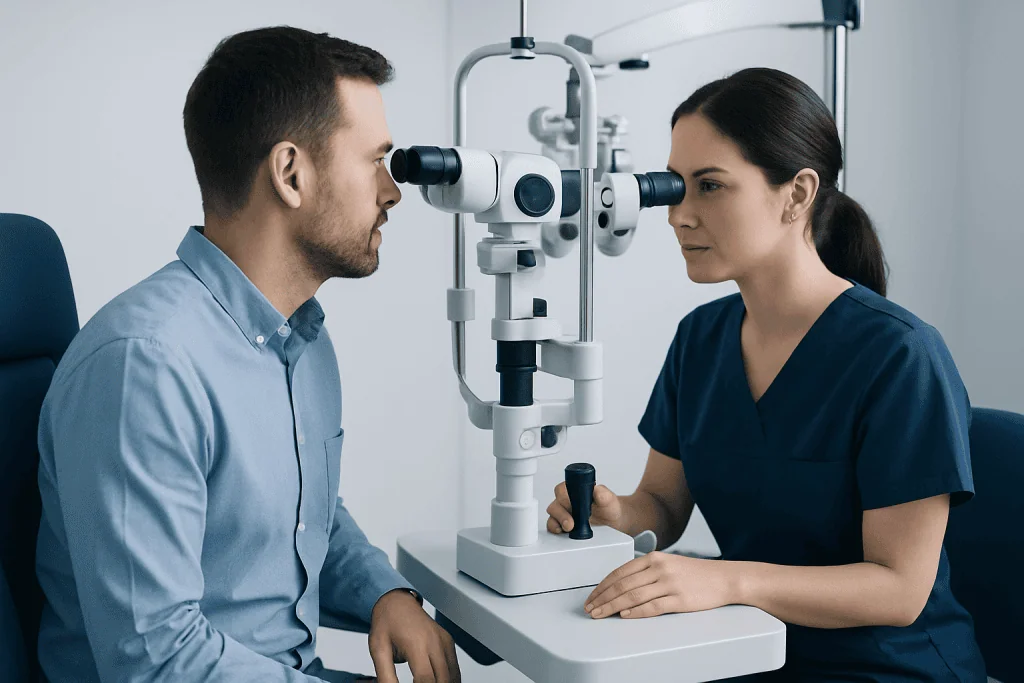
The retina at the back of the eye contains special light-detecting cells called cones. These cones help the brain interpret color. Human color vision typically depends on three cone types that respond most strongly to long, medium, and short wavelengths of light, often described as red, green, and blue sensitive systems.
In deuteranopia, the medium-wavelength, or green-sensitive, cone function is absent or severely altered. As a result, the brain receives incomplete color information and certain shades become difficult to distinguish. This is why the condition belongs to the broader group of red-green color vision deficiencies.
Some people use the term color blindness for all color vision problems, but many affected individuals do see color. They simply perceive some colors differently. Deuteranopia is one specific pattern within this larger category, and it is distinct from other forms such as color blindness caused by different cone changes.
Symptoms and daily-life effects

The symptoms of deuteranopia can be subtle or more noticeable depending on the setting. The most common issue is difficulty telling apart colors that contain green components. This may include confusion between green and brown, red and green, orange and green, or pink and gray in some lighting conditions.
Daily challenges often appear in situations that rely heavily on color coding. Reading maps, charts, wiring labels, medication packaging, school materials, app interfaces, and transport signals may take extra concentration. Clothing choices, makeup matching, and checking whether food is ripe or cooked can also be more difficult.
Children may not complain because they assume everyone sees color the same way they do. Adults may only realize the difference during occupational screening, a school vision test, or an eye examination. Common signs include:
- Frequent confusion between red, green, brown, and orange shades
- Difficulty identifying colored objects against similar backgrounds
- Trouble with color-coded learning tools or safety labels
- Needing to rely on position, brightness, or context rather than color alone
Although these effects can be frustrating, many people develop reliable strategies and lead normal daily lives. The condition does not typically worsen if it is inherited, and it usually does not cause eye pain, headaches, or loss of central vision on its own.
Causes and who is at risk
Most deuteranopia is inherited. The genes responsible for red-green color vision are carried on the X chromosome, which is why red-green color vision deficiencies are more common in males. A person may have a family history of similar color perception differences, though the condition can also go unrecognized across generations.
Inherited deuteranopia is present from birth and is not caused by eye strain, screen use, or poor lighting. It is a genetic trait rather than a disease that spreads or develops from lifestyle habits. In most cases, it remains stable over time.
Less commonly, a deuteranopia-like change in color vision can be acquired later in life. Eye conditions affecting the retina or optic nerve, some neurological disorders, injuries, and certain medications may alter color perception. If color vision changes suddenly or appears together with blurred vision, eye pain, visual field loss, or reduced brightness perception, it should be assessed by a doctor promptly. In some cases, evaluation may overlap with testing used for retinal diseases or optic nerve problems.
How deuteranopia is diagnosed
Diagnosis usually begins with a medical history and a description of the person’s color perception difficulties. An eye care professional asks when the problem was first noticed, whether it has changed over time, and whether there is a family history of color vision deficiency. This helps distinguish inherited cases from acquired ones.
Color vision is commonly tested with standardized plates made of colored dots that form numbers or patterns. Other tests may use colored arrangement tasks or digital assessment tools. These examinations help identify the type and degree of color vision deficiency. A full eye examination is also important to check visual acuity, retinal health, and the optic nerve.
If the doctor suspects an acquired cause, further testing may be needed. This may include a more detailed eye examination, retinal imaging, or visual field assessment depending on symptoms and findings. In children, early diagnosis can be especially helpful so teachers and parents can avoid relying only on color-coded instructions.
Management, support, and treatment options
There is currently no standard cure that restores normal inherited color vision in everyday clinical practice. Management focuses on adaptation, education, and addressing any underlying disorder if the color vision change is acquired rather than inherited. For many patients, reassurance is important: deuteranopia usually does not threaten general eye health or lead to blindness.
Some people benefit from tinted lenses or digital filters designed to improve contrast between certain colors. These tools may be useful in selected situations, but they do not correct the underlying cone abnormality and do not work the same way for everyone. Their benefits are practical rather than curative.
Supportive strategies often make the biggest difference. These can include labeling items by text rather than color, adjusting device accessibility settings, organizing clothing, using high-contrast displays, and learning the order or position of signals instead of relying on color alone. If an acquired cause is suspected, doctors may recommend retina treatment or additional care directed at the underlying condition.
For patients needing specialist assessment, Acibadem International’s multidisciplinary teams in JCI-accredited hospitals evaluate color vision concerns and related eye conditions for international patients. When structural eye disease is suspected, referral to ophthalmology care may be appropriate.
Prevention and self-care
Inherited deuteranopia cannot be prevented, but its impact can often be reduced with planning. Parents, teachers, and employers can help by using patterns, labels, symbols, or written instructions instead of color alone. This supports learning, safety, and confidence without drawing unnecessary attention to the condition.
Useful self-care measures include choosing apps and devices with accessibility settings, increasing contrast on screens, and using good lighting when sorting objects or reading labels. Some people find it helpful to memorize traffic signal positions, use smartphone tools to identify colors, or keep household items arranged in consistent places.
Regular eye checkups are still important. Although inherited deuteranopia itself usually stays stable, routine care can detect unrelated problems such as refractive errors, retinal disease, or age-related eye changes. Protecting overall eye health with UV protection, chronic disease management, and avoiding smoking is also sensible general advice.
When to seek medical care
A person should seek medical care if color vision changes suddenly, appears in only one eye, or worsens over time. Medical assessment is also important if the change is accompanied by blurred vision, eye pain, flashes, floaters, loss of side vision, or reduced brightness perception. These features are not typical of stable inherited deuteranopia and may suggest another eye or nerve problem.
Children who seem to struggle with color-based learning materials may benefit from testing, even if they have no other eye symptoms. Early identification can prevent avoidable school frustration and help families and teachers make simple adjustments. Adults may also need assessment if color vision affects work, driving requirements, or safety tasks.
Anyone with concerns about visual symptoms should consult a qualified eye specialist rather than self-diagnosing. Timely evaluation helps confirm whether the issue is inherited color vision deficiency or a different condition that needs treatment.
Frequently asked questions
Is deuteranopia the same as complete color blindness?
No. Deuteranopia is a specific type of red-green color vision deficiency, not a complete absence of color vision. Most people with deuteranopia still see many colors, but they have difficulty distinguishing certain shades that depend on green cone function.
Is deuteranopia inherited?
Yes, most cases are inherited and present from birth. It is commonly linked to genes on the X chromosome, which is why it is seen more often in males. Family history may be present, although some families do not recognize it right away.
Can deuteranopia get worse with age?
Inherited deuteranopia is usually stable and does not typically worsen over time. However, color vision can change later in life because of other eye or nerve conditions. A new or progressive change should be medically evaluated.
Can glasses cure deuteranopia?
No glasses can cure inherited deuteranopia or restore normal cone function. Some tinted lenses may improve contrast or make certain color differences easier to notice in specific situations. Their effects vary from person to person.
How is deuteranopia diagnosed in children?
Children are usually diagnosed with color vision tests performed during an eye exam or school screening. The doctor may use patterned color plates or other age-appropriate tests. Early diagnosis can help teachers avoid relying only on color-coded materials.
Does deuteranopia affect driving?
Many people with deuteranopia can drive safely because they learn to use the position and brightness of traffic signals, not color alone. Driving rules vary by country, and some occupations may have color vision requirements. An eye specialist can advise if formal testing is needed.
References
- American Academy of Ophthalmology
- National Eye Institute
- MedlinePlus
- NHS
- Merck Manual Consumer Version
This article is for general information only and is not a substitute for professional medical advice. Please consult a qualified doctor about your individual situation.
Explore treatments in Turkey — costs, top hospitals & a free quote
JCI-accredited · board-certified surgeons · reply within 24h
Add us as a Preferred Source to see more of our trusted health content across Google Search, AI Overviews and Discover.