Djd of the Knees: An Evidence-Based Guide for Patients

Djd of the knees usually means knee osteoarthritis, a common cause of knee pain and stiffness. Symptoms often develop gradually and may worsen with activity, aging, previous injury, or excess body weight.
Key Takeaways
- Djd of the knees usually means knee osteoarthritis, a common cause of knee pain and stiffness.
- Symptoms often develop gradually and may worsen with activity, aging, previous injury, or excess body weight.
- Diagnosis is based on medical history, physical examination, and sometimes X-rays or other imaging.
- Treatment often starts with exercise therapy, weight management, pain relief, and activity adjustments.
- Some people benefit from injections or surgery, including knee replacement, when symptoms become severe.
- Early evaluation can help preserve mobility and improve quality of life.
Djd of the knees refers to degenerative joint disease of the knee, most often <a href="https://acibademinternational.com/diseases/knee-osteoarthritis/”>knee osteoarthritis. It develops when cartilage and other joint structures gradually change over time, leading to pain, stiffness, swelling, and difficulty with daily movement, but many people improve with a combination of exercise, weight management, medicines, and targeted procedures when needed.
Overview: what djd of the knees means
Djd of the knees means degenerative joint disease of the knee. In most cases, this term refers to knee osteoarthritis, a condition in which the smooth cartilage that cushions the knee joint gradually breaks down and the structures around the joint change over time. As cartilage becomes thinner, the bones and soft tissues in the joint may no longer move as easily or comfortably as before.
This is not simply a problem of “wear and tear.” Modern understanding shows that knee osteoarthritis involves the whole joint, including cartilage, bone, the joint lining, ligaments, and surrounding muscles. These changes can lead to pain, stiffness, swelling, reduced range of motion, and difficulty with walking, stairs, or standing up from a chair.
Djd of the knees is very common, especially with increasing age, but it can also affect younger adults after sports injuries, repeated stress, or certain joint alignment problems. Symptoms may come and go at first, then become more persistent. Although the condition cannot always be reversed, many people can manage it successfully and stay active with the right plan.
Symptoms and how they affect daily life

The symptoms of djd of the knees often begin gradually. Knee pain is the most common complaint. It may be felt during walking, climbing stairs, kneeling, or after long periods of standing. Some people notice pain mainly after activity, while others feel discomfort at the start of movement after resting. Morning stiffness is common but usually improves within a short time after getting moving.
Other symptoms can include swelling, a grinding or crackling sensation, warmth around the joint, reduced flexibility, and the feeling that the knee is weaker or less stable. In more advanced cases, the knee may not fully straighten or bend, making everyday tasks more difficult. Pain can also disturb sleep or reduce confidence in movement.
Symptoms do not always match X-ray findings. A person may have significant pain even with mild imaging changes, while someone else may have clear joint degeneration on X-ray but relatively few symptoms. This is one reason why treatment should focus on the person’s function, goals, and examination findings rather than imaging alone.
- Pain during or after movement
- Stiffness after rest
- Swelling or tenderness
- Reduced range of motion
- Grinding, clicking, or crackling sensations
- Difficulty with stairs, walking, or prolonged standing
Causes and risk factors
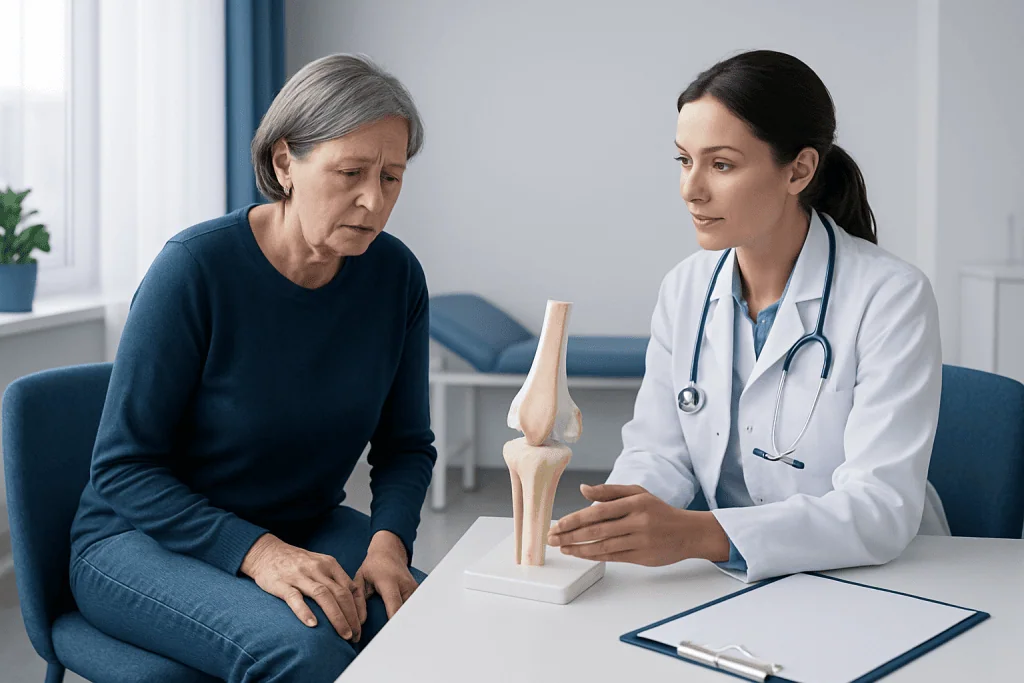
Djd of the knees develops from a combination of biological and mechanical factors. Age is one of the strongest risk factors because joint tissues become less resilient over time. However, aging alone does not fully explain the condition. Body weight, past injuries, muscle weakness, joint alignment, repetitive strain, and family history also play important roles.
Previous knee injuries can increase risk years later. Meniscus tears, ligament injuries, fractures involving the joint, and surgery on the knee may alter how force is distributed across the joint. Repeated kneeling, squatting, lifting, or high-impact sports may also contribute in some people. Weakness of the thigh and hip muscles can place extra stress on the knee and worsen symptoms.
Some people have other forms of arthritis that can affect the knee, so it is important not to assume that all knee pain is simple osteoarthritis. A clinician may also consider conditions such as a meniscus tear or inflammatory joint disease if the symptoms or examination suggest another cause. Structural problems like bow-legged or knock-kneed alignment can also increase pressure on one side of the joint and speed degeneration.
How doctors diagnose djd of the knees
Diagnosis starts with a careful medical history and physical examination. A doctor will ask when the pain began, what activities make it better or worse, whether the knee swells, and how symptoms affect walking, sleep, work, or exercise. The examination usually assesses tenderness, swelling, range of motion, alignment, walking pattern, and signs of instability or muscle weakness.
X-rays are often used when the diagnosis is uncertain, symptoms are persistent, or treatment decisions depend on understanding the joint structure. X-rays may show joint space narrowing, bone spurs, and changes in the bone beneath the cartilage. They are useful, but they do not measure pain. Imaging findings need to be interpreted together with symptoms and the physical exam.
Other tests are not always necessary. MRI may be considered when a doctor suspects another problem such as a ligament or cartilage injury, or when symptoms seem out of proportion to standard imaging findings. In some situations, doctors may also evaluate for rheumatoid arthritis or other inflammatory conditions if there is prolonged morning stiffness, marked swelling, or symptoms in multiple joints.
Treatment options: from conservative care to surgery
Treatment for djd of the knees usually begins with non-surgical care. Exercise therapy is one of the most effective approaches. Strengthening the muscles around the knee and hip can reduce stress on the joint and improve function. Low-impact activities such as walking on even ground, cycling, swimming, and supervised physical therapy are commonly recommended. When needed, people may benefit from physical therapy and rehabilitation to build strength, improve balance, and learn joint-friendly movement strategies.
Weight management can also make a meaningful difference for people who are overweight. Even modest weight reduction may reduce pressure on the knee with each step. Doctors may also suggest supportive measures such as a cane, knee brace, shoe inserts, heat or cold therapy, and activity adjustments that keep a person moving without overloading the joint.
Medicines may help control pain and support exercise participation. Options can include topical anti-inflammatory gels, oral pain relievers, or anti-inflammatory medicines when appropriate for the individual’s overall health. In some cases, injections are considered, especially when pain remains limiting despite other measures. Depending on the person’s situation, a specialist may discuss knee replacement if pain is severe, function is significantly reduced, and conservative treatment no longer provides enough relief. Some patients may also be evaluated in an orthopedics and traumatology clinic to review the full range of non-surgical and surgical options.
Self-care and prevention strategies
Self-care is an important part of living well with djd of the knees. Regular movement is usually better than prolonged rest. The goal is to stay active while avoiding patterns that consistently trigger flare-ups. Many people do best with shorter, more frequent activity sessions rather than occasional strenuous effort. Warming up before exercise and allowing time for recovery can also help.
Strength, flexibility, and balance all matter. Exercises that target the quadriceps, hamstrings, hip muscles, and core can support better knee mechanics. It is also helpful to choose footwear that feels stable and comfortable. If a certain activity causes repeated swelling or sharp pain, it may need modification rather than complete avoidance.
Prevention is not always possible, but some steps may reduce risk or slow symptom progression:
- Maintain a healthy body weight if possible
- Stay physically active with low-impact exercise
- Build leg and hip muscle strength
- Treat knee injuries promptly and follow rehabilitation plans
- Use proper form during sports, lifting, and repetitive work
- Seek assessment early if pain persists or mobility declines
When to seek medical care
Medical care is appropriate if knee pain lasts more than a few weeks, keeps returning, or begins to limit daily activities. A doctor should also assess pain that interferes with walking, climbing stairs, working, sleeping, or exercise. Early evaluation can help identify whether the problem is djd of the knees or another condition requiring different treatment.
Prompt medical attention is especially important if the knee becomes suddenly very swollen, red, hot, or difficult to bear weight on. Care is also needed after a fall or twisting injury, or if the knee locks, gives way, or cannot fully bend or straighten. These signs may suggest a different diagnosis or a more urgent problem than typical osteoarthritis.
For patients seeking coordinated care, Acibadem International’s multidisciplinary specialists and JCI-accredited hospitals diagnose and treat knee joint conditions for international patients. A structured plan can help combine symptom relief, rehabilitation, and longer-term joint care in a way that fits the patient’s lifestyle and goals.
Frequently asked questions
Is djd of the knees the same as arthritis?
Djd of the knees usually refers to knee osteoarthritis, which is the most common form of arthritis in the knee. It is a degenerative joint condition involving cartilage, bone, and other structures in and around the joint.
Can djd of the knees be cured?
There is no simple cure that fully restores the joint to its original state. However, many people can manage symptoms very well and maintain mobility through exercise, weight management, medicines, physical therapy, and, in some cases, procedures or surgery.
What is the best exercise for djd of the knees?
The best exercise is one that strengthens the muscles around the knee without causing a significant flare-up. Common options include walking, cycling, swimming, and guided strengthening exercises for the thighs and hips. A clinician or physical therapist can help tailor a program to the person’s pain level and function.
Does knee pain always mean severe joint damage?
Not necessarily. Pain levels do not always match the degree of change seen on imaging. Some people have significant pain with only mild X-ray changes, while others have advanced degeneration and less discomfort.
When is knee replacement considered?
Knee replacement is usually considered when pain is persistent, daily function is seriously affected, and non-surgical treatments no longer provide enough relief. The decision depends on symptoms, examination findings, imaging, overall health, and personal goals.
Can weight loss really help djd of the knees?
Yes, for people who are overweight, weight loss can reduce the load placed on the knee joint during daily activities. Even modest changes may improve pain and function when combined with regular exercise and a broader treatment plan.
References
- American Academy of Orthopaedic Surgeons
- Arthritis Foundation
- National Institute of Arthritis and Musculoskeletal and Skin Diseases
- Centers for Disease Control and Prevention
- Osteoarthritis Research Society International
This article is for general information only and is not a substitute for professional medical advice. Please consult a qualified doctor about your individual situation.
Joint and spine care in Turkey — expert assessment & treatment
JCI-accredited · board-certified surgeons · reply within 24h
Add us as a Preferred Source to see more of our trusted health content across Google Search, AI Overviews and Discover.

More from the Health Library

Benzonatate 200mg: An Evidence-Based Guide for Patients

Deon sanders: Symptoms, Causes, and Treatment — Complete Patient Guide

Signs of fever: Symptoms, Causes, and Treatment — Complete Patient Guide

Triangle of Death: A Complete Medical Overview
Tooth Pulp: An Evidence-Based Guide for Patients

Facial Swelling on Left Side: An Evidence-Based Guide for Patients
Physical Medicine & Rehabilitation Specialists at Acibadem

Dr. Cem Tangay
Orthopedic Surgery & Traumatology
Dr. Cem Tekin Baran
Orthopedic Surgery & Traumatology
Fzt. Ceren Kandemir Gençsoylu
Physical Medicine & Rehabilitation
Fzt. Ceren Keser
Physical Medicine & Rehabilitation