Endovascular Neurosurgery vs Open Brain Surgery: When Is a Minimally Invasive Approach Possible?
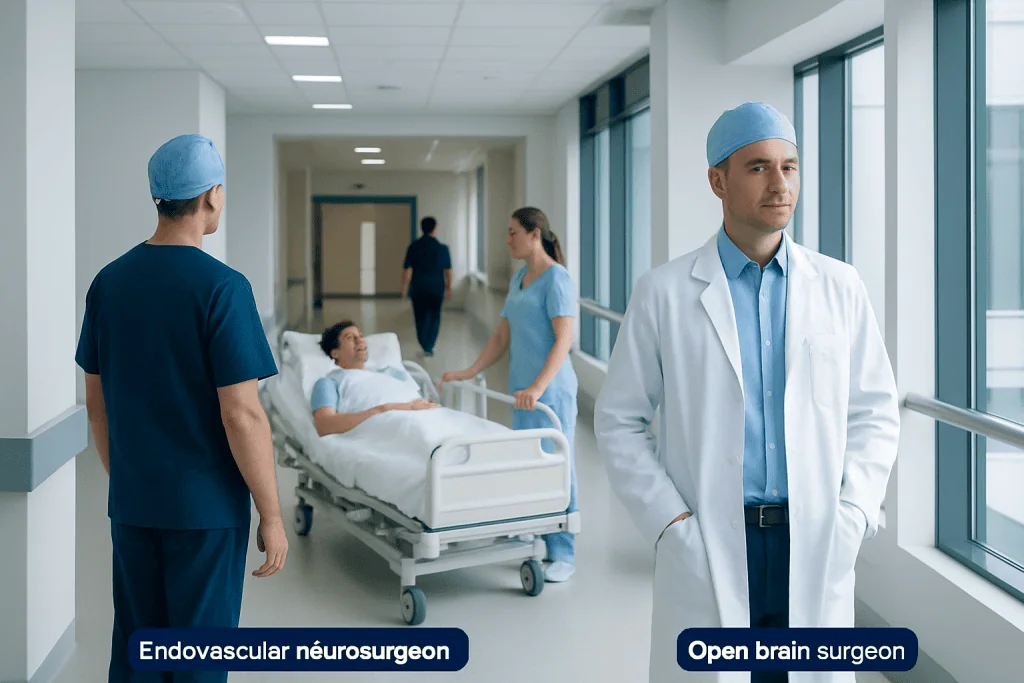
Endovascular neurosurgery treats certain brain and vascular conditions from inside the blood vessels using catheters. Open brain surgery allows direct access to the brain and may be preferred when a lesion cannot be safely treated from within the vessels.
Key Takeaways
- Endovascular neurosurgery treats certain brain and vascular conditions from inside the blood vessels using catheters.
- Open brain surgery allows direct access to the brain and may be preferred when a lesion cannot be safely treated from within the vessels.
- The best approach depends on the condition, size and location of the problem, bleeding risk, and the patient’s general health.
- Some patients benefit from a combined plan that uses both endovascular and open surgical techniques.
- Treatment decisions are usually made by a multidisciplinary team that includes neurosurgeons, interventional neuroradiologists, and neurologists.
Endovascular neurosurgery and open brain surgery are two different ways to treat disorders of the brain and its blood vessels. A minimally invasive approach may be possible when the problem can be reached safely through the blood vessels, but the best choice depends on the exact diagnosis, location, anatomy, and overall health of the patient.
Overview: How the Two Approaches Differ
When comparing endovascular neurosurgery vs open brain surgery, the main difference is how doctors reach the problem area. Endovascular neurosurgery is a minimally invasive technique that uses thin tubes called catheters, usually inserted through an artery in the wrist or groin, and guided through the blood vessels to the brain. Open brain surgery, also called craniotomy-based surgery in many situations, involves creating an opening in the skull to directly see and treat the brain, blood vessel, or surrounding structures.
Neither approach is automatically better in every case. Each has specific strengths, limitations, and risks. Endovascular techniques may reduce tissue disruption and can shorten recovery for selected patients, but they are not suitable for every condition. Open surgery remains essential when direct visualization, tissue removal, decompression, or complex reconstruction is needed.
In modern brain care, the decision is often highly individualized. Specialists consider the exact diagnosis, whether the problem is within a blood vessel or in the brain tissue itself, how urgent treatment is, and the patient’s age, medical history, and imaging findings. In some situations, minimally invasive and open techniques are used together as part of a staged treatment plan.
When a Minimally Invasive Endovascular Approach May Be Possible
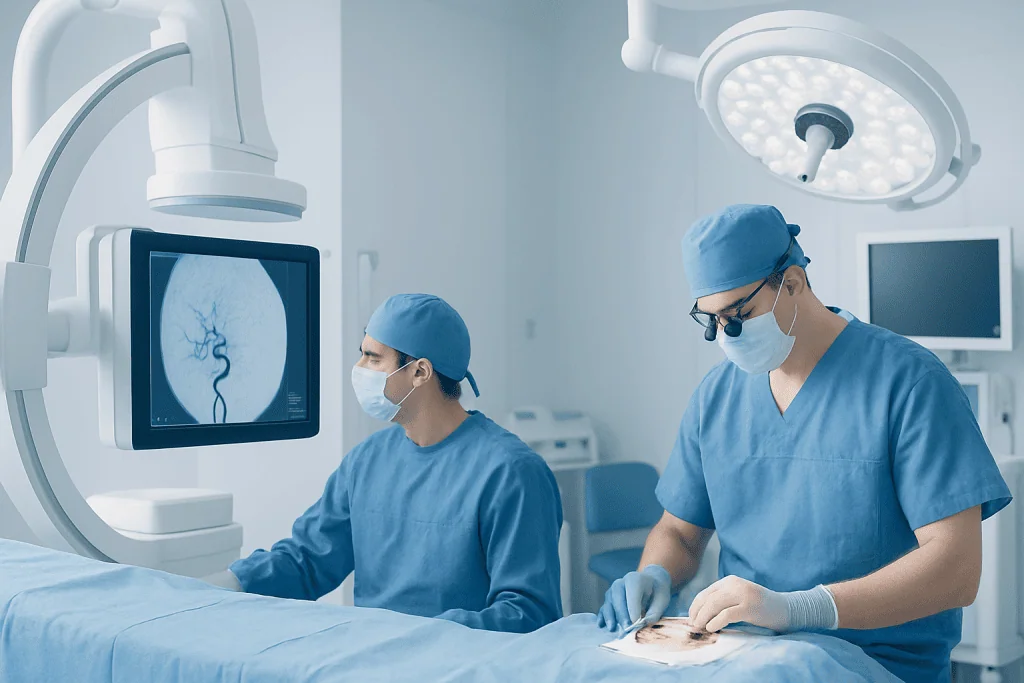
Endovascular treatment is most often considered for conditions involving the brain’s blood vessels. These include certain aneurysms, arteriovenous malformations, dural arteriovenous fistulas, carotid or intracranial artery narrowing, and some types of acute ischemic stroke caused by a blocked large artery. In these cases, doctors may be able to reach the target from inside the artery and treat it without opening the skull.
For example, an aneurysm may sometimes be treated with coils, stents, or flow-diverting devices rather than open clipping. A blood clot causing a major stroke may be removed with mechanical thrombectomy in appropriate patients. Some vascular malformations can be reduced or blocked with embolization materials, either as the main treatment or before surgery to lower bleeding risk. In selected situations, this may overlap with care for brain aneurysm or stroke.
Whether a minimally invasive approach is possible depends on technical and anatomical details seen on imaging. Doctors assess the shape and size of the lesion, the width of an aneurysm neck, the route through the arteries, nearby branch vessels, the presence of bleeding, and whether endovascular tools can be placed safely and effectively. Even if an endovascular option exists, it still must offer a good balance of benefit and risk.
- Common situations where endovascular treatment may be considered include aneurysms, vessel narrowing, certain vascular malformations, and large-vessel ischemic stroke.
- It is especially useful when the problem is inside or closely related to the blood vessels.
- Some cases need urgent treatment, while others allow time for planning and comparison of options.
When Open Brain Surgery May Be the Better Choice

Open brain surgery may be recommended when a condition cannot be reached through the blood vessels or when direct access provides a safer or more complete treatment. This is often the case for many brain tumors, some superficial aneurysms, hemorrhages causing pressure on the brain, and lesions that need tissue diagnosis or removal. Surgery may also be needed if there is swelling that requires decompression.
In aneurysm care, for instance, clipping through open surgery may be preferred when the aneurysm’s shape or branch pattern makes endovascular treatment less durable or less safe. In vascular malformations, microsurgery may offer definitive removal in selected patients. In other conditions, such as bleeding near the surface of the brain or mass lesions compressing important structures, the surgeon may need direct visual control and immediate access to surrounding tissue.
Open surgery also remains important when endovascular treatment has failed, is not technically feasible, or would leave too much residual risk. Although it is more invasive, it can provide clear advantages in carefully chosen cases. The goal is not to avoid surgery at all costs, but to select the method most likely to protect brain function and achieve durable results.
What Doctors Consider Before Choosing Between Them
The choice between endovascular neurosurgery and open brain surgery is based on several layers of evaluation. Imaging is central to this process. CT, MRI, CT angiography, MR angiography, and catheter angiography help show the exact location, size, blood flow pattern, and relationship of the lesion to nearby vessels and brain structures. These details strongly influence whether a minimally invasive route is realistic.
Doctors also consider the patient’s overall health and treatment goals. Age, kidney function, bleeding risk, heart and lung disease, previous surgeries, medications such as blood thinners, and ability to tolerate anesthesia all matter. In emergency situations such as ruptured aneurysm or acute stroke, the speed at which treatment can be delivered may also affect the decision.
Another key factor is the expected long-term result. A minimally invasive treatment may offer a faster recovery, but specialists also look at durability, the chance of recurrence, the need for follow-up procedures, and whether the treatment could interfere with future options. This is why many patients benefit from review by a multidisciplinary team rather than relying on a single viewpoint.
In specialized centers, treatment planning may involve experts in interventional neuroradiology, vascular neurosurgery, stroke neurology, neuroanesthesia, and intensive care. Their shared goal is to choose the safest, most effective option for the individual patient.
Examples of Conditions and Typical Treatment Paths
Brain aneurysms are one of the clearest examples of how treatment paths can differ. Some aneurysms are well suited to endovascular coiling or flow diversion, while others are better managed with surgical clipping. The decision depends on whether the aneurysm has ruptured, where it is located, how wide its neck is, and whether nearby branches must be preserved. In some patients, doctors may discuss brain aneurysm treatment using either method.
In acute ischemic stroke caused by a large artery blockage, endovascular thrombectomy can be a life-changing treatment for eligible patients when performed quickly after symptom onset and when imaging supports benefit. Open brain surgery is not usually the first treatment for removing an intravascular clot, but surgery may be required later if swelling or bleeding causes dangerous pressure. This may be part of broader stroke treatment planning.
For arteriovenous malformations and fistulas, the strategy can be especially tailored. Some are treated fully through embolization, some with microsurgery, some with radiosurgery, and many with a combination. Endovascular treatment may reduce blood flow before surgery, making open removal safer. This illustrates an important point: minimally invasive treatment and open surgery are not always competing options; they can be complementary.
Recovery, Benefits, and Possible Risks
Endovascular procedures often involve smaller access sites, less direct disruption of scalp and skull tissues, and potentially shorter hospital stays for selected patients. Recovery may be quicker, and postoperative discomfort may be less than with open surgery. However, endovascular treatment still carries important risks, including bleeding, vessel injury, stroke, contrast-related complications, and the possibility that another procedure may be needed later.
Open brain surgery usually requires a longer recovery period because it involves a craniotomy and healing of the scalp and skull. Patients may spend more time in hospital and need closer short-term monitoring for pain, swelling, infection, seizures, or neurological changes. At the same time, open surgery can offer durable, direct treatment and may solve problems that cannot be addressed endovascularly.
For both approaches, outcomes depend not only on the procedure itself but also on the underlying condition and how urgent it is. A planned treatment for an unruptured aneurysm is very different from emergency care after a hemorrhage or severe stroke. Patients and families often find it helpful to ask the team about the purpose of the treatment, immediate risks, expected recovery, and whether more than one procedure may be needed.
- Potential benefits of endovascular care include less invasive access and, in some cases, faster recovery.
- Potential benefits of open surgery include direct visualization and the ability to remove or repair tissue immediately.
- Both methods have risks, and those risks vary by condition, urgency, and patient-specific anatomy.
Questions to Ask and When to Seek Specialist Care
Patients who are told they may need treatment for a brain or cerebrovascular condition often benefit from asking whether both endovascular and open surgical options have been considered. Helpful questions include: What is the exact diagnosis? Why is one approach preferred? What are the short-term and long-term goals? What are the main risks in this specific case? Will follow-up imaging or additional treatment be needed?
Specialist evaluation is especially important when symptoms suggest a possible stroke, brain hemorrhage, or aneurysm rupture, because these can be medical emergencies. Sudden weakness, difficulty speaking, facial droop, severe sudden headache, loss of consciousness, or new seizures need urgent medical attention. For non-emergency findings discovered on imaging, timely referral to a center with both endovascular and open neurosurgical expertise can help patients understand their choices clearly.
A balanced opinion from a multidisciplinary team can be reassuring, particularly when more than one reasonable treatment path exists. Near the end of the decision process, some international patients may choose centers such as Acibadem International, where multidisciplinary specialists and JCI-accredited hospitals diagnose and treat complex neurovascular conditions using both minimally invasive and open techniques.
Frequently asked questions
Is endovascular neurosurgery always safer than open brain surgery?
Not always. Endovascular treatment is less invasive in how it reaches the brain, but safety depends on the condition being treated, the patient’s anatomy, and the experience of the treating team. In some cases, open surgery may actually offer the safer or more durable result.
Can all brain aneurysms be treated without opening the skull?
No. Many aneurysms can be treated endovascularly, but some are better treated with surgical clipping. The decision depends on factors such as aneurysm size, shape, neck width, location, rupture status, and nearby blood vessels.
What conditions are most commonly treated with endovascular techniques?
Endovascular techniques are commonly used for certain brain aneurysms, acute ischemic stroke caused by large-vessel blockage, some arteriovenous malformations or fistulas, and selected vessel narrowings. These treatments work best when the target problem can be reached safely through the blood vessels.
Does minimally invasive mean there is no recovery time?
No. Even minimally invasive procedures require monitoring and recovery, and patients may still need hospital observation, medications, and follow-up imaging. Recovery is often shorter than with open surgery, but it is still an important part of care.
Why would a doctor recommend open surgery if an endovascular option exists?
A doctor may recommend open surgery if it provides a more complete, durable, or safer treatment for that specific case. This can happen when anatomy is complex, when tissue must be removed or decompressed, or when endovascular devices are unlikely to work well.
Can a patient need both endovascular treatment and open surgery?
Yes. Some conditions are managed with a combined approach, such as embolization before surgery or endovascular treatment followed by later open intervention if needed. This is common in complex vascular conditions where one technique supports the success of the other.
References
- World Stroke Organization
- American Heart Association
- National Institute of Neurological Disorders and Stroke
- European Stroke Organisation
- Society of NeuroInterventional Surgery
This article is for general information only and is not a substitute for professional medical advice. Please consult a qualified doctor about your individual situation.
Minimally Invasive in Turkey — costs, top hospitals & a free quote
JCI-accredited · board-certified surgeons · reply within 24h
Add us as a Preferred Source to see more of our trusted health content across Google Search, AI Overviews and Discover.

Robotic Surgery
Robot-assisted procedures across urology, gynecology and general surgery for greater precision and faster recovery.