

Endovascular Neurosurgery: What It Treats and How Minimally Invasive Brain Vessel Procedures Work

Endovascular neurosurgery uses catheters inserted through a blood vessel, usually in the wrist or groin, to reach brain or spinal vessels. It can treat conditions such as brain aneurysms, arteriovenous malformations, carotid artery disease, dural fistulas, and some types of stroke.
Key Takeaways
- Endovascular neurosurgery uses catheters inserted through a blood vessel, usually in the wrist or groin, to reach brain or spinal vessels.
- It can treat conditions such as brain aneurysms, arteriovenous malformations, carotid artery disease, dural fistulas, and some types of stroke.
- Common procedures include cerebral angiography, coiling, flow diversion, embolization, carotid stenting, and mechanical thrombectomy.
- Because it is minimally invasive, recovery is often faster than with open surgery, but risks and benefits vary by condition.
- Treatment planning usually involves a multidisciplinary team, including interventional neuroradiologists, neurologists, and neurosurgeons.
- Anyone with sudden stroke symptoms, a severe unusual headache, or new neurological changes needs urgent medical evaluation.
Endovascular neurosurgery is a minimally invasive approach used to diagnose and treat selected blood vessel problems in the brain, head, neck, and spine. Instead of opening the skull, specialists guide thin catheters through blood vessels to reach the problem area and perform treatment from inside the vessel.
Overview
Endovascular neurosurgery is a specialized field focused on treating disorders of the blood vessels that supply the brain, spinal cord, head, and neck. The word endovascular means “inside the blood vessel.” Instead of making a large incision or opening the skull, the specialist inserts a very thin tube called a catheter into an artery, often through the wrist or groin, and carefully guides it to the area that needs treatment.
Using live X-ray imaging and contrast dye, the team can see the blood vessels in detail and perform highly targeted procedures. These may be done to stop bleeding, close an abnormal vessel connection, widen a narrowed artery, remove a clot, or reduce the risk of rupture in a weakened blood vessel. In many cases, the approach shortens hospital stay and recovery compared with traditional open surgery.
Endovascular neurosurgery overlaps with interventional neurology, interventional neuroradiology, and vascular neurosurgery. The exact specialist performing the procedure can vary by hospital and country, but the goal is the same: to treat delicate neurovascular conditions with precision while minimizing trauma to surrounding tissues.
What Endovascular Neurosurgery Treats
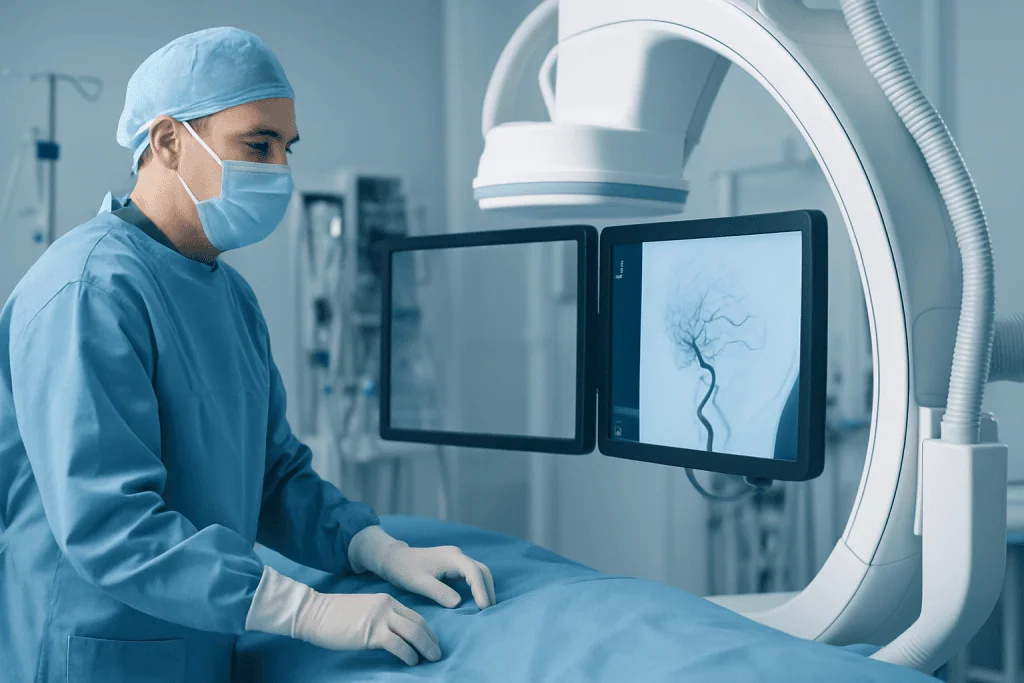
Endovascular neurosurgery is used for a range of conditions that affect the brain and spinal blood vessels. One of the best-known is a brain aneurysm, a weakened area in a blood vessel wall that can bulge and, in some cases, rupture. Endovascular techniques can help seal the aneurysm from inside the vessel to lower the risk of bleeding.
It is also commonly used in some forms of stroke. In an ischemic stroke caused by a blocked artery, mechanical clot removal may restore blood flow in selected patients. This is especially important when a large artery is blocked. Endovascular treatment may also help manage certain bleeding problems, depending on the source and location of the hemorrhage.
Other conditions that may be treated include arteriovenous malformations, dural arteriovenous fistulas, carotid artery narrowing, vertebral artery disease, and some tumors that have a strong blood supply. In selected cases, embolization may be used before surgery to reduce bleeding risk. The approach can also support treatment for arteriovenous malformation (AVM) and other complex vascular lesions.
- Brain aneurysms
- Acute ischemic stroke due to a large vessel blockage
- Arteriovenous malformations and fistulas
- Carotid or vertebral artery narrowing
- Some head, neck, or spinal vascular abnormalities
- Selected tumors before surgery to reduce blood flow
How Minimally Invasive Brain Vessel Procedures Work

The procedure usually begins with imaging review and planning. After the patient is prepared, the doctor places a catheter into a blood vessel through a small skin puncture. From there, the catheter is gently navigated through the body’s arteries toward the brain, neck, or spine. Continuous imaging helps the team track the catheter’s position with great accuracy.
Different tools can then be passed through the catheter depending on the goal of treatment. Tiny coils may be placed into an aneurysm to help it clot off. A flow-diverting stent may be positioned across an aneurysm neck to redirect blood away from the weak area. In a blocked artery causing stroke, devices may be used to capture and remove the clot. In other cases, liquid embolic agents, particles, or glue-like materials are used to close abnormal vessels.
Many patients have sedation or general anesthesia, depending on the complexity of the procedure and their medical condition. Although the skin opening is small, these are still highly specialized interventions involving the brain’s circulation, so careful monitoring before, during, and after treatment is essential. Procedures such as cerebral angiography may be used for diagnosis and treatment planning, while aneurysm treatment and thrombectomy are examples of common therapeutic interventions.
Symptoms and Situations That May Lead to Evaluation
Many people are evaluated for endovascular neurosurgery after symptoms suggest a problem in the brain’s blood vessels. These symptoms can vary widely depending on the condition. Sudden weakness, facial drooping, speech difficulty, numbness, vision changes, or loss of coordination can point to stroke and need emergency care. A sudden severe headache, especially one described as the worst headache of a person’s life, may be a warning sign of bleeding around the brain.
Some vascular conditions cause more gradual or subtle symptoms. These may include pulsating noises in the ear, chronic headaches, seizures, double vision, neck pain, or problems with memory or concentration. In other cases, there are no symptoms at all, and the condition is found incidentally during imaging done for another reason.
Not every symptom means a person needs an endovascular procedure. The purpose of the evaluation is to identify the cause and decide whether a minimally invasive treatment is appropriate, whether watchful monitoring is safer, or whether open surgery or medical therapy would be a better option.
Diagnosis and Pre-Procedure Assessment
Diagnosis typically starts with a neurological examination and imaging tests. Doctors may use CT, MRI, CT angiography, MR angiography, ultrasound of the neck vessels, or formal catheter angiography. Each test provides different information. Catheter angiography is often considered the most detailed way to map blood vessel anatomy and understand complex lesions before treatment.
Before recommending a procedure, the care team considers the exact diagnosis, symptoms, size and location of the lesion, the risk of rupture or stroke, the patient’s age, and overall health. Blood tests, heart evaluation, and medication review are also important. Some patients may need to stop certain medicines or begin antiplatelet medication in advance if a stent is planned.
The discussion before treatment should cover expected benefits, possible alternatives, and risks such as bleeding, stroke, vessel injury, reaction to contrast dye, or the need for additional procedures. Because decisions can be complex, many cases are reviewed by a multidisciplinary board. In experienced centers, endovascular experts work closely with stroke neurologists, neurosurgeons, anesthesiologists, and intensive care teams.
Treatment Options, Benefits, and Recovery
There is no single endovascular procedure for every patient. The best option depends on the condition being treated. Aneurysms may be managed with coiling, stent-assisted coiling, or flow diversion. Arteriovenous malformations or fistulas may be treated with embolization, sometimes in stages. Carotid artery narrowing may be addressed with angioplasty and stenting in selected patients, and acute stroke may call for urgent clot retrieval.
One major advantage of endovascular treatment is that it avoids a large incision and may reduce pain, blood loss, and time in the hospital. Some patients go home within a day or two after a planned procedure, while others, especially those treated for stroke or bleeding, may need more intensive monitoring. Recovery also depends on the underlying condition, not just the procedure itself.
After treatment, patients are observed for changes in blood pressure, neurological status, and the catheter access site. Follow-up imaging is often needed because some treated lesions can change over time or require repeat treatment. In some situations, open surgery remains the better choice, and sometimes both surgical and endovascular approaches are combined. For selected patients with blood vessel narrowing, carotid artery stenting may be considered as part of a broader vascular care plan.
Risks, Prevention, and When to See a Doctor
Although minimally invasive, endovascular neurosurgery still carries important risks. Possible complications include bleeding, infection, blood vessel injury, stroke, contrast allergy, kidney strain from contrast dye, or recurrence of the treated problem. The care team works to reduce these risks by using careful planning, advanced imaging, and close monitoring. Patients can help by sharing their full medical history, allergies, and all medications they take.
Some neurovascular conditions cannot be fully prevented, but general vascular health matters. Controlling blood pressure, avoiding tobacco, managing diabetes and cholesterol, staying physically active, and following treatment for heart and vascular disease may lower the risk of stroke and some vessel-related complications. People with a family history of aneurysm or inherited vascular disorders should ask a doctor whether screening is appropriate.
Urgent medical attention is needed for sudden weakness, trouble speaking, facial drooping, confusion, severe unusual headache, seizures, loss of vision, or collapse. Even if symptoms improve quickly, emergency assessment is important because time-sensitive treatment may protect brain function. Near the end of the care journey, some patients may choose evaluation at comprehensive centers; Acibadem International’s multidisciplinary specialists in JCI-accredited hospitals diagnose and treat neurovascular conditions for international patients.
Frequently asked questions
Is endovascular neurosurgery the same as open brain surgery?
No. Endovascular neurosurgery is performed through blood vessels using thin catheters, usually inserted through the wrist or groin. Open brain surgery involves a larger incision and direct access to the skull or brain, so the two approaches differ in technique, recovery, and use cases.
What conditions are most commonly treated with endovascular neurosurgery?
Common examples include brain aneurysms, some types of stroke caused by a blocked artery, arteriovenous malformations, dural fistulas, and narrowing in certain neck or brain arteries. The best treatment depends on the exact anatomy, symptoms, and overall health of the patient.
Is endovascular neurosurgery safe?
It is a well-established and often effective approach when performed in experienced centers, but no procedure is risk-free. Safety depends on the condition being treated, the urgency, the patient’s health, and the complexity of the blood vessel anatomy.
How long does recovery take after an endovascular brain vessel procedure?
Recovery varies widely. Some people return home within one or two days after a planned procedure, while others need longer hospitalization, especially after stroke or bleeding. Full recovery depends as much on the underlying condition as on the procedure itself.
Will a patient be awake during the procedure?
Some procedures are done with conscious sedation, while others require general anesthesia. The choice depends on the type of treatment, the need for stillness, the patient’s comfort, and the urgency of the situation.
Can endovascular treatment cure a brain aneurysm or AVM completely?
In some cases, treatment can completely close the abnormal vessel problem. In others, the goal is to reduce risk, control symptoms, or prepare for additional treatment such as surgery or radiosurgery. Follow-up imaging is often needed to confirm long-term results.
References
- World Health Organization
- American Stroke Association
- National Institute of Neurological Disorders and Stroke
- Society of NeuroInterventional Surgery
- Radiological Society of North America
This article is for general information only and is not a substitute for professional medical advice. Please consult a qualified doctor about your individual situation.
Minimally Invasive in Turkey — costs, top hospitals & a free quote
JCI-accredited · board-certified surgeons · reply within 24h
Add us as a Preferred Source to see more of our trusted health content across Google Search, AI Overviews and Discover.

Robotic Surgery
Robot-assisted procedures across urology, gynecology and general surgery for greater precision and faster recovery.
More from the Health Library



Related Specialists

Assoc. Prof. Dr. Mustafa Emir Tavşanlı
Neurology
Dr. Bülent Şengül
Gastroenterology
Dr. Nurşat Erdemli
Pediatrics
Dr. Savaş Gündoğan
Gynecology & Obstetrics