Fat Transfer Breast Augmentation: A Complete Clinical Guide for Patients

Fat transfer breast augmentation uses liposuction and purified fat injections rather than implants. It is usually best for people seeking a subtle size increase and contour improvement rather than a large change.
Key Takeaways
- Fat transfer breast augmentation uses liposuction and purified fat injections rather than implants.
- It is usually best for people seeking a subtle size increase and contour improvement rather than a large change.
- Some of the transferred fat is naturally reabsorbed, so final volume may take months to judge and more than one session may be needed.
- Careful patient selection, surgical technique, and follow-up are important to reduce complications and improve outcomes.
- Screening and routine breast imaging remain important after the procedure, especially as fat necrosis or oil cysts can appear on exams.
Fat transfer breast augmentation is a breast enhancement procedure that uses a person’s own fat, usually taken by liposuction from areas such as the abdomen or thighs, then carefully purified and injected into the breasts. It can create a modest increase in volume and improve contour with a natural feel, but it is not the best option for everyone and results depend on anatomy, goals, and how much transferred fat survives.
Overview: what fat transfer breast augmentation involves
Fat transfer breast augmentation is a surgical procedure that increases breast volume using fat taken from the same person’s body. In most cases, a plastic surgeon removes fat with liposuction from areas such as the abdomen, flanks, thighs, or hips, processes the fat, and then injects small amounts into different layers of the breast to improve shape and fullness.
This approach appeals to people who want a more natural-feeling result and who prefer to avoid breast implants. It can also improve body contour in the area where the fat is harvested. However, the increase in breast size is usually modest, and the body naturally reabsorbs some of the transferred fat during healing.
Unlike implant surgery, fat grafting does not place a silicone or saline device in the body. Still, it remains a real operation with anesthesia, incisions for liposuction, recovery time, and possible complications. A consultation with an experienced plastic surgeon helps determine whether goals, available donor fat, breast anatomy, and overall health make this procedure a suitable choice.
Who may be a good candidate and what results to expect

Fat transfer breast augmentation is often best suited to adults in good general health who want a subtle increase in breast size, correction of mild asymmetry, or improved contour after weight changes, pregnancy, or previous surgery. It may also be considered in selected reconstructive settings, although treatment planning can differ from cosmetic use.
Good candidates usually have enough excess fat in donor areas for harvesting and have realistic expectations about the likely outcome. In general, the procedure is better for refining shape and adding limited volume than for achieving a dramatic enlargement. Those who want a larger cup-size increase may discuss implant-based options such as breast augmentation surgery with their surgeon.
Results are not fully visible right away. Early swelling can make the breasts seem larger at first, while some transferred fat will not survive long term and is absorbed by the body. Surgeons typically advise waiting several months before judging final results. In some cases, a second session may be needed to reach the desired contour.
- Often chosen for natural-looking, moderate enhancement
- May help improve asymmetry or upper-pole fullness
- Requires enough donor fat for harvesting
- Final size is less predictable than with implants
How the procedure is performed
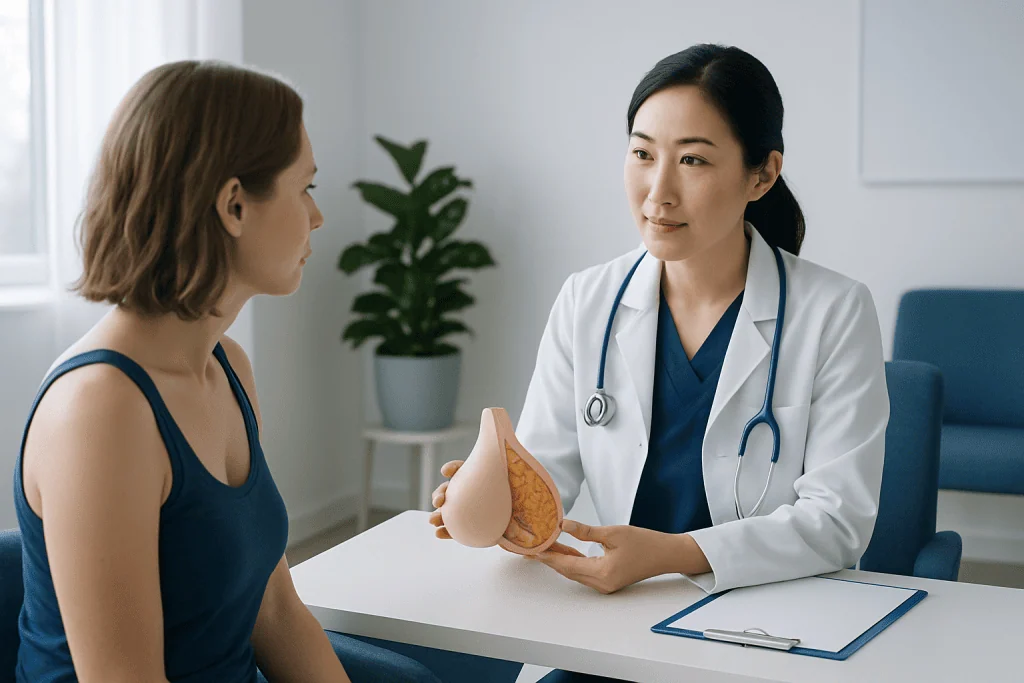
The procedure generally has three main stages: fat harvesting, fat preparation, and fat injection. First, fat is removed by liposuction through small incisions. Surgeons usually choose donor areas where extra fat is available and where contouring may also be beneficial. The amount collected depends on the treatment plan and on how much fat is expected to survive after transfer.
Next, the harvested fat is processed to separate healthy fat cells from blood, fluid, and damaged tissue. The exact technique can vary, but the goal is to prepare viable fat for reinjection. During the final stage, the surgeon injects tiny amounts of fat through small cannulas into multiple areas and layers of the breast. This careful placement helps the grafted fat establish a blood supply.
The operation may be done under general anesthesia or, in some cases, another appropriate anesthesia plan depending on the extent of liposuction and the surgeon’s recommendation. People considering body contouring from the donor areas sometimes also ask about liposuction itself, since the fat harvest is a key part of the process. Procedure details, scar placement, and expected recovery should be reviewed before surgery so the person understands both benefits and limitations.
Benefits, limitations, and possible risks
The main advantages of fat transfer breast augmentation are the use of the person’s own tissue, the absence of implants, and a natural softness in many cases. It may also provide improvement in body shape in donor areas because fat is removed by liposuction. For some patients, this combination of breast contouring and body contouring is a meaningful benefit.
Its limitations are equally important to understand. The amount of enlargement is usually limited, and outcomes are less exact than with implants because some of the transferred fat will be reabsorbed. Not everyone has enough donor fat, and very lean individuals may not be good candidates. Repeat procedures are sometimes needed, particularly when the desired change is more than subtle.
Possible risks include bleeding, infection, asymmetry, contour irregularities in donor areas, prolonged swelling, and changes in breast sensation. Specific fat-grafting issues include fat necrosis, oil cysts, calcifications, and partial loss of the grafted fat. These changes are often benign but can lead to lumps or imaging findings that need expert interpretation. Anyone with a breast lump after surgery should have it assessed rather than assuming it is harmless, as surgeons may also need to distinguish it from conditions such as breast cancer.
Evaluation before surgery and how diagnosis differs from illness care
Because fat transfer breast augmentation is an elective procedure rather than treatment for a disease, the preoperative assessment focuses on candidacy, safety, and planning. The surgeon reviews medical history, medications, smoking status, weight stability, prior breast procedures, family history of breast disease, and cosmetic goals. A physical examination assesses breast size, skin quality, chest wall shape, asymmetry, and donor fat availability.
Breast imaging may be recommended based on age, risk factors, symptoms, or local screening guidelines. If a person has a current breast lump, nipple discharge, skin changes, or unexplained breast pain, these concerns should be evaluated before cosmetic surgery. In some cases, additional tests or referral to a breast specialist are appropriate so that surgery is not performed before a concerning finding is understood.
This distinction matters because postoperative changes from fat grafting can sometimes create palpable lumps or mammographic findings. Experienced radiologists can usually interpret these changes, but it is helpful to have baseline records and to continue routine screening after the procedure. If there is a history of prior breast surgery or treatment, including breast reconstruction, the surgeon may tailor the plan to reduce risk and preserve future imaging clarity as much as possible.
Recovery, aftercare, and long-term follow-up
Recovery after fat transfer breast augmentation involves healing in both the breasts and the liposuction donor sites. Swelling, bruising, soreness, and temporary tightness are common in the first days to weeks. The breasts may appear overfilled initially because surgeons often account for expected reabsorption and postoperative swelling. Donor areas may feel more uncomfortable than the breasts themselves.
Aftercare instructions vary by surgeon, but patients are often advised to avoid pressure on the breasts, follow wound-care guidance, wear recommended support garments for donor areas, and gradually return to activity. Heavy exercise and smoking are usually discouraged during early healing because they may interfere with recovery and fat survival. Follow-up visits help the surgeon monitor healing, symmetry, and the need for any further treatment.
Long-term follow-up is important because breast tissue continues to change with age, hormones, pregnancy, and weight fluctuation. Significant weight loss can reduce the volume of transferred fat, while weight gain can increase it. Routine breast screening should continue according to age and risk. Near the end of the care pathway, some international patients choose centers such as Acibadem International, where multidisciplinary specialists in JCI-accredited hospitals evaluate and treat cosmetic and reconstructive breast concerns.
When to seek medical care
Medical advice should be sought promptly if there are signs of a complication after surgery. These include worsening redness, fever, increasing pain, significant one-sided swelling, drainage with a bad odor, shortness of breath, chest pain, or calf swelling. Although many postoperative symptoms are mild and expected, symptoms that are severe, sudden, or getting worse need medical review.
Even long after healing, a new breast lump, persistent hardness, skin dimpling, nipple changes, or unexplained shape change should not be ignored. These findings may be related to fat necrosis or scar tissue, but they still require assessment by a qualified doctor and, when appropriate, imaging. Ongoing questions about contour, asymmetry, or whether a revision may help are also reasons to return to the surgeon rather than relying on informal advice.
Frequently asked questions
How much bigger can breasts become with fat transfer breast augmentation?
In most cases, fat transfer provides a modest increase in breast volume rather than a dramatic enlargement. The exact change depends on the person’s anatomy, available donor fat, skin characteristics, and how much of the transferred fat survives. A surgeon can explain what is realistically achievable after an examination.
Is fat transfer breast augmentation safer than implants?
The two procedures have different benefits and risks, so one is not automatically safer for every person. Fat transfer avoids implant-related issues such as implant rupture or capsular contracture, but it has its own concerns, including fat reabsorption, lumps, fat necrosis, and donor-site contour irregularities. Safety depends greatly on patient selection, surgeon experience, and proper follow-up.
How long do the results last?
The fat that successfully establishes a blood supply can remain long term, but some of the transferred fat is naturally reabsorbed in the first months. Final results are usually assessed after swelling settles and fat survival stabilizes. Future weight changes, aging, pregnancy, and hormonal changes can also affect breast shape and volume.
Will fat transfer breast augmentation affect mammograms?
It can create benign changes such as calcifications, oil cysts, or areas of fat necrosis that may appear on breast imaging. Radiologists who are familiar with post-surgical breast changes can usually interpret these findings appropriately. It is important to continue regular screening and to tell the imaging team about any prior breast procedures.
Does the procedure leave scars?
The incisions used for liposuction and fat injection are usually small, but they can still leave scars. In many people these marks fade over time and are placed in less noticeable areas when possible. Scar quality varies by individual skin type, healing tendency, and postoperative care.
Can someone have fat transfer after previous breast surgery?
Often yes, but it depends on the type of prior surgery, the condition of the tissues, and the reason for the earlier operation. Previous augmentation, reduction, reconstruction, or radiation treatment may change the surgical plan and may affect expected results. A detailed in-person evaluation is needed to decide whether fat grafting is appropriate.
References
- American Society of Plastic Surgeons
- U.S. Food and Drug Administration
- National Health Service
- American College of Radiology
- International Society of Aesthetic Plastic Surgery
This article is for general information only and is not a substitute for professional medical advice. Please consult a qualified doctor about your individual situation.
Breast Augmentation in Turkey — costs, top hospitals & a free quote
JCI-accredited · board-certified surgeons · reply within 24h
Add us as a Preferred Source to see more of our trusted health content across Google Search, AI Overviews and Discover.

Plastic, Reconstructive & Aesthetic Surgery
Reconstructive and aesthetic procedures for the face and body, performed by experienced surgeons.
35 specialists in this unitMore from the Health Library



Related Specialists

Prof. Dr. Gündüz Tezeren
Orthopedic Surgery & Traumatology
Dr. Ahmet Varolan
Gynecology & Obstetrics
Prof. Dr. Müslime Akbaba
Ophthalmology
Prof. Dr. Mustafa Hakan Dinçkal
Cardiology