Flat Warts Virus: What Patients Need to Know

Flat warts are caused by certain strains of human papillomavirus affecting the outer layer of skin. They often appear as small, smooth, slightly raised spots on the face, hands, arms, or legs.
Key Takeaways
- Flat warts are caused by certain strains of human papillomavirus affecting the outer layer of skin.
- They often appear as small, smooth, slightly raised spots on the face, hands, arms, or legs.
- Flat warts are not dangerous in most cases, but they can spread through skin contact or shaving-related irritation.
- Diagnosis is usually clinical, meaning a doctor often recognizes them by appearance and location.
- Treatment may include topical medicines, freezing, or other dermatologist-directed procedures if the warts persist or spread.
- Medical review is important if the growths change, bleed, hurt, or the diagnosis is uncertain.
Flat warts virus refers to infection with certain types of human papillomavirus, or HPV, that lead to small, smooth, flat-topped skin growths. These warts are usually harmless, but they can spread, persist, or become bothersome, so proper diagnosis and treatment can help.
Overview: what the flat warts virus really means
The term flat warts virus usually refers to infection with specific types of human papillomavirus (HPV) that cause flat warts. Flat warts are small, smooth, slightly raised growths that develop on the skin, often on the face, forehead, backs of the hands, arms, or legs. They are generally benign, meaning they are not cancerous, and many cases can be managed successfully.
Unlike common warts, which are often rough and more dome-shaped, flat warts tend to be flatter, smaller, and more uniform. They can appear in clusters and may be skin-colored, pink, light brown, or slightly yellowish depending on the person’s skin tone. Because they are subtle, they are sometimes mistaken for acne, small moles, or other minor skin changes.
Flat warts are more common in children, teenagers, and young adults, but they can occur at any age. The virus enters through tiny breaks in the skin. Once present, it may lead to one wart or multiple lesions, especially in areas that are shaved, scratched, or rubbed repeatedly.
Although these warts are often harmless, they can be frustrating because they may persist for months or longer and can spread to nearby skin. A doctor, especially a dermatologist, can help confirm the diagnosis and discuss whether watchful waiting or active treatment is the better approach.
What flat warts look and feel like
Flat warts are usually very small, often just a few millimeters across. Their surface is smooth rather than rough, and the top looks flat or only slightly elevated. Many people notice them because several appear together in a line or cluster, especially after shaving or scratching, which can spread the virus across the skin.
They often do not cause pain. In many cases, they are more of a cosmetic concern than a physical one. Some people may notice mild itching or irritation, particularly if the area is rubbed by clothing or if multiple lesions develop close together.
Common features include:
- Small, flat-topped bumps
- Skin-colored, pink, tan, or light brown appearance
- Groups or clusters rather than a single lesion
- Frequent location on the face, neck, hands, wrists, arms, or legs
- Spread along shaving lines or scratch marks
Because other skin conditions can resemble flat warts, it is helpful not to self-diagnose based on appearance alone. Skin tags, acne, seborrheic keratoses, and other growths may look similar at first glance. If there is uncertainty, a clinical skin examination is the safest next step.
Causes and risk factors

Flat warts are caused by certain low-risk types of HPV that infect the top layer of the skin. HPV is a large family of viruses, and different types affect different body areas. The types linked with flat warts are different from those associated with more serious disease. In this setting, the virus stays in the skin and causes localized wart growths.
The virus is typically transmitted by direct skin-to-skin contact or by contact with surfaces or objects that carry viral particles, although casual exposure does not always lead to infection. Tiny cuts, dry skin, eczema, or irritation can make it easier for the virus to enter. Autoinoculation, meaning spread from one part of a person’s own skin to another, is also common.
Risk factors that may increase the chance of developing flat warts include:
- Childhood or adolescence
- Shaving the face or legs
- Nail biting or scratching the skin
- Close contact with someone who has warts
- Damaged skin or chronic skin irritation
- A weakened immune system
People sometimes worry that all HPV-related conditions behave the same way, but that is not the case. HPV can cause several different skin and mucosal conditions, including genital warts, yet the location, subtype, and treatment approach differ. A doctor can clarify whether a lesion is a simple flat wart or another HPV-related skin issue.
How doctors diagnose flat warts
Diagnosis is usually based on the appearance, size, and distribution of the lesions. An experienced clinician can often recognize flat warts during a physical examination, especially when they appear in typical areas such as the face or backs of the hands. The pattern of clustered, smooth, flat-topped papules is often distinctive.
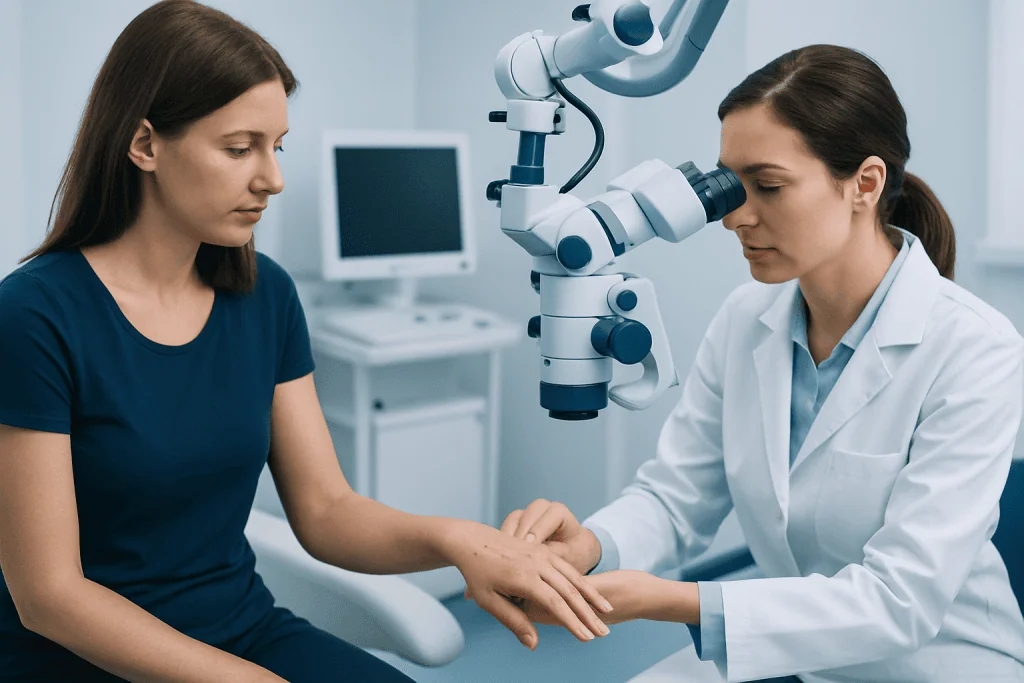
In some cases, a dermatologist may use a dermatoscope, a handheld magnifying device that helps examine the skin in more detail. This can improve diagnostic confidence and help distinguish flat warts from acne, lichen planus, molluscum contagiosum, seborrheic keratoses, or other benign skin conditions.
If the diagnosis remains unclear, a small skin sample may occasionally be taken for laboratory analysis. This is not needed for most patients, but it may be considered when a lesion behaves unusually, fails standard treatment, or has features that suggest another diagnosis.
When flat warts are persistent or extensive, the doctor may also ask about immune health, skin habits, and previous wart treatments. In some settings, referral for dermatology evaluation is the most useful next step, especially when facial lesions are widespread or when the patient wants to minimize the risk of scarring or discoloration.
Treatment options and what to expect
Not every flat wart needs immediate treatment. Some eventually improve on their own as the immune system clears the virus, although this can take time. Treatment is usually considered if the warts are spreading, cosmetically bothersome, irritated, or difficult to distinguish from another skin condition.
Doctors may recommend topical therapies that help the skin remove infected cells or encourage local immune activity. Depending on the patient’s age, skin type, wart location, and number of lesions, treatment may include prescription creams, chemical peeling agents, or other dermatologist-guided topical options. Because facial skin can be sensitive, treatment selection needs to be individualized.
Procedural treatment may also be used. Options can include cryotherapy, which freezes the wart, or other office-based methods designed to remove superficial lesions. For carefully selected cases, procedural cryotherapy may be helpful, though repeated sessions may be needed and there is a small risk of temporary skin color change, especially in darker skin tones.
It is generally best to avoid picking, scraping, or aggressively using over-the-counter wart products on the face without medical guidance. These products may irritate healthy skin and can worsen marks or post-inflammatory pigmentation. If the lesions are extensive, recurrent, or resistant, a broader skin treatment plan may be discussed with a specialist.
Prevention and self-care
Because flat warts spread through the skin, prevention focuses on reducing irritation and limiting transfer of the virus from one area to another. Good skin care habits can lower the chance of new lesions and may help prevent existing ones from spreading in lines or clusters.
Helpful self-care steps include keeping the skin clean, avoiding scratching, and not sharing razors, towels, or other personal items. If shaving seems to worsen the problem, changing shaving technique or pausing shaving in the area may reduce spread. People with eczema or very dry skin may also benefit from treating the underlying irritation, since broken skin creates easier entry points for the virus.
- Avoid picking or scratching warts
- Do not shave directly over affected areas if possible
- Do not share razors, towels, or cosmetics
- Wash hands after touching the lesions
- Protect and moisturize irritated skin
- Follow treatment instructions consistently if medicine is prescribed
Prevention does not always stop every wart from appearing, because HPV can remain in the skin before visible changes develop. Still, careful skin habits can reduce spread and make treatment more effective. If warts keep recurring, a doctor can reassess the diagnosis and look for contributing factors.
When to seek medical care
Medical review is appropriate when flat-topped skin bumps are new, spreading, or uncertain in diagnosis. This is especially important if the lesions appear around the eyes, on sensitive facial skin, or in a person with a weakened immune system. A doctor can confirm whether they are flat warts or another skin condition that needs a different approach.
Prompt assessment is also wise if a lesion bleeds, becomes painful, changes color quickly, develops crusting, or does not respond to initial treatment. While flat warts are usually harmless, unusual features can point to irritation, infection, or a different diagnosis entirely.
People should also seek care if home treatment is causing redness, burning, peeling, or dark or light marks on the skin. This is particularly relevant for facial lesions, where preserving normal skin appearance matters. In some situations, a clinician may recommend broader skin check assessment to evaluate similar spots and rule out look-alike conditions.
For patients who need specialist support, Acibadem International’s multidisciplinary teams in JCI-accredited hospitals evaluate and treat skin conditions, including bothersome or persistent warts, for international patients. The most suitable treatment depends on the person’s skin type, location of the lesions, and overall health.
Frequently asked questions
Is flat warts virus the same as HPV?
Flat warts are caused by certain types of HPV, so the term flat warts virus usually refers to HPV affecting the skin. However, HPV includes many different virus types, and not all of them cause flat warts.
Are flat warts contagious?
Yes, flat warts can spread through direct skin contact or by transferring the virus from one part of the body to another. They are more likely to spread when the skin is shaved, scratched, or irritated.
Do flat warts go away on their own?
Some flat warts do resolve without treatment as the immune system clears the infection. This can take months or sometimes longer, so medical treatment may be considered if they are spreading, persistent, or bothersome.
Can flat warts appear on the face?
Yes, the face is one of the most common locations for flat warts, especially in children and young adults. Because facial skin is delicate, it is best to avoid harsh self-treatment and seek professional advice if needed.
Is it safe to remove flat warts at home?
Home care should be cautious, especially for facial lesions. Some over-the-counter wart products can irritate healthy skin or leave marks, so a doctor or dermatologist should guide treatment when the diagnosis is uncertain or the area is sensitive.
When should someone worry about a flat wart?
A person should seek medical advice if a lesion changes quickly, bleeds, becomes painful, or does not look typical for a wart. Medical review is also important if many new lesions appear or if the person has a weakened immune system.
References
- American Academy of Dermatology
- Centers for Disease Control and Prevention
- National Health Service
- Mayo Clinic
- DermNet
This article is for general information only and is not a substitute for professional medical advice. Please consult a qualified doctor about your individual situation.
Explore treatments in Turkey — costs, top hospitals & a free quote
JCI-accredited · board-certified surgeons · reply within 24h
Add us as a Preferred Source to see more of our trusted health content across Google Search, AI Overviews and Discover.