Gold 2024 Lung Volume Reduction Surgery Endobronchial Valves Criteria: Procedure, Recovery and Results

Lung volume reduction is not suitable for every person with COPD; it is mainly considered for carefully selected people with severe emphysema. Endobronchial valves are placed through a bronchoscope and aim to collapse a severely damaged lung lobe without removing lung tissue.
Key Takeaways
- Lung volume reduction is not suitable for every person with COPD; it is mainly considered for carefully selected people with severe emphysema.
- Endobronchial valves are placed through a bronchoscope and aim to collapse a severely damaged lung lobe without removing lung tissue.
- Successful valve treatment requires a target lobe with little or no collateral ventilation between lobes.
- Recovery after valve placement is often shorter than after surgery, but hospital observation is important because pneumothorax can occur.
- Neither surgery nor valves can cure emphysema, but selected patients may experience better breathing, activity tolerance and quality of life.
GOLD 2024 lung volume reduction surgery endobronchial valves criteria support considering surgical or bronchoscopic lung-volume reduction for selected people with severe emphysema whose breathlessness remains limiting despite optimized COPD care. The best approach depends on emphysema pattern, lung function, exercise capacity, smoking status, airway anatomy and the risk of complications.
Overview: GOLD 2024 criteria for lung volume reduction
GOLD 2024 lung volume reduction surgery endobronchial valves criteria describe when people with severe emphysema may be referred for a specialist assessment after standard chronic obstructive pulmonary disease (COPD) treatment has been optimized. Lung volume reduction can be performed surgically, by removing the most damaged parts of the lung, or bronchoscopically, most commonly by placing one-way endobronchial valves.
These treatments are intended for selected patients with troublesome breathlessness, reduced exercise ability and hyperinflation, meaning the lungs remain overly expanded and cannot empty effectively. By reducing the volume of the most damaged area, the remaining lung and breathing muscles may work more efficiently. They do not reverse emphysema or replace the need for inhalers, pulmonary rehabilitation, vaccinations and smoking cessation.
Referral to a multidisciplinary emphysema or lung-volume-reduction team is important. The team usually includes respiratory physicians, interventional pulmonologists, thoracic surgeons, radiologists, anesthesiologists and pulmonary rehabilitation specialists. They compare the likely benefits and risks of valves, surgery, transplant assessment when appropriate, and continued non-surgical care.
How lung volume reduction and endobronchial valves work
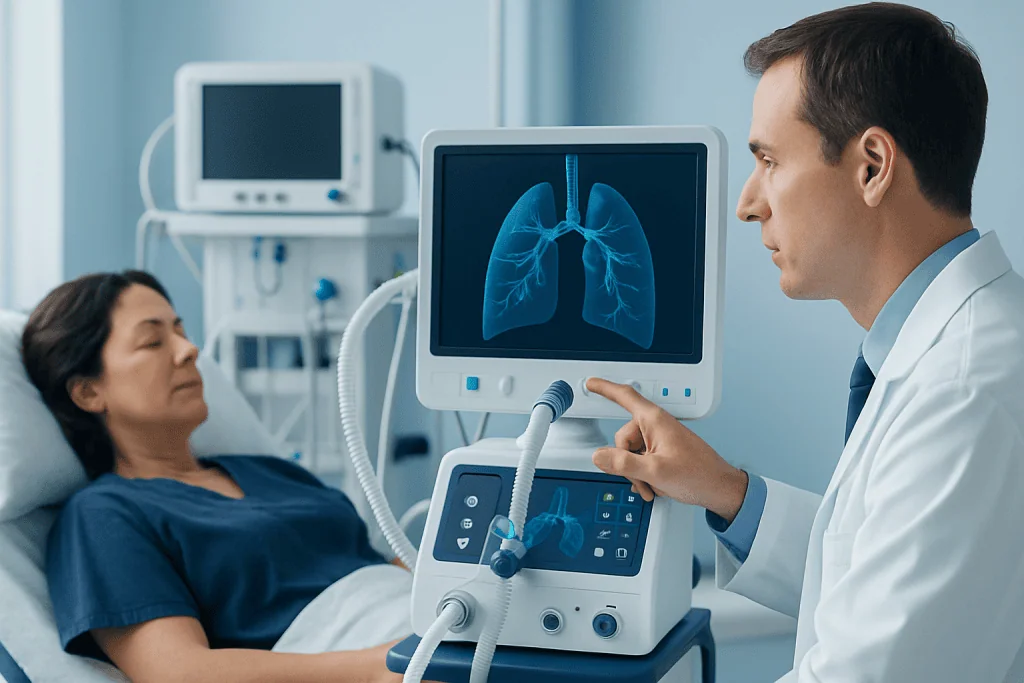
In emphysema, air sacs are damaged and lose elasticity. Air can become trapped, especially in the most affected regions of the lungs. This hyperinflation can flatten the diaphragm, increase the work of breathing and leave less room for healthier lung tissue to expand.
Lung volume reduction surgery (LVRS) removes selected portions of severely damaged lung, usually through minimally invasive chest surgery or occasionally a larger incision. It is most often considered when emphysema is predominantly in the upper parts of the lungs and when clinical assessment suggests the person can tolerate surgery.
Endobronchial valve treatment is a less invasive form of bronchoscopic lung volume reduction. During bronchoscopy, a clinician places small one-way valves in airways leading to the chosen lobe. The valves let trapped air and secretions leave but reduce airflow into that lobe. Over time, the target lobe may deflate, reducing hyperinflation. This option is only likely to work when the lobe is sufficiently separated from adjacent lobes by intact fissures and has little or no collateral ventilation.
For people with advanced COPD and emphysema, a specialist may also review related care needs, including COPD management, oxygen assessment, nutrition, emotional wellbeing and structured pulmonary rehabilitation.
Who may be a candidate for valves or lung volume reduction surgery?

GOLD recommends that people with severe emphysema and persistent symptoms despite optimized medical treatment be considered for referral to an experienced center. Before either procedure, clinicians confirm the COPD diagnosis, assess emphysema on high-resolution chest CT, perform detailed lung function testing and review exercise capacity, symptoms and overall health.
Potential candidates generally have significant hyperinflation and remain limited by breathlessness despite appropriate inhaled treatment, pulmonary rehabilitation and avoidance of tobacco smoke. A person should usually be able and willing to participate in rehabilitation and follow-up. The exact lung function ranges used by a center vary because candidacy is based on the full clinical picture rather than one test result.
For endobronchial valves, imaging and, in some cases, a bronchoscopic collateral-ventilation assessment help identify a target lobe. The most suitable pattern is often heterogeneous emphysema, where one lobe is considerably more damaged than others. Some people with more evenly distributed emphysema may still be assessed, but potential benefit and risk require individualized review.
Active smoking, untreated infection, unstable heart disease, severe <a href="https://acibademinternational.com/diseases/pulmonary-hypertension/”>pulmonary hypertension, inability to safely undergo bronchoscopy or anesthesia, and certain patterns of very poor lung function may make treatment unsuitable or require further assessment. A prior lung procedure does not automatically rule out treatment, but it can affect the available options.
- Optimized COPD treatment and pulmonary rehabilitation should be completed or actively underway.
- CT imaging should show a suitable target region of emphysema.
- For valves, collateral ventilation should be absent or low enough for the target lobe to collapse.
- Risks must be balanced against expected functional benefit and the person’s goals of care.
Step-by-step: what happens during the procedure?
Before treatment, the team reviews scans, breathing tests, blood tests and medications. They may assess heart health, oxygen needs and infection risk. Patients are commonly asked to stop smoking and may need medication adjustments before the procedure. The treating team provides individualized fasting and medication instructions.
For endobronchial valve placement, the patient receives sedation or general anesthesia. A flexible bronchoscope is passed through the mouth or nose into the airways. The clinician may perform a measurement to check for collateral ventilation, then places the required number of one-way valves in the airways of the selected lobe. The bronchoscopy itself is often completed within a relatively short procedure time, although preparation and recovery from anesthesia add time.
For LVRS, a thoracic surgeon removes targeted damaged lung tissue under general anesthesia. Chest drains are commonly used afterward to remove air and fluid while the lung heals. Surgery involves a longer operation and more intensive early recovery than bronchoscopic valve placement.
Valve placement is reversible in the sense that valves can be removed if needed, for example because of complications, lack of benefit, infection or valve movement. However, removal is itself another bronchoscopy and should be planned by the treating team. Patients considering bronchoscopic treatment can discuss endobronchial valve treatment with an interventional pulmonology service.
Recovery timeline, benefits and possible risks
After valve placement, people are usually monitored in hospital for several days. The most important early complication is pneumothorax, or a collapsed lung, which can occur as the treated lobe deflates and the remaining lung expands. It may require a chest tube and a longer stay. Teams monitor symptoms, oxygen levels and chest imaging closely during this period.
Some patients notice improved breathing or exercise tolerance within days to weeks, while others improve more gradually over several months. Follow-up commonly includes symptom review, chest imaging, lung function tests and pulmonary rehabilitation. Ongoing inhalers and other COPD treatments are usually still needed.
After LVRS, hospital recovery is generally longer because chest surgery and wound healing are involved. Fatigue, discomfort and reduced stamina are expected initially. Gradual activity, breathing exercises, rehabilitation and follow-up appointments support recovery. The time needed to resume usual routines varies with the surgical approach, complications, baseline fitness and other health conditions.
Possible risks of valve treatment include pneumothorax, COPD exacerbation, pneumonia, coughing up blood, valve migration, airway irritation and the need for repeat bronchoscopy. LVRS may involve air leaks, infection, bleeding, pneumonia, heart rhythm problems and surgical risks. The purpose of a specialist evaluation is not simply to identify eligibility, but to decide whether anticipated benefit outweighs these risks for that individual.
How long does it take to recover from lung volume reduction surgery?
Recovery from lung volume reduction surgery commonly takes weeks to months rather than days. The first hospital phase may last around one to two weeks, although this varies, particularly if air leaks or other complications occur. Some people need additional inpatient rehabilitation or temporary support at home.
In the first several weeks, activity is usually increased gradually with guidance from the surgical and rehabilitation teams. Many people begin to regain stamina over the following two to three months, but full recovery can take longer. Age, general fitness, severity of COPD, nutritional status, the surgical technique used and complications all influence the timeline.
Regular pulmonary rehabilitation is an important part of recovery. It can help a person build strength, learn energy-conserving breathing strategies and safely return to daily activities. The treating team should be contacted if breathlessness suddenly worsens, fever develops, chest pain occurs or wound concerns arise.
What is the success rate of lung volume reduction surgery?
There is no single success rate that applies to all patients because results depend strongly on selection. In carefully chosen people, particularly those with upper-lobe predominant emphysema and reduced exercise capacity after rehabilitation, LVRS can improve lung function, breathlessness, exercise capacity and quality of life. Some selected groups have also shown a survival benefit compared with medical treatment alone.
However, surgery carries meaningful short-term risk, and outcomes are less favorable for some emphysema patterns and levels of lung impairment. For this reason, experienced teams use detailed testing to identify people most likely to benefit and to avoid surgery when the risk is unacceptably high.
Success should be discussed in personal terms: whether a person can walk farther, manage daily tasks more comfortably, reduce hyperinflation or improve quality of life. It should not be understood as a cure for COPD. Continued smoking abstinence, rehabilitation and guideline-based COPD care remain central to longer-term outcomes.
What is the recovery for lung valve surgery?
Lung valve treatment is not surgery in the traditional sense because valves are placed through a bronchoscope rather than through chest incisions. Recovery is therefore usually faster than LVRS, but it still requires careful inpatient monitoring, often for several days, because pneumothorax is most likely shortly after the procedure.
Patients may have a sore throat, cough, tiredness or temporary changes in breathing after bronchoscopy. If recovery is uncomplicated, many return to light everyday activities relatively soon after leaving hospital, following the instructions of their clinical team. More strenuous activity should be resumed gradually and only when approved.
Improvement may appear within the first weeks, but response differs between individuals. Follow-up is essential because clinicians need to check valve position, assess whether the target lobe has reduced in volume, manage COPD medications and identify complications early. Rehabilitation remains useful after valve placement as breathing becomes more efficient and activity tolerance improves.
What is the life expectancy after lung reduction surgery?
Life expectancy after lung reduction surgery cannot be predicted accurately for one person. It depends on COPD severity, emphysema distribution, lung and heart function, smoking status, exacerbation history, physical activity, nutritional health and other medical conditions. The operation is intended primarily to improve breathing, function and quality of life in appropriately selected patients.
Evidence from carefully selected groups has shown that LVRS may improve survival for some people, particularly those with upper-lobe predominant emphysema and low exercise capacity after rehabilitation. This does not mean that every patient will live longer, and it does not eliminate the progressive nature of COPD.
Endobronchial valves have demonstrated improvements in lung function, exercise ability and quality of life in suitable patients, but survival outcomes are less straightforward and should not be assumed. A specialist can explain what current evidence means in the context of an individual’s scans, tests and treatment goals. For some people with very advanced disease, a lung transplantation assessment may also be part of a broader discussion.
When to seek medical care
Anyone with COPD who has increasing breathlessness, declining ability to carry out daily activities, repeated flare-ups or persistent symptoms despite prescribed treatment should arrange a review with a respiratory clinician. A referral to a specialist emphysema service may be appropriate when severe emphysema and hyperinflation are suspected.
Urgent medical assessment is needed for sudden or severe breathlessness, new chest pain, blue or gray lips, confusion, fainting, coughing up more than a small streak of blood, or symptoms of a serious infection such as high fever and marked deterioration. These symptoms can have several causes and should not be managed by waiting at home.
Acibadem International’s multidisciplinary respiratory and thoracic specialists in JCI-accredited hospitals assess and treat emphysema-related conditions for international patients, including evaluation for bronchoscopic and surgical lung-volume-reduction approaches where appropriate.
Frequently asked questions
Are endobronchial valves included in GOLD 2024 COPD guidance?
Yes. GOLD 2024 recognizes bronchoscopic lung volume reduction with endobronchial valves as an option for carefully selected people with severe emphysema, hyperinflation and persistent symptoms despite optimized treatment. Suitability requires assessment in an experienced center, including CT review and evaluation for collateral ventilation.
What is collateral ventilation, and why does it matter for valves?
Collateral ventilation is airflow reaching a lung lobe through connections between neighboring lobes rather than through its usual airway. If too much collateral ventilation is present, the treated lobe may not deflate after valve placement. This makes a meaningful benefit from one-way valves less likely.
Can endobronchial valves cure emphysema?
No. Endobronchial valves do not repair damaged air sacs or cure emphysema. In suitable patients, they can reduce hyperinflation and may improve breathlessness, exercise capacity and quality of life while other COPD treatments continue.
Is lung volume reduction surgery better than endobronchial valves?
Neither option is universally better. Surgery may be appropriate for some emphysema patterns and patient profiles, while valves may be preferred when anatomy is suitable and a less invasive approach is desirable. A multidisciplinary team compares expected benefits, procedural risks and personal treatment goals.
Will inhalers still be needed after valve placement or LVRS?
Most people continue to need COPD treatment after lung volume reduction. This may include inhalers, vaccinations, pulmonary rehabilitation, action plans for exacerbations and oxygen therapy when prescribed. Medication changes should only be made with the treating clinician.
Can a valve be removed after it has been placed?
Yes, endobronchial valves can usually be removed during another bronchoscopy if clinically necessary. Removal may be considered for complications, valve movement, infection, lack of benefit or other treatment-related concerns. The decision is made by the specialist team based on the person’s condition.
References
- Global Initiative for Chronic Obstructive Lung Disease
- American Thoracic Society
- European Respiratory Society
- National Heart, Lung, and Blood Institute
- U.S. Food and Drug Administration
This article is for general information only and is not a substitute for professional medical advice. Please consult a qualified doctor about your individual situation.
Explore treatments in Turkey — costs, top hospitals & a free quote
JCI-accredited · board-certified surgeons · reply within 24h
Add us as a Preferred Source to see more of our trusted health content across Google Search, AI Overviews and Discover.