Hyperopia: An Evidence-Based Guide for Patients

Hyperopia is a refractive error that often affects near vision more than distance vision. Symptoms may include blurry vision, headaches, eye strain, and tired eyes during reading or screen use.
Key Takeaways
- Hyperopia is a refractive error that often affects near vision more than distance vision.
- Symptoms may include blurry vision, headaches, eye strain, and tired eyes during reading or screen use.
- A comprehensive eye exam is the standard way to diagnose hyperopia and check for related eye problems.
- Treatment may include prescription glasses, contact lenses, or refractive surgery in selected adults.
- Children with hyperopia may need early assessment to support normal visual development.
- Prompt medical care is important for sudden vision changes, eye pain, redness, or flashes and floaters.
Hyperopia, also called farsightedness, is a common refractive error in which light focuses behind the retina instead of directly on it. This can make near vision blurry, cause eye strain, and sometimes affect distance vision too, but effective diagnosis and treatment options are available.
What hyperopia is and how it affects vision
Hyperopia is the medical term for farsightedness. In a hyperopic eye, incoming light does not focus precisely on the retina, the light-sensitive tissue at the back of the eye. Instead, the focus point falls behind the retina, which can make nearby objects look blurry and may also strain the focusing muscles of the eye.
Many people think hyperopia only affects reading distance, but the experience can vary. Mild hyperopia may cause few symptoms, especially in younger people whose eyes can adjust focus for a time. Moderate or higher hyperopia can affect both near and distance vision, particularly when the eyes become tired or with increasing age.
Hyperopia is one of the most common refractive errors. It is different from myopia, where distant objects appear blurry, and from astigmatism, where the eye’s shape causes blurred or distorted vision at different distances. Understanding this distinction helps patients know why treatment is individualized rather than one-size-fits-all.
Common symptoms of hyperopia
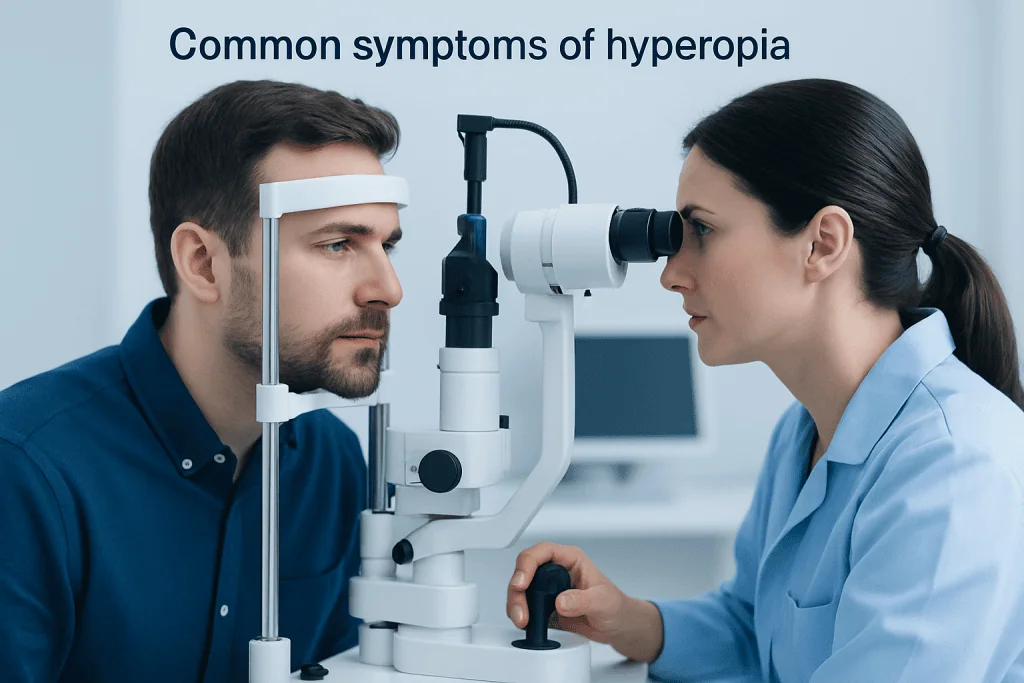
The most recognizable symptom of hyperopia is blurry vision when looking at close objects, such as a book, phone screen, or sewing work. Some people notice that they need to hold reading material farther away to see it more clearly. Others may not describe blur directly but instead feel that visual tasks are more tiring than they should be.
Hyperopia can also cause symptoms related to eye effort. The eye’s natural focusing system tries to compensate, and this extra work may lead to headaches, a pulling sensation around the eyes, burning, watering, or tired eyes after reading or using digital devices.
In children, hyperopia may be harder to detect because they may not realize their vision is different from normal. Parents or teachers may notice squinting, reduced attention during reading, rubbing of the eyes, or avoidance of close work. If significant hyperopia is not recognized, it may contribute to focusing problems or eye alignment issues in some children.
- Blurred near vision
- Eye strain during reading or screen time
- Headaches after close work
- Squinting or frequent blinking
- Tired or uncomfortable eyes
- Occasionally blurred distance vision, especially with higher hyperopia
Why hyperopia happens: causes and risk factors
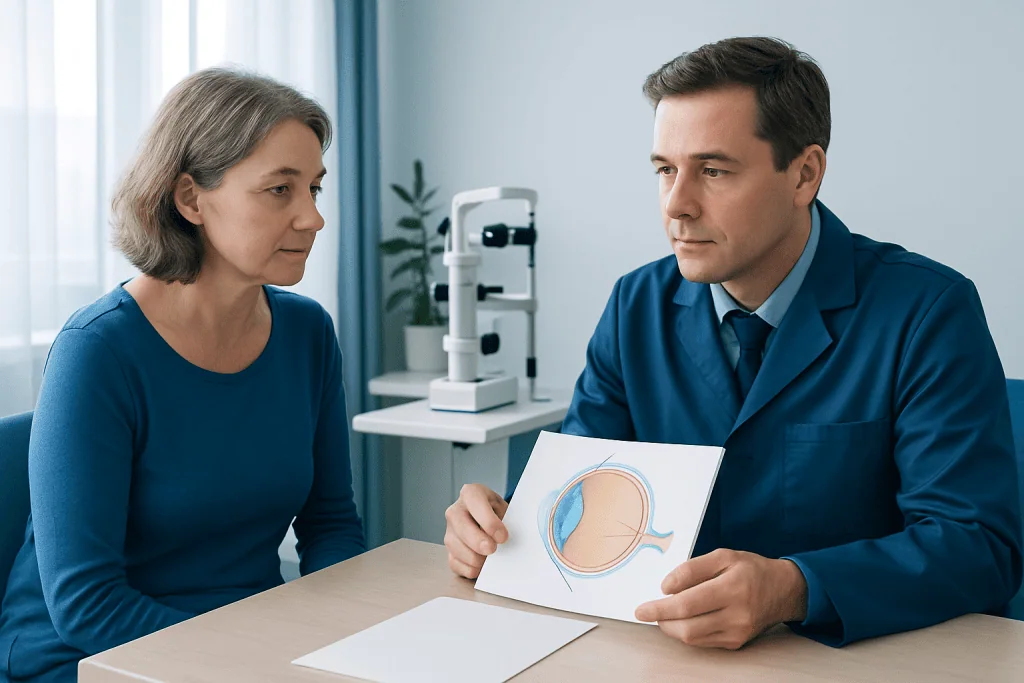
Hyperopia usually happens because the eye is slightly shorter than average from front to back, or because the cornea or lens does not bend light strongly enough. These differences in eye shape are often present from childhood and may run in families. In many cases, hyperopia is simply part of natural variation in eye development.
Age also affects how hyperopia is experienced. Younger eyes can often adjust focus more easily, which may partly mask symptoms for years. As natural focusing ability declines with age, previously mild hyperopia may become more noticeable, especially during reading and other close tasks. This age-related change is different from presbyopia, although both can make near work more difficult.
Less commonly, hyperopia may be related to changes in the lens, previous eye surgery, or certain medical conditions that alter the shape or optical power of the eye. These situations require assessment by an eye specialist, because management may involve more than simple vision correction.
How hyperopia is diagnosed
Hyperopia is diagnosed through a comprehensive eye examination. An eye care professional measures how well a person sees at different distances and checks how the eyes focus light. Refraction testing, which determines the lens power needed to sharpen vision, is central to confirming the diagnosis.
The exam may also include assessment of eye alignment, eye pressure, and the health of the retina, optic nerve, cornea, and lens. In children, the clinician may use dilating drops to relax the eye’s focusing muscles and reveal the full degree of hyperopia. This is important because a child’s strong focusing ability can sometimes hide the true prescription.
Diagnosis is not only about assigning glasses power. The eye exam helps identify whether symptoms are due solely to hyperopia or whether another issue, such as astigmatism, dry eye, or an eye muscle imbalance, is contributing. In some patients, the doctor may also evaluate candidacy for LASIK surgery or other vision-correction procedures if long-term surgical treatment is being considered.
Treatment options for hyperopia
Treatment depends on age, the degree of hyperopia, symptoms, and overall eye health. The most common and simplest treatment is prescription glasses. Glasses correct the way light enters the eye so that images focus properly on the retina. They can be worn full-time or for specific tasks, depending on the prescription and the doctor’s advice.
Contact lenses are another option for many adults and some teenagers. They provide a wider field of view than glasses and may be preferred for sports or lifestyle reasons. Safe use requires proper fitting, careful hygiene, and regular follow-up to reduce the risk of irritation or infection.
For selected adults with stable prescriptions, refractive surgery may reduce dependence on glasses or contacts. Procedures may include laser eye surgery or other methods chosen according to corneal thickness, prescription level, tear film quality, and general eye health. Surgery is not suitable for everyone, and an individualized evaluation is essential to discuss expected benefits, limitations, and risks.
In children, treatment decisions are especially important because good vision supports learning and visual development. Some children with mild hyperopia may only need monitoring, while others benefit from glasses to improve comfort, clear vision, or eye alignment. If there is concern about reduced vision in one eye, clinicians may also assess for lazy eye.
Living with hyperopia: self-care and daily habits
Hyperopia can usually be managed very well, but daily habits still matter. Using the correct prescription, attending follow-up eye exams, and replacing lenses when advised can make a meaningful difference in comfort and visual performance. People who spend long hours reading or using screens may feel better when they take regular breaks and adjust lighting to reduce visual strain.
General eye health measures can also help. Good screen habits, including blinking regularly and pausing to look into the distance, may ease tired eyes. If dryness contributes to discomfort, a clinician may suggest environmental changes or lubricating drops, depending on the cause.
It is also helpful to understand that symptoms do not always reflect prescription strength alone. A small refractive error can feel troublesome in one person and barely noticeable in another. Follow-up care allows the prescription and treatment plan to be refined as vision needs change over time.
Near the end of the care journey, some patients seek specialist assessment for broader vision correction options. Acibadem International’s multidisciplinary specialists and JCI-accredited hospitals diagnose and treat hyperopia for international patients, including comprehensive evaluation and appropriate medical or surgical planning when needed.
When to seek medical care
Routine eye examinations are important for anyone with suspected hyperopia, ongoing headaches with reading, or difficulty seeing clearly at near distances. Children should be assessed if parents notice squinting, frequent eye rubbing, poor concentration during close work, or concern about school performance related to vision.
Prompt medical attention is especially important if blurred vision appears suddenly, vision changes rapidly, or symptoms are accompanied by eye pain, redness, light sensitivity, flashes of light, many new floaters, or a curtain-like shadow in vision. These signs are not typical of simple hyperopia and may point to a more urgent eye problem.
Adults considering surgery should also seek a formal eye evaluation rather than relying on online vision tests or old prescriptions. An in-person assessment helps confirm the diagnosis, rule out other causes of blurred vision, and determine whether procedures such as smart lenses or corneal laser treatment are appropriate.
Frequently asked questions
Is hyperopia the same as farsightedness?
Yes. Hyperopia is the medical term for farsightedness. It describes an eye that focuses light behind the retina, often making near vision less clear and causing visual strain.
Can hyperopia get worse with age?
It can become more noticeable with age, even if the basic eye shape does not change much. This is because the eye gradually loses some of its natural ability to adjust focus, so close work may become harder over time.
Do all people with hyperopia need glasses?
No. Mild hyperopia may not need treatment if vision is clear and there are no symptoms. Glasses or contact lenses are usually recommended when hyperopia causes blur, headaches, eye strain, or affects daily activities.
Can children outgrow hyperopia?
Some children have mild hyperopia as part of normal eye development, and it may decrease as the eye grows. However, significant hyperopia should still be evaluated because it can affect comfort, learning, and normal visual development.
Is hyperopia different from presbyopia?
Yes. Hyperopia is a refractive error related to how the eye focuses light, often due to eye shape. Presbyopia is an age-related loss of near focusing ability that usually develops in midlife, even in people who did not previously need glasses.
Can surgery permanently correct hyperopia?
Refractive surgery can reduce dependence on glasses or contact lenses in some adults, but suitability varies from person to person. A detailed eye exam is needed to assess eye health, prescription stability, and the most appropriate procedure.
References
- American Academy of Ophthalmology
- National Eye Institute
- American Optometric Association
- Mayo Clinic
- World Health Organization
This article is for general information only and is not a substitute for professional medical advice. Please consult a qualified doctor about your individual situation.
Explore treatments in Turkey — costs, top hospitals & a free quote
JCI-accredited · board-certified surgeons · reply within 24h
Add us as a Preferred Source to see more of our trusted health content across Google Search, AI Overviews and Discover.